Posture Exercises: Where to Start, From a Quick Measure to a 4-Week Plan
Not sure which posture exercises to do first? Measure, pick the one area that stands out, stretch what is short and strengthen what is long, three times a week for four weeks. Plus a map of guides for the neck, shoulders, back, hips and knees.
Short answer: With posture exercises, order matters more than any single move. (1) Measure where you are now. (2) Pick the one area that stands out. (3) Stretch what has gotten short and strengthen what has gotten long. (4) Do it three times a week for four weeks. (5) Measure again the same way and compare. If you can't decide where to start, begin with the 12-minute full-body routine below.
Hi, I'm an editor on the Bodycheck Care team. I have a habit of saving workout videos to a "watch later" list. Neck stretches, hip moves, leg routines. The list grew into dozens of videos, and on a lot of evenings I'd roll out the mat, scroll through the list, and never pick one.
So today isn't about one perfect move. It's about where to start and in what order. I've also collected the body-area guides on this blog in one place, so you can use this post as a map and jump to the one you need.
Why does posture drift a little at a time?
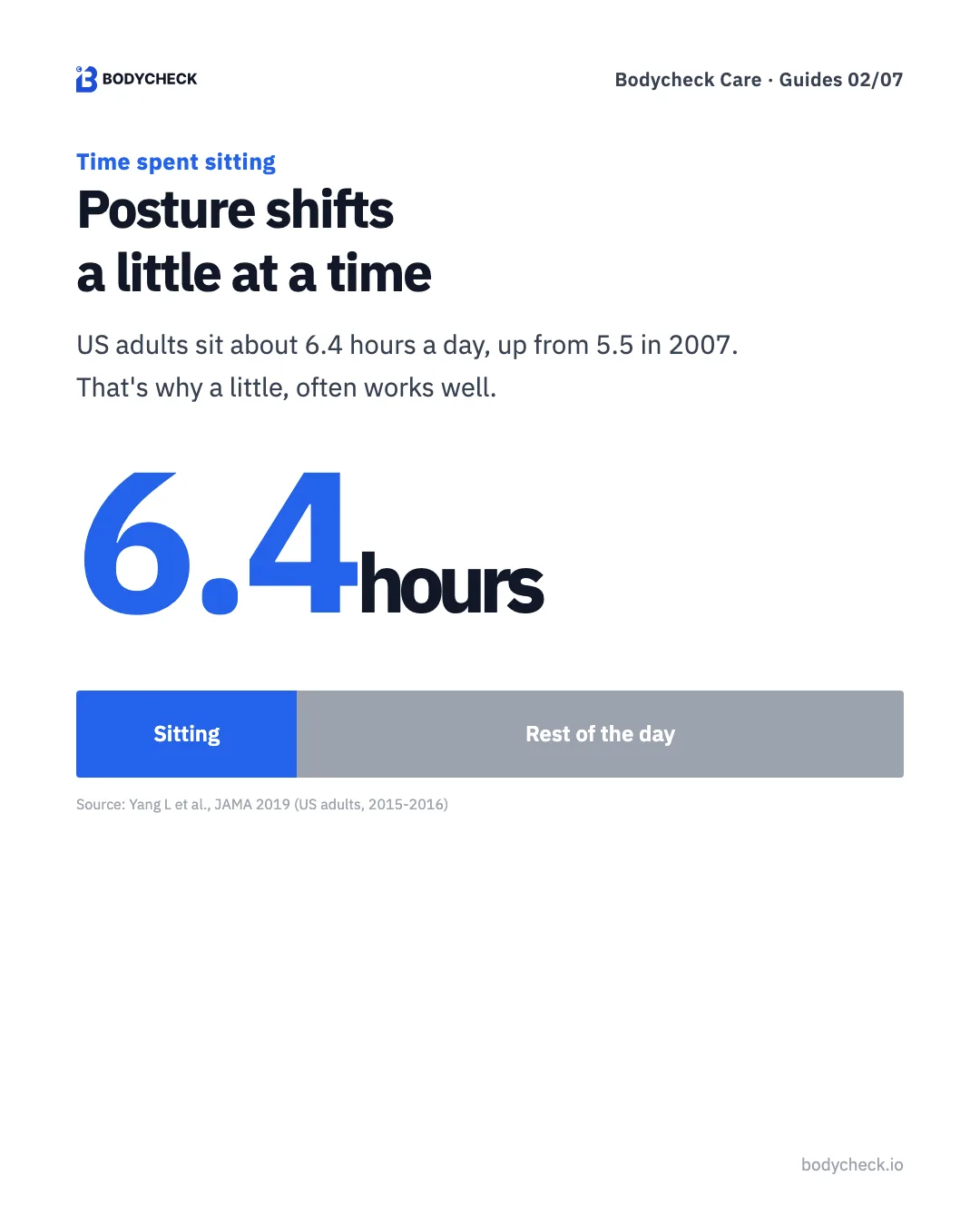
A study in JAMA found that US adults sat about 6.4 hours a day in 2015–2016, up from about 5.5 hours in 2007.
While you sit, the screen is usually below eye level, your arms gather in front of you, and your glutes let the chair do the work. A day or two is fine. Over months, your body can start to treat that shape as normal. That's why posture work tends to suit a little, often better than one big effort.
How do you pick where to start?
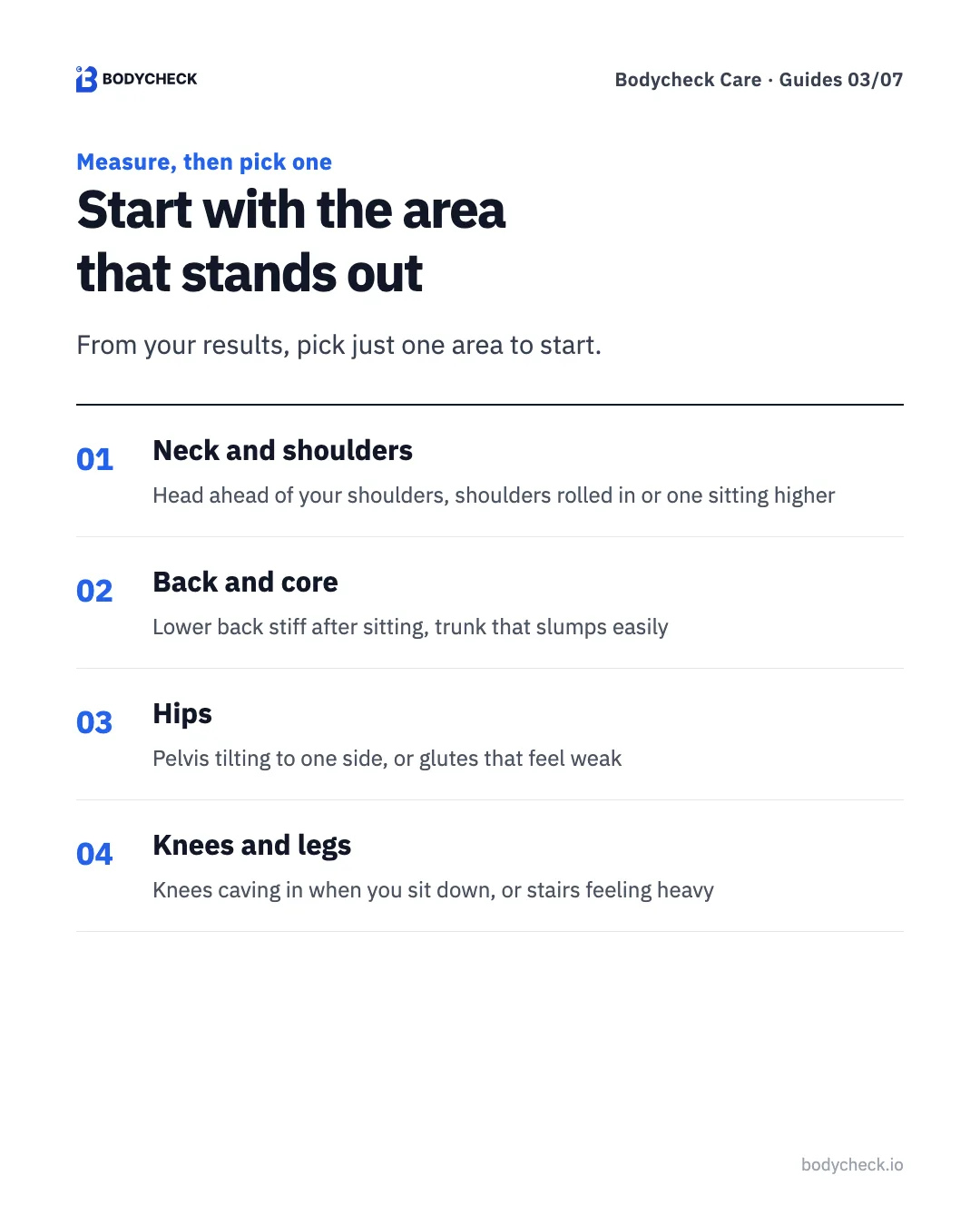
Start by measuring where you are now. If you skip that, it's hard to know what to work on, and hard to tell what changed four weeks later. Standing against a wall or checking a mirror works. Saving one front photo and one side photo makes the later comparison much easier.
Then pick the one area that stands out most. Try to cover all five at once and the routine gets long, which makes it hard to keep going. Here are the more detailed guides by body area.
- Neck: If your head looks ahead of your shoulders, start with the forward head posture self-check, then move on to the 11-minute forward head posture routine.
- Shoulders: If your shoulders roll forward, try the rounded shoulders exercises at home. If one shoulder sits higher, see the uneven shoulders self-check.
- Back and core: If your lower back gets stiff from sitting, try the 13-minute core routine for your lower back. New to core work? Start with core exercises for beginners at home.
- Hips: If your pelvis seems to tilt to one side, see the pelvic tilt self-check. If your glutes feel asleep after sitting, try the glute activation routine.
- Knees and legs: If your knees cave in when you squat, see the knee alignment self-check. If stairs feel heavier lately, try the leg strength routine for stairs.
If nothing stands out, or you can't decide, do the full-body routine at the end of this post for four weeks.
What does "stretch the short, strengthen the long" mean?
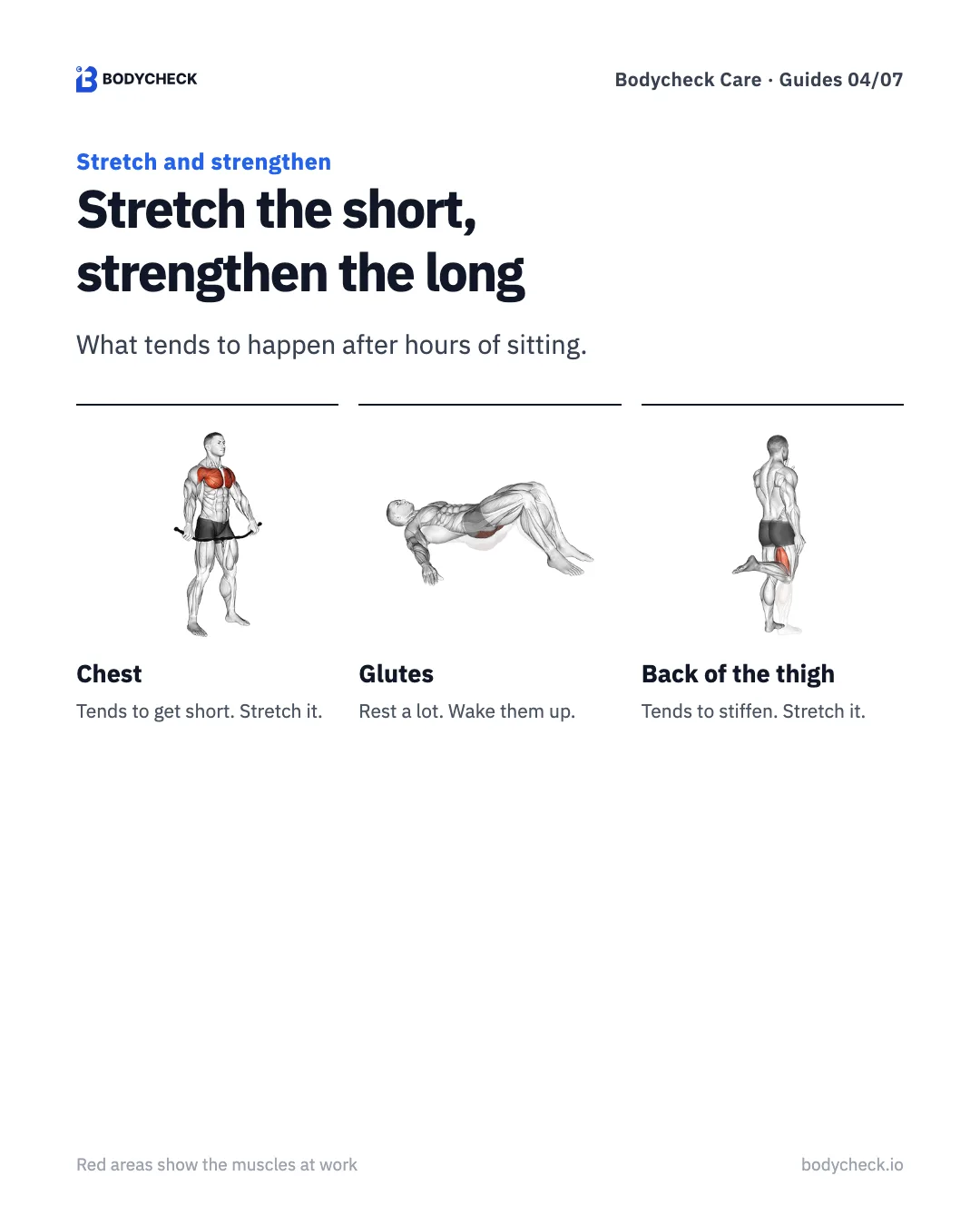
When you hold one position for a long time, some muscles tend to stay short and stiffen, while the ones on the other side stay long and find it harder to produce force. At a screen, the chest and front shoulders tend to get short while the upper back gets long. After hours in a chair, the back of the thigh tends to stiffen and the glutes spend most of the day resting.
So the moves come in pairs. Stretch what tends to get short, and strengthen what tends to get long. Not just stretching, not just strength work, but both. Today's routine has two stretches and four strength moves.
How often, and for how long?
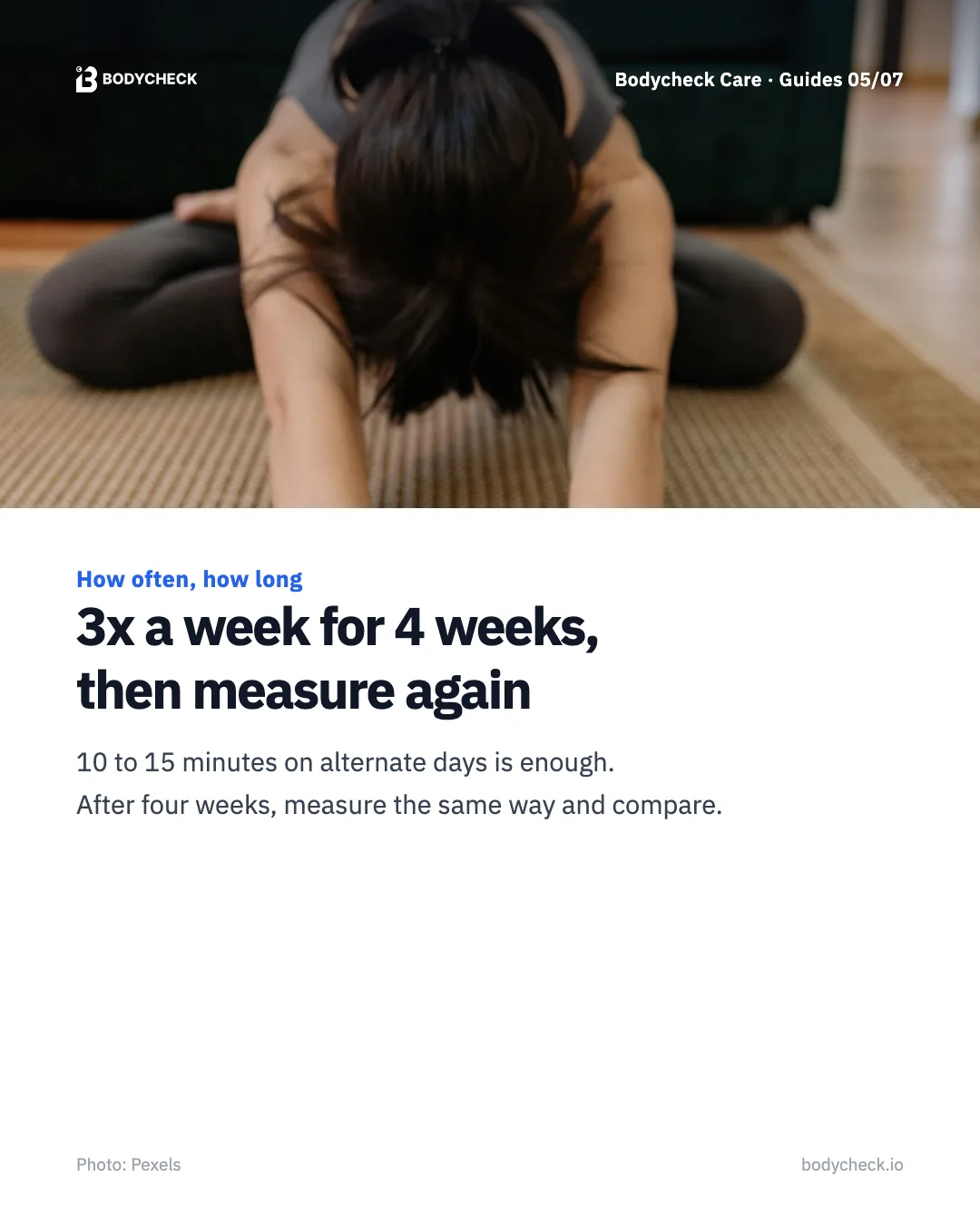
To start, three times a week on alternate days (say Monday, Wednesday, Friday), 10 to 15 minutes each time, is enough. Muscles need a rest day to move well the next time. On rest days, a walk is plenty.
Give it four weeks. Then measure again the same way, in the same spot, in similar clothes, and put the two side by side. Look at what changed and what didn't, then decide whether to keep going or move to another area. Results vary from person to person, so it helps to focus on keeping a record rather than chasing a number.
How can you see which area stands out most?
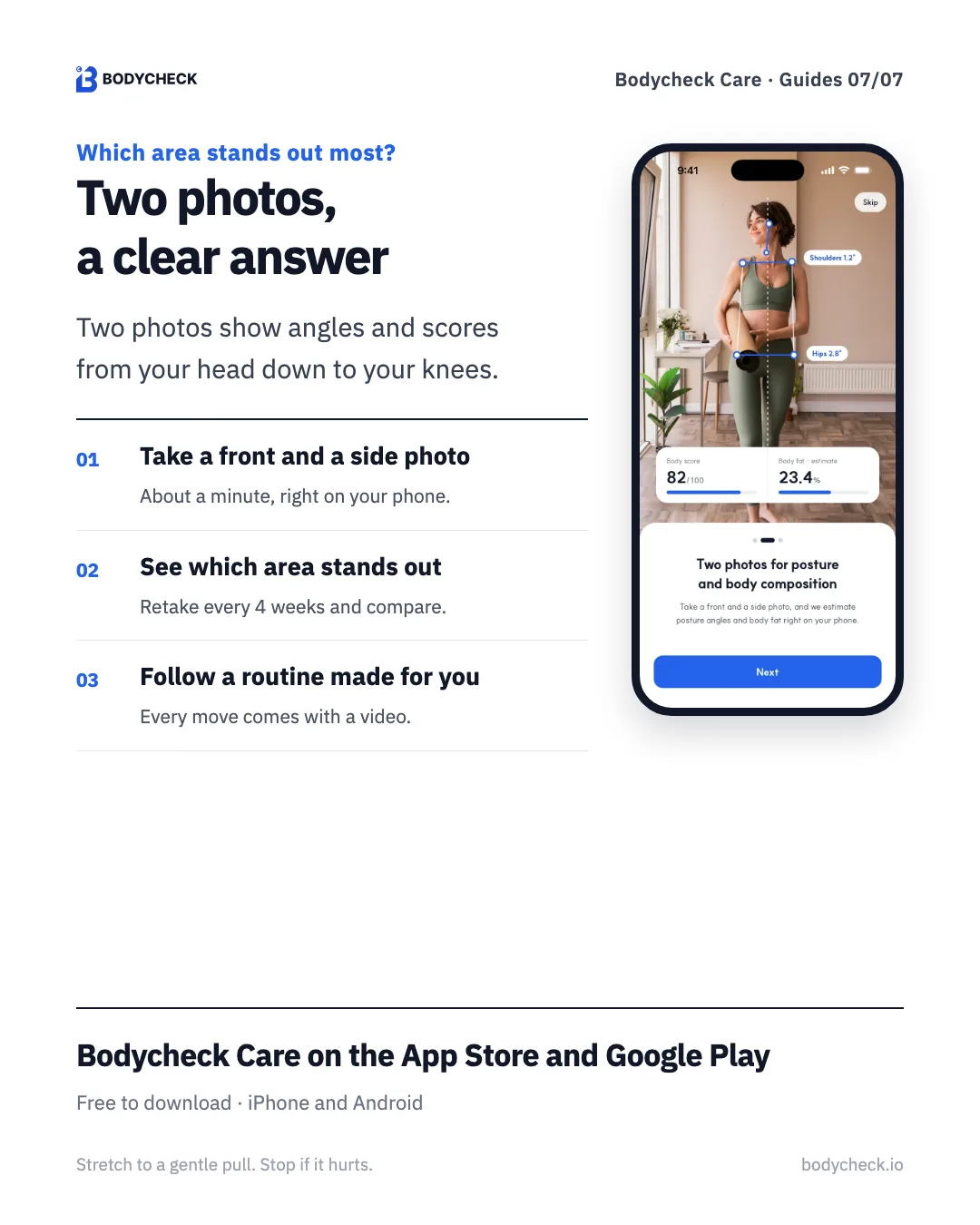
A wall and a mirror can tell you "my head seems a bit forward," but not much more. In Bodycheck Care you take a front and a side photo. From the front, the app measures head tilt and shoulder, hip and knee balance. From the side, it measures how far your head and shoulders sit forward and how your pelvis tilts front to back. You get each as an angle and a score.
- Get the app and take a front and a side full-body photo.
- See which area, from head to knees, stands out most.
- Follow the moves picked for your result and where you'll exercise, each with a video.
- Retake the photos after four weeks and compare.
If deciding where to start is the hardest step, this is an easy first one. It isn't a medical device. It's a reference to help you look at yourself.
Bodycheck Care · Free
Find where to start, from two photos
Take a front and a side photo to see how far your head and shoulders sit forward as a score, then follow moves picked for your result, each with a video.
The 12-minute full-body starter routine
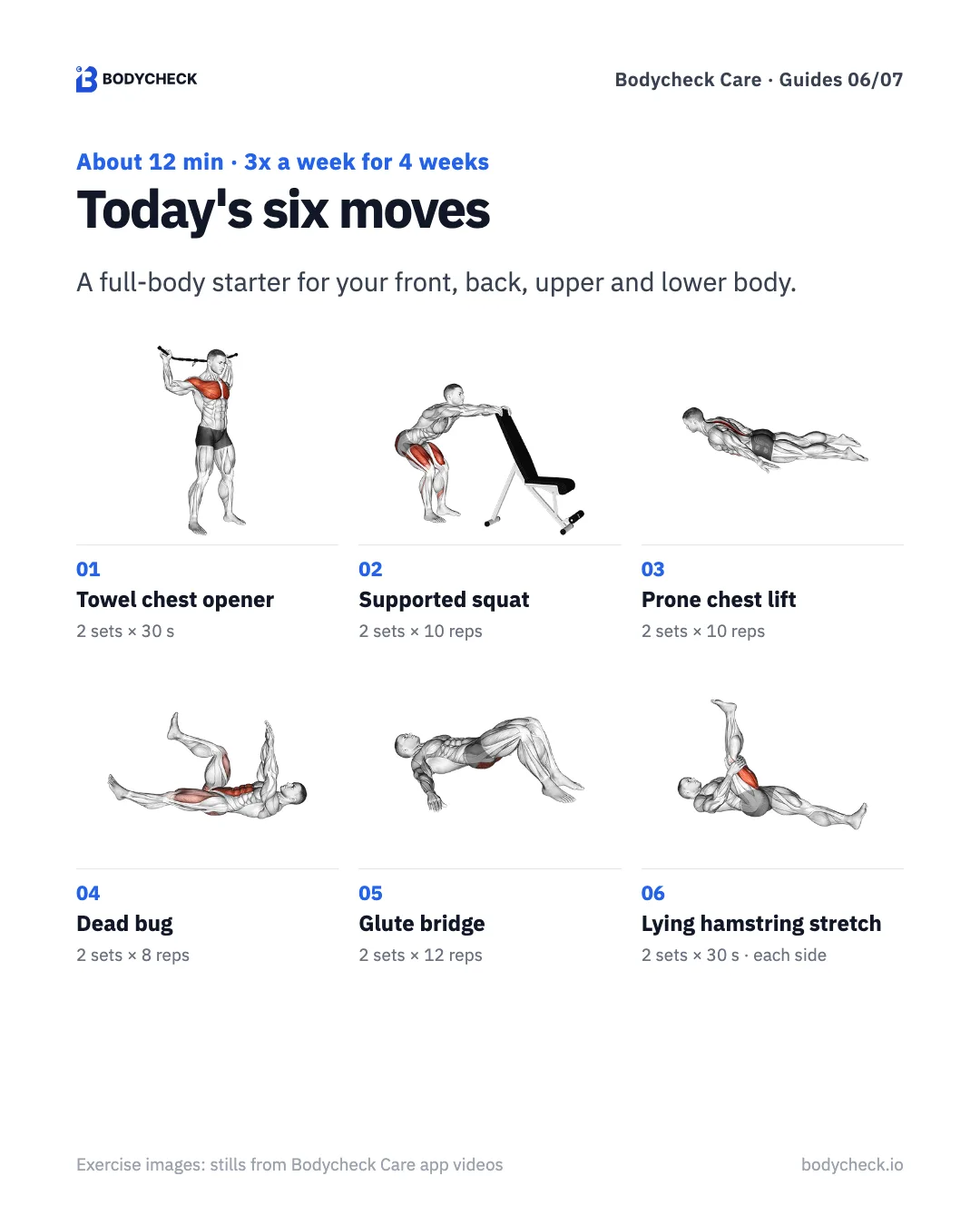
These six moves work your front, back, upper and lower body evenly instead of one area. Two standing, one face down, then three on your back, so you barely move around. Every move starts at two sets. Do it three times a week for four weeks.
1. Towel chest opener · 2 sets × 30 s
- Hold a towel or long stick wider than your shoulders and stand tall.
- Keep your arms straight and slowly raise them overhead.
- Take them back behind your head only as far as they go easily, to stretch your chest and front shoulders.
- Slowly bring them forward again and repeat for 30 seconds. If your shoulders catch, widen your grip.
2. Supported squat · 2 sets × 10 reps
- Hold a chair back or a wall with feet shoulder-width apart.
- Push your hips back and lower as if sitting into a chair.
- Keep your knees following your toes and your chest up.
- Push through your heels to stand. Repeat 10 times.
3. Prone chest lift · 2 sets × 10 reps
- Lie face down with legs straight and hands by your head or your sides.
- Squeeze your shoulder blades toward the middle of your back.
- Lift your chest slightly off the floor and pause one second. Eyes on the floor, no arching.
- Lower slowly. Repeat 10 times.
4. Dead bug · 2 sets × 8 reps
- Lie with arms reaching to the ceiling and hips and knees bent to 90 degrees.
- Keeping your lower back on the floor, slowly reach one arm and the opposite leg out.
- Stop before your back lifts, then return.
- Alternate sides for 8 reps.
5. Glute bridge · 2 sets × 12 reps
- Lie with knees bent and arms by your sides.
- Push through your heels and lift your hips.
- Squeeze your glutes for one second with knees, hips and shoulders in a line. Don't arch your back.
- Lower slowly. Repeat 12 times.
6. Lying hamstring stretch · 2 sets × 30 s · each side
- Lie on your back and raise one leg toward the ceiling.
- Hold the back of your thigh or your calf with both hands.
- Straighten the knee only as far as it goes and gently pull the leg toward you.
- Hold 30 seconds, then switch sides.
At a glance
| # | Move | Sets | Job |
|---|---|---|---|
| 1 | Towel chest opener | 2 × 30 s | Stretch |
| 2 | Supported squat | 2 × 10 reps | Strengthen |
| 3 | Prone chest lift | 2 × 10 reps | Strengthen |
| 4 | Dead bug | 2 × 8 reps | Strengthen |
| 5 | Glute bridge | 2 × 12 reps | Strengthen |
| 6 | Lying hamstring stretch | 2 × 30 s · each side | Stretch |
Once it feels easy, add a set, or switch to the routine for the area that stands out from the guides above. In Bodycheck Care every move has a video, and the app counts the time and sets for you.
Frequently asked questions
Which body area should I work on first? Measure first, then start with the one area that stands out most. If your head sits forward, start with the neck and shoulders. If your hips tilt, start with the hips. After four weeks, measure again and choose the next area.
Can I just stretch? Stretching and strengthening work as a pair. Stretch the muscles that tend to get short, and strengthen the ones that tend to get long and weak. That's why today's routine has two stretches and four strength moves.
Isn't it better to do it every day? Muscles need rest days too. Three times a week, on alternate days, is easier to keep up at the start. On rest days, a walk or a few stretches is plenty.
What do I do after four weeks? Measure again the same way and put the results side by side. Look at what changed and what didn't, then decide whether to keep the routine or move to another area.
Is Bodycheck Care free? Yes. Search for Bodycheck Care on the App Store or Google Play. It measures head, shoulder, hip and knee balance from a front and a side photo, then gives you moves for your result, each with a video.
Before you start
- Stretch to a gentle pull. Stop right away if anything hurts or tingles.
- Don't hold your breath. Breathe out as you push.
- In the first week it's fine to do just one set of each move.
- When you measure again, use the same spot, clothes and stance so the comparison is fair.
- This is exercise guidance. If you have pain in your neck, back or knees, or numbness in your arms or legs, see a doctor before you exercise.
How about closing that "watch later" list for tonight and taking two photos instead?
Bodycheck Care · Free
Take two photos and get moves picked for you
Take a front and a side photo to see how far your head and shoulders sit forward as a score, then follow moves picked for your result, each with a video.
References
- Yang L, Cao C, Kantor ED, et al. Trends in sedentary behavior among the US population, 2001–2016. JAMA, 2019;321(16):1587-1597.
- Photos: Pexels (free license). Exercise images and app screens: Bodycheck Care app.