Wake Up Your Glutes After Sitting All Day: A 13-Minute Hip Routine
The back of your glutes pushes you up, the side keeps your pelvis level. Check yourself with a 30-second single-leg stand, then do six moves from bridges to the butterfly stretch on one mat.
Short answer: When you sit, the chair holds you up, so your glutes rarely have to work, and your lower back and thighs pick up the slack. The order that works: start with a bridge to feel where your glutes are, wake up the side of the hips, then stretch to finish. Do the six moves below for about 13 minutes, three times a week for four weeks.
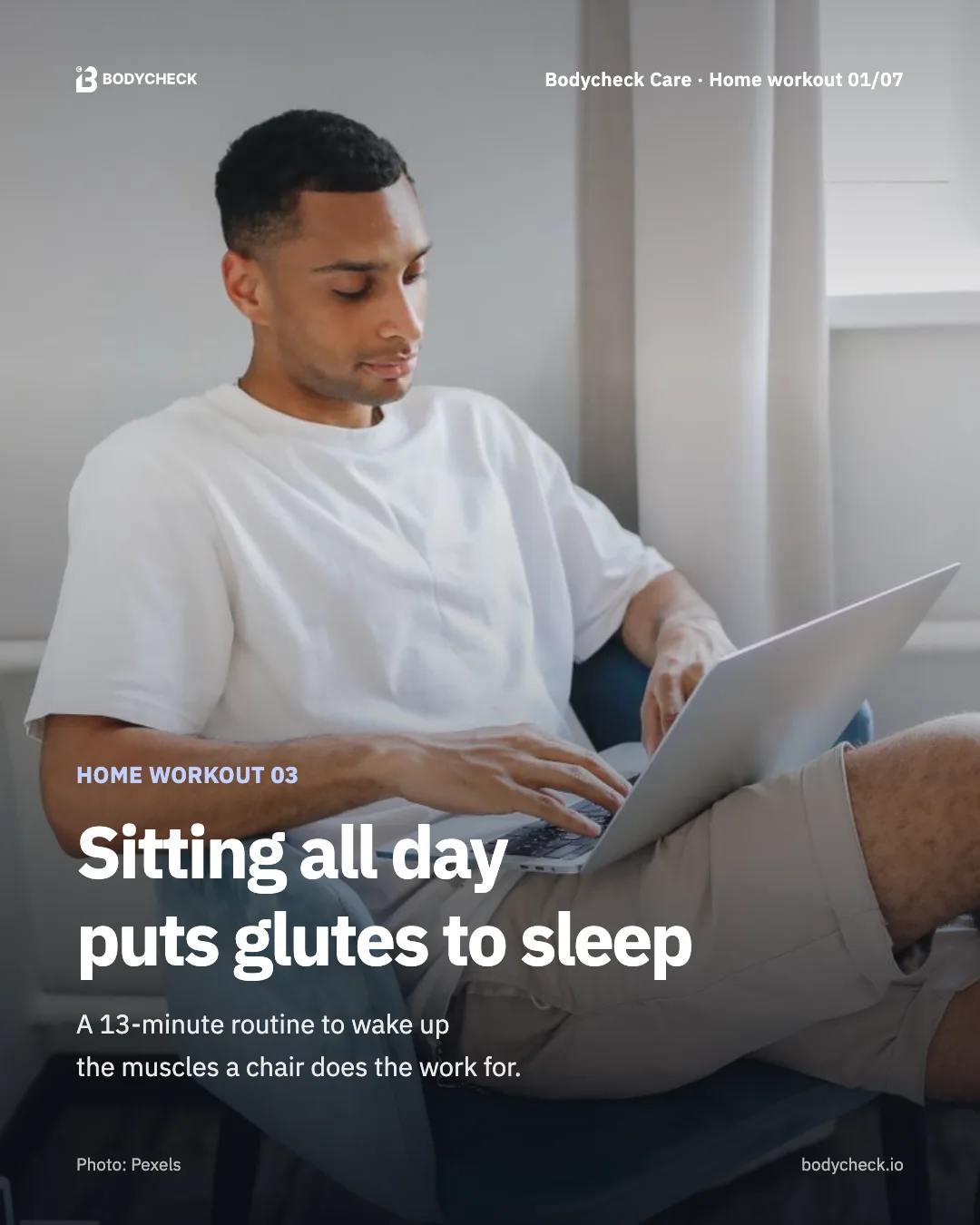
Hi, I'm an editor on the Bodycheck Care team. A coworker joked recently that their glutes had "gone flat." We all laughed, but it's not entirely a joke. Spend most of the day in a chair and your glutes really don't get much to do.
Muscles you don't use slowly forget how to switch on. Below I'll sum up what your glutes do and what long sitting changes, then share a 13-minute routine to wake them up.
What do your glutes actually do?
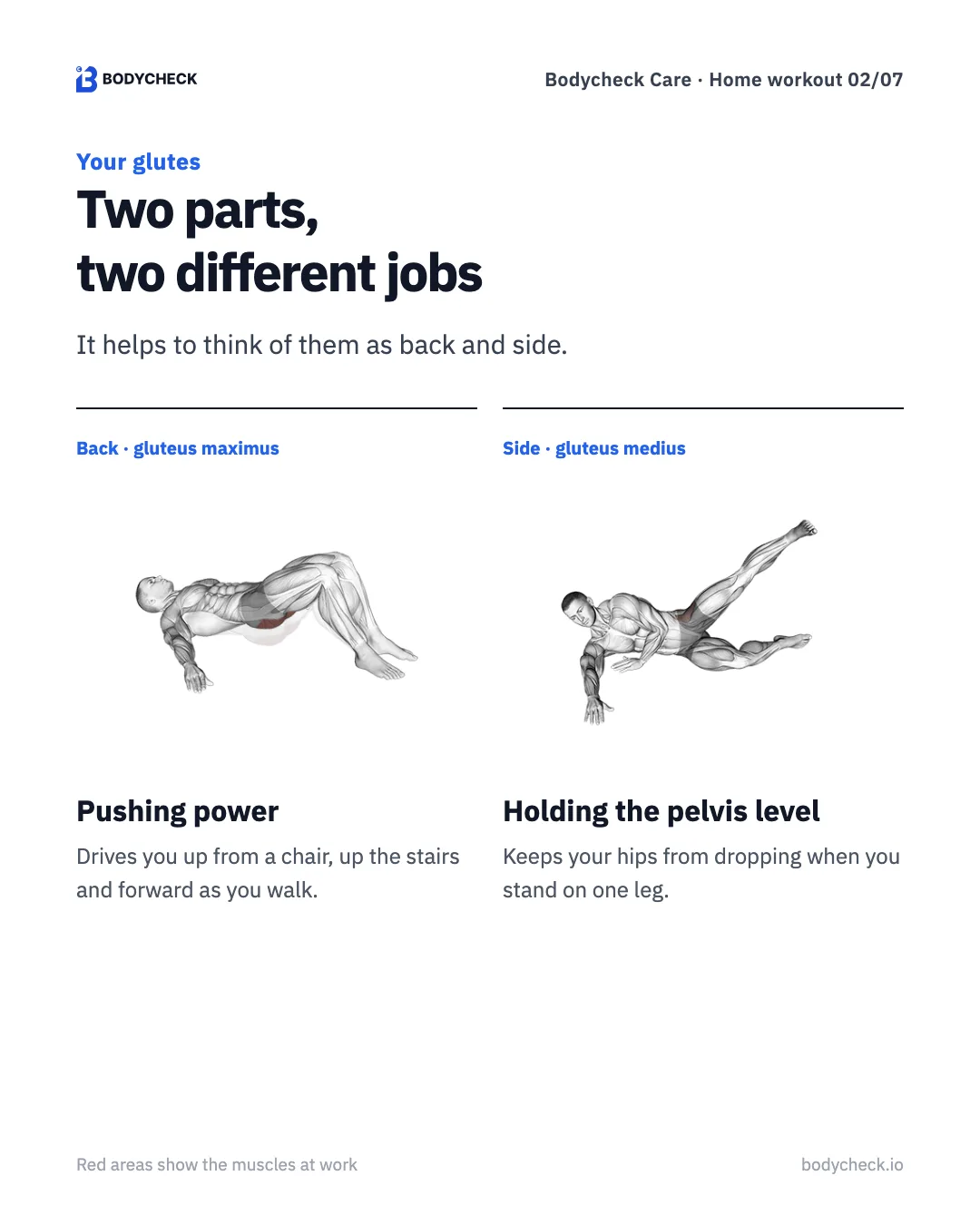
It's easiest to think of them as back and side.
- Back (gluteus maximus): one of the biggest muscles in your body. It drives you up from a chair, up the stairs and forward as you walk.
- Side (gluteus medius): keeps your pelvis from dropping when you stand on one leg. Every step you take is a brief single-leg stand, so it works all day.
That's why this routine pairs two bridges for the back with two leg raises for the side.
What does long sitting change?
Day after day in a chair, these changes tend to add up.
- Your glutes get less work. The chair holds you up, so they rarely have to push.
- The front of the hips gets short. Hours with your legs bent shorten the front of the thigh and hip.
- Other muscles step in. Your lower back and thighs end up doing the glutes' job.
Everyone is a little different, but if you sit a lot, it's worth making time to use your glutes on purpose.
Why start with a bridge?
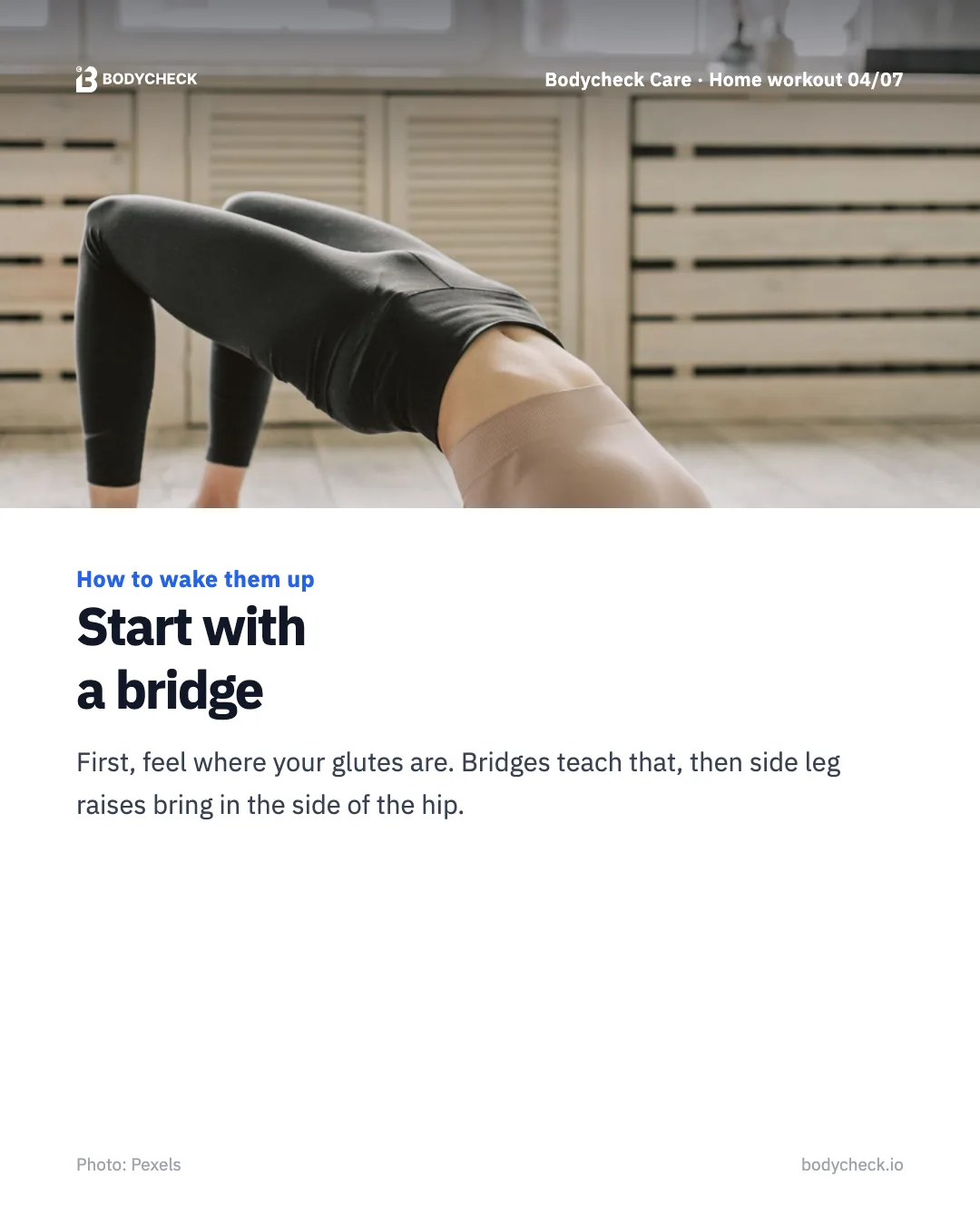
The first step is simply feeling "oh, that's my glutes." Lying bridges are easy on the lower back and make it easy to feel the glutes working.
Once you have the feel, the bridge march teaches you to keep your pelvis steady on one leg, and standing and side-lying leg raises bring in the side of the hip. Then you finish with stretches.
30-second check: stand on one leg
In front of a mirror, lift one foot and hold for 30 seconds. Stand near a wall so you can catch yourself.
- Do your hips stay level? If the lifted side drops, the side of your hip may be weak.
- Does your upper body lean? Leaning means something else is doing the hip's job.
- Is one side harder? If one side wobbles more, give it a little extra attention.
My right leg is definitely the wobbly one. But this is a feeling, and it can't tell you how much your hips actually tilt.
How can you see whether your hips are really uneven?
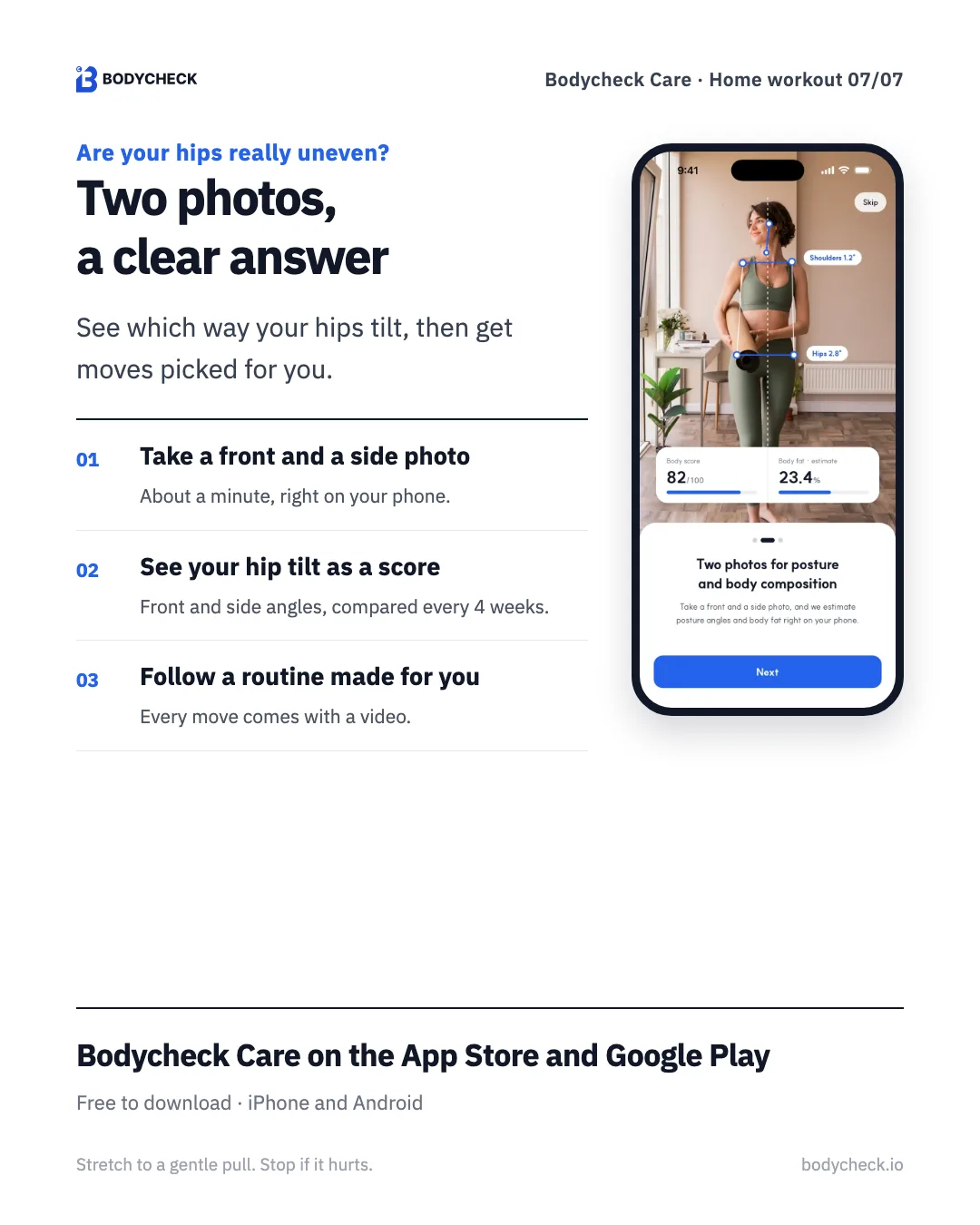
In Bodycheck Care you take a front and a side photo, and the app shows which way and roughly how many degrees your hips tilt, as angles and a score. It takes about a minute.
- Get the app and take a front and a side full-body photo.
- See your hip and shoulder tilt as a score.
- Follow the moves picked for your result, each with a video.
- Retake the photos after four weeks and compare.
Bodycheck Care · Free
See which way your hips tilt, from two photos
Take a front and a side photo to see how far your head and shoulders sit forward as a score, then follow moves picked for your result, each with a video.
The 13-minute glute and hip routine
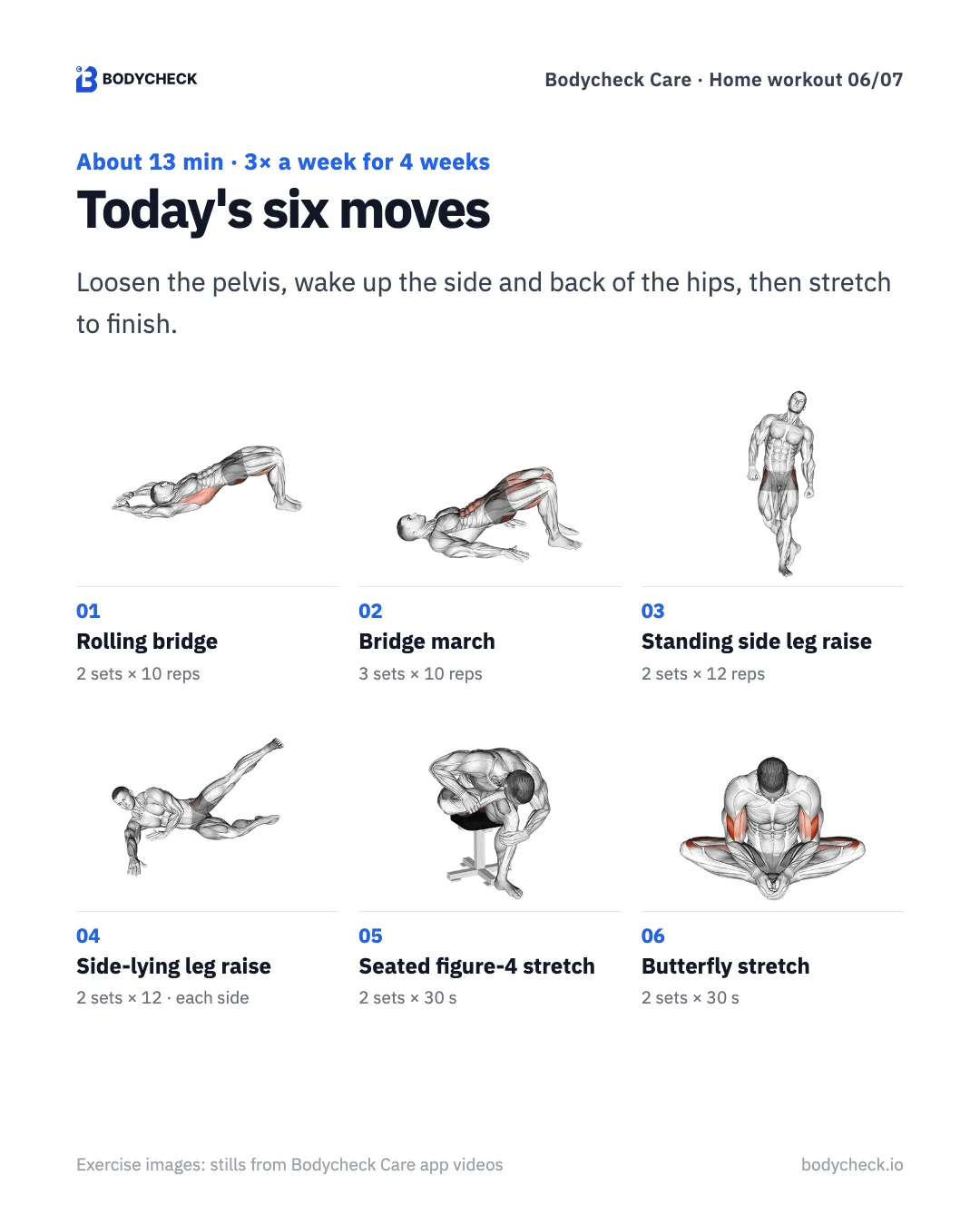
Loosen your pelvis, wake up the back and side of your hips, then stretch to finish. A mat and a chair are all you need. Do it three times a week on alternate days, for four weeks.
1. Rolling bridge · 2 sets × 10 reps
- Lie with knees bent and arms by your sides.
- Tuck your pelvis slightly to press your lower back down.
- Peel your spine up from the tailbone, one section at a time, into a bridge.
- Roll back down the same way. 10 reps.
2. Bridge march · 3 sets × 10 reps
- Lift into a bridge.
- Keeping your hips at the same height, lift one knee toward your chest.
- Lower it and lift the other.
- Alternate for 10 reps without letting your pelvis tilt.
3. Standing side leg raise · 2 sets × 12 reps
- Stand tall, holding a wall with one hand if needed.
- Without leaning, lift one straight leg out to the side.
- Go only as high as the side of your hip squeezes, then lower slowly.
- After 12 reps, switch sides.
4. Side-lying leg raise · 2 sets × 12 reps · each side
- Lie on your side, propped on your elbow.
- Keep the bottom leg on the floor and the top leg straight.
- With toes pointing forward, slowly lift the top leg.
- Lower slowly. After 12 reps, switch sides.
5. Seated figure-4 stretch · 2 sets × 30 s
- Sit on a chair and rest one ankle on the opposite knee.
- Keep your back straight and lean your chest forward.
- Turn slightly toward the raised leg to stretch deep in the hip.
- Hold 30 seconds, then switch sides.
6. Butterfly stretch · 2 sets × 30 s
- Sit on the floor with the soles of your feet together.
- Hold your feet and sit tall.
- Slowly let your knees lower toward the floor to stretch the inner thighs. No bouncing.
- Breathe and hold 30 seconds.
At a glance
| # | Move | Sets |
|---|---|---|
| 1 | Rolling bridge | 2 × 10 reps |
| 2 | Bridge march | 3 × 10 reps |
| 3 | Standing side leg raise | 2 × 12 reps |
| 4 | Side-lying leg raise | 2 × 12 reps · each side |
| 5 | Seated figure-4 stretch | 2 × 30 s |
| 6 | Butterfly stretch | 2 × 30 s |
Moves 5 and 6 also work on their own after a long day of sitting. In Bodycheck Care every move has a video, and the app counts the time and sets for you.
Frequently asked questions
My lower back hurts when I bridge. Lifting too high arches the lower back. Stop when knees, hips and shoulders form a line, and focus on squeezing your glutes.
I can't feel my glutes working. Think about pushing the floor away with your heels. Resting your hands on your glutes makes it easier to feel them switch on.
Can I stretch every day? Yes, moves 5 and 6 are fine daily, especially on evenings after a long day of sitting.
Can I check for uneven hips at home? Stand on one leg for 30 seconds in front of a mirror and notice whether your hips stay level, whether your upper body leans and whether one side is harder. For numbers, Bodycheck Care shows hip tilt as a score from a front and a side photo.
Is Bodycheck Care free? Yes, it is free to download on the App Store and Google Play.
Before you start
- Stretch to a gentle pull. Stop right away if anything hurts or tingles.
- Don't hold your breath. Breathe out as you push.
- In the first week it's fine to drop one set from each move.
- This is exercise guidance. If you have pain, see a doctor before you exercise.
Before your next meeting, try move 5 on one side for 30 seconds, right there in your chair. Nobody will notice.
Bodycheck Care · Free
Take two photos and get moves picked for you
Take a front and a side photo to see how far your head and shoulders sit forward as a score, then follow moves picked for your result, each with a video.
References
- Photos: Pexels (free license). Exercise images and app screens: Bodycheck Care app.