Swayback Posture vs Anterior Pelvic Tilt: How to Tell Them Apart From One Side Photo, Plus a 10-Minute Routine
Swayback and anterior pelvic tilt both make the belly look pushed forward, but the hips sit in different places. Four clues you can see in a side photo, everyday habits behind swayback, and a 10-minute routine.
Short answer: Swayback and anterior pelvic tilt both make the belly look pushed forward, but the hips sit in different places. With swayback the hips slide ahead of the ankles and the chest leans behind the hips. With anterior pelvic tilt the pelvis tips forward while the hips stay roughly over the ankles. Neither is a diagnosis, and a side photo is the easiest way to see which pattern you are closer to.
Hi, I'm an editor on the Bodycheck Care team. A reader wrote to us after doing a routine for anterior pelvic tilt for a month: "My belly still sticks out and my lower back doesn't even look that curved." When she sent a side photo, her pelvis wasn't tipped forward much at all. Her whole hips were simply standing a few centimeters in front of her ankles, with her chest leaning back to balance. That's the pattern usually called swayback.
The two get mixed up all the time online, so below I'll show how to tell them apart from a single side photo, which everyday habits feed swayback, and a 10-minute routine you can do on a mat.
Swayback vs anterior pelvic tilt: what's the difference?
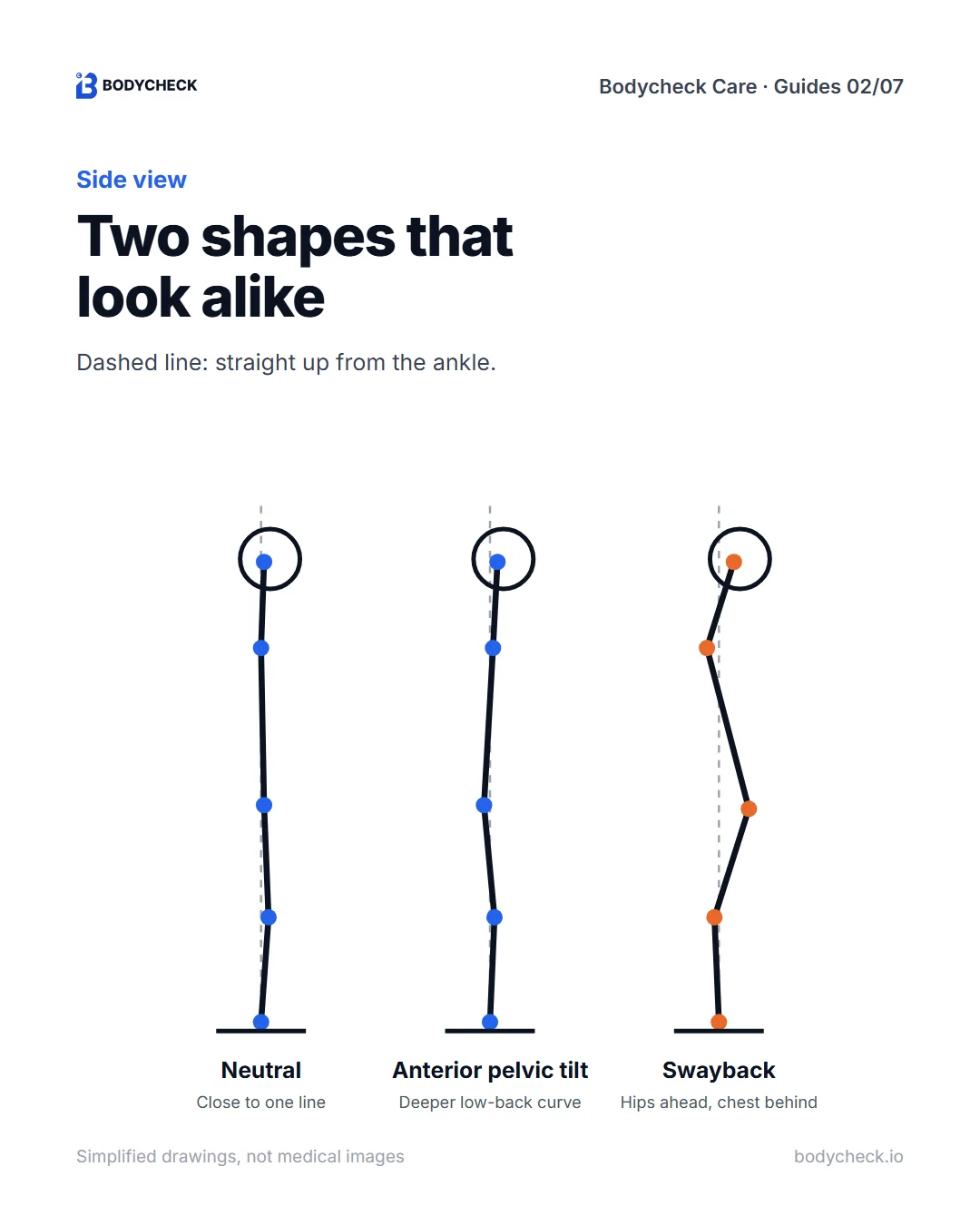
Draw an imaginary line straight up from the ankle bone. In a relaxed, fairly neutral stance, the knee, hip, shoulder and ear sit close to that line. The two patterns move away from it in different ways.
| Anterior pelvic tilt | Swayback | |
|---|---|---|
| Where the hips are | Roughly over the ankles | Pushed ahead of the ankles |
| Where the chest is | Roughly over the hips | Leaning back behind the hips |
| Lower-back curve | Deeper, the pelvis tips forward | Often flatter low down, with a long curve higher up |
| Knees | Usually unremarkable | Often pushed back (locked) |
| How it looks | Bottom sticks out behind | Hips and belly drift forward, upper body sways back |
Both are descriptions of posture, not conditions. Plenty of people stand like this with no discomfort at all, and most of us drift between patterns depending on how tired we are.
Four clues you can see in a side photo
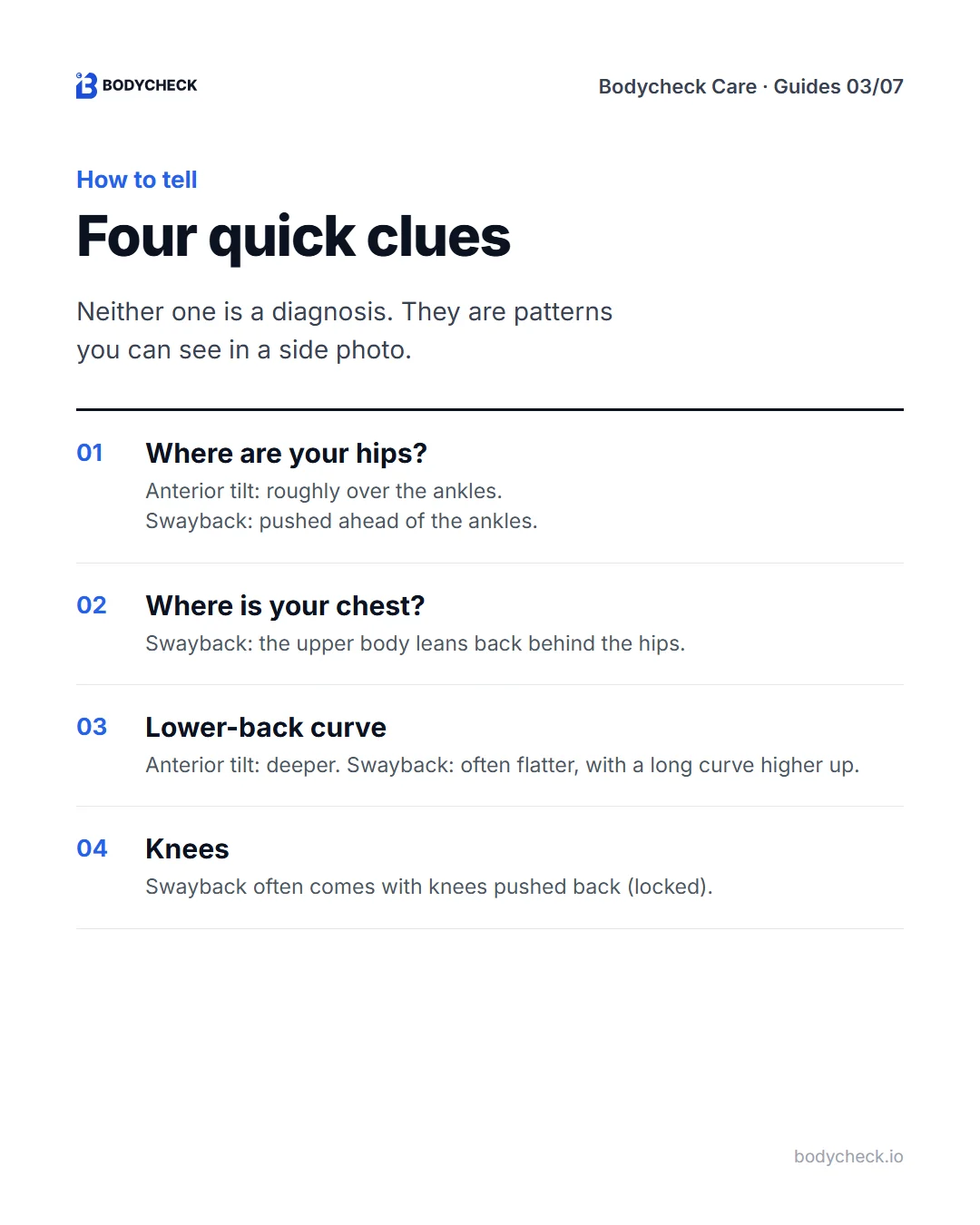
- Where are your hips? If the side of your hip is clearly in front of your ankle, that points toward swayback.
- Where is your chest? In swayback the upper body leans back so the shoulders sit behind the hips.
- The lower-back curve. A deep curve right above the pelvis points toward anterior tilt. A flatter low back with the curve starting higher up is more typical of swayback.
- Your knees. Knees pushed straight back (locked) often come along with swayback.
You won't fit either column perfectly, and that's fine. The point is to know which direction you lean so the exercises match.
How to take a side photo you can compare
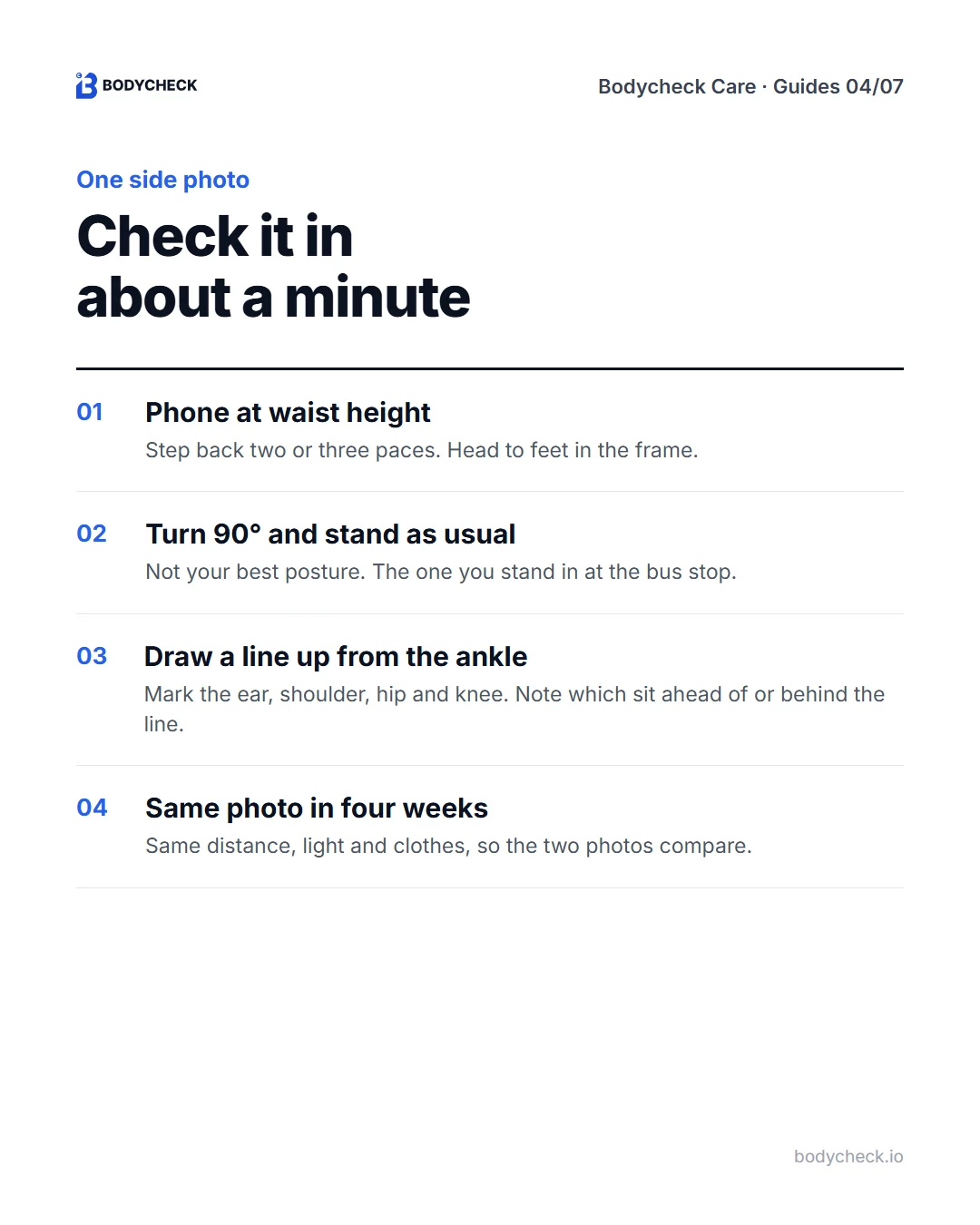
- Phone at waist height, two or three paces away, so your head and feet are both in the frame.
- Turn 90° and stand as you usually stand. Not your best posture: the one you'd stand in at a bus stop.
- Fitted clothes, so the hip, knee and ankle are visible.
- Draw a line up from the ankle and note whether the knee, hip, shoulder and ear sit ahead of it or behind it.
- Repeat in four weeks with the same distance, light and clothes.
For more ways to check your posture at home, see the posture test at home and the anterior pelvic tilt self-check. You can also try the free posture test: it reads a side photo in your browser and shows how far your hip and shoulder sit ahead of or behind your ankle, without uploading the photo.
Everyday habits behind swayback
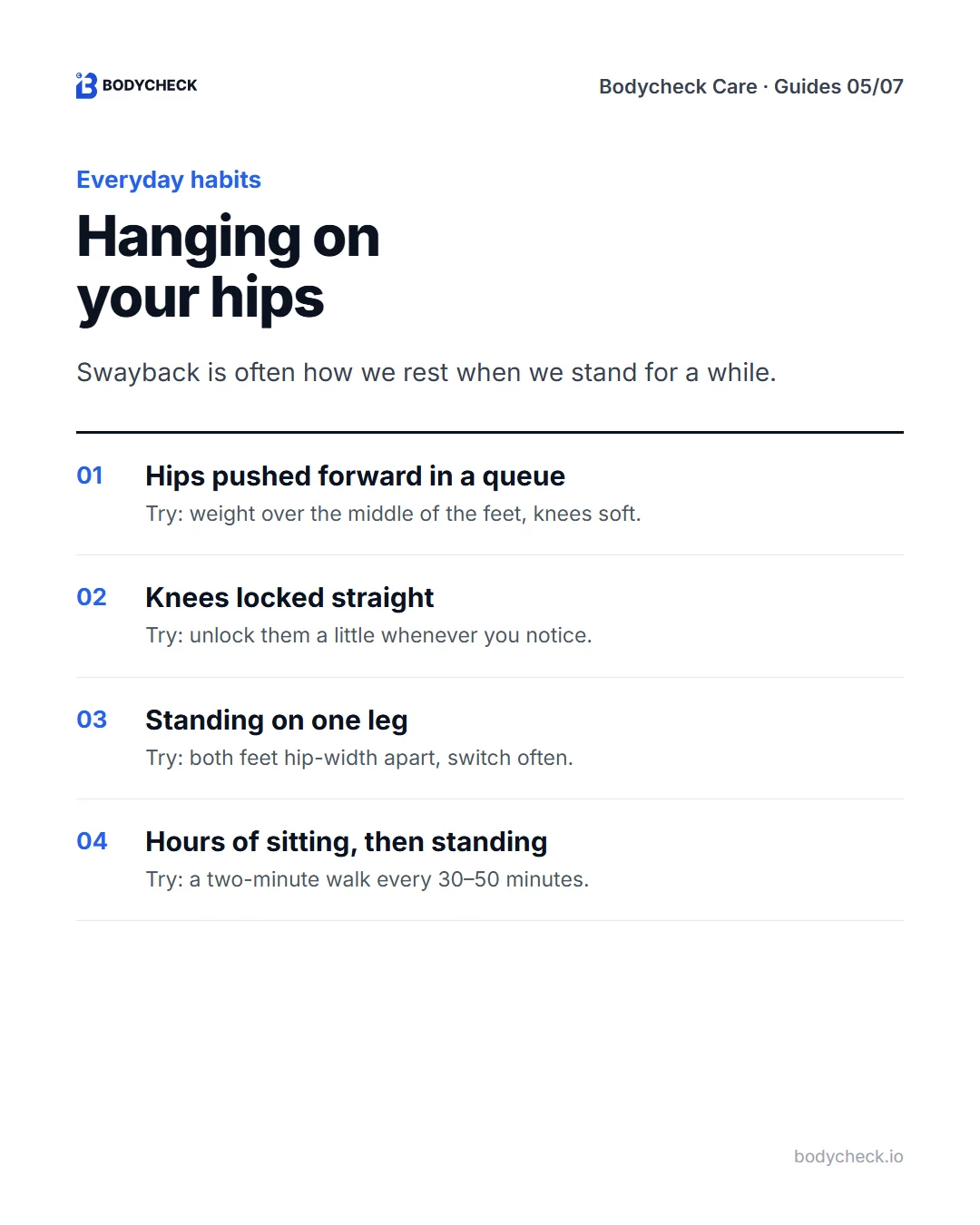
Swayback is often simply how we rest when we stand for a while. Instead of holding ourselves up with muscles, we hang on the front of the hips and lock the knees.
| Habit | Try instead |
|---|---|
| Hips pushed forward while waiting in a queue | Weight over the middle of your feet, knees soft |
| Knees locked straight | Unlock them a little whenever you notice |
| Standing on one leg with the hip pushed out | Both feet hip-width apart, switch often |
| Hours of sitting, then standing still | A two-minute walk every 30–50 minutes |
None of these needs to be perfect. Noticing once an hour adds up over a week.
How can you see it as a number?
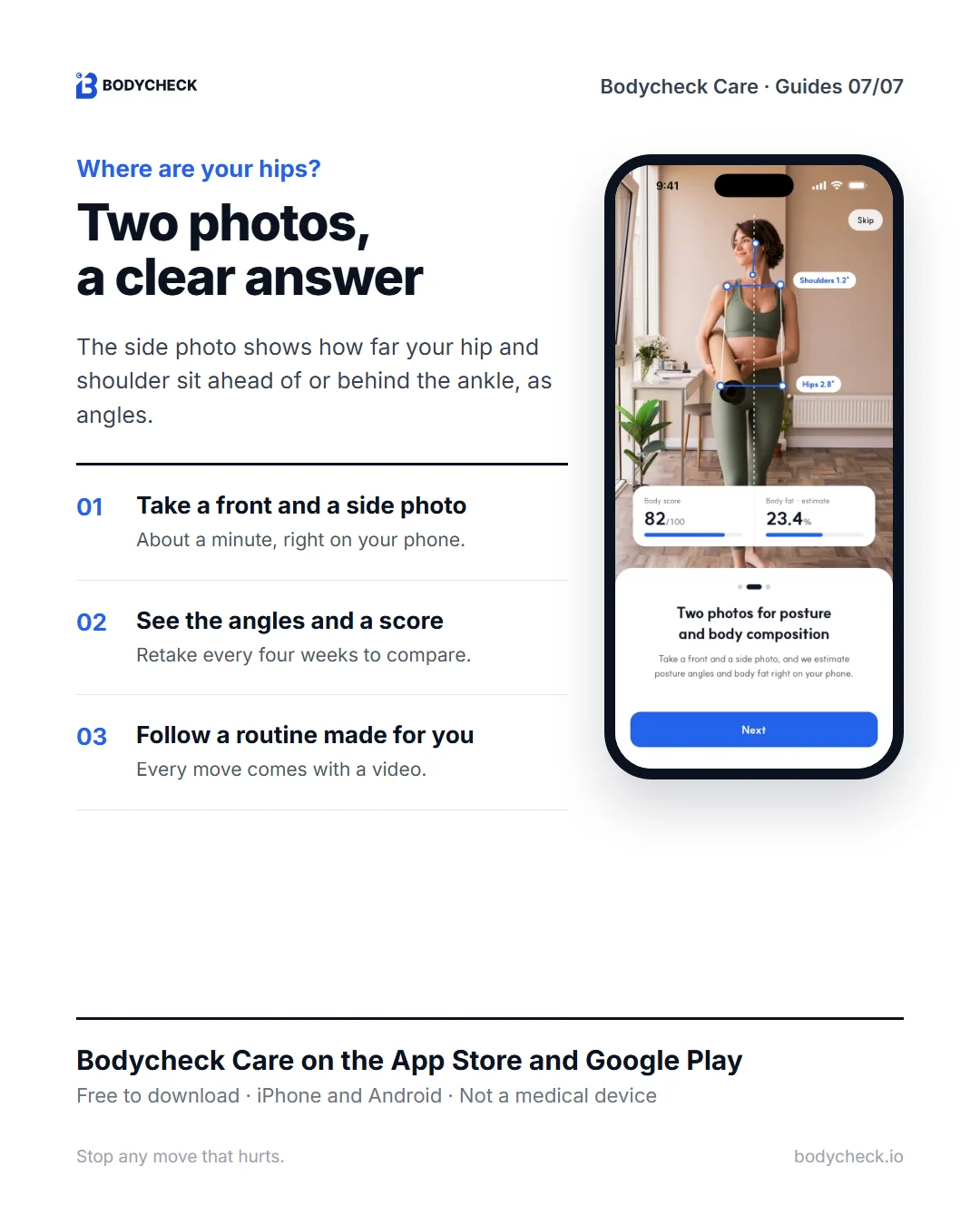
In Bodycheck Care you take a front and a side full-body photo. From the side photo the app shows how far your hip (pelvis front-to-back position) and shoulder sit ahead of or behind your ankle, as angles, together with a posture score out of 100. It takes about a minute.
- Get the app and take a front and a side photo.
- See your hip and shoulder position as angles and scores.
- Follow the moves picked for your result, each with a video.
- Retake the photos every four weeks and compare.
It's free on iPhone and Android and it is not a medical device. It won't tell you that you "have swayback", but it gives you numbers to compare next month, which a mirror can't. The formulas are on how we measure.
Bodycheck Care · Free
See where your hips sit from two photos
Take a front and a side photo to see how far your head and shoulders sit forward as a score, then follow moves picked for your result, each with a video.
The 10-minute swayback routine
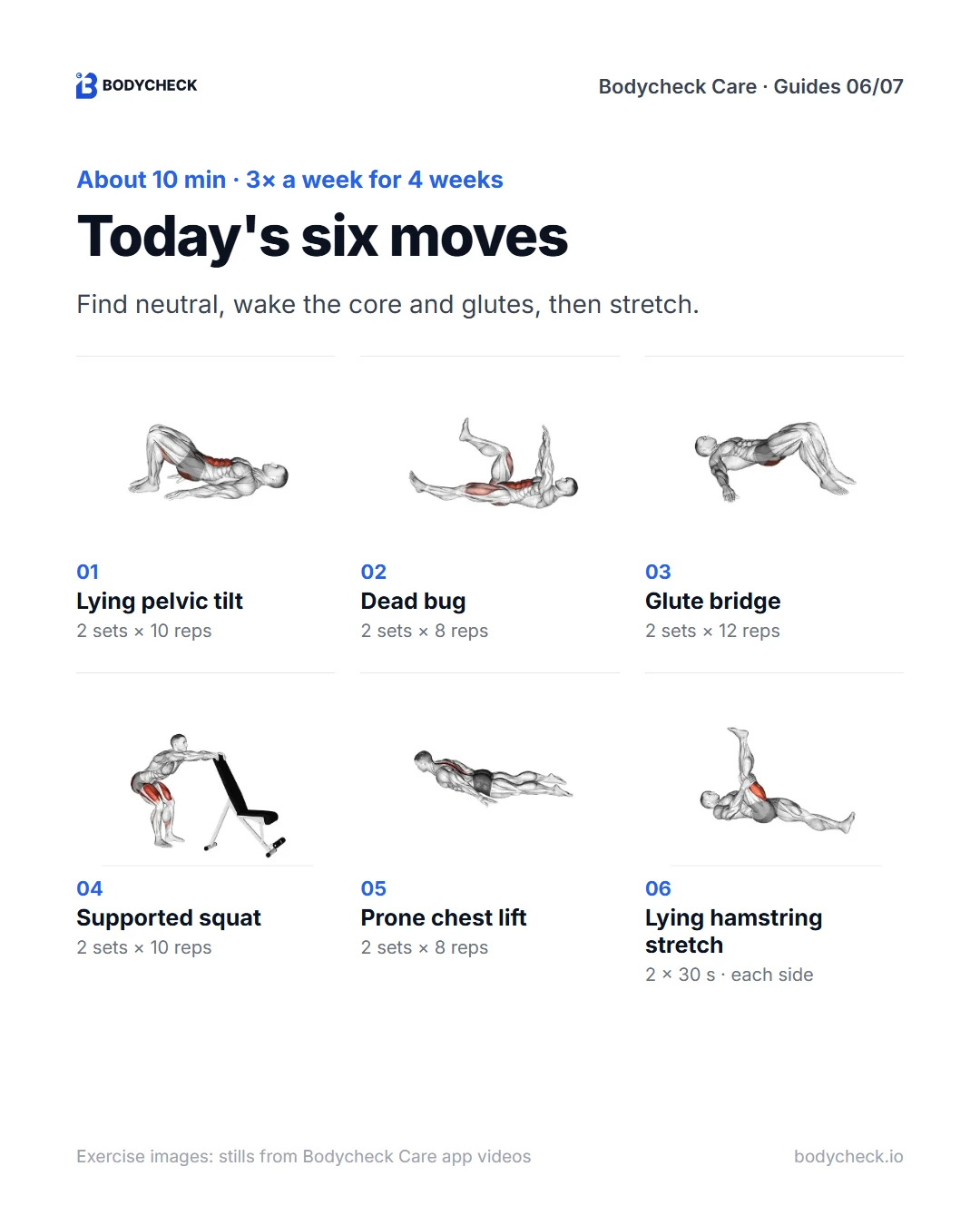
The order is simple: find neutral, wake up the core and glutes, then stretch. Try it three times a week for four weeks. If you also suspect anterior tilt, the 4-week hip and pelvis program builds up more slowly.
1. Lying pelvic tilt · 2 sets × 10 reps
- Lie on your back with knees bent and feet flat.
- Breathe out and gently flatten your lower back into the mat by tipping your pelvis.
- Breathe in and let it return to a small natural curve.
- Keep it slow and small. This teaches you where "neutral" is.
2. Dead bug · 2 sets × 8 reps
- On your back, lift your knees above your hips with shins level, arms toward the ceiling.
- Keep your lower back quiet on the mat.
- Slowly lower one arm overhead and the opposite leg toward the floor, only as far as your back stays still.
- Return and switch sides. Eight per side.
3. Glute bridge · 2 sets × 12 reps
- Lie with knees bent, feet hip-width apart.
- Push through your heels and lift your hips until your body makes a line from shoulders to knees.
- Squeeze your glutes for one second at the top. Don't arch the lower back to get higher.
- Lower slowly.
4. Supported squat · 2 sets × 10 reps
- Hold the back of a sturdy chair or bench, feet hip-width apart.
- Sit your hips back and down as if reaching for a seat behind you.
- Keep your knees soft and pointing the same way as your toes.
- Stand up by pushing the floor away. This practices moving the hips back instead of forward.
5. Prone chest lift · 2 sets × 8 reps
- Lie face down, legs straight.
- Squeeze your shoulder blades toward the middle of your back.
- Lift your chest slightly off the floor and pause for one second. Eyes on the floor, no arching the lower back.
- Lower slowly.
6. Lying hamstring stretch · 2 × 30 s · each side
- Lie on your back and lift one straight leg, holding behind the thigh.
- Bring it up only until you feel a gentle stretch at the back of the leg.
- Keep the other leg relaxed on the floor and breathe slowly.
- Hold 30 seconds, then switch.
At a glance
| # | Move | Sets |
|---|---|---|
| 1 | Lying pelvic tilt | 2 × 10 reps |
| 2 | Dead bug | 2 × 8 reps |
| 3 | Glute bridge | 2 × 12 reps |
| 4 | Supported squat | 2 × 10 reps |
| 5 | Prone chest lift | 2 × 8 reps |
| 6 | Lying hamstring stretch | 2 × 30 s · each side |
Moves can be hard to follow from text alone. In Bodycheck Care every move has a video, and the app counts the time and sets for you.
Frequently asked questions
What is swayback posture? Swayback is an everyday name for a standing pattern where the hips drift forward of the ankles and the upper body leans back behind the hips to balance. It is a description of posture, not a medical diagnosis.
Is swayback the same as anterior pelvic tilt? Not quite. With anterior pelvic tilt the pelvis tips forward and the lower-back curve gets deeper, while the hips stay roughly over the ankles. With swayback the whole pelvis slides forward of the ankles and the chest sits behind it.
How do I fix swayback posture? There is no single fix and no fixed timeline. Notice how you stand, break up long periods of standing or sitting, and do a few minutes of core, glute and hamstring work. Take the same side photo every four weeks to see whether anything changes.
Can swayback cause back pain? Posture alone rarely explains pain, and many people with a swayback pattern have none. If you have back pain that does not settle, pain that spreads down a leg, or numbness, see a healthcare professional.
Is there an app that checks swayback? Bodycheck Care shows, as angles, how far your hip and shoulder sit ahead of or behind your ankle from a side photo, along with a posture score. It does not diagnose swayback. It is free on iPhone and Android and is not a medical device.
Before you start
- Move slowly and stop if anything hurts, tingles or feels sharp.
- Don't hold your breath. Breathe out as you lift or push.
- In bridges and chest lifts, the work should be in the glutes and upper back, not a pinch in the lower back.
- This is exercise guidance, not treatment. If you are pregnant, recovering from surgery or have back pain that spreads down a leg, check with a healthcare professional first.
Next time you're waiting for a bus, check where your hips are. Then give your hips ten minutes tonight.
Bodycheck Care · Free
Take two photos and get moves picked for you
Take a front and a side photo to see how far your head and shoulders sit forward as a score, then follow moves picked for your result, each with a video.
References
- Kendall FP, McCreary EK, Provance PG, et al. Muscles: Testing and Function with Posture and Pain, 5th ed. Lippincott Williams & Wilkins, 2005. (Postural types, including sway-back)
- Physiopedia. "Sway Back Posture." https://www.physio-pedia.com/Sway_Back_Posture
- Images: cover photo from the Bodycheck Care site; exercise images and app screens from the Bodycheck Care app.