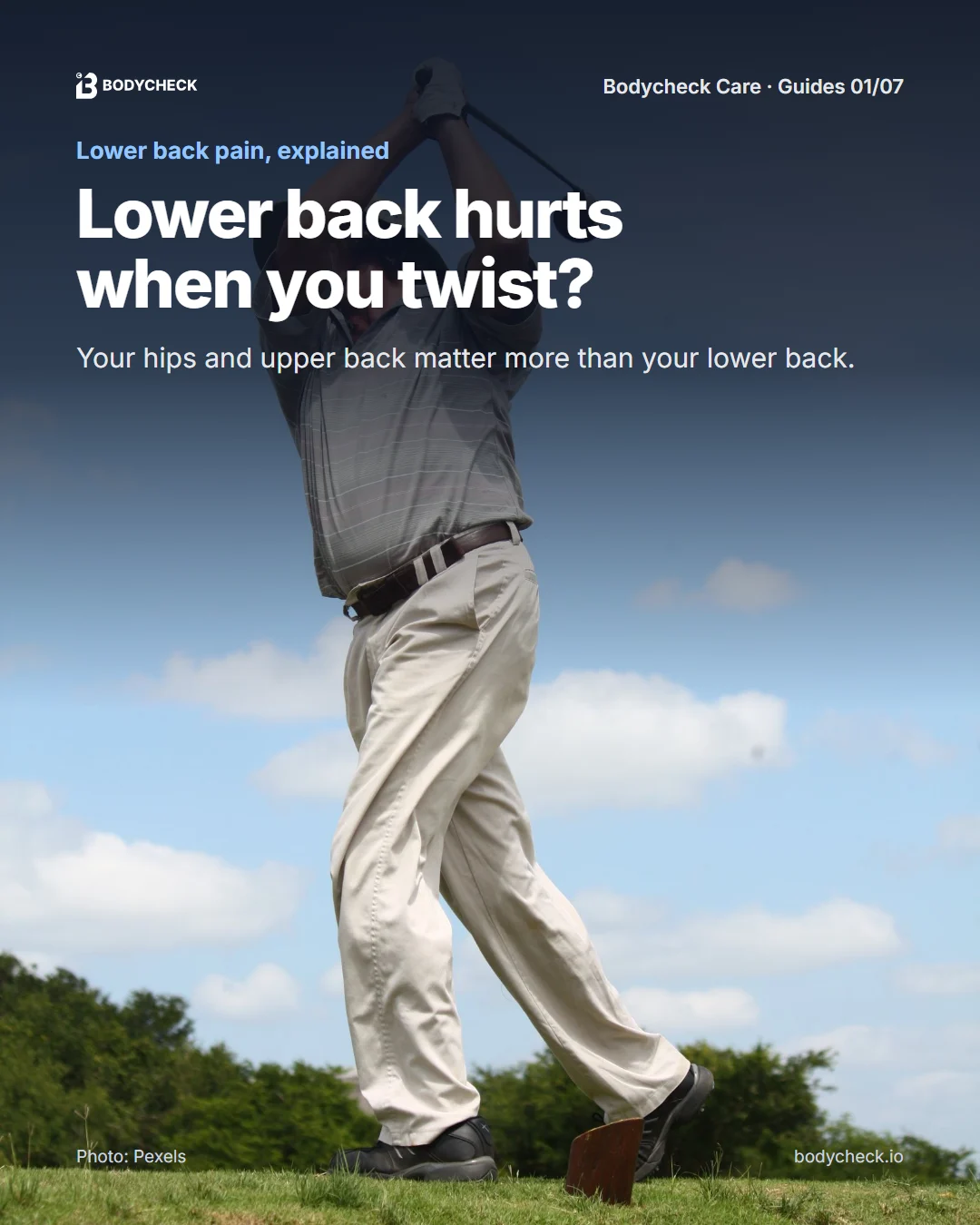
Lower Back Pain When You Twist? Why Your Hips and Upper Back Matter More Than Your Lower Back
Why the lower back isn't built to twist, how stiff hips and a stiff upper back push golf, tennis and everyday rotation into the lower back, and a 10-minute routine that starts with the hips and upper back.
Short answer: The lower back is built more to hold steady than to twist: it rotates only a few degrees at each level. Most of the turning in daily life and in sports like golf and tennis is meant to come from the hips and the upper back. When those get stiff from long days of sitting, the lower back starts doing their job, and the discs and joints take repeated twisting and compression. So with lower back pain, it often makes sense to work on the hips and upper back first, then teach the lower back to stay steady.
Some of the most frustrating lower back stories come from people who have been doing lower back exercises for months. They twist, they stretch the lower back, they do every "back pain routine" they can find, and the pain keeps coming back, especially after golf, tennis or a long day at a desk.
Often the lower back isn't the only part that isn't moving well. Usually the hips and the upper back have stopped doing their share. Here's why that matters, two quick checks you can do at home and a 10-minute routine that starts in the right place.
The lower back is built to hold, not to twist
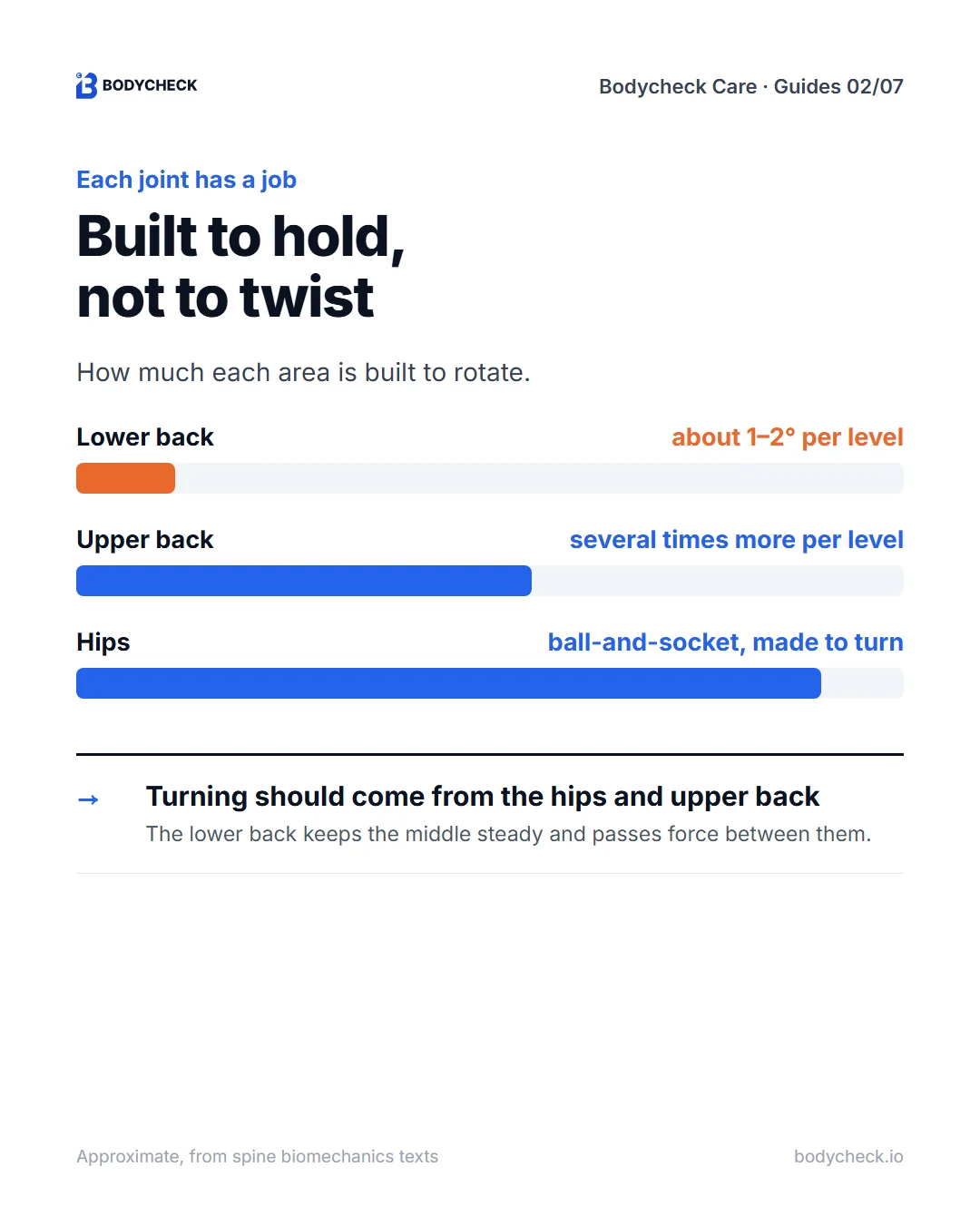
Each joint in the spine has a job. The vertebrae of the lower back (lumbar spine) have joint surfaces that face mostly front-to-back, which allows bending forward and back but only about 1–2° of rotation per level. The upper back (thoracic spine) is shaped to rotate several times more per level, and the hips are ball-and-socket joints made for turning.
So when you turn to look behind you, swing a club or hit a forehand, most of that turn is supposed to come from the hips and the upper back. The lower back's main job is to keep the middle steady and pass force between them.
A simple way to picture it: mobile, stable, mobile
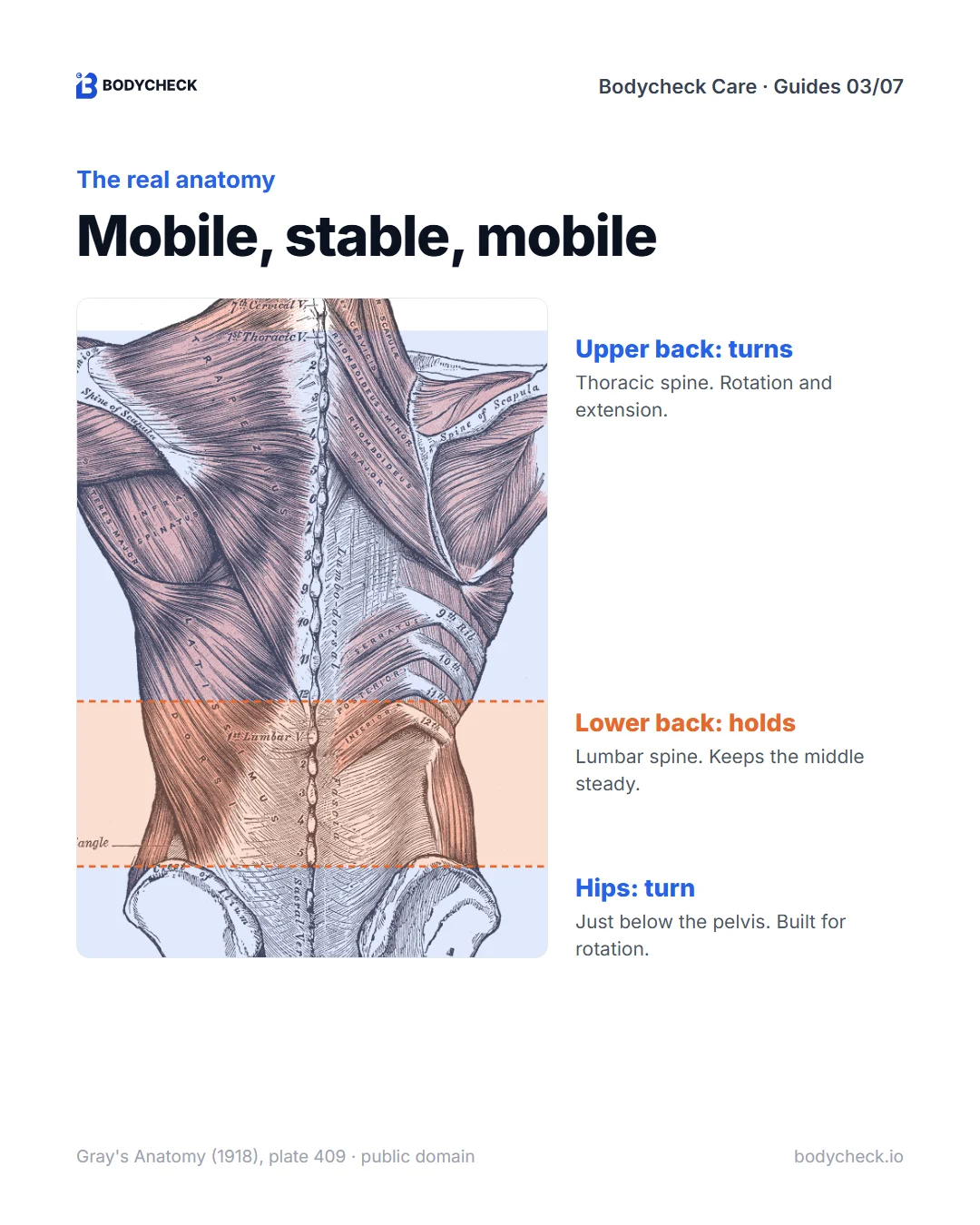
Many physical therapists and coaches use a model often called the joint-by-joint approach: the body alternates between joints that need mobility and joints that need stability.
| Area | Main job | What happens when it stiffens |
|---|---|---|
| Upper back (thoracic spine) | Mobility: turning and extending | The neck and lower back move more to make up for it |
| Lower back (lumbar spine) | Stability: holding steady | Pain when it is asked to twist and bend repeatedly |
| Hips | Mobility: turning in all directions | The lower back twists in their place |
It's a simplification, not a law of nature, but it explains a very common pattern.
How everyday life changes the pattern
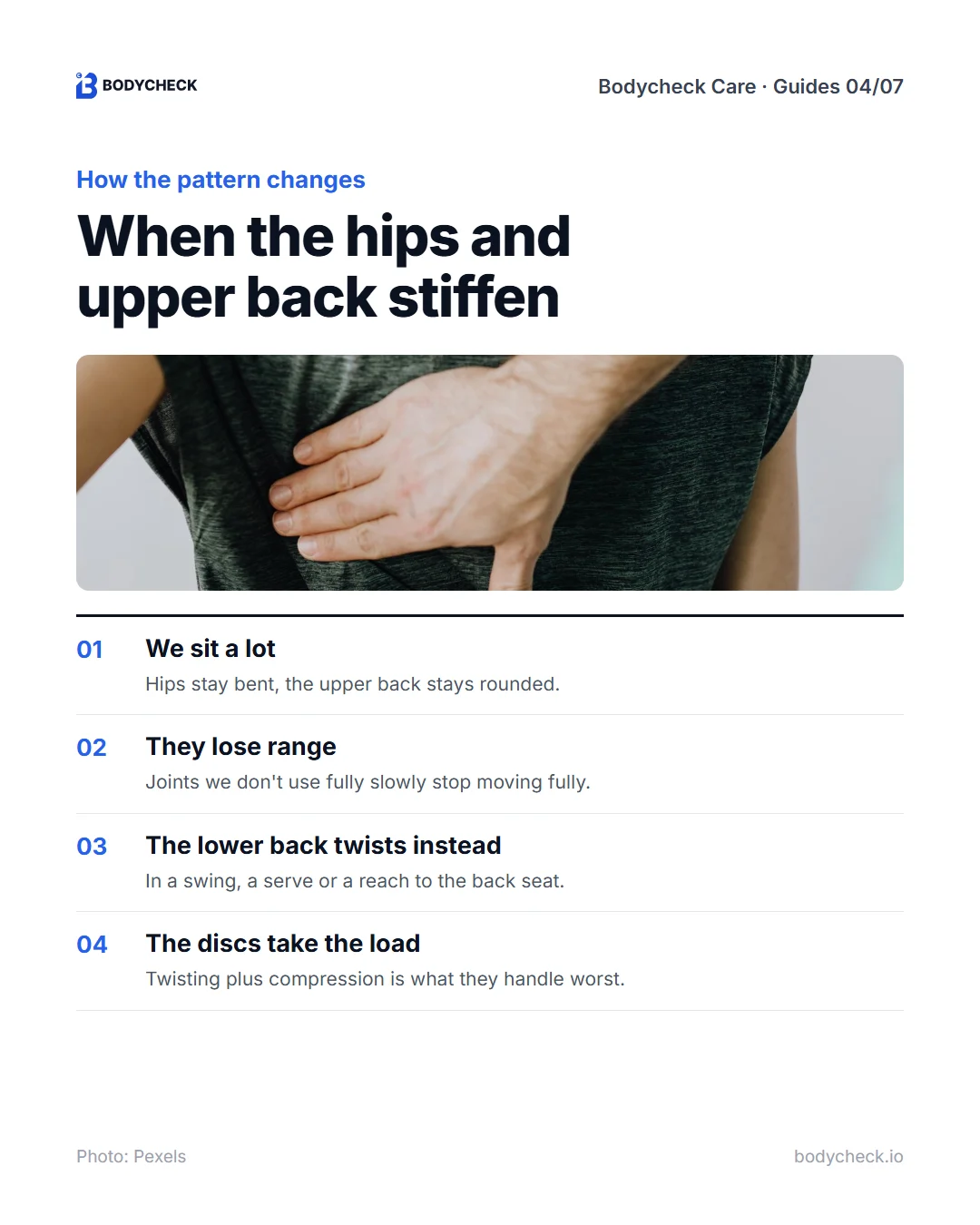
- We sit a lot. Hours in a chair keep the hips bent and the upper back rounded. Joints we don't use through their full range gradually lose it.
- The hips and upper back move less. Daily life rarely asks them to turn fully, so the range shrinks without us noticing.
- Rotation still has to come from somewhere. In a golf swing, a tennis serve or just turning to grab something from the back seat, the lower back starts to twist in place of the hips and upper back.
- The discs pay for it. Repeated twisting combined with compression is the kind of load lumbar discs and joints tolerate least.
Research in golf points the same way: in a study of professional golfers, those with a history of low back pain had less internal rotation in the lead hip (the hip closest to the target). Not every study finds a clear link, and pain always has more than one cause, but the pattern is common enough that the hips and upper back are worth checking whenever the lower back keeps hurting.
Why "lower back exercises" can make it worse
If the lower back is already doing too much twisting, more twisting stretches and lumbar rotations aren't what it needs. That's the trap: the pain is felt in the lower back, so it seems obvious to work on the lower back.
A better order:
- Hips: restore rotation, especially internal rotation.
- Upper back: restore rotation and extension.
- Lower back: teach it to stay steady while the hips and upper back do the turning.
Two quick checks at home
These aren't diagnoses, but they show where to start.
1. Seated rotation (upper back). Sit on a chair with your feet flat and arms crossed on your chest. Without letting your knees or hips move, turn your upper body to the right as far as is comfortable, then to the left. Notice whether one side stops much earlier.
2. Seated hip rotation (hips). Sit tall with your knees together, bent about 90 degrees. Keeping your knees together, let one foot swing outward, then the other. That outward swing of the foot is hip internal rotation. Compare sides. If you play golf, pay attention to your lead hip.
If one side is clearly more limited, that's your starting point. A physical therapist can measure both properly.
How can you see it as numbers?
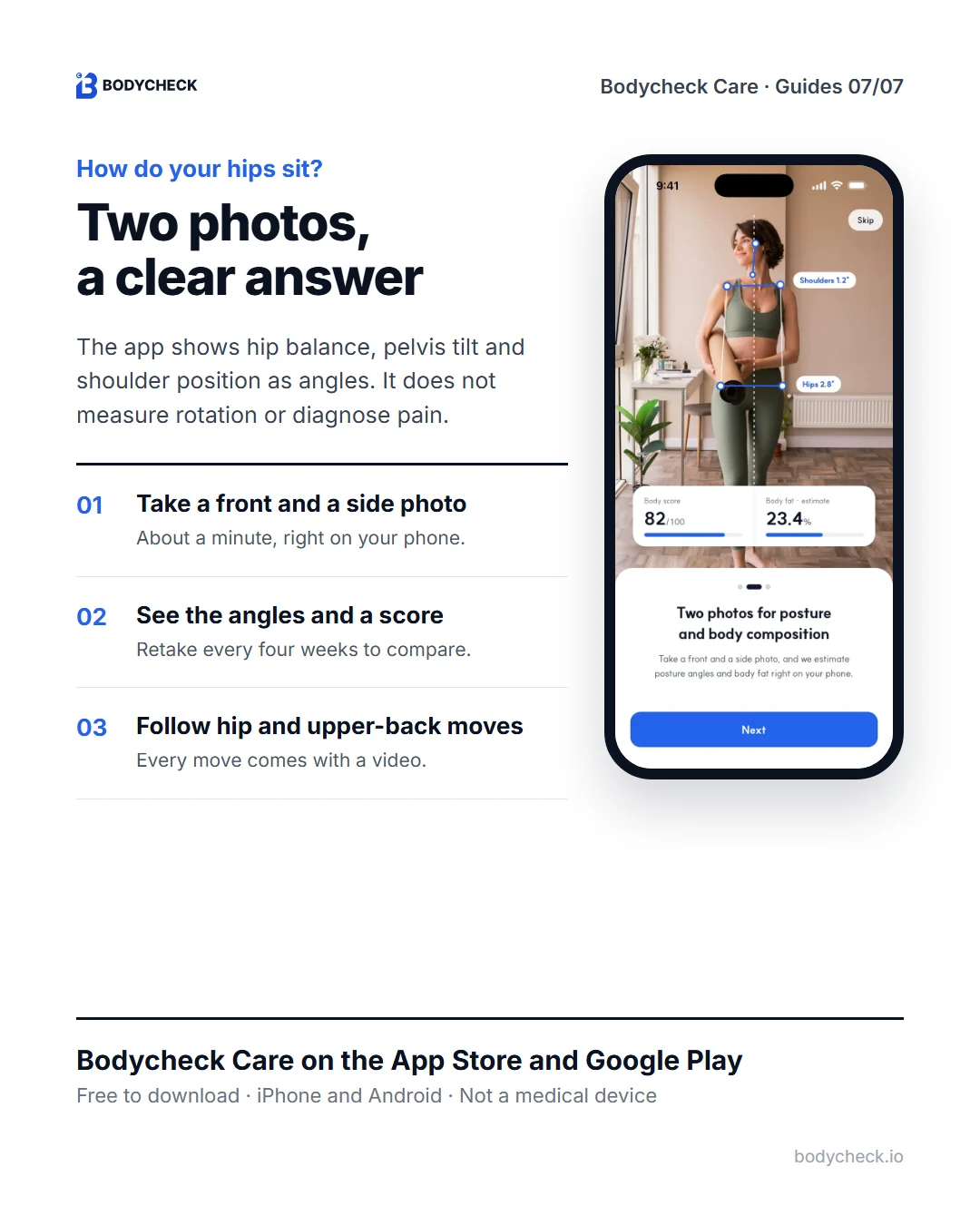
Bodycheck Care doesn't measure rotation range, and it can't tell you why your back hurts. What it does show, from a front and a side photo, is how your pelvis and shoulders sit: hip balance, pelvis front-to-back tilt and shoulder position as angles and a score, in about a minute. That gives you a baseline to compare every four weeks while you work on your hips and upper back.
It's free on iPhone and Android and it is not a medical device. You can also try the free posture test in your browser; the photos aren't uploaded.
Bodycheck Care · Free
See how your pelvis and shoulders sit from two photos
Take a front and a side photo to see how far your head and shoulders sit forward as a score, then follow moves picked for your result, each with a video.
The 10-minute routine: hips and upper back first
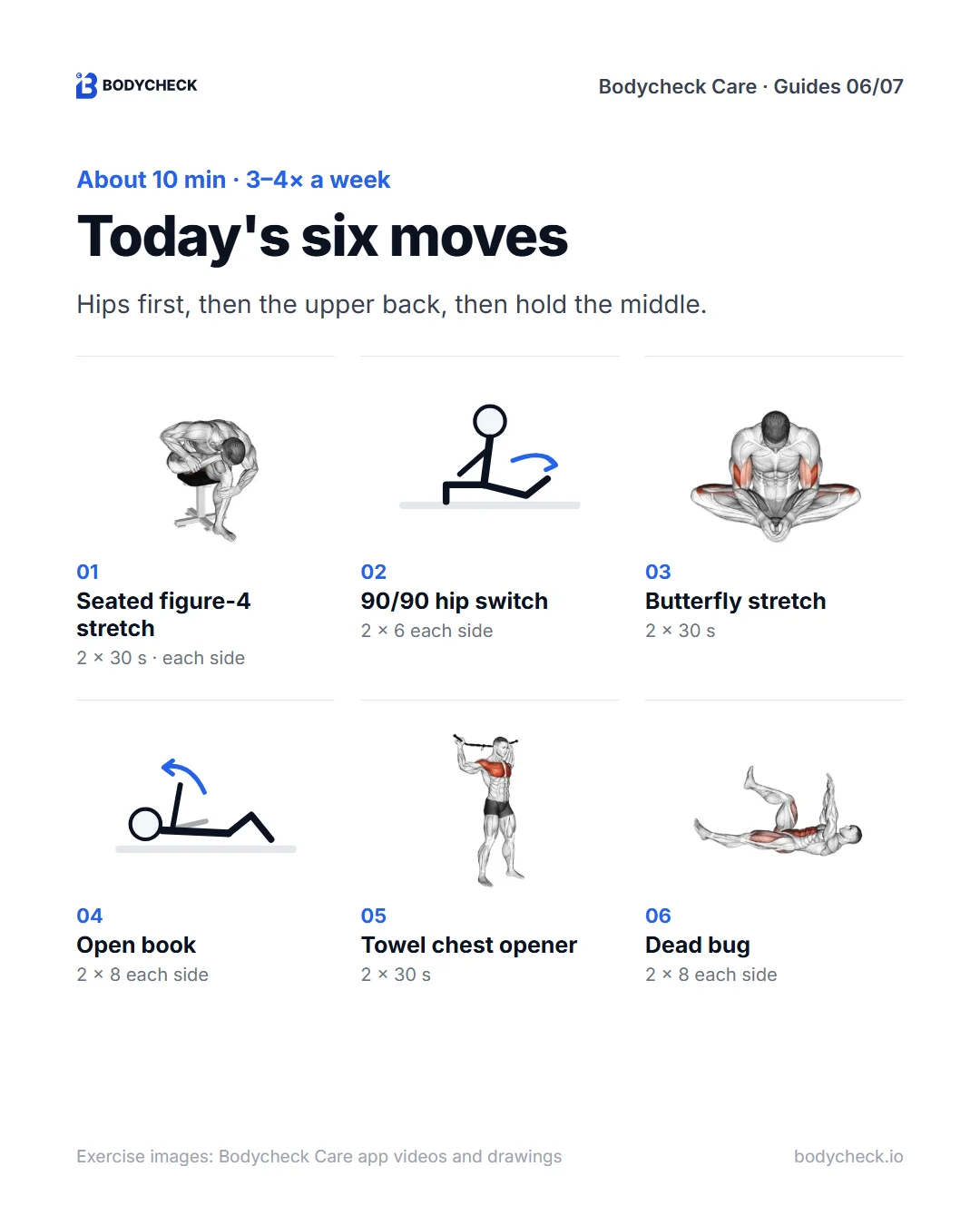
Hips first, then the upper back, then one move that teaches the lower back to stay steady. Try it three to four times a week for four weeks, and do moves 1, 2 and 4 before golf or tennis. Everything should feel like a comfortable stretch or light effort. Stop any move that increases pain or sends it down a leg.
1. Seated figure-4 stretch · 2 × 30 s · each side
- Sit on a chair and rest one ankle on the opposite knee.
- Sit tall and keep your back long.
- Hinge forward from the hips until you feel a stretch in the side of the hip.
- Hold 30 seconds, then switch.
2. 90/90 hip switch · 2 × 6 each side
- Sit on the floor with both knees bent about 90 degrees and lean back on your hands.
- Slowly let both knees fall to one side.
- Bring them back up and over to the other side, turning from the hips.
- Keep your lower back quiet and move only as far as is comfortable.
3. Butterfly stretch · 2 × 30 s
- Sit with the soles of your feet together and knees out to the sides.
- Sit tall, holding your ankles.
- Let your knees drop gently. Don't push them down.
- Breathe slowly and hold 30 seconds.
4. Open book · 2 × 8 each side
- Lie on your side with knees bent up to hip height and arms straight out in front.
- Keep your knees together and stacked.
- Open the top arm up and across to the other side, turning through the upper back. Follow your hand with your eyes.
- Pause, breathe out, and return slowly.
5. Towel chest opener · 2 × 30 s
- Stand tall holding a towel wider than your shoulders.
- Raise straight arms overhead.
- Take them back only as far as they move freely, keeping your ribs down.
- Return slowly and repeat for 30 seconds.
6. Dead bug · 2 × 8 each side
- Lie on your back with knees above your hips and arms toward the ceiling.
- Keep your lower back quiet on the mat.
- Slowly lower one arm overhead and the opposite leg toward the floor, only as far as your back stays still.
- Return and switch sides.
At a glance
| # | Move | Sets |
|---|---|---|
| 1 | Seated figure-4 stretch | 2 × 30 s · each side |
| 2 | 90/90 hip switch | 2 × 6 each side |
| 3 | Butterfly stretch | 2 × 30 s |
| 4 | Open book | 2 × 8 each side |
| 5 | Towel chest opener | 2 × 30 s |
| 6 | Dead bug | 2 × 8 each side |
For more on the hips and pelvis, see glute activation after sitting and the anterior pelvic tilt self-check. If sitting is the main trigger, lower back stiff from sitting has desk-break ideas.
When to see a doctor or physical therapist
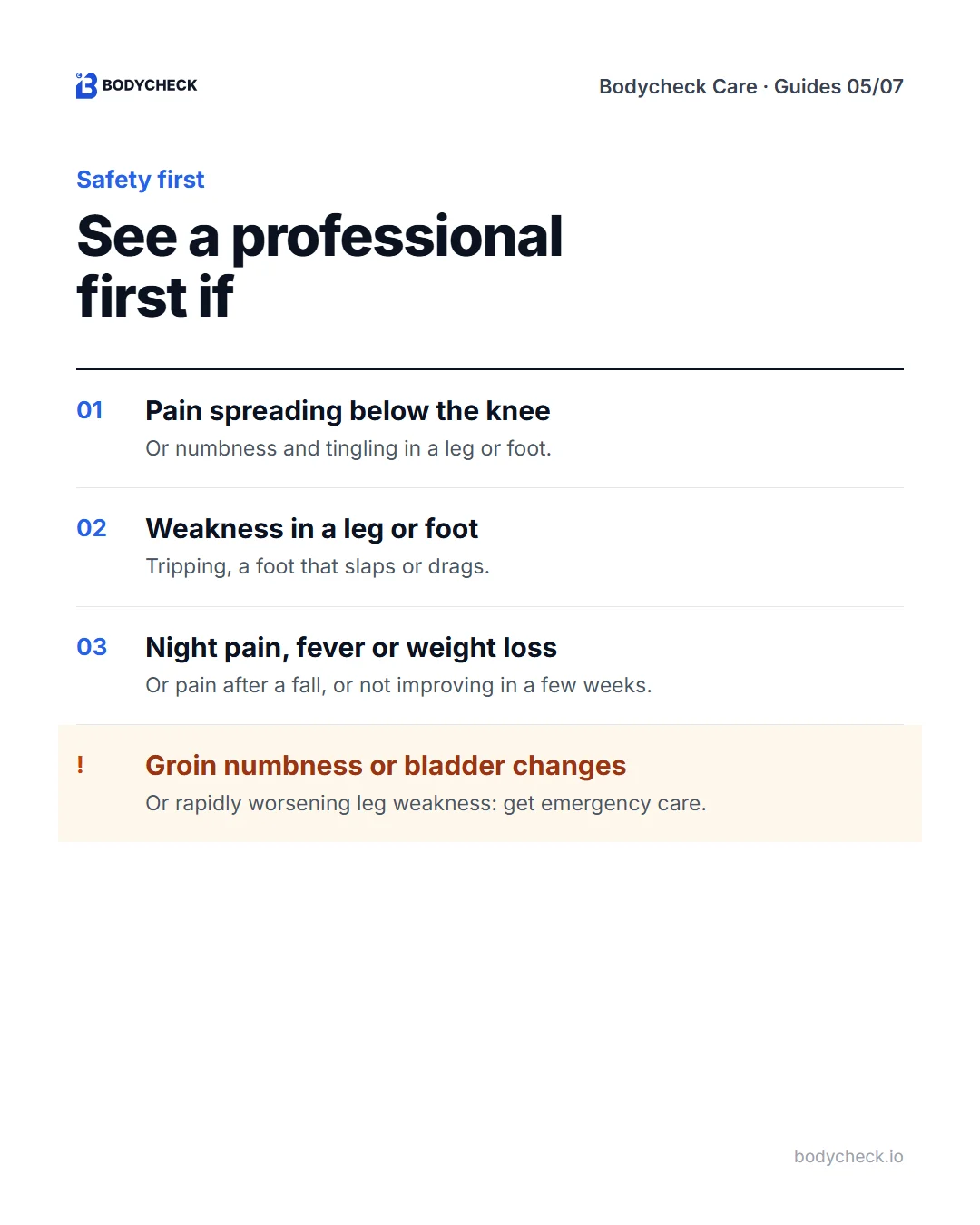
Get emergency care for numbness in the groin or saddle area, new trouble controlling your bladder or bowels, or rapidly worsening weakness in a leg.
Book an appointment if you have:
- pain spreading below the knee, or numbness or tingling in a leg or foot
- weakness in a leg or foot
- pain that is worse at night or at rest
- fever, unexplained weight loss, a history of cancer, or pain after a fall
- pain that hasn't improved after a few weeks
Frequently asked questions
Why does my lower back hurt when I twist? The lower back rotates only a few degrees at each level. When the hips and upper back get stiff, it is asked to twist more than it is built for. That is one common pattern, not the only cause.
Should I do lower back exercises if my lower back hurts? Often the better first step is to improve how your hips and upper back move, then add exercises that teach the lower back to stay steady.
Why does golf hurt my lower back? A swing needs a lot of rotation. Professional golfers with a history of low back pain had less internal rotation in the lead hip in one study. If the hips and upper back don't turn enough, the lower back makes up the difference.
How do I know if my hips are stiff? Sit with your knees together and let each foot swing outward. If one side moves much less, or both feel very limited, start with the hips.
When should I see a doctor for lower back pain? Immediately for groin or saddle numbness, bladder or bowel changes, or rapidly worsening leg weakness. Soon for pain below the knee, leg numbness or weakness, fever, weight loss, pain after a fall, or pain that isn't improving.
Before you start
- Move slowly and stay in a comfortable range. Mild stretch is fine; sharp pain is not.
- Breathe out during the effort.
- Keep the lower back quiet in every move. The hips and upper back do the moving.
- This is general exercise guidance, not a diagnosis or treatment. If anything on the list above applies to you, see a professional first.
Bodycheck Care · Free
Take two photos and get moves picked for you
Take a front and a side photo to see how far your head and shoulders sit forward as a score, then follow moves picked for your result, each with a video.
References
- White AA, Panjabi MM. Clinical Biomechanics of the Spine, 2nd ed. Lippincott, 1990. (Segmental rotation of the thoracic and lumbar spine)
- Vad VB, Bhat AL, Basrai D, et al. Low back pain in professional golfers: the role of associated hip and low back range-of-motion deficits. American Journal of Sports Medicine, 2004;32(2):494-497.
- Cook G. Movement: Functional Movement Systems. On Target Publications, 2010. (Joint-by-joint approach)
- Images: photos from Pexels (free license); anatomy plate 409 from Gray's Anatomy of the Human Body, 20th ed. (1918), public domain via Wikimedia Commons; exercise images and app screens from the Bodycheck Care app, with simple drawings by Bodycheck Care.