Lower Back Stiff After Sitting? A 13-Minute Core Routine on One Mat
US adults now sit about 6.4 hours a day. Learn what your core really is, why to start lying down, and work through six moves from pelvic tilts to planks.
Short answer: When you sit, the chair holds you up and your trunk muscles (your core) take a break. So you need to give them work on purpose. The order that works: learn to move your pelvis lying down first, save the holds for last. Do the six moves below for about 13 minutes, three times a week for four weeks.
Hi, I'm an editor on the Bodycheck Care team. After the forward head posture guide, today it's the lower back. On deadline days I sometimes sit down after lunch and don't get up until dinner. When I finally stand, my back lets me know about it.
Jumping straight into sit-ups can make a stiff back feel worse. So let's look at how much we actually sit, what the "core" really is, and a 13-minute core routine you can do on one mat.
How much do we sit each day?
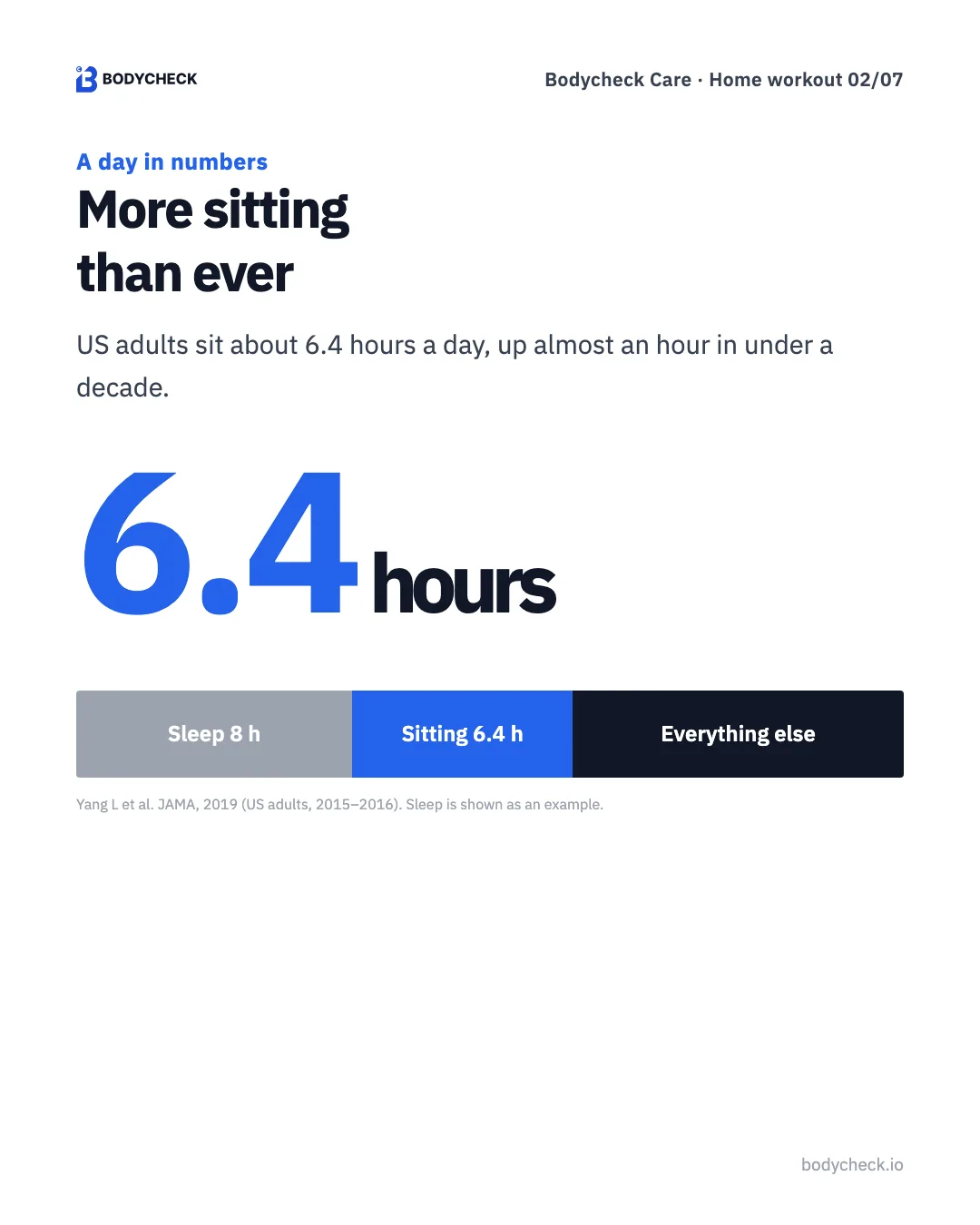
A study in JAMA found that US adults sat about 6.4 hours a day in 2015–2016, up from about 5.5 hours in 2007. That is almost an extra hour in under a decade.
Take out sleep and that is a big share of your waking day. While you sit, the chair does the holding and your trunk muscles rest. That's why it pays to set aside time to put them back to work.
Is the core just your abs?
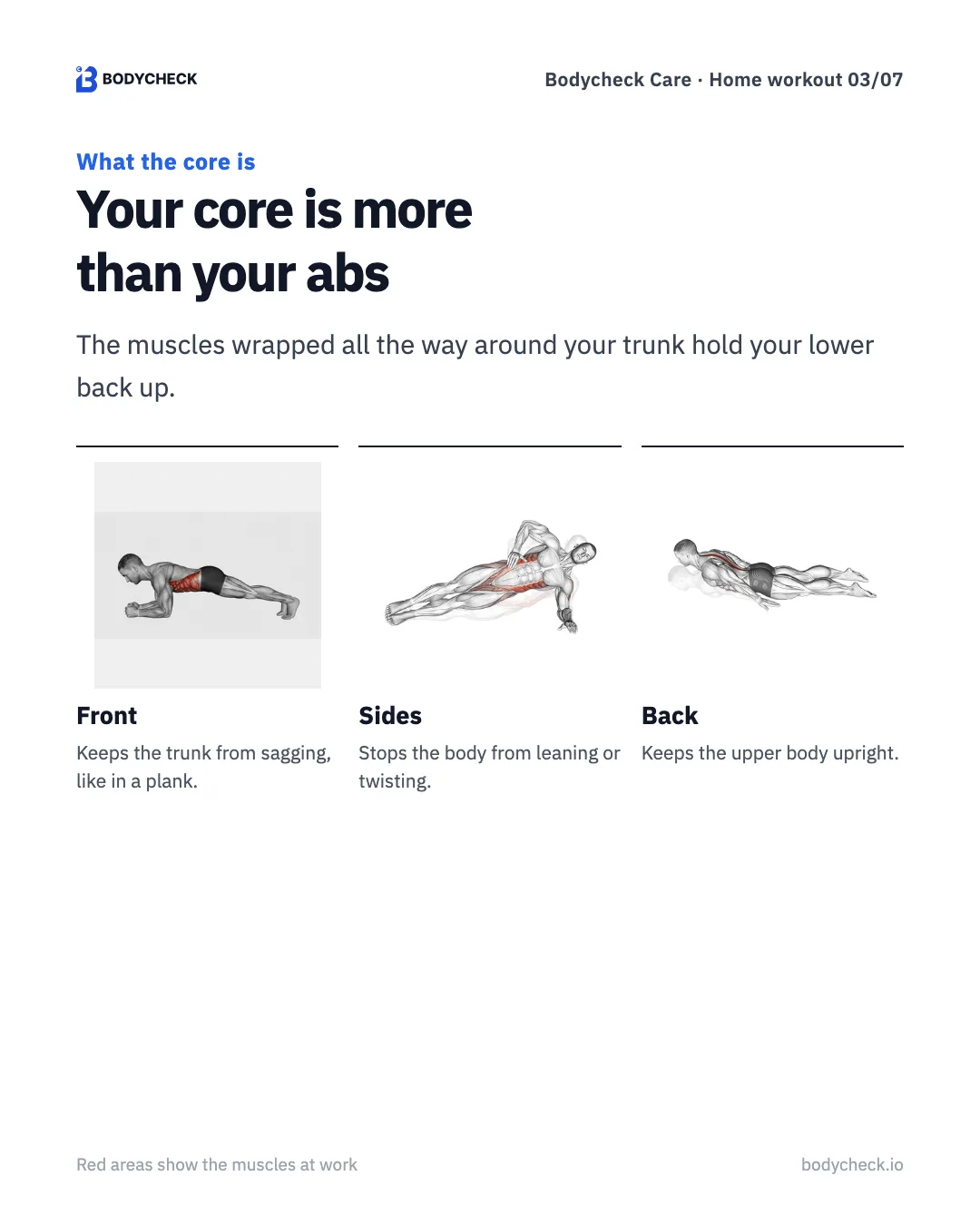
I used to think core meant abs. It actually means every muscle that wraps around your trunk: the front, the sides, the back, the breathing muscle (diaphragm) on top and the pelvic floor below.
When they work together, your trunk stays solid and your lower back doesn't carry the load alone. That's why this routine covers the front (dead bug, plank), the sides (side plank) and the glutes and back (bridge).
Why start lying down?
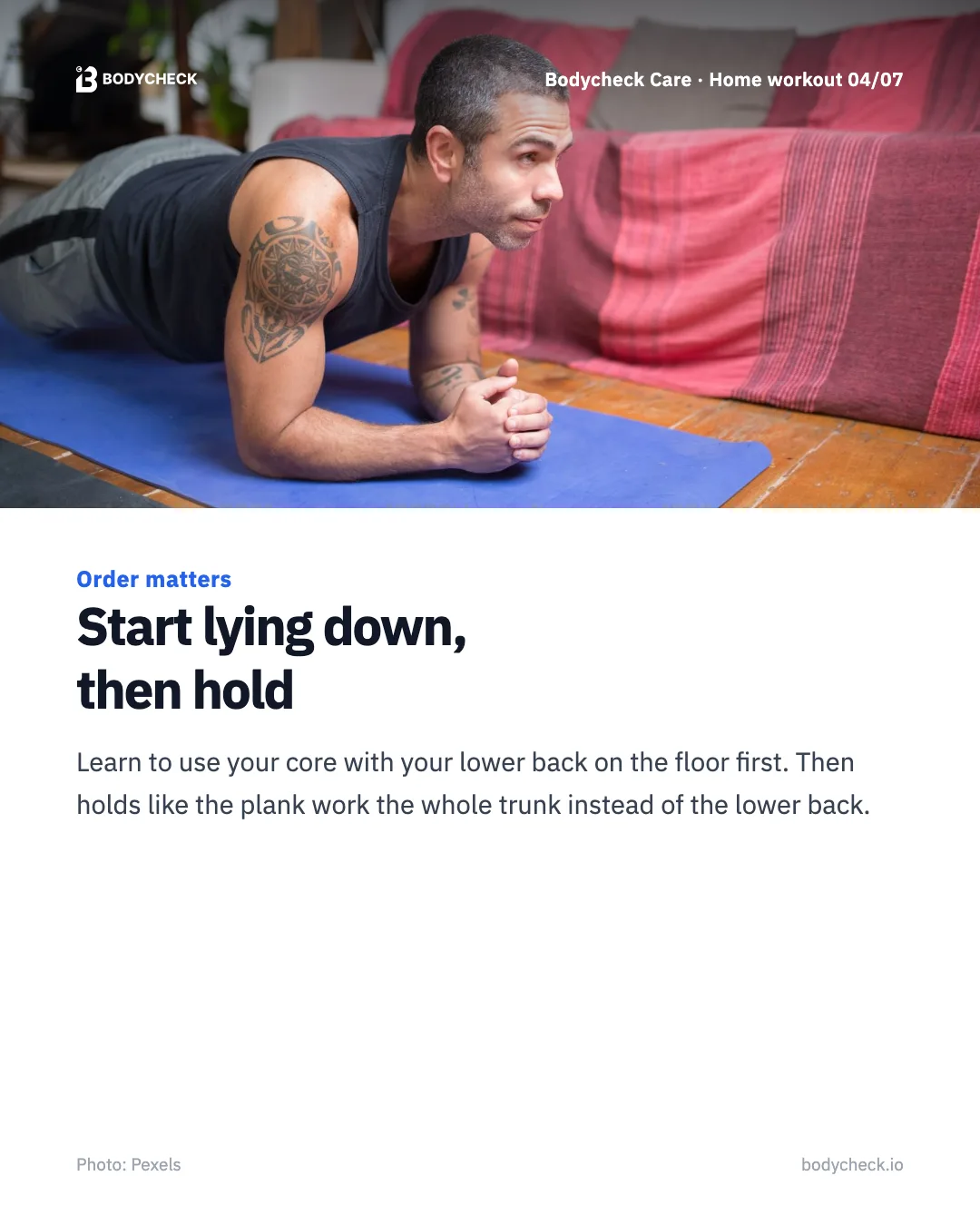
Go straight into a long plank and your lower back tends to sag. Order matters.
First, learn to tilt your pelvis and press your lower back into the floor. Then move your arms and legs without letting your back lift (dead bug), lift your hips (bridge), and only then hold on your side and front. That way, even in the holds, your whole trunk works instead of just your lower back.
Four desk habits for a happier back
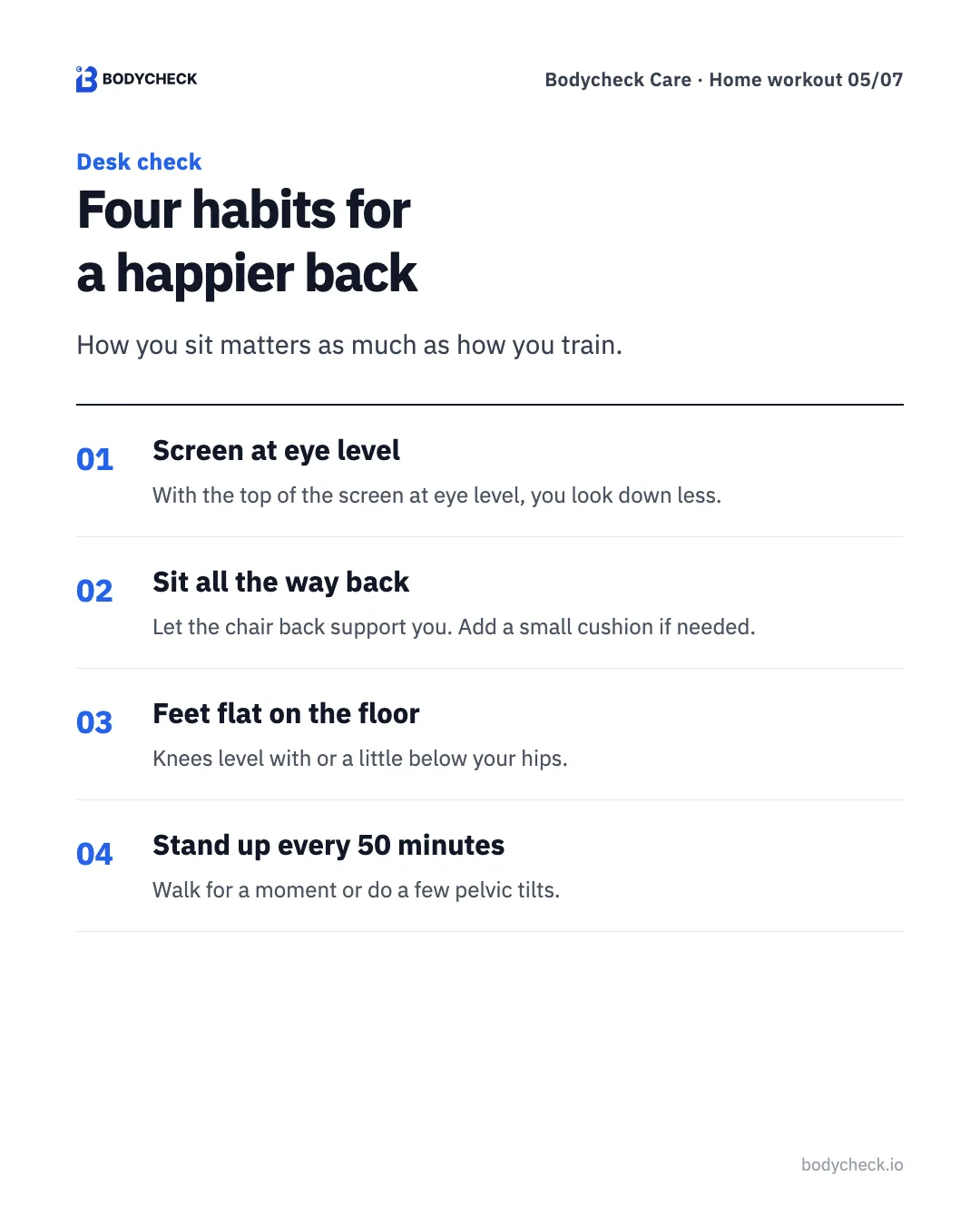
How you sit matters as much as how you train. I keep these four on a sticky note by my monitor.
- Screen at eye level. With the top of the screen at eye level, you look down less.
- Sit all the way back. Let the chair back support you. Add a small cushion if needed.
- Feet flat on the floor. Knees level with or a little below your hips.
- Stand up every 50 minutes. Walk for a moment, or do a few pelvic tilts (move 1).
How can you see which way your posture leans?
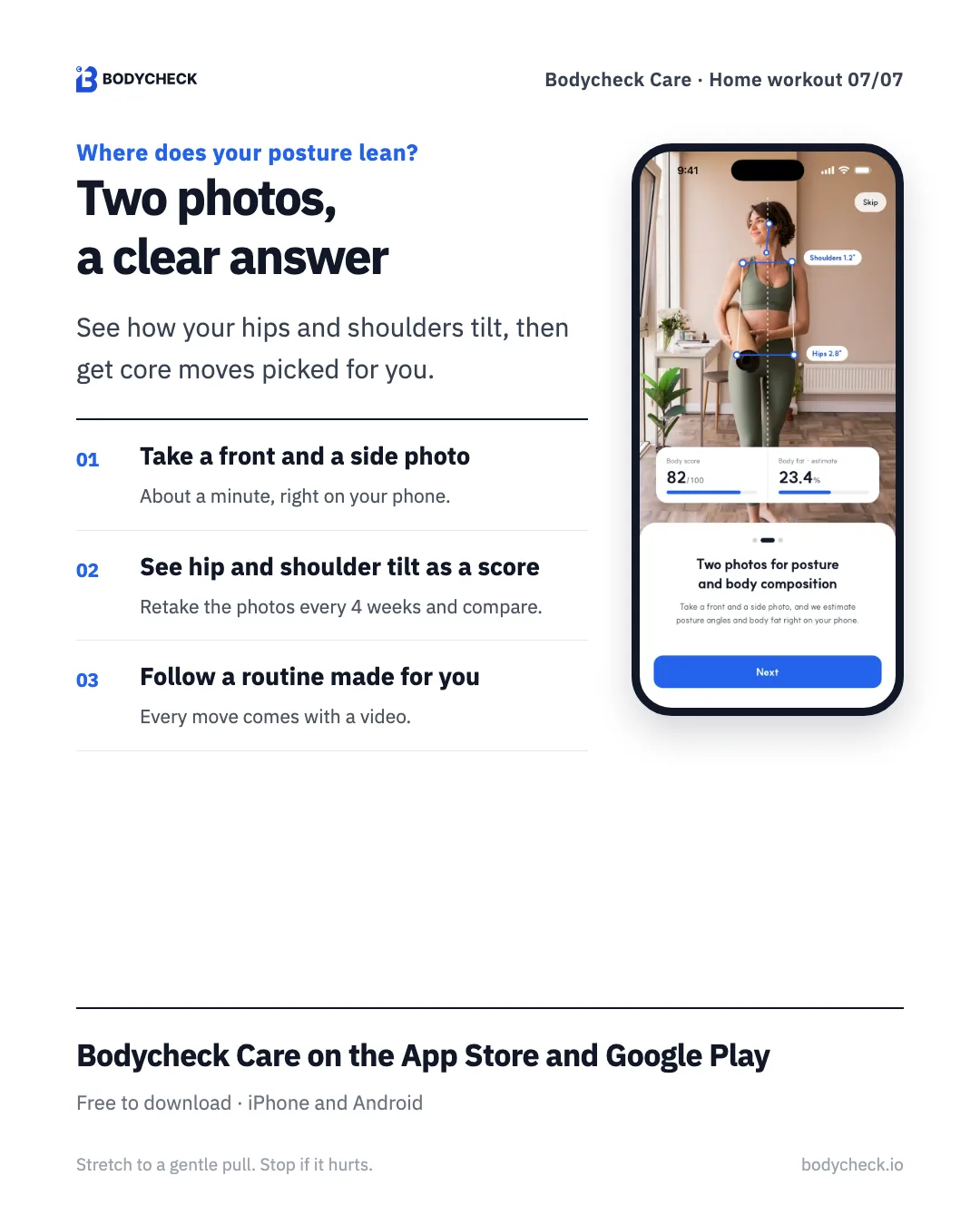
If your back is often stiff, it's worth seeing which way your hips and shoulders tilt. In Bodycheck Care you take a front and a side photo, and the app shows hip and shoulder tilt as angles and a score.
- Get the app and take a front and a side full-body photo.
- See your hip and shoulder tilt as a score.
- Follow the moves picked for your result, each with a video.
- Retake the photos after four weeks and compare.
Bodycheck Care · Free
See how your hips and shoulders tilt, from two photos
Take a front and a side photo to see how far your head and shoulders sit forward as a score, then follow moves picked for your result, each with a video.
The 13-minute core routine
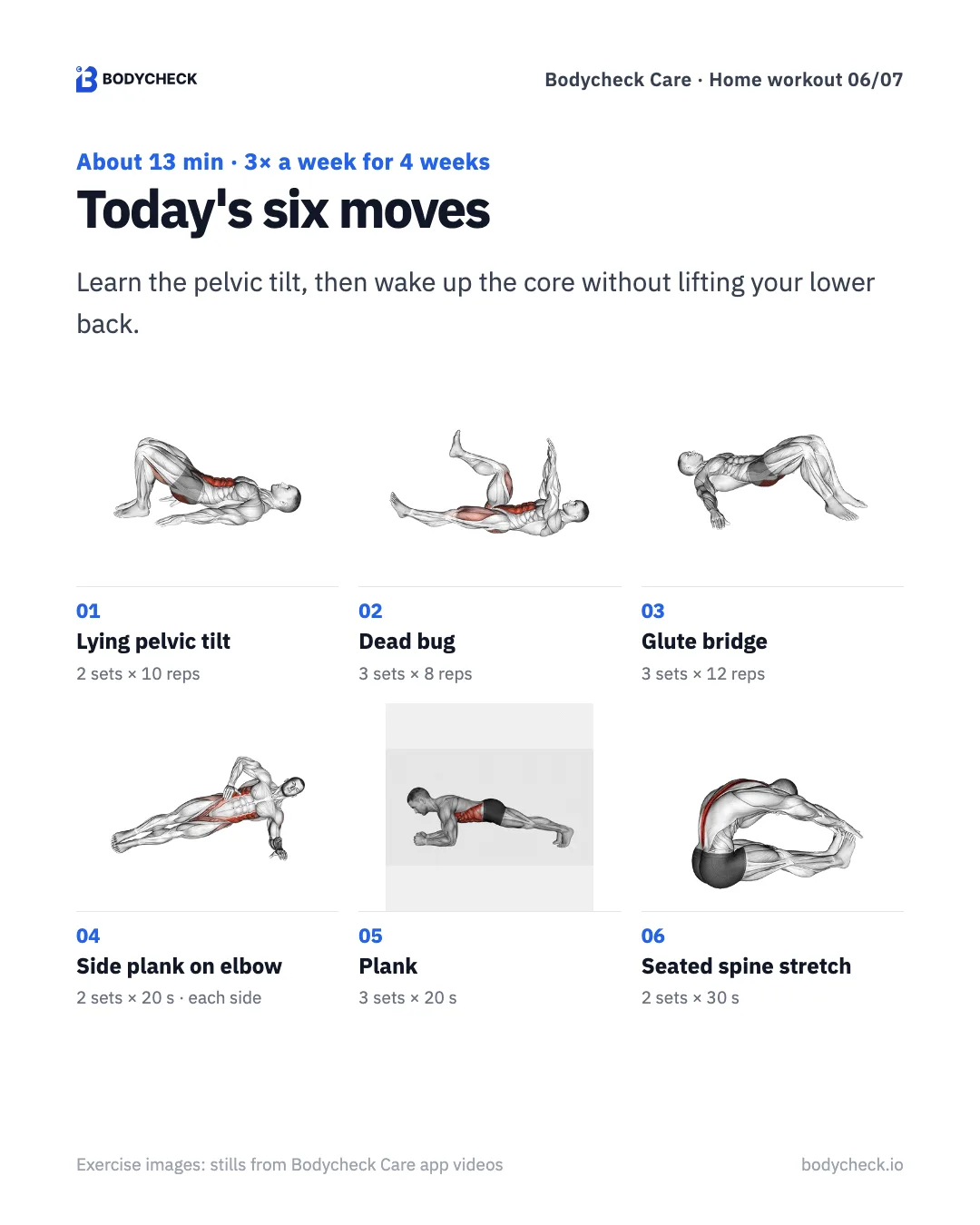
Learn the pelvic tilt first, then wake up your core without lifting your lower back off the floor. One mat is enough. Do it three times a week on alternate days, for four weeks. I usually do mine with the evening news on.
1. Lying pelvic tilt · 2 sets × 10 reps
- Lie on your back with knees bent and feet flat.
- Breathe out, brace your stomach and press your lower back toward the floor.
- Hold for two seconds as your pelvis tucks slightly.
- Breathe in, release, and repeat 10 times.
2. Dead bug · 3 sets × 8 reps
- Lie with arms reaching to the ceiling and hips and knees bent to 90 degrees.
- Keeping your lower back on the floor, slowly reach one arm and the opposite leg out.
- Stop before your back lifts, then return.
- Alternate sides for 8 reps.
3. Glute bridge · 3 sets × 12 reps
- Lie with knees bent and arms by your sides.
- Push through your heels and lift your hips.
- Squeeze your glutes for one second with knees, hips and shoulders in a line. Don't arch your back.
- Lower slowly. Repeat 12 times.
4. Side plank on elbow · 2 sets × 20 s · each side
- Lie on your side with your elbow right under your shoulder.
- Stack your legs straight.
- Lift your hips so your body forms a straight line from head to feet.
- Hold 20 seconds, then switch sides.
5. Plank · 3 sets × 20 s
- Lie face down with elbows under your shoulders.
- Lift onto your toes so your body forms a line from head to heels.
- Brace your stomach and glutes and keep breathing.
- Hold 20 seconds. Drop to your knees if needed.
6. Seated spine stretch · 2 sets × 30 s
- Sit with legs straight and arms reaching forward.
- Sit tall first.
- Breathe out and roll your head and back forward one section at a time.
- Hold 30 seconds, then roll back up slowly.
At a glance
| # | Move | Sets |
|---|---|---|
| 1 | Lying pelvic tilt | 2 × 10 reps |
| 2 | Dead bug | 3 × 8 reps |
| 3 | Glute bridge | 3 × 12 reps |
| 4 | Side plank on elbow | 2 × 20 s · each side |
| 5 | Plank | 3 × 20 s |
| 6 | Seated spine stretch | 2 × 30 s |
The dead bug in particular is hard to follow from text. In Bodycheck Care every move has a video, and the app counts the time and sets for you.
Frequently asked questions
I can't hold a plank for 20 seconds. Drop to your knees. Hold only as long as your hips don't sag, and add five seconds each week.
What if my lower back feels uncomfortable during a move? Stop and shorten the range. For the dead bug, start by moving only your arms or only your legs.
Can I do core work every day? Your trunk muscles need rest days too. Three times a week, on alternate days, works well.
Is the core just your abs? No. It is every muscle that wraps around your trunk: the front, the sides, the back, the breathing muscle (diaphragm) on top and the pelvic floor below.
Can I see whether my hips or shoulders tilt? Bodycheck Care measures hip and shoulder tilt from a front and a side photo and shows them as angles and a score, then picks moves for your result. It is free on iPhone and Android.
Before you start
- Stretch to a gentle pull. Stop right away if anything hurts or tingles.
- Don't hold your breath. Breathe out as you push.
- In the first week it's fine to drop one set from each move.
- This is exercise guidance. If you have numbness or pain in your back or legs, see a doctor before you exercise.
How about just 10 pelvic tilts today? Getting out of the chair and onto the mat is the hardest step.
Bodycheck Care · Free
Take two photos and get moves picked for you
Take a front and a side photo to see how far your head and shoulders sit forward as a score, then follow moves picked for your result, each with a video.
References
- Yang L, Cao C, Kantor ED, et al. Trends in sedentary behavior among the US population, 2001–2016. JAMA, 2019;321(16):1587-1597.
- Photos: Pexels (free license). Exercise images and app screens: Bodycheck Care app.