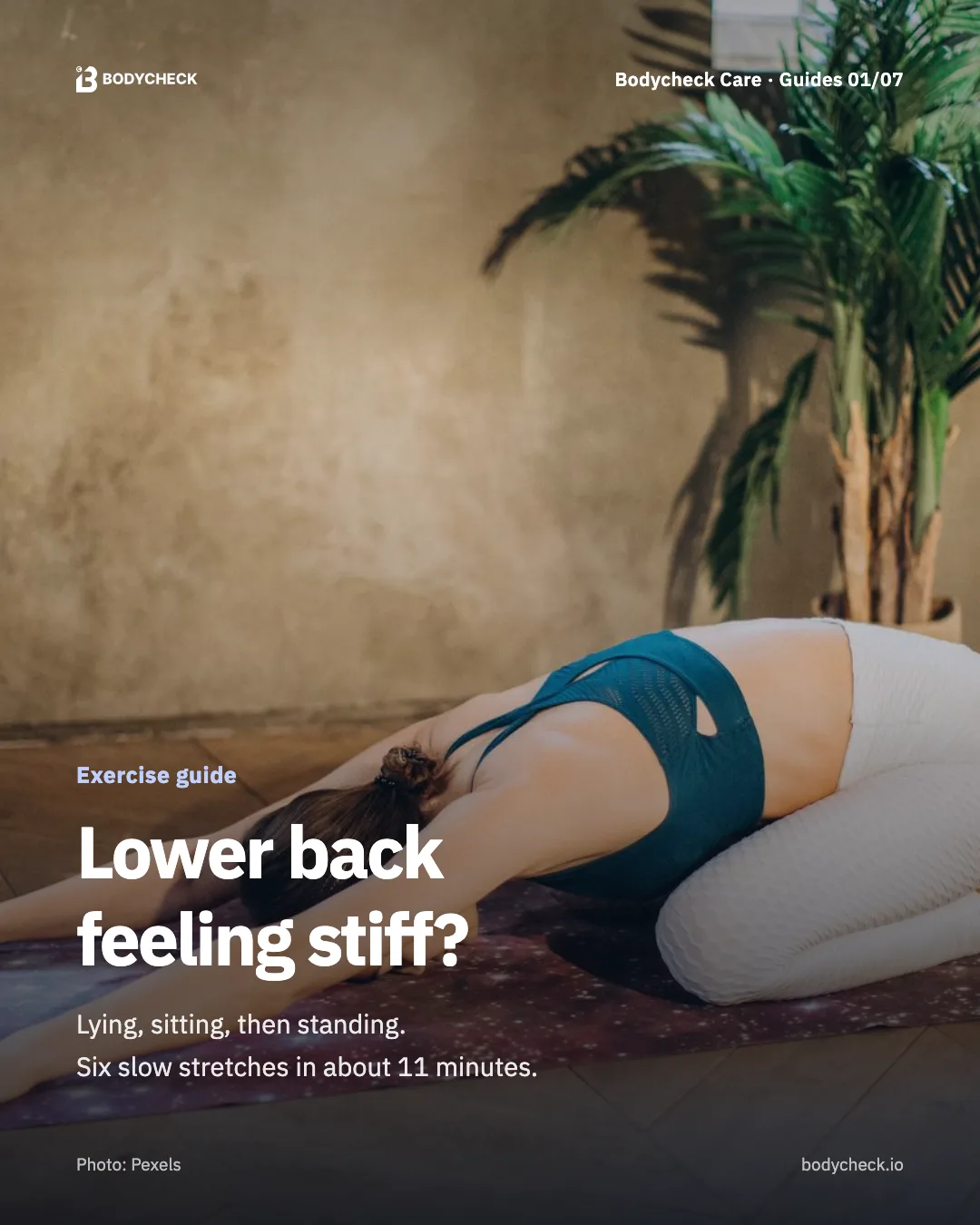
Lower Back Stretches for a Stiff Back: 6 Gentle Moves in 11 Minutes
Six slow lower back stretches you do with your breath: lying, sitting, then standing. How long to hold, how far to go, and when to see a doctor before you stretch.
Short answer: On a stiff-back day, go slow, only to a gentle pull, and breathe out as you ease in. Hold each position 10 to 30 seconds and repeat once or twice. Do the six stretches below lying, then sitting, then standing, for about 11 minutes. If you have pain down a leg or numbness, see a doctor before you stretch.
Hi, I'm an editor on the Bodycheck Care team. Over a holiday weekend I sat in traffic for almost five hours on the way to see family. At the rest stop I opened the car door to stand up, and my back wouldn't straighten in one go. I stood there holding the door for a moment and thought, okay, tonight I need to loosen up.
That night, lying on the bed, I put together the six stretches in this post. I left out anything that means holding for ages or pushing hard. Instead, I'll cover how long to hold, how far to go, and how to breathe.
How long should you hold a stretch?
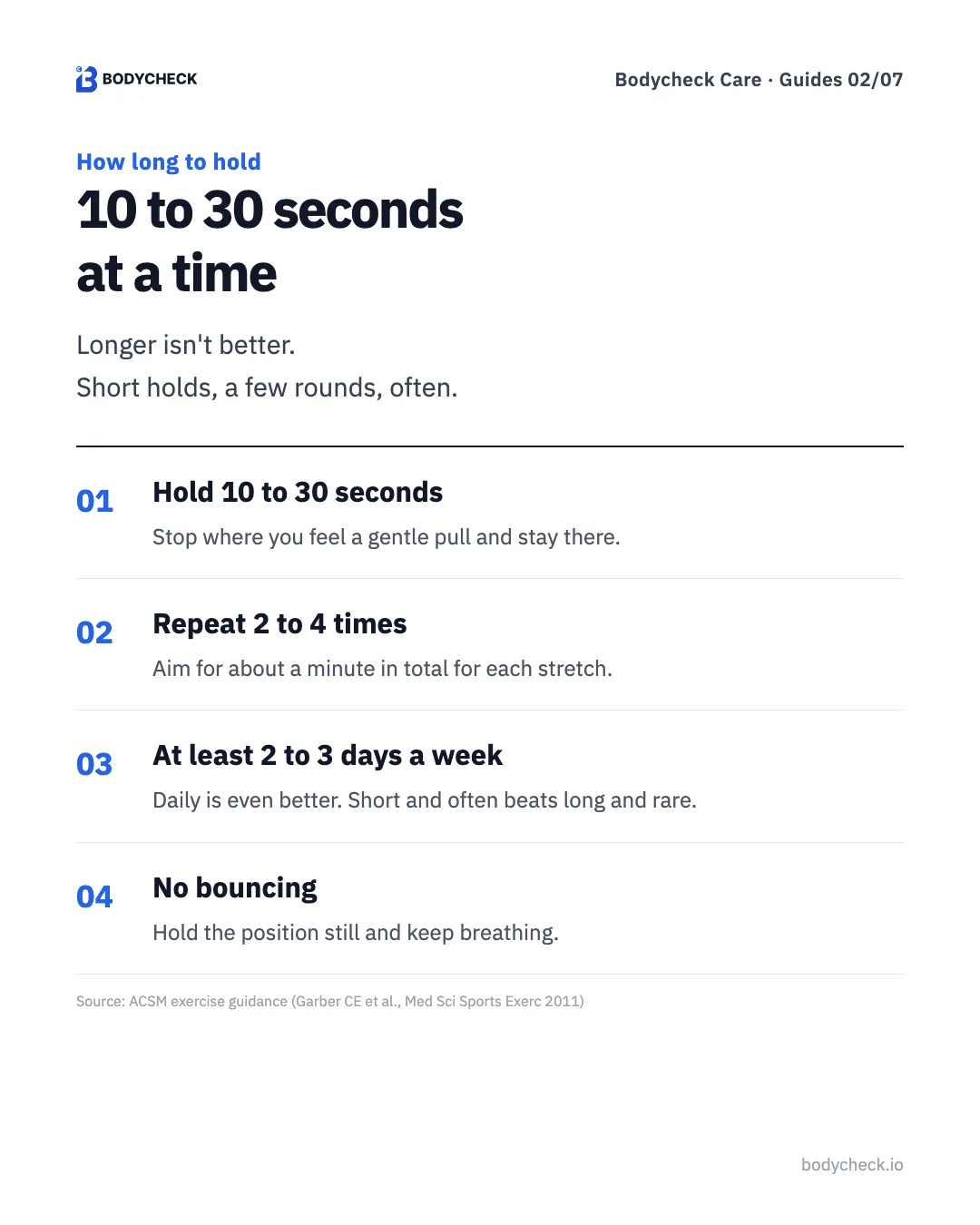
I used to think longer was always better. The American College of Sports Medicine (ACSM) guidance is shorter than I expected: hold at the point of a gentle pull for 10 to 30 seconds and repeat 2 to 4 times, for about a minute per stretch. Do it at least 2 to 3 days a week. Daily is even better.
So most holds in this routine are 20 to 30 seconds, twice. One more thing: no bouncing. If you bounce into a stretch, your body may tense up to protect itself. Hold still and just breathe.
How far should you go, and how should you breathe?
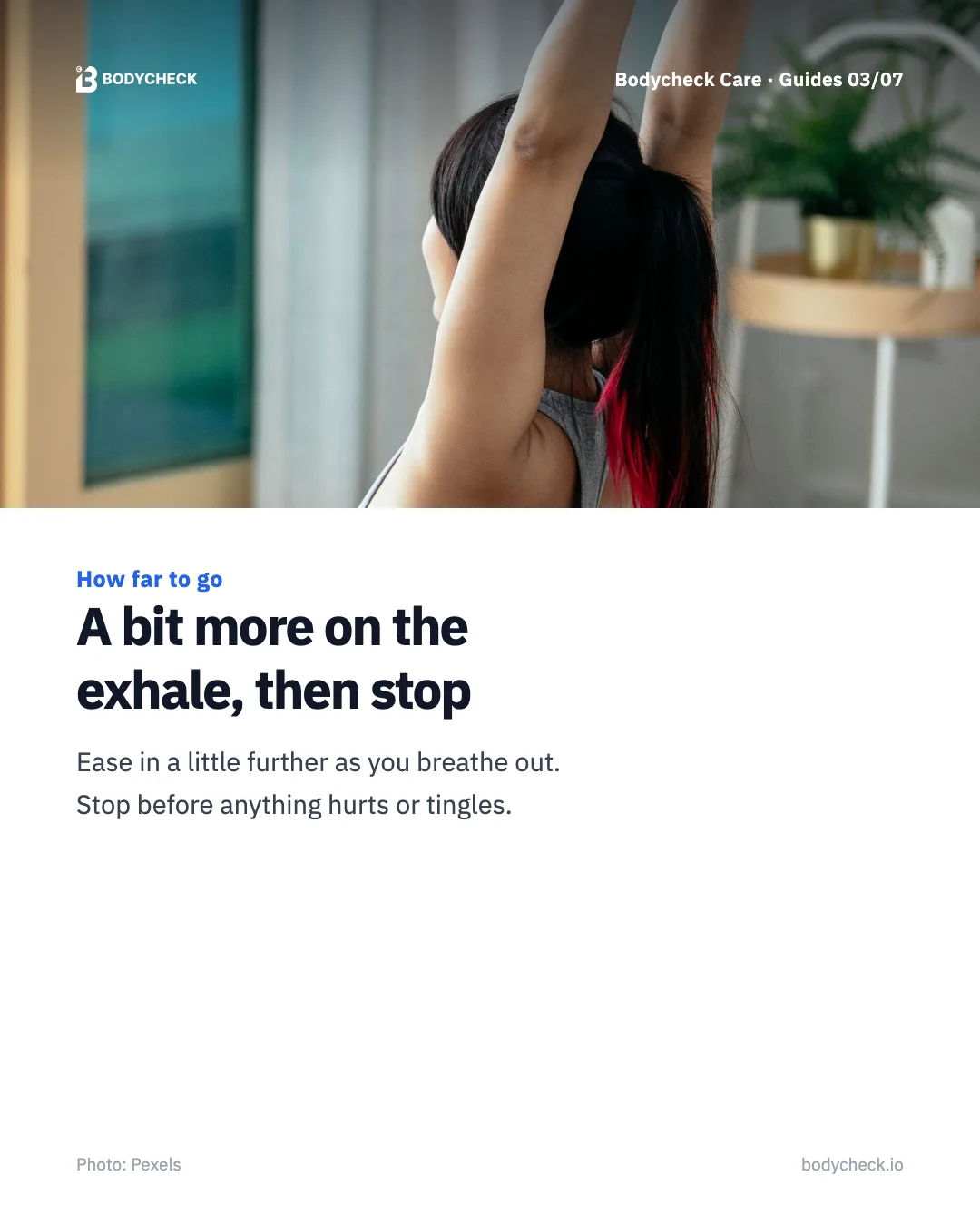
My rule is simple: go to a gentle pull and stop before it hurts. On a 0 to 10 scale, think 3 or 4, a pull you can still breathe easily through. A sharp, zinging or tingling feeling means you've gone too far.
Here's how I use my breath.
- As you set up, breathe in slowly through your nose.
- Breathe out long through your mouth and ease in just a little further.
- While you hold, keep breathing evenly. Don't hold your breath.
- On the way out, come back slowly, as slowly as you went in.
Make each exhale a little longer than the inhale. You'll likely feel your shoulders and stomach soften with it.
Why not just stretch your back?
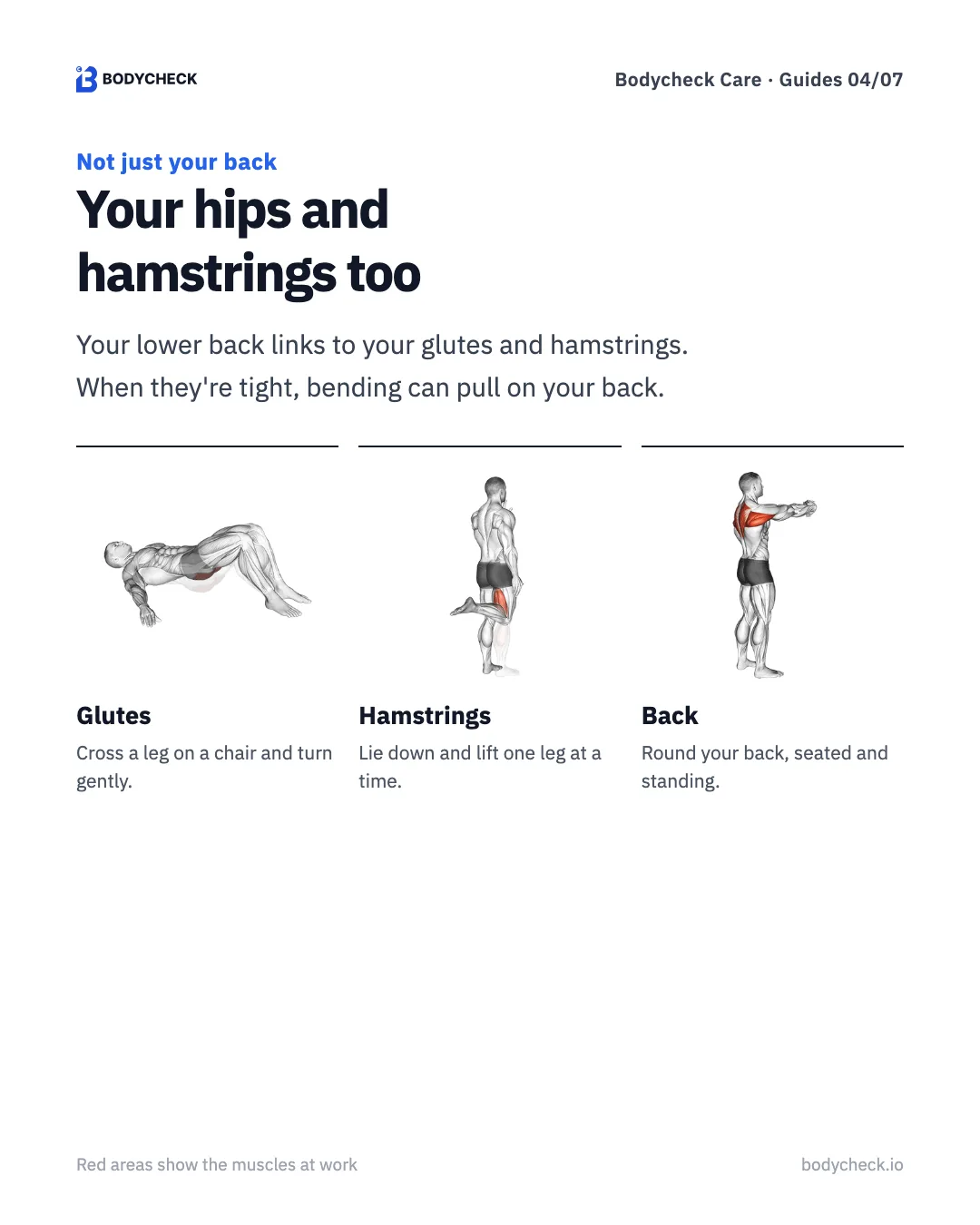
Your lower back doesn't move on its own. It links through the pelvis to your glutes and hamstrings, so when those are tight, bending forward can pull on your back too.
That's why this routine mixes moves for the back itself (rolling bridge, sphinx, seated spine stretch) with the hamstrings (lying hamstring stretch) and the glutes (seated figure-4). You finish standing, rounding your upper back.
This post sticks to stretching. For moves that build trunk strength, see my 13-minute core routine for the lower back.
When should you see a doctor before stretching?
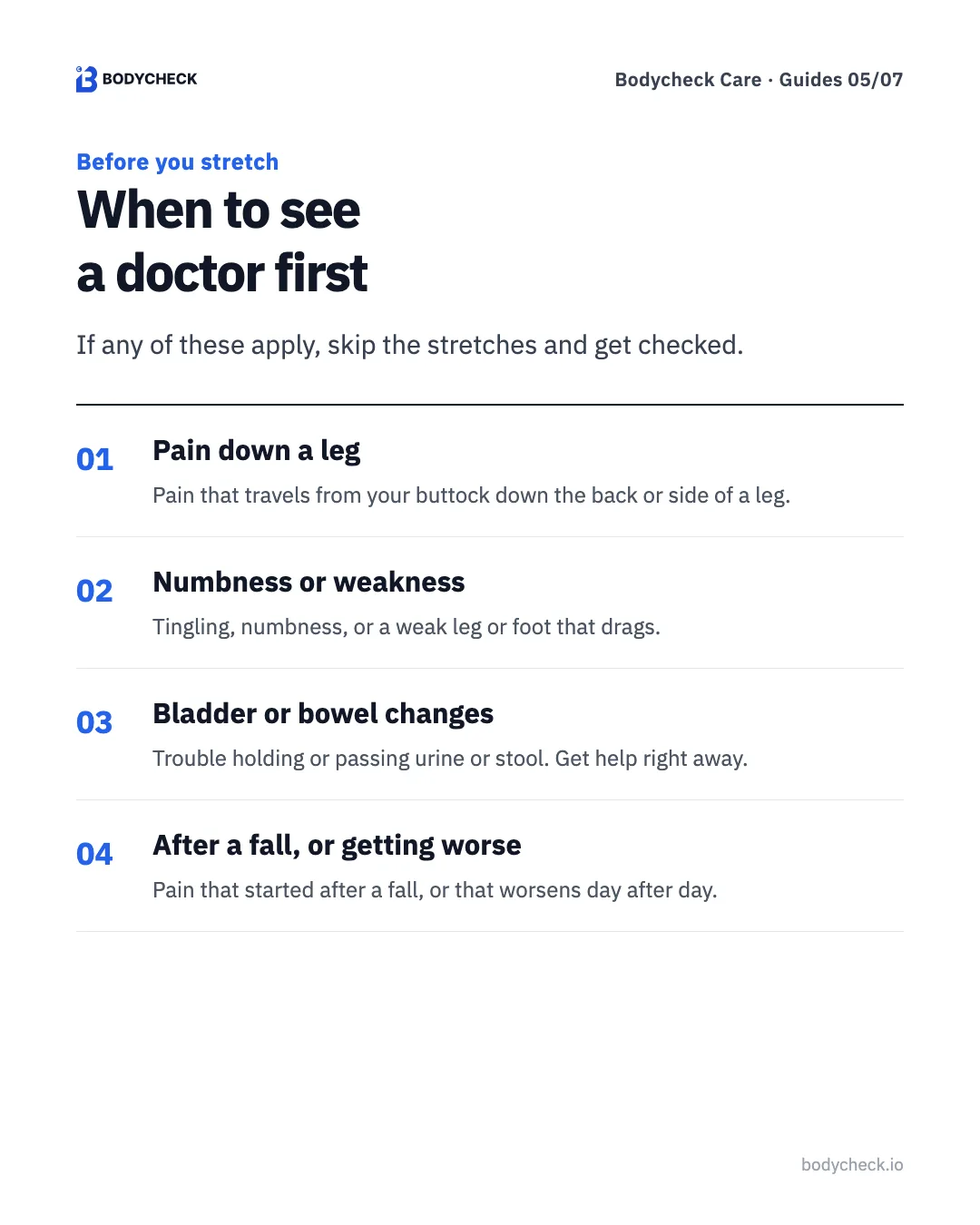
Back stiffness has many possible causes, and stretching won't cover all of them. If any of these apply, skip today's routine and talk to a doctor first.
- Pain down a leg. Pain that travels from your buttock down your leg.
- Numbness or weakness. Tingling, numbness or reduced feeling in a leg or foot, or a weak foot that drags.
- Bladder or bowel changes. Trouble holding or passing urine or stool. Get help right away.
- After a fall. Back pain that started after a fall or a knock.
- Pain that keeps getting worse. Pain that doesn't ease with rest or gets worse day after day.
How can you see your pelvic tilt as numbers?
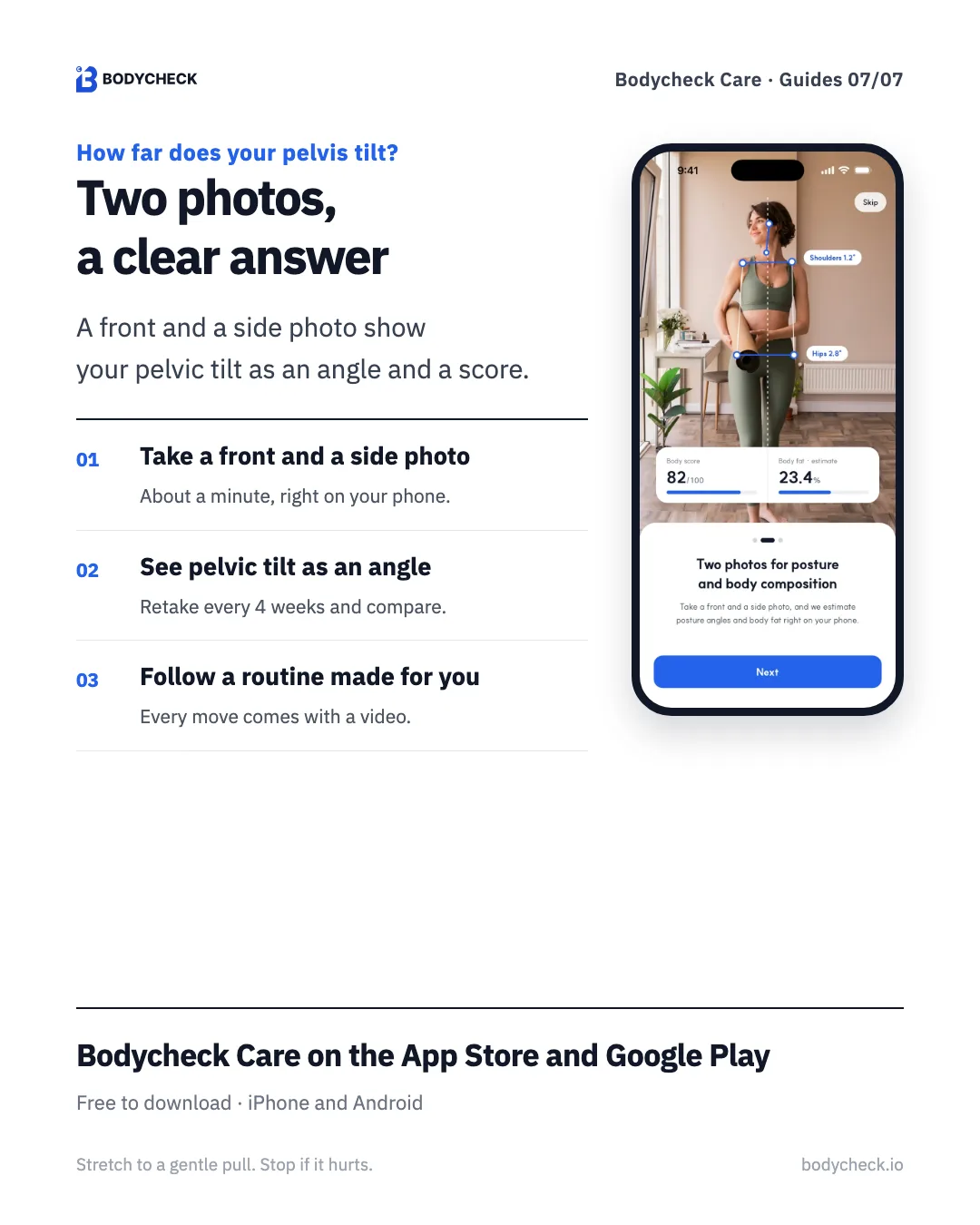
If your back often feels stiff, it's worth seeing how your pelvis tilts when you stand. In Bodycheck Care you take a front and a side photo, and the app shows pelvic tilt and left-right balance as angles and a score.
- Get the app and take a front and a side full-body photo.
- See your pelvic tilt as an angle.
- Follow the moves picked for your result, each with a video.
- Retake the photos after four weeks and compare.
Bodycheck Care · Free
See your pelvic tilt from two photos
Take a front and a side photo to see how far your head and shoulders sit forward as a score, then follow moves picked for your result, each with a video.
The 11-minute gentle stretch routine
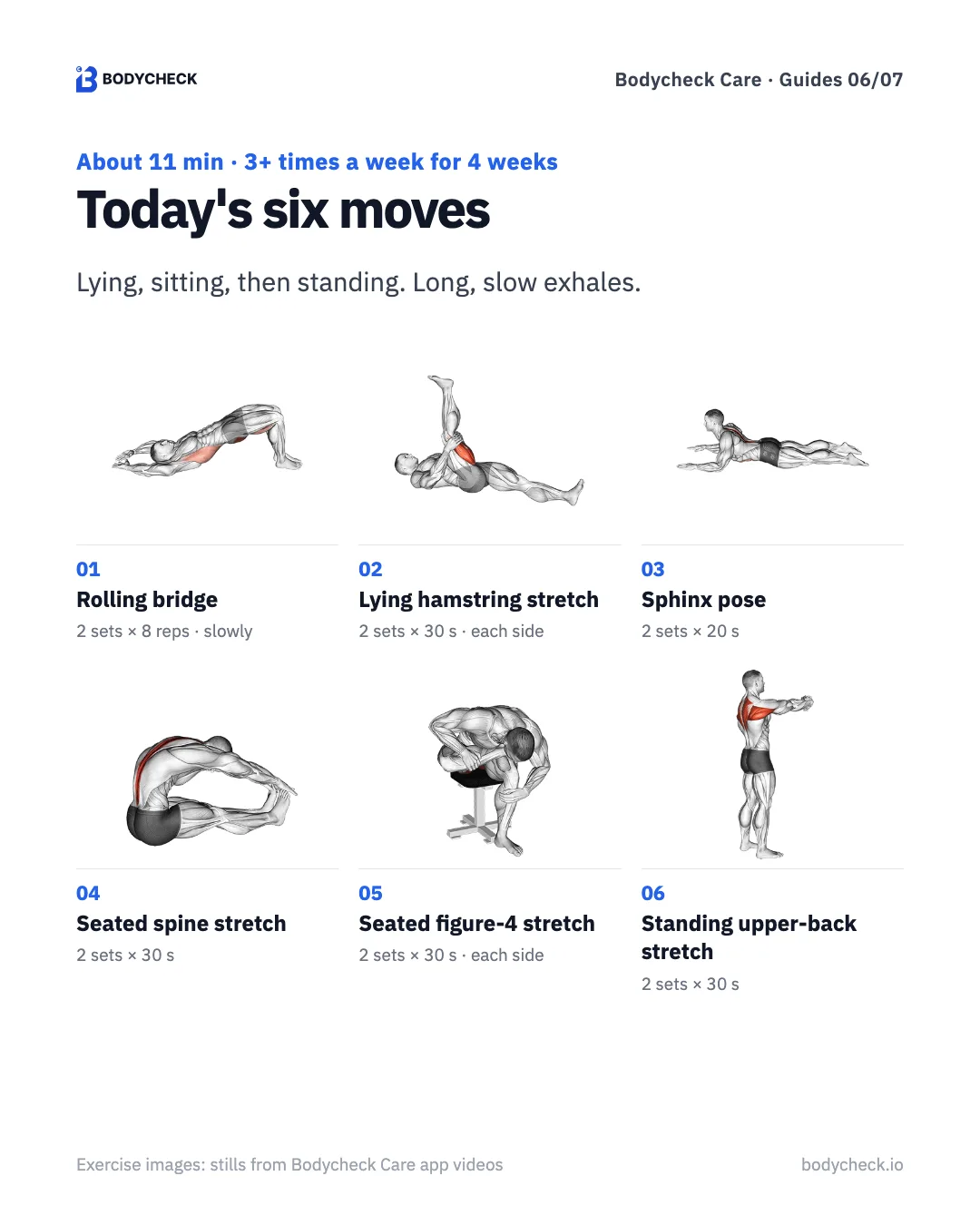
All you need is a mat and a chair. Go three lying, two sitting, one standing, and take a breath or two between moves. Do it at least three times a week for four weeks. I like to do mine right after a shower, while I'm still warm.
1. Rolling bridge · 2 sets × 8 reps · slowly
- Lie with knees bent and arms by your sides.
- Breathe out, tuck your pelvis slightly and press your lower back to the floor.
- Lift from the tailbone up, one section at a time, into a bridge. No need to go high.
- Roll back down from the top of your back. 8 reps.
2. Lying hamstring stretch · 2 sets × 30 s · each side
- Lie on your back and lift one leg toward the ceiling.
- Hold the back of your thigh or calf with both hands.
- Straighten the knee only as far as it goes, breathe out and gently pull the leg toward you.
- Hold 30 seconds, then switch sides.
3. Sphinx pose · 2 sets × 20 s
- Lie face down with elbows right under your shoulders.
- Lightly brace your stomach and lift your chest off the floor. Lift your chest, not your lower back.
- Keep your neck long and look at the floor a little ahead.
- Hold 20 seconds, then lower slowly. If your lower back feels pinched, skip this one.
4. Seated spine stretch · 2 sets × 30 s
- Sit with legs straight and arms reaching forward.
- Sit tall first.
- Breathe out and roll your head and back forward one section at a time.
- Hold 30 seconds, then roll back up slowly.
5. Seated figure-4 stretch · 2 sets × 30 s · each side
- Sit on a chair and rest one ankle on the opposite knee.
- Keep your back long and lean your chest forward.
- Turn your upper body slightly toward the raised leg to stretch deep in the hip.
- Hold 30 seconds, then switch sides.
6. Standing upper-back stretch · 2 sets × 30 s
- Stand tall with feet shoulder-width apart.
- Clasp your hands and reach forward at shoulder height.
- Push your hands away and round your upper back so your shoulder blades spread.
- Breathe out slowly and hold 30 seconds.
At a glance
| # | Move | Sets |
|---|---|---|
| 1 | Rolling bridge | 2 × 8 reps · slowly |
| 2 | Lying hamstring stretch | 2 × 30 s · each side |
| 3 | Sphinx pose | 2 × 20 s |
| 4 | Seated spine stretch | 2 × 30 s |
| 5 | Seated figure-4 stretch | 2 × 30 s · each side |
| 6 | Standing upper-back stretch | 2 × 30 s |
Rolling down "one section at a time" in move 1 is hard to picture from text. In Bodycheck Care every move has a video, and the app counts your holds for you.
Frequently asked questions
How long should I hold each stretch? 10 to 30 seconds is enough. The American College of Sports Medicine suggests holding at the point of a gentle pull for 10 to 30 seconds and repeating 2 to 4 times, for about a minute per stretch.
What if my back hurts during a stretch? Stop and shorten the range. If it still feels wrong, skip that move. If you get pain down a leg or numbness, stop exercising and see a doctor.
Can I stretch every day? Yes. The guidance is at least 2 to 3 days a week, and daily is even better. On heavy days, just do fewer sets.
How should I breathe? Breathe in through your nose as you set up. Breathe out slowly through your mouth and ease in a little further. Keep breathing while you hold.
Can I see how far my pelvis tilts? Bodycheck Care measures pelvic tilt and left-right balance from a front and a side photo and shows them as angles and a score, then picks moves for your result. It is free on iPhone and Android.
Before you start
- Stretch to a gentle pull. Stop right away if anything hurts or tingles.
- Don't bounce, and don't hold your breath.
- In the first week it's fine to hold for just 10 to 20 seconds.
- This is exercise guidance. If you have pain down a leg, numbness or weakness, bladder or bowel changes, pain after a fall, or pain that keeps getting worse, see a doctor before you exercise.
Today, try just moves 1 to 3, lying down. A few long exhales on the bed is a fine place to start.
Bodycheck Care · Free
Take two photos and get moves picked for you
Take a front and a side photo to see how far your head and shoulders sit forward as a score, then follow moves picked for your result, each with a video.
References
- Garber CE, Blissmer B, Deschenes MR, et al. American College of Sports Medicine position stand. Quantity and quality of exercise for developing and maintaining cardiorespiratory, musculoskeletal, and neuromotor fitness in apparently healthy adults. Medicine & Science in Sports & Exercise, 2011;43(7):1334-1359.
- Photos: Pexels (free license). Exercise images and app screens: Bodycheck Care app.