Lower Back Stiff From Sitting All Day? Desk Breaks and a 10-Minute Routine
Long sitting switches off your glutes and keeps your hips folded for hours. Here's what changes while you sit, how to break it up every 50 minutes, a simple desk setup, and six moves you can do beside your chair.
Short answer: When you sit for a long time, your glutes rest, your hips stay folded and your lower back holds one shape. After a few hours, that can be connected to the stiffness you feel when you stand up. So start by breaking up your sitting about every 50 minutes and moving for two minutes. Once a day, do the six moves below beside your chair, about 10 minutes in all.
Hi, I'm an editor on the Bodycheck Care team. Not long ago I had video calls stacked back to back all afternoon. I sat up nice and straight for the camera the whole time. When the last call ended and I went to stand, my back wouldn't straighten right away. I had to lean on the edge of my desk for a second.
My posture wasn't bad. The problem was simpler: I'd stayed in one position for too long. So today: what happens in your body while you sit, how to break it up, and a 10-minute routine you can do right beside your chair.
What happens in your body while you sit?
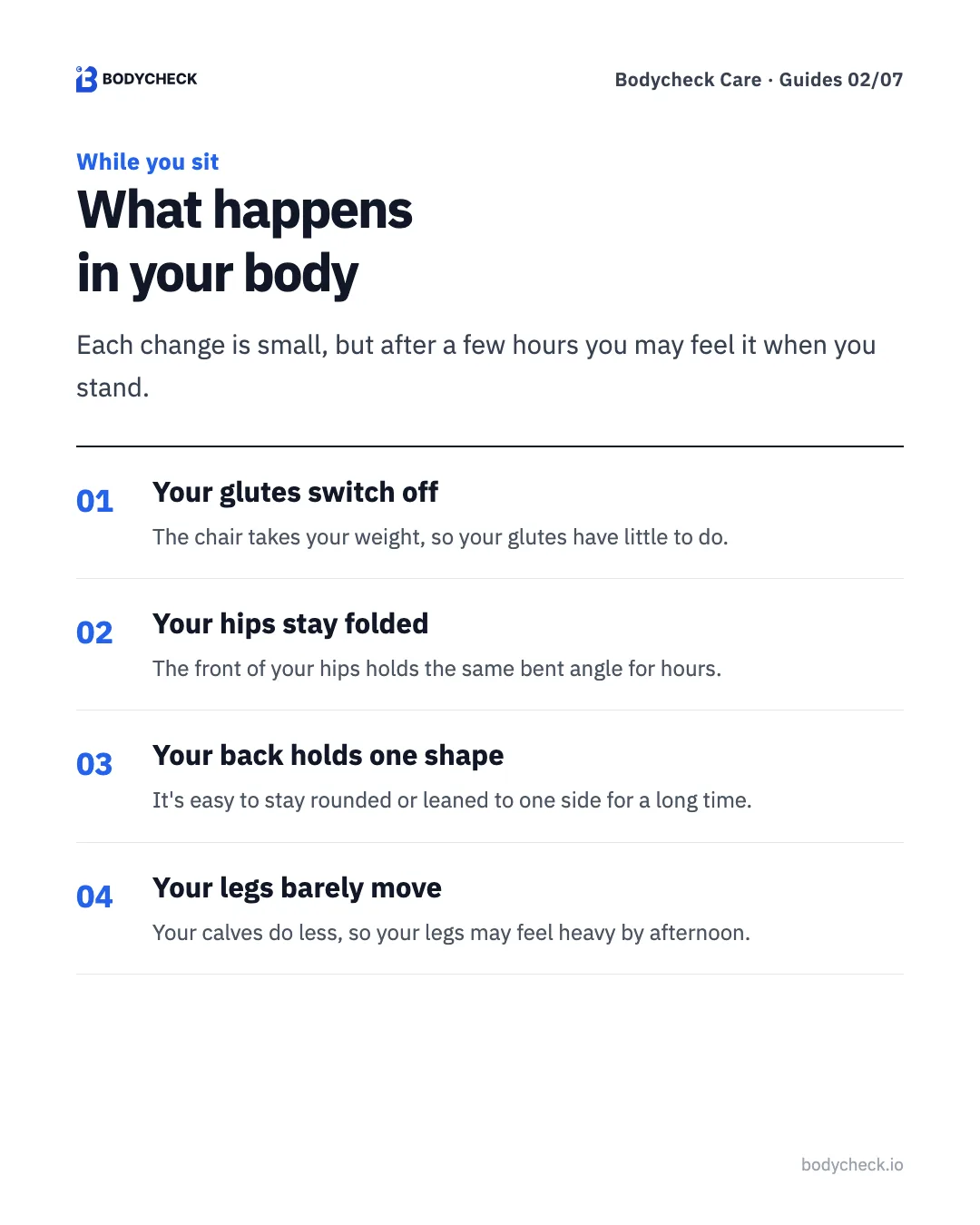
A study in JAMA found that US adults sat about 6.4 hours a day in 2015–2016, up from about 5.5 hours in 2007. Over those hours, a few things happen.
- Your glutes switch off. The chair takes your weight, so your glutes have little to do.
- Your hips stay folded. The front of your hips holds the same bent angle for hours.
- Your back holds one shape. It's easy to stay rounded, or leaned on one armrest, for a long time.
- Your legs barely move. Your calves do less, so your legs may feel heavy by afternoon.
Each change is small. But after a few hours, they can be connected to a lower back that feels stiff or achy when you stand. That's why changing position often is more realistic than trying to hold one perfect posture all day.
What should you do when you stand up every 50 minutes?
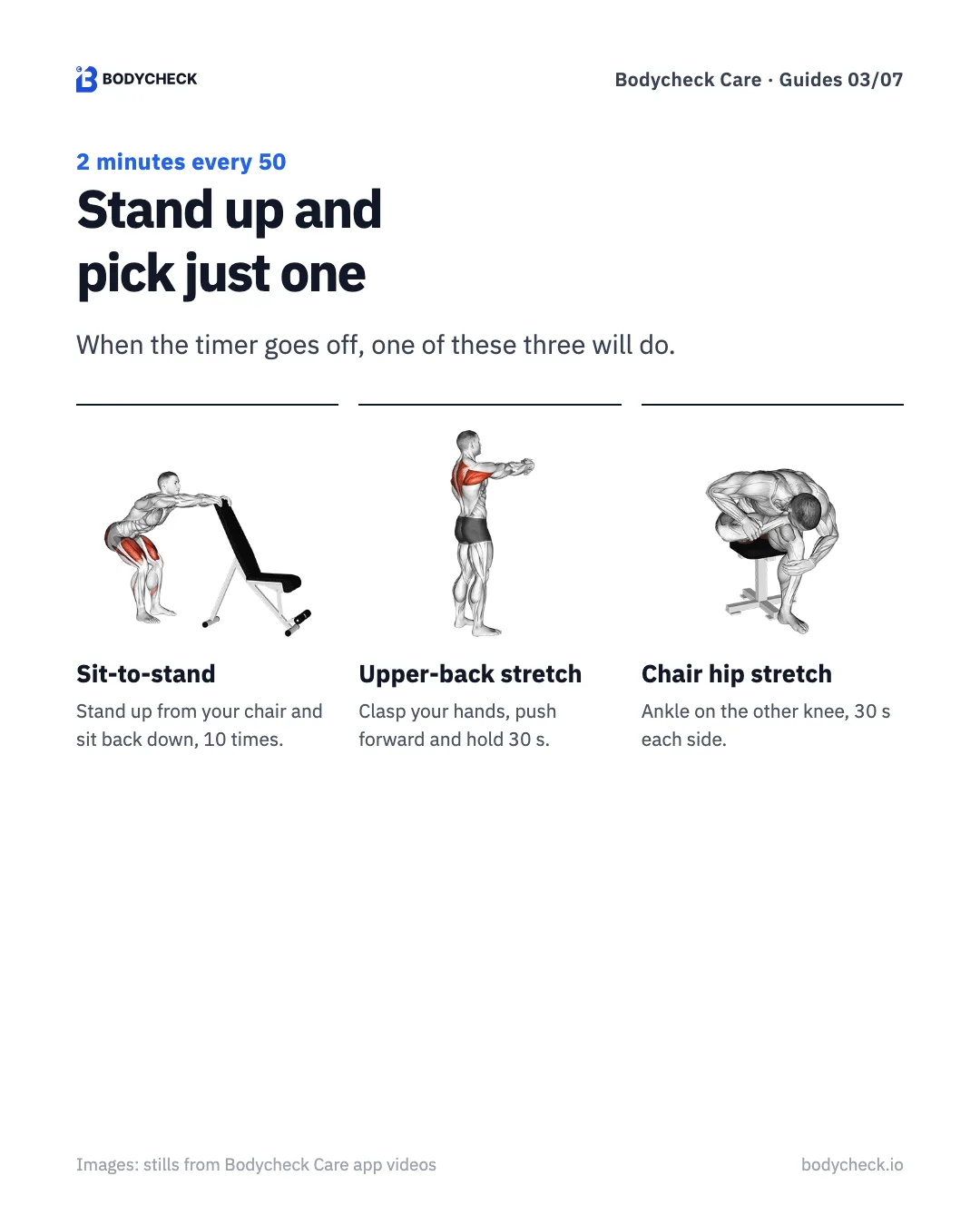
I set a 50-minute timer on my phone. For the first few days I just kept dismissing it. Once I changed the rule to "do just one thing," it got much easier. When the timer goes off, I pick one of these three.
- Sit-to-stand. Stand up from your chair and sit back down, 10 times. Your folded hips open up and your glutes get back to work.
- Upper-back stretch. Clasp your hands, push them forward and hold 30 seconds. It eases the upper body that's been leaning toward the screen.
- Chair hip stretch. Still seated, rest one ankle on the other knee and hold 30 seconds each side. You don't even have to get up.
If two minutes feels like too much, walking to refill your water still breaks up the sitting. What matters most isn't which move you do. It's how often you stop and stand.
How should you set up your desk?
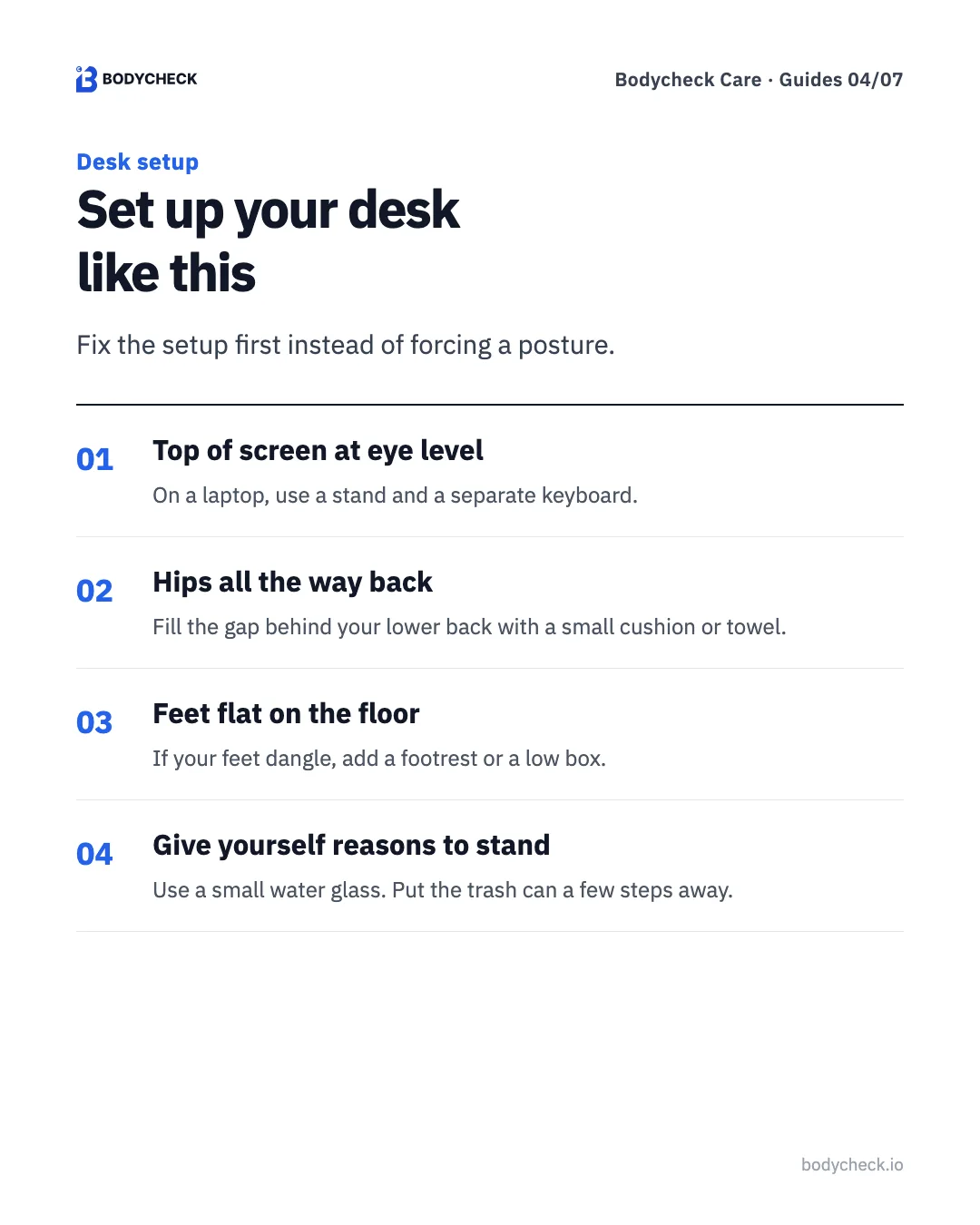
Fixing your setup lasts longer than forcing a posture. I changed these four things at once.
- Top of the screen at eye level. On a laptop, use a stand and a separate keyboard so you look down less.
- Hips all the way back. Sit deep in the chair and fill the gap behind your lower back with a small cushion or a folded towel.
- Feet flat on the floor. If your feet dangle, add a footrest or a low box. Knees about level with your hips feels comfortable.
- Give yourself reasons to stand. Use a small water glass, put the trash can a few steps away and take phone calls standing up.
If you also want to put your trunk muscles to work, I covered that in the 13-minute core routine for your lower back. This post is about breaking up sitting. That one is about adding strength.
When should you see a doctor before exercising?

If your back feels stiff for a moment when you stand and loosens up once you move, looking at your daily habits is a reasonable first step. But in cases like these, don't try to work it out with exercise on your own. See a doctor first.
- Pain that spreads into your buttock or down your leg.
- Numbness, tingling or reduced feeling in your leg or foot.
- Weakness in your leg.
- Pain that doesn't ease with rest or keeps getting worse.
- Pain that started after a fall or a knock.
Back pain has many possible causes, and they differ from person to person. Long sitting may be part of it, or something else may be going on. A doctor is the right person to check.
How can you see how sitting shows in your posture?
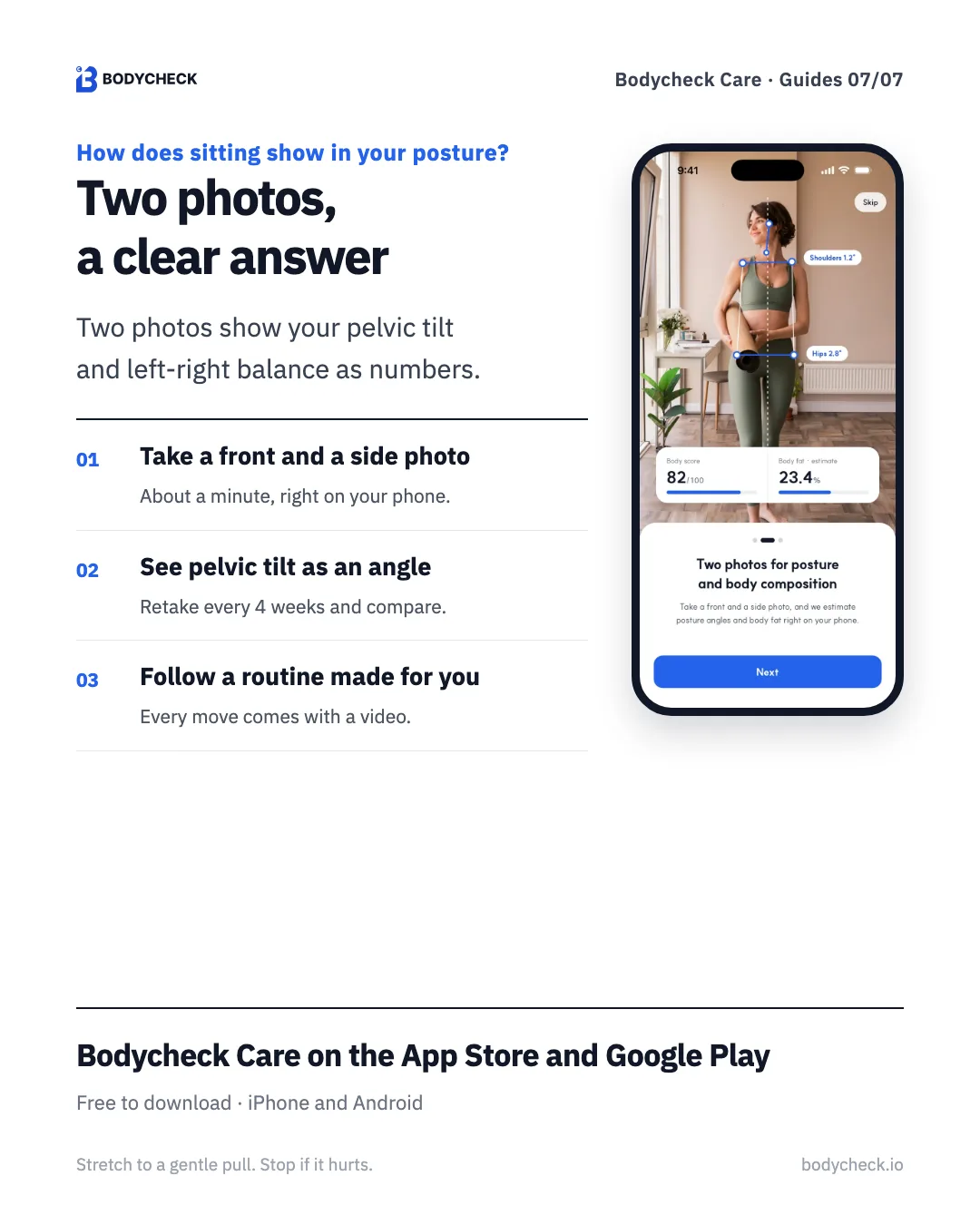
If you sit a lot, it's worth seeing how far your pelvis tilts forward or back and how balanced you are side to side. In Bodycheck Care you take a front and a side photo, and the app shows pelvic tilt and left-right balance as angles and a score.
- Get the app and take a front and a side full-body photo.
- See your pelvic tilt and left-right balance as angles and a score.
- Follow the moves picked for your result, each with a video.
- Retake the photos after four weeks and compare.
Bodycheck Care · Free
See your pelvic tilt from two photos
Take a front and a side photo to see how far your head and shoulders sit forward as a score, then follow moves picked for your result, each with a video.
The 10-minute routine beside your chair
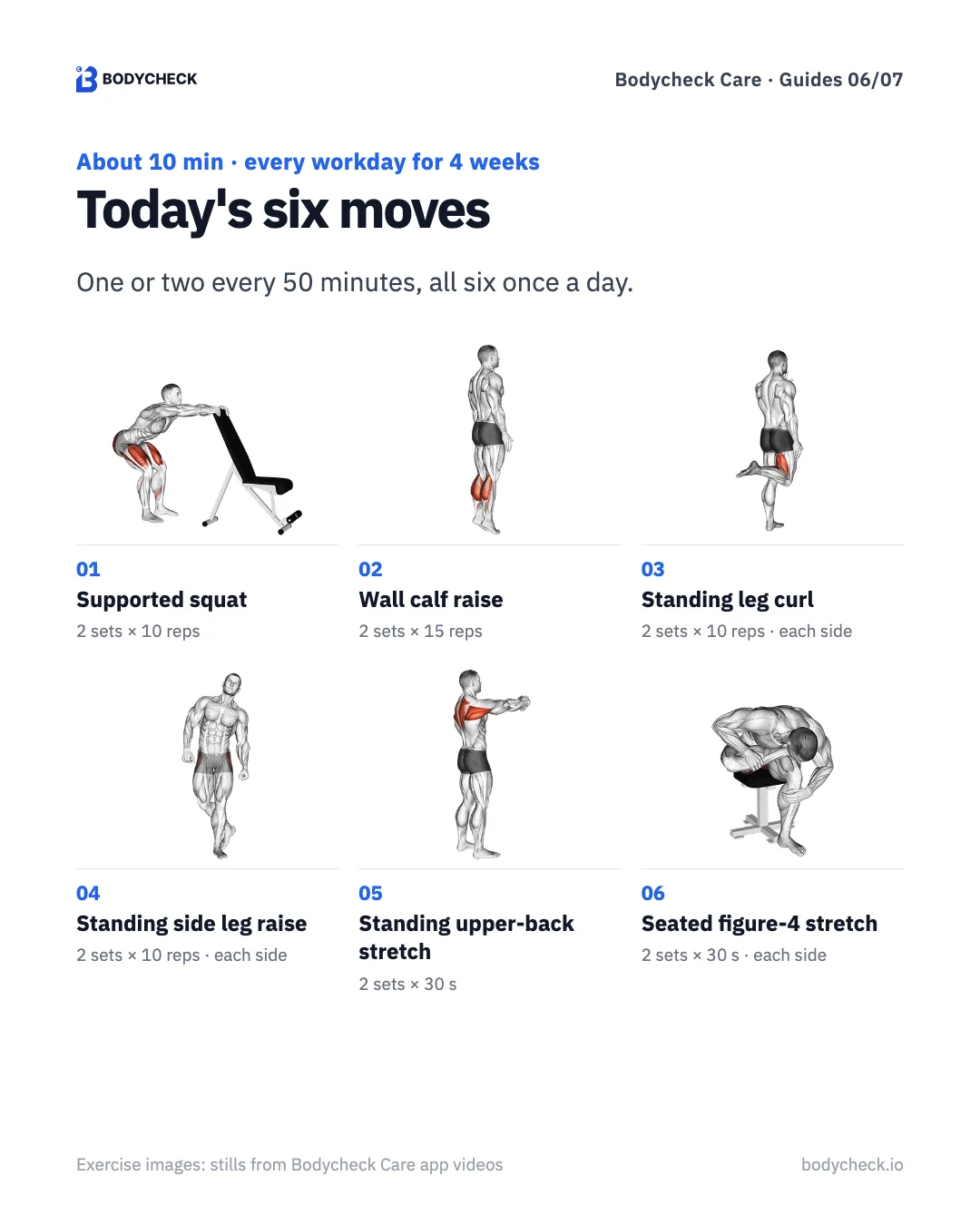
No mat needed, just a chair and a wall. Pick a sturdy chair without wheels. Do one or two moves every 50 minutes, and all six once a day (about 10 minutes). Try it every workday for four weeks. I usually do the full set when I get back to my desk after lunch.
1. Supported squat · 2 sets × 10 reps
- Hold a chair back or a wall with feet shoulder-width apart.
- Push your hips back as if sitting into a chair.
- Keep your knees tracking over your toes and your chest up.
- Press through your heels to stand. 10 reps.
2. Wall calf raise · 2 sets × 15 reps
- Put your hands on a wall with feet shoulder-width apart.
- Shift your weight to the balls of your feet and lift your heels.
- Pause for one second at the top.
- Lower slowly. Repeat 15 times.
3. Standing leg curl · 2 sets × 10 reps · each side
- Hold a chair and stand tall.
- Bend one knee to bring your heel toward your glutes.
- Keep your thigh still and move only your lower leg.
- Lower slowly. After 10 reps, switch sides.
4. Standing side leg raise · 2 sets × 10 reps · each side
- Stand tall and hold a wall or chair with one hand.
- Without leaning your trunk, lift one straight leg out to the side.
- Lift only until you feel your outer hip tighten, then lower slowly.
- After 10 reps, switch sides.
5. Standing upper-back stretch · 2 sets × 30 s
- Stand tall with feet shoulder-width apart.
- Clasp your hands and reach forward at shoulder height.
- Push your hands away and round your upper back so your shoulder blades spread.
- Breathe out slowly and hold 30 seconds.
6. Seated figure-4 stretch · 2 sets × 30 s · each side
- Sit in a chair and rest one ankle on the opposite knee.
- Keep your back long and lean your chest forward.
- Turn your upper body slightly toward the raised leg to stretch deep in your hip.
- Hold 30 seconds, then switch sides.
At a glance
| # | Move | Sets |
|---|---|---|
| 1 | Supported squat | 2 × 10 reps |
| 2 | Wall calf raise | 2 × 15 reps |
| 3 | Standing leg curl | 2 × 10 reps · each side |
| 4 | Standing side leg raise | 2 × 10 reps · each side |
| 5 | Standing upper-back stretch | 2 × 30 s |
| 6 | Seated figure-4 stretch | 2 × 30 s · each side |
Move 6 in particular is hard to follow from text. In Bodycheck Care every move has a video, and the app counts the time and sets for you.
Frequently asked questions
Do I really have to stand up every 50 minutes? The exact number matters less than breaking up long stretches of sitting. Fifty minutes is just easy to remember. If you're in a meeting, stand up as soon as it ends.
I have a standing desk. Should I just stand all day? Standing for hours is also holding one position. Switch between sitting and standing, and walk a few steps in between.
My lower back feels stiff. Is it OK to exercise? If it's mild stiffness, move slowly within a comfortable range. If you have pain down the leg, numbness, weakness, or pain that keeps getting worse, see a doctor before you exercise.
I feel awkward doing this at the office. Start with moves that don't draw attention, like the seated hip stretch at your desk or calf raises while you refill your water.
Can I see whether my pelvis tilts forward or back? Bodycheck Care measures front-to-back pelvic tilt and left-right balance from a front and a side photo, shows them as angles and a score, then picks moves for your result. It is free on iPhone and Android.
Before you start
- Stretch to a gentle pull. Stop right away if anything hurts or tingles.
- Chairs with wheels can roll. Use a chair that stays put for holding and sitting.
- Don't hold your breath. Breathe out as you push.
- This is exercise guidance. If you have pain down the leg, numbness, weakness, or pain that doesn't ease with rest and keeps getting worse, see a doctor before you exercise.
You've made it to the end of this post, so how about standing up right now? Ten sit-to-stands take less than a minute.
Bodycheck Care · Free
Take two photos and get moves picked for you
Take a front and a side photo to see how far your head and shoulders sit forward as a score, then follow moves picked for your result, each with a video.
References
- Yang L, Cao C, Kantor ED, et al. Trends in sedentary behavior among the US population, 2001–2016. JAMA, 2019;321(16):1587-1597.
- Photos: Pexels (free license). Exercise images and app screens: Bodycheck Care app.