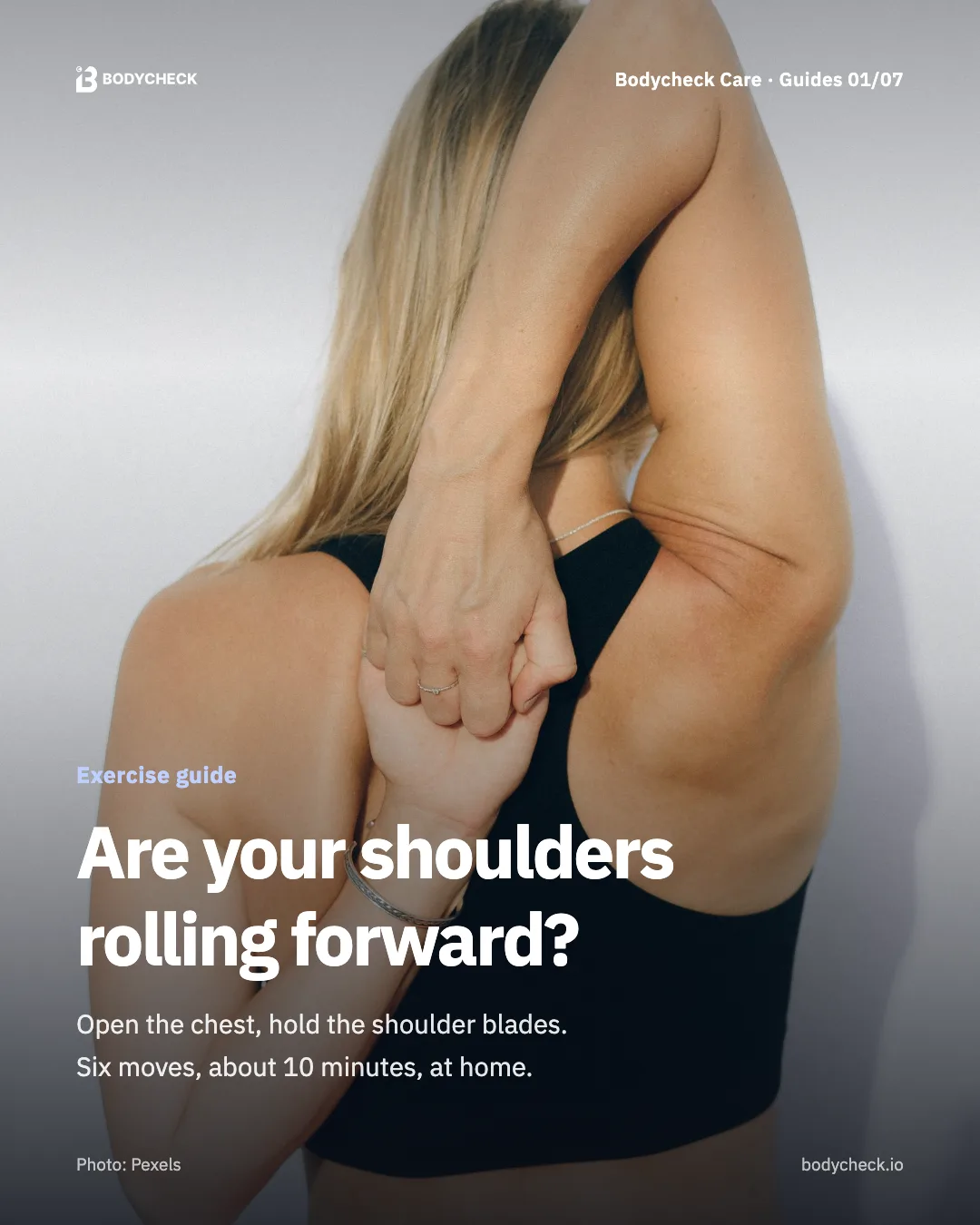
Rounded Shoulders Beyond the Workout: 5 Daily Habits and a 4-Week Plan
Your shoulder routine takes ten minutes. The rest of the day decides the rest. Here are five habits that keep shoulders rolled forward (phone grip, laptop on the lap, bag straps, side sleeping, crossed arms), what to change in each, a week-by-week plan and how to track it.
Short answer: A shoulder routine takes about ten minutes. Your shoulders spend far longer than that drifting forward. Phone grip, a laptop on your lap, one bag strap, sleeping with a shoulder tucked in, crossed arms. Change one of these five a week, and do six moves for the chest, shoulder blades, core and hips three times a week for four weeks. Take a side photo at the start and again at week four to compare.

Hi, I'm an editor on the Bodycheck Care team. Last weekend I woke up curled on my left side, hugging my pillow. My bottom shoulder was tucked in front of my chest and my top arm had flopped forward. I do shoulder stretches most evenings, and I had still spent the whole night like that.
Once I started looking, the same shape kept showing up all day. Laptop on my lap on the couch. Bag on one shoulder. Arms crossed on the train. So this post is less about exercise and more about the hours outside it. If you want the background on why shoulders roll and what happens in the chest and shoulder blades, start with the 10-minute rounded shoulders routine.
Where are your shoulders after the workout?
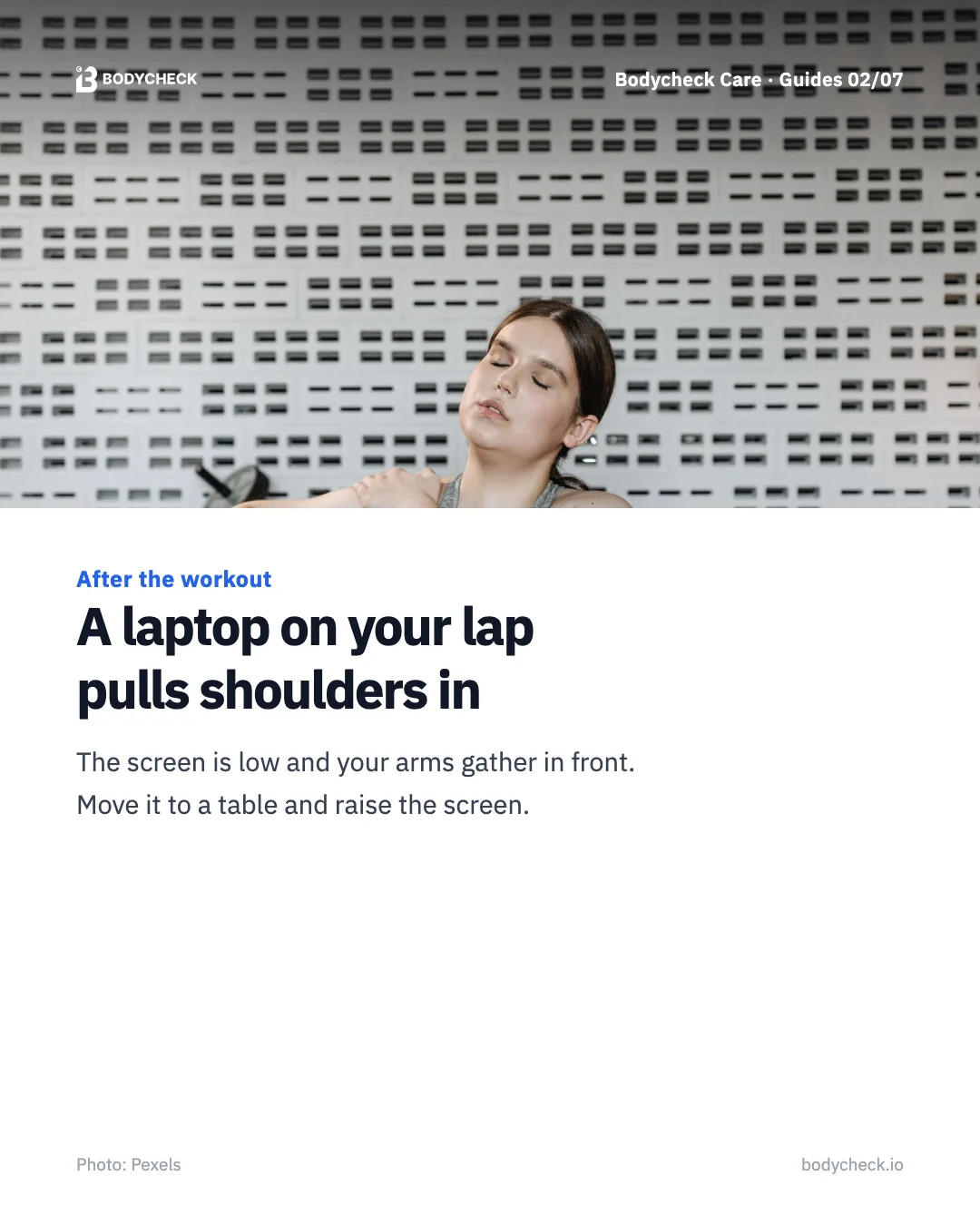
Ten minutes of exercise, and then most of us go back to a screen. With a laptop on your lap, the screen sits far below eye level and the keyboard sits low in front of you. Your head drops, your arms come together in front, and your shoulders tend to roll in with them.
Try this instead. Put the laptop on a table, not your knees, and for long sessions raise the screen toward eye level with a few books. A stand lifts the keyboard too, so a separate keyboard lets you type with your elbows by your sides. On the couch, even a cushion on your lap lifts the laptop a little.
Which habits pull your shoulders forward?
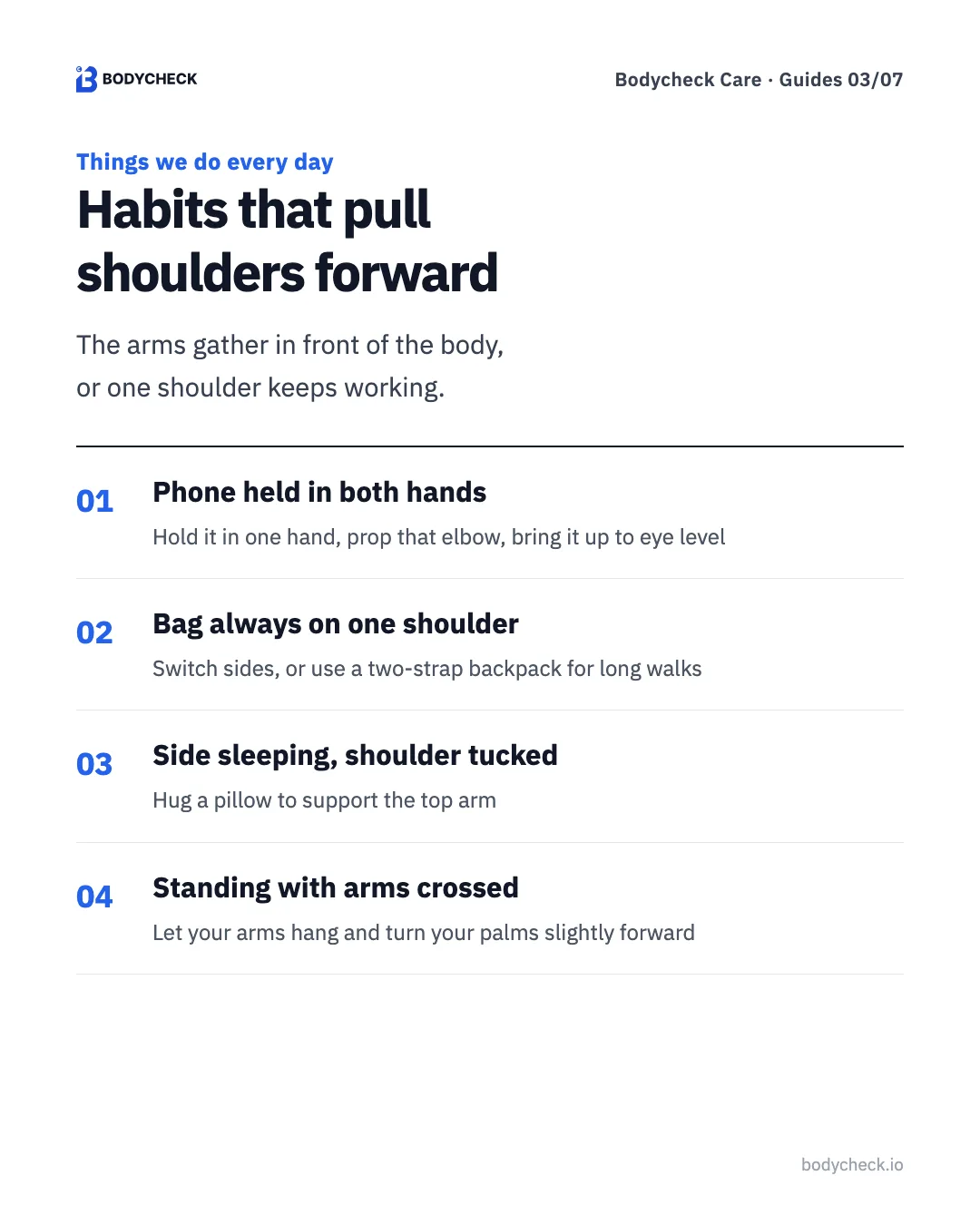
Beyond the laptop, there are four things most of us do every day. Each one is small. What they share: the arms gather in front of the body, or one shoulder keeps working.
- Phone held with both hands in front of your chest. When your elbows come together, your shoulders turn in too. Hold it in one hand, prop that elbow on your other arm, and bring the screen up toward your eyes.
- Bag always on the same shoulder. You lift or hunch that shoulder to stop the strap from sliding. Switch sides, use a two-strap backpack for long walks, and carry less.
- Side sleeping with a shoulder tucked in. The bottom shoulder folds in front of the chest and the top arm drops forward for hours. Hug a pillow to support the top arm, and pick a head pillow that fills the gap between your shoulder and head.
- Standing with arms crossed. Folding your arms in front of your chest pulls the shoulders forward. While you wait, let your arms hang and turn your palms slightly forward.
Changing everything at once wears you out fast. I picked the one I did the longest, and went one a week.
Why train the hips and core for your shoulders?
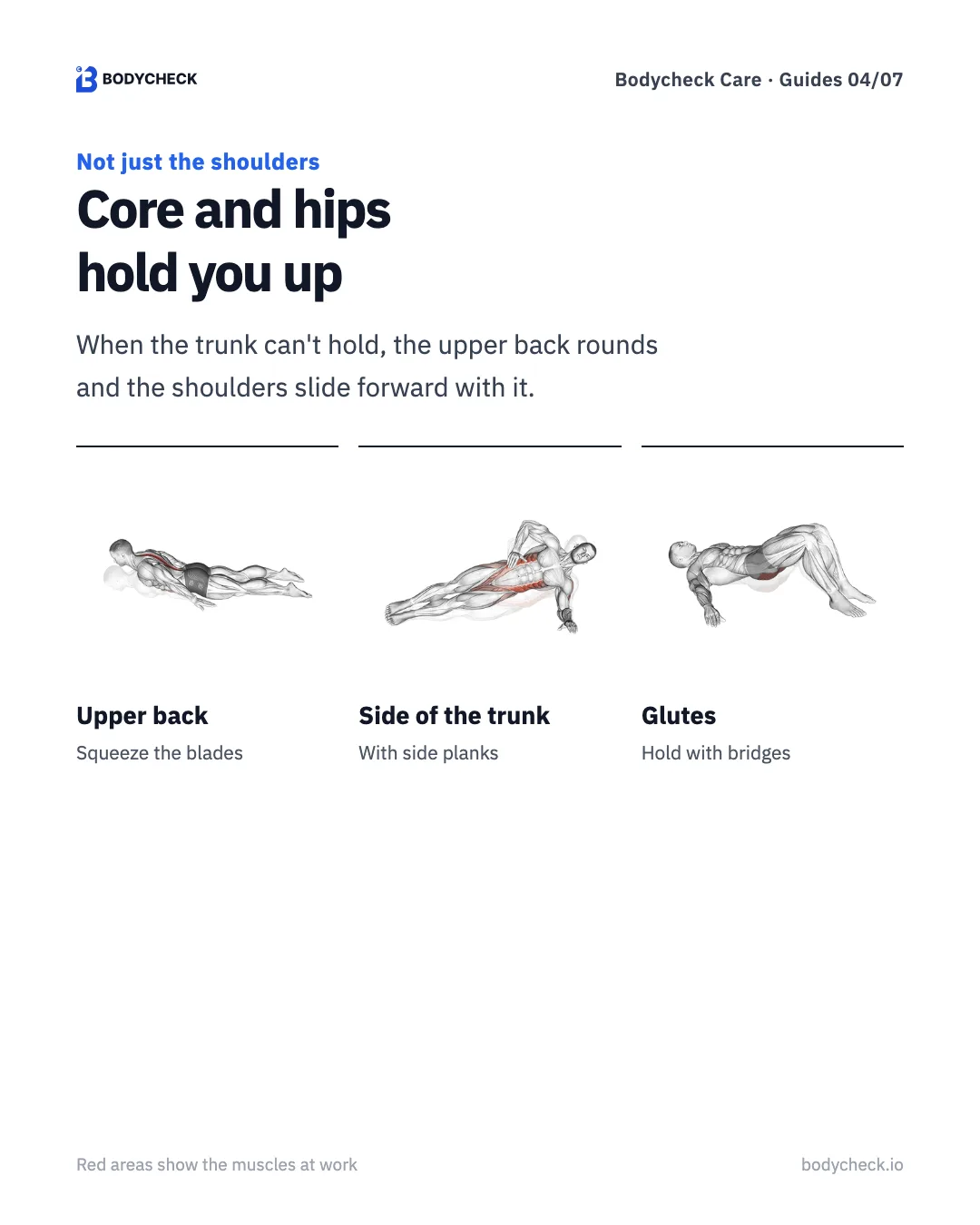
Your shoulders sit on top of your trunk. When your core and glutes don't hold you up through long hours of sitting or standing, the upper back slumps and the shoulders slide forward on top of it.
So this routine is a little different from the last one. The chest opener and shoulder-blade squeeze stay. Then dead bugs, glute bridges and side planks bring in the stomach, hips and sides. The idea is to let the whole body support the shoulders, not to treat them on their own.
What do you add each week?
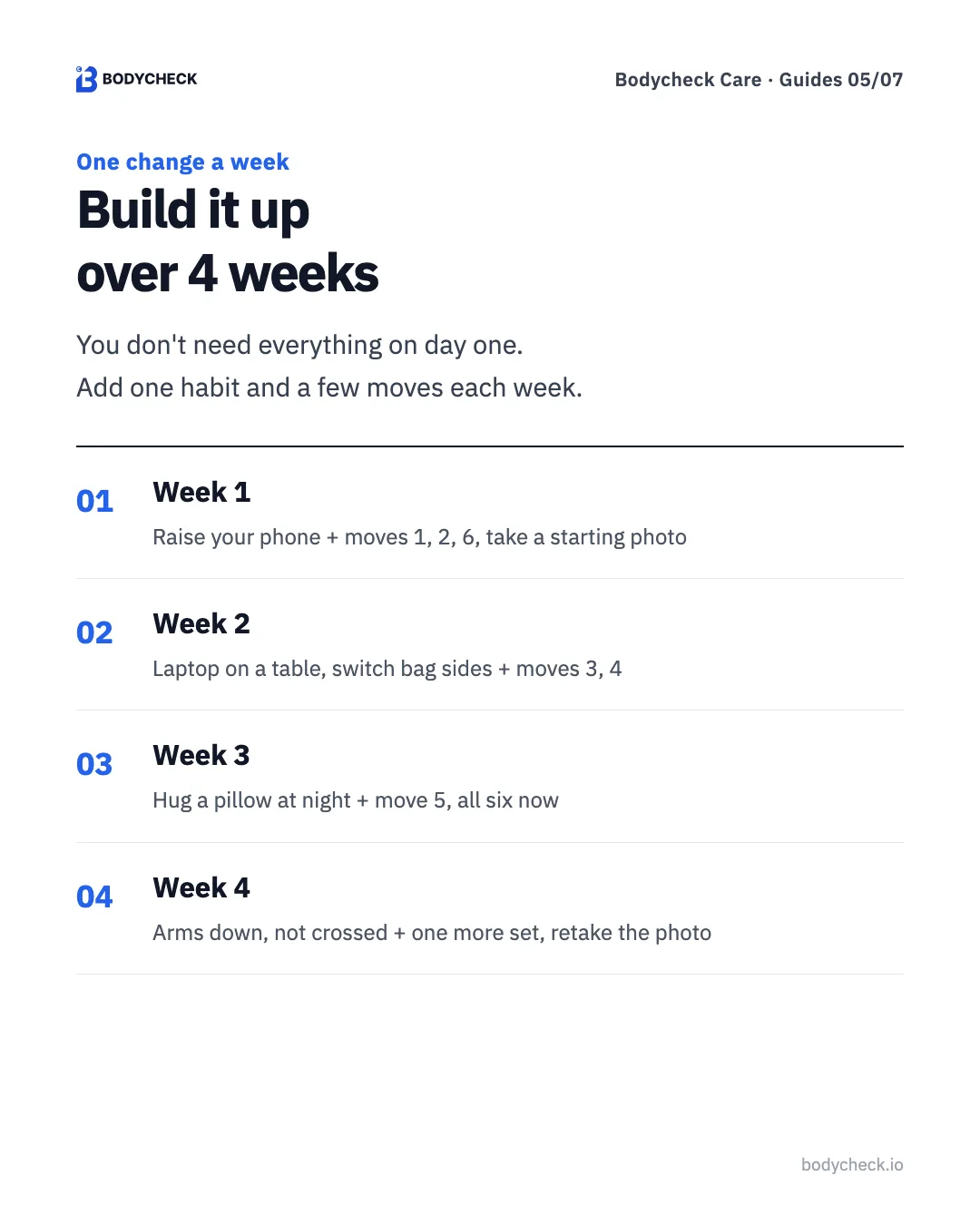
You don't need all six moves on day one. Add one habit and a couple of moves each week.
| Week | Habit to change | Routine |
|---|---|---|
| Week 1 | Bring your phone up toward your eyes | Moves 1, 2 and 6, three times a week + starting photo |
| Week 2 | Laptop on a table, switch bag shoulders | Add moves 3 and 4 |
| Week 3 | Hug a pillow when you sleep | Add move 5, the side plank, for all six |
| Week 4 | Arms down instead of crossed | One extra set or 10 more seconds per hold + retake the photo |
Three times a week means alternate days, like Monday, Wednesday and Friday. Missed one? Just pick it up the next day. If the week 4 volume feels like too much, keep it where it was.
How can you see how far forward your shoulders are?
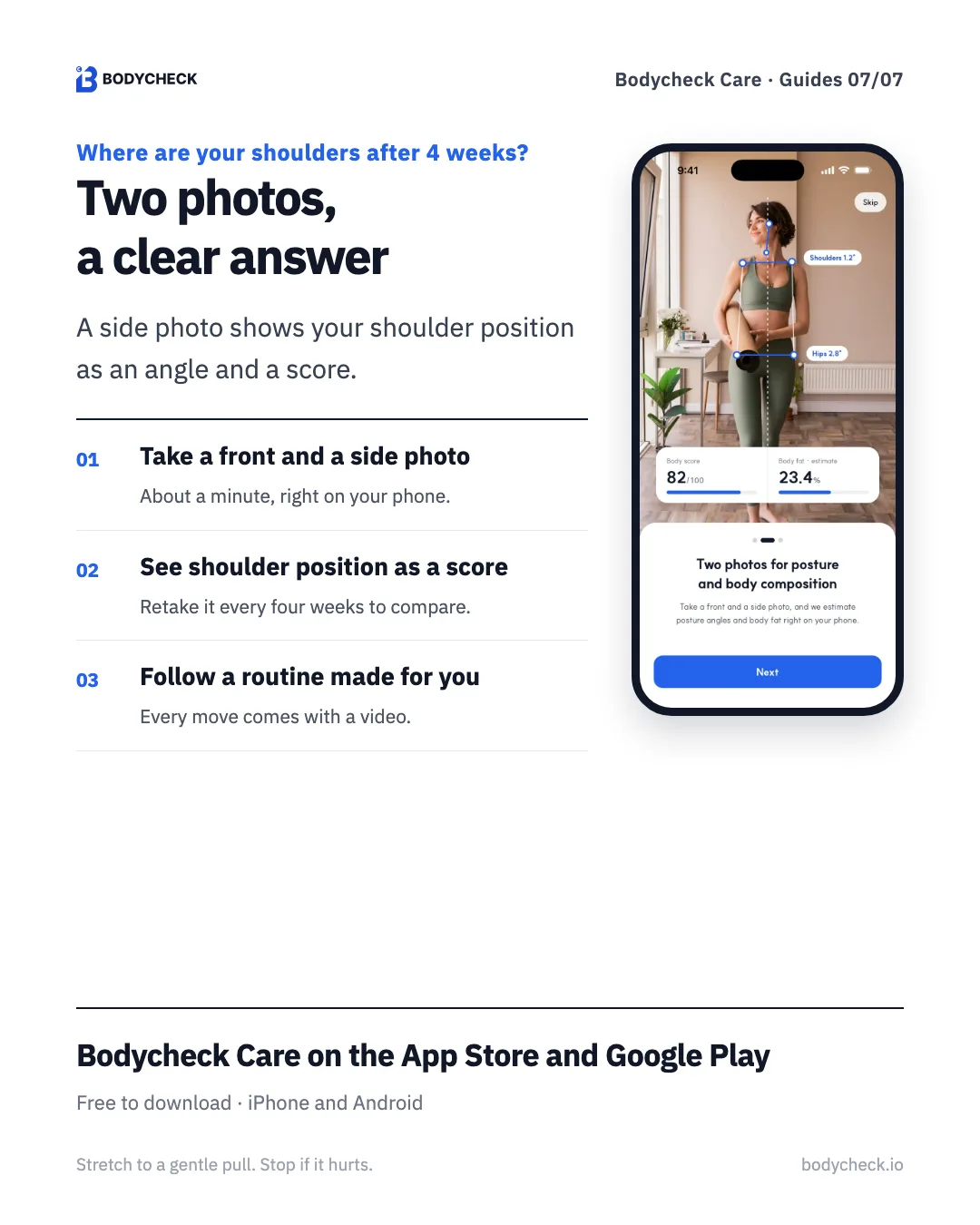
Habit changes are hard to notice, which makes them easy to drop. That's why I suggest comparing the start and week four under the same conditions.
- On day one, take a full-body side photo in the same spot, in the same clothes, from the same distance. Let your arms hang.
- In Bodycheck Care, a front and a side photo show your shoulder position and shoulder balance as angles and a score.
- Follow the moves picked for your result, each with a video.
- Retake the photos after four weeks and compare them side by side.
If the number hasn't moved, that's fine. If you changed even one habit, add another for the next four weeks.
Bodycheck Care · Free
See how far forward your shoulders sit, from two photos
Take a front and a side photo to see how far your head and shoulders sit forward as a score, then follow moves picked for your result, each with a video.
The 12-minute routine
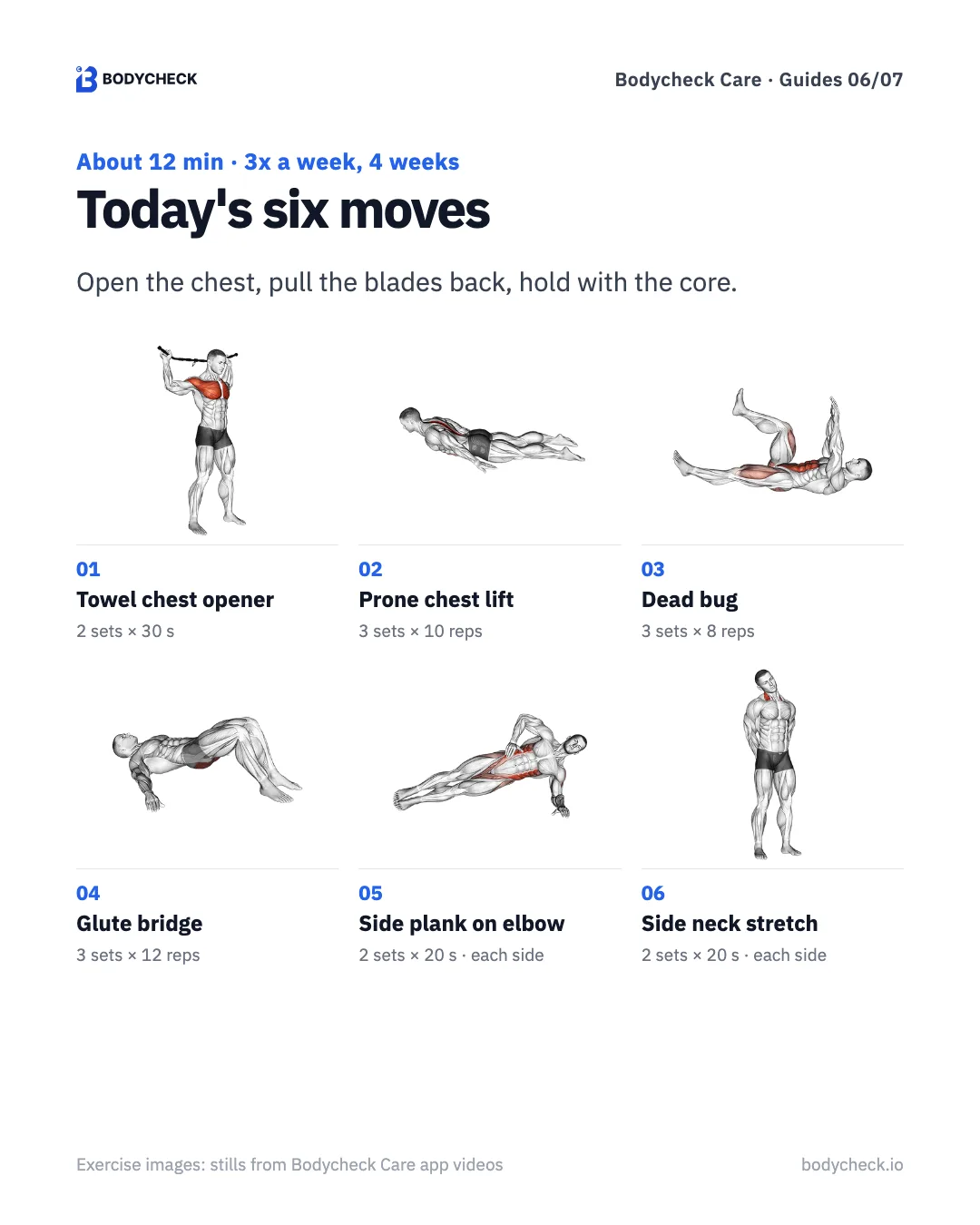
Open the chest, pull the shoulder blades back, then let the core and hips hold you up. Finish by releasing the side of the neck after a day of bag straps. Do it three times a week for four weeks, or build up to it with the plan above.
1. Towel chest opener · 2 sets × 30 s
- Stand tall holding a towel or long stick wider than your shoulders.
- Keep your arms straight and raise them slowly overhead.
- Take them behind your head only as far as they move freely, opening the chest and front shoulders.
- Come back slowly and repeat for 30 seconds. If your shoulders catch, widen your grip.
2. Prone chest lift · 3 sets × 10 reps
- Lie face down, legs straight, hands by your head or by your sides.
- Squeeze your shoulder blades toward the middle of your back.
- Lift your chest slightly off the floor and pause for one second. Eyes on the floor, no arching the lower back.
- Lower slowly. Repeat 10 times.
3. Dead bug · 3 sets × 8 reps
- Lie on your back with your arms toward the ceiling and your hips and knees bent to 90 degrees.
- Keeping your lower back on the floor, slowly reach one arm and the opposite leg out.
- Stop before your lower back lifts, then return to the start.
- Alternate sides for 8 reps.
4. Glute bridge · 3 sets × 12 reps
- Lie on your back with knees bent and arms by your sides.
- Push through your heels and lift your hips.
- With knees, hips and shoulders in a line, squeeze your glutes and pause one second. Don't arch your lower back.
- Lower slowly. Repeat 12 times.
5. Side plank on elbow · 2 sets × 20 s · each side
- Lie on your side with your elbow right under your shoulder.
- Straighten your legs and stack them.
- Lift your hips so your body makes a straight line from head to feet.
- Hold 20 seconds, then switch sides. If it's too hard, bend the bottom knee and rest it on the floor.
6. Side neck stretch · 2 sets × 20 s · each side
- Stand or sit tall with relaxed shoulders.
- Rest a hand on the side of your head and tilt your ear toward your shoulder.
- Keep the opposite shoulder pressed down so it doesn't rise.
- Hold 20 seconds, then switch sides.
At a glance
| # | Move | Sets |
|---|---|---|
| 1 | Towel chest opener | 2 × 30 s |
| 2 | Prone chest lift | 3 × 10 reps |
| 3 | Dead bug | 3 × 8 reps |
| 4 | Glute bridge | 3 × 12 reps |
| 5 | Side plank on elbow | 2 × 20 s · each side |
| 6 | Side neck stretch | 2 × 20 s · each side |
Moves can be hard to follow from text alone. In Bodycheck Care every move has a video, and the app counts the time and sets for you.
Frequently asked questions
Isn't exercise enough for rounded shoulders? A routine takes about ten minutes a day. Habits shape the rest of the day. That is why I suggest changing the habits that pull your shoulders forward alongside the exercises. How much changes differs from person to person, so no one can promise a result.
Do I need to change every habit at once? No. One habit a week is plenty. Start with the one you do the longest, like the phone in week 1 and the laptop and bag in week 2.
Is sleeping on my side bad for my shoulders? Side sleeping itself isn't the issue. Spending hours with the bottom shoulder tucked in and the top arm dropped forward can pull the shoulders in. Try hugging a pillow to support the top arm.
Why do glute bridges and side planks show up in a shoulder routine? When your core and hips don't hold you up while you sit or stand, the upper back tends to round and the shoulders slide forward with it. So this routine mixes chest and shoulder-blade moves with core and hip work.
How do I know if anything changed after four weeks? Take a side photo every four weeks in the same spot, in the same clothes, from the same distance, and compare them side by side. Bodycheck Care shows shoulder position as an angle and a score from a front and a side photo, and you can retake them after four weeks to compare. It is free on iPhone and Android.
Before you start
- Stretch to a gentle pull. Stop right away if anything hurts or tingles.
- Don't hold your breath. Breathe out as you push.
- If side planks or dead bugs feel like too much, drop a set or start with your knees down.
- This is exercise guidance. If you have shoulder or arm pain, numbness, or trouble raising your arm, see a doctor before you exercise.
Pick just one habit today. Tonight, I'm going to sleep hugging a pillow.
Bodycheck Care · Free
Take two photos and get moves picked for you
Take a front and a side photo to see how far your head and shoulders sit forward as a score, then follow moves picked for your result, each with a video.
References
- Photos: Pexels (free license). Exercise images and app screens: Bodycheck Care app.