Rounded Shoulders Exercises: A 10-Minute Home Routine to Open the Chest
Rounded shoulders come from a tight chest and a long, tired upper back. Try a 30-second mirror check, then six moves with a towel and a mat to open the front and pull the shoulder blades back.
Short answer: Rounded shoulders build up from hours with your arms out in front of you. The chest and front of the shoulders get short, and the upper back between the shoulder blades gets long. So the order that works is stretch the chest, pull the blades back, then hold them there. Do the six moves below for about 10 minutes, three times a week for four weeks.
Hi, I'm an editor on the Bodycheck Care team. A while ago a friend sent me a photo she took of me from the side, and I did a double take. My shoulders were rounded forward, and my arms hung with the backs of my hands facing the camera. I never noticed it standing up. In the photo, it was obvious.
Sound familiar? Today is all about the shoulders: why they roll forward, what happens in the chest and between the shoulder blades, and a 10-minute routine you can do with a towel and a mat. If you want to work on your neck too, read the forward head posture routine as well.
How are rounded shoulders different from forward head posture?
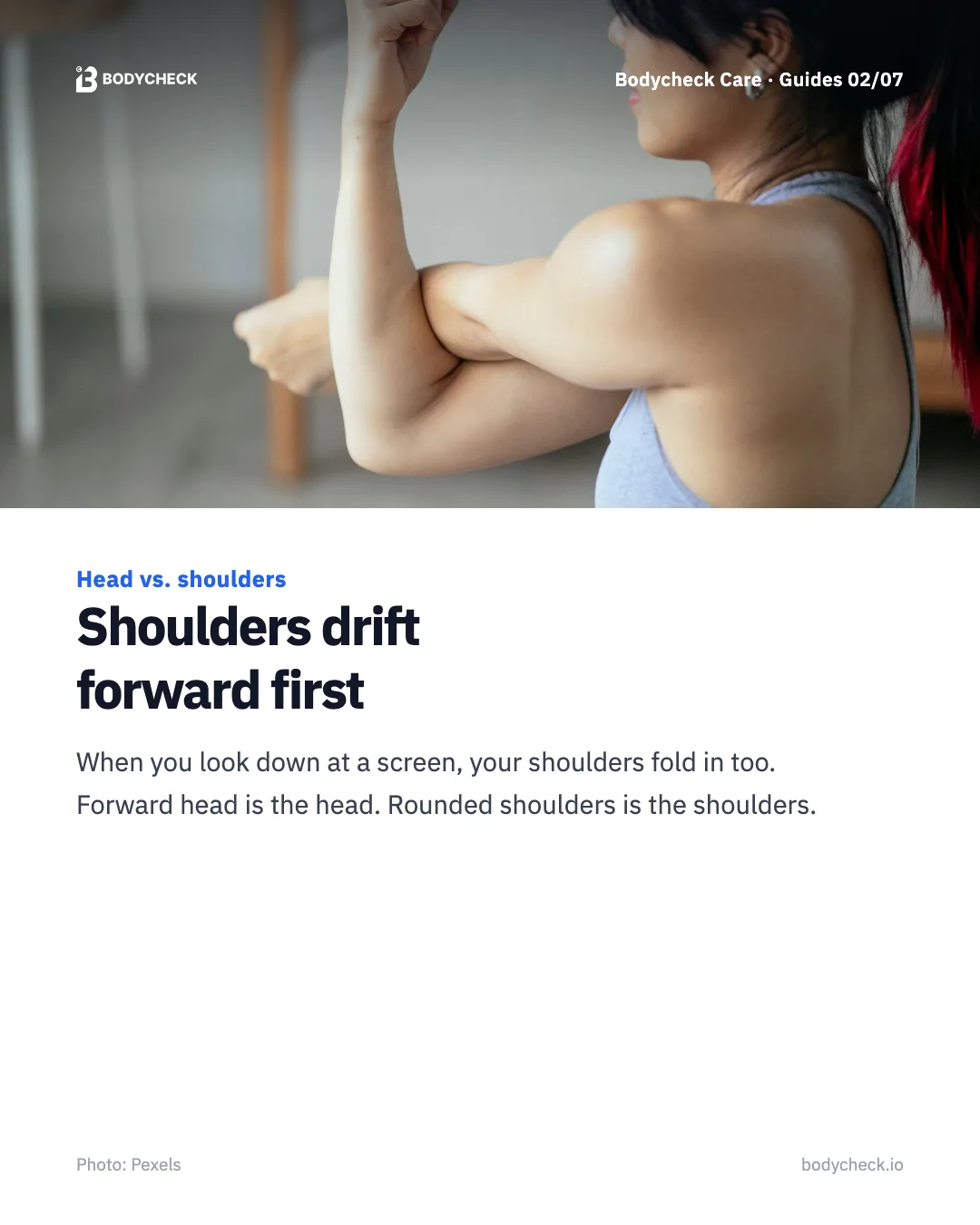
They often come as a pair, but they look at different things. Forward head posture is about your head sitting in front of your shoulders. Rounded shoulders is about your shoulders rolling in front of your torso.
Think about reading your phone. You don't just tip your head. Both hands come together in front of you to hold the screen, and your shoulders fold in with them. That's why your shoulders can stay forward even after you lift your head.
Why do shoulders roll forward?
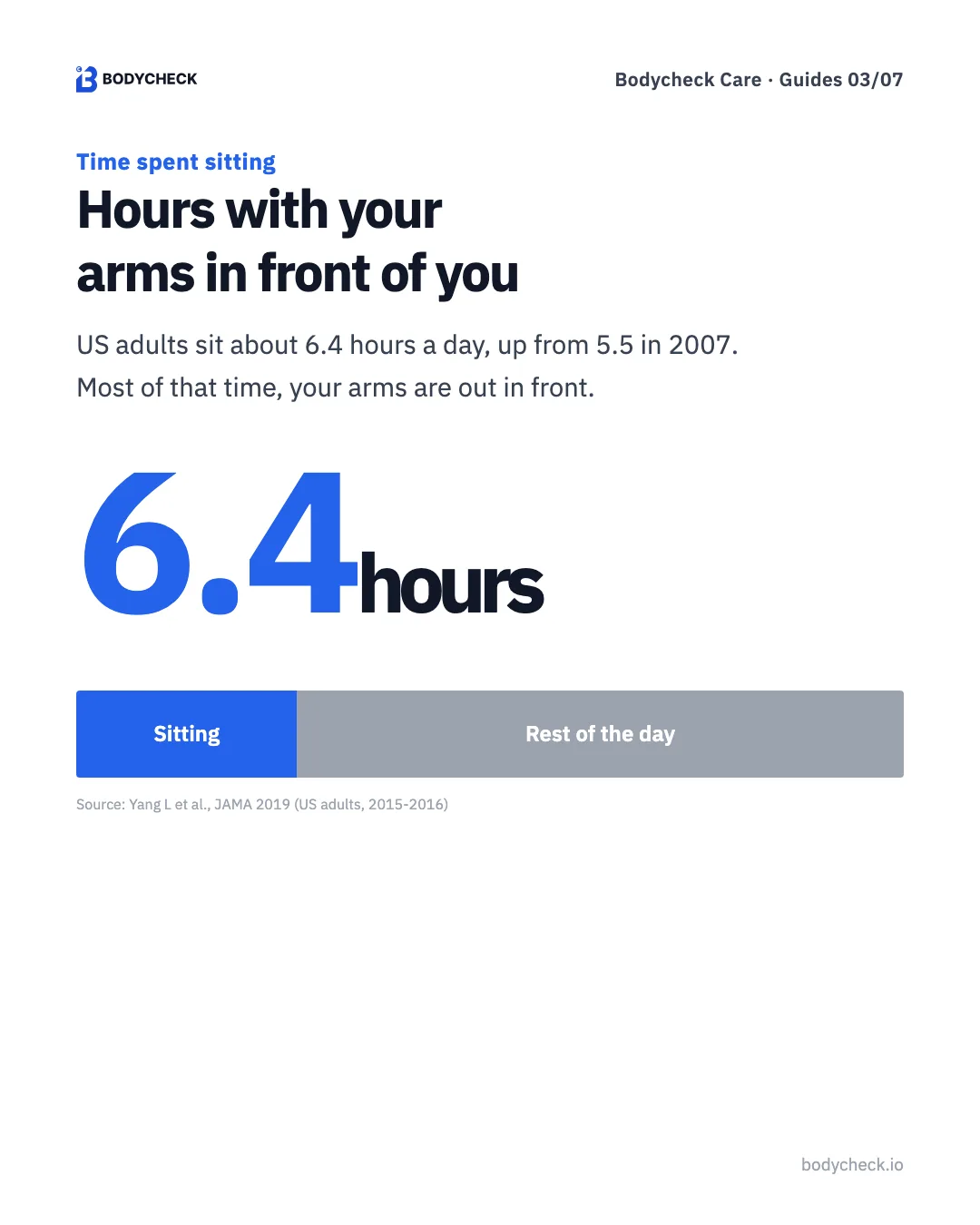
A 2019 study in JAMA found that US adults sit about 6.4 hours a day, up from about 5.5 hours in 2007.
Where are your arms during those hours? On a keyboard, on a mouse, holding a phone. Mostly out in front. When your shoulders sit pulled forward for hours every day, your body starts to treat that as normal. That's why sitting up with an open chest can feel strange at first.
What happens in the chest and shoulder blades?
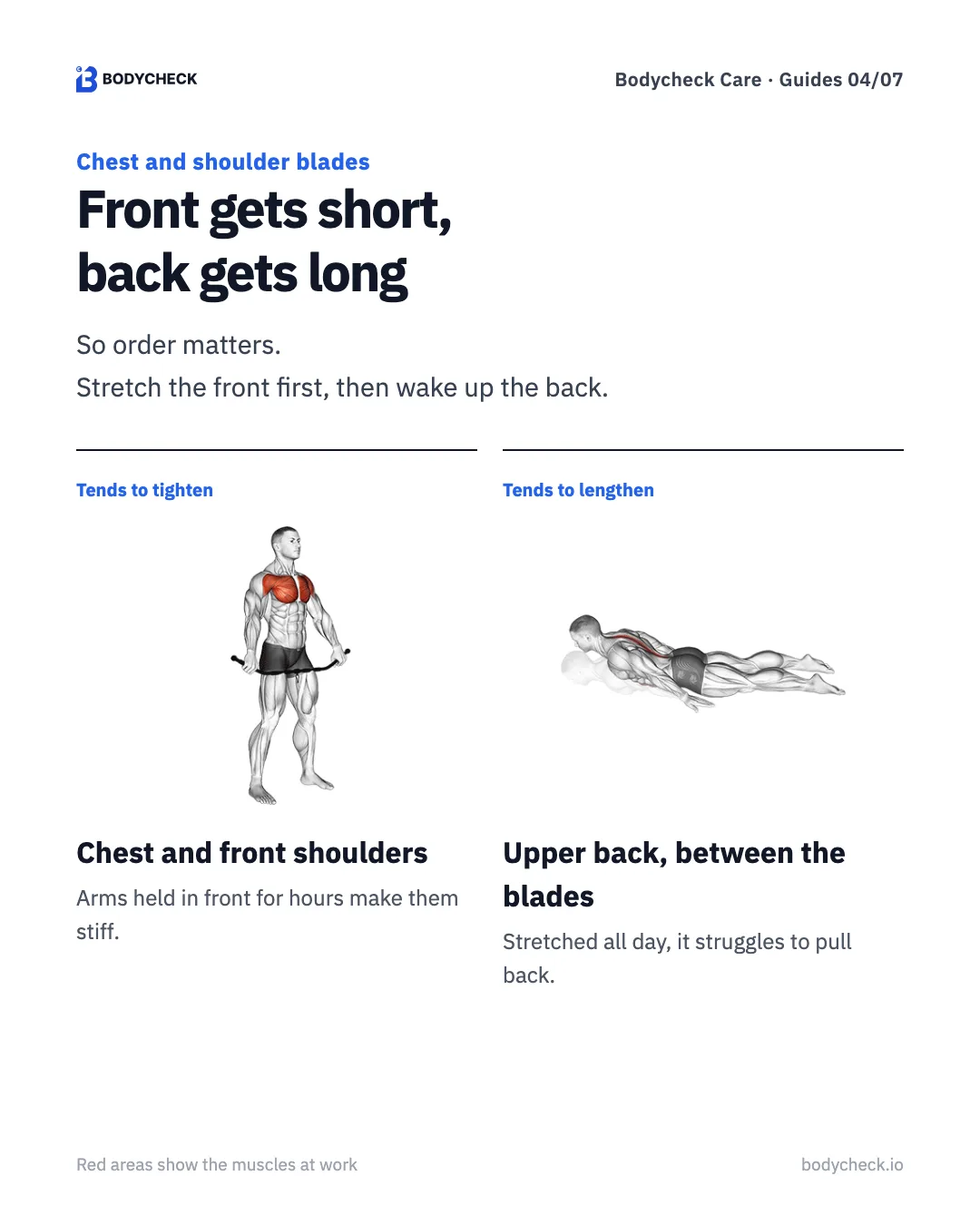
When your shoulders round forward, the chest and front shoulders tend to stay short and stiff. Meanwhile the upper back between your shoulder blades stays stretched all day, so it has a hard time pulling your shoulders back.
That's why order matters. First stretch the front to make room for the shoulders to move back. Then train the muscles that squeeze the blades together. Then practice holding that position. Today's routine goes stretch, squeeze, hold.
Do I have rounded shoulders? A 30-second check
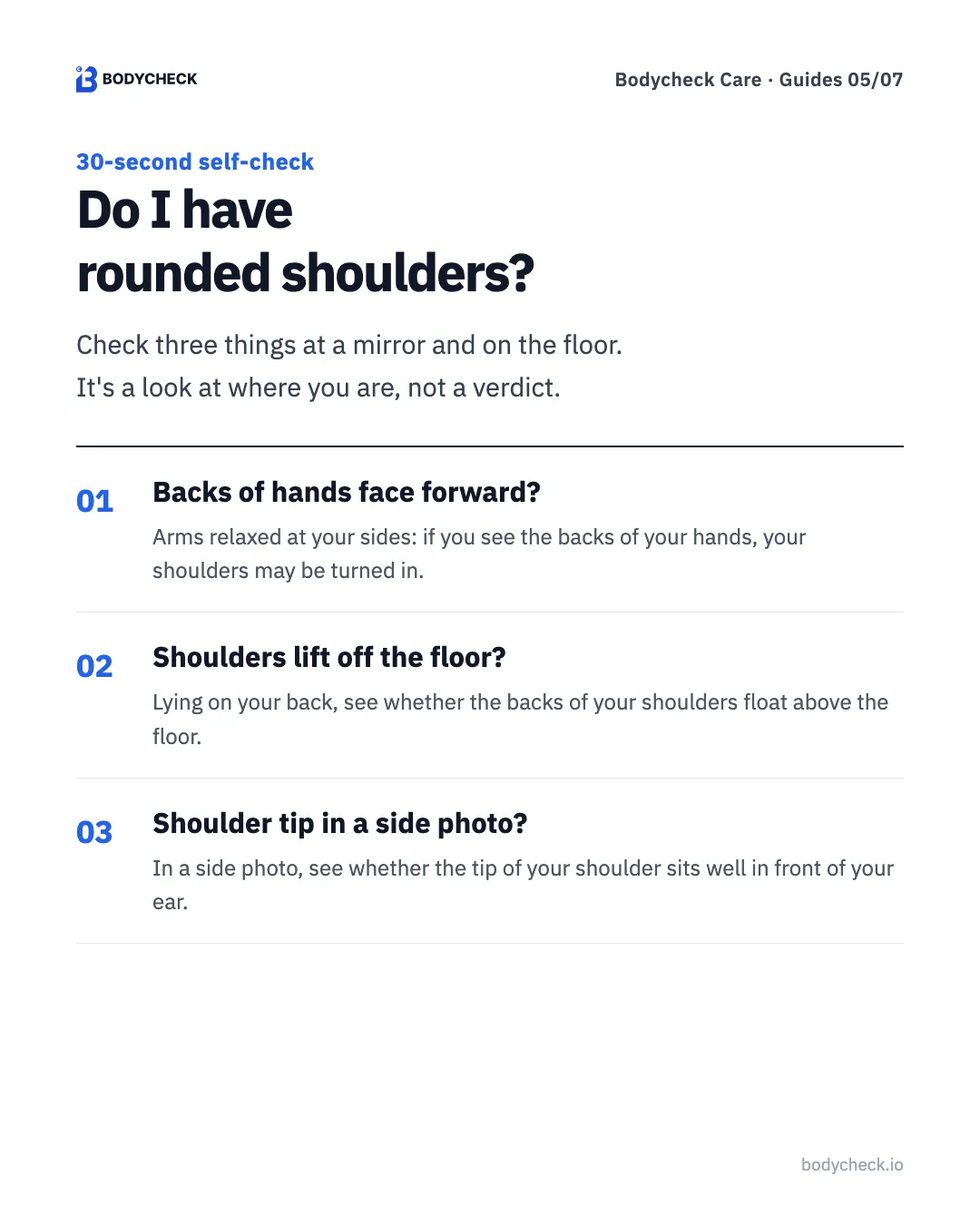
Before you start, take a look at where your shoulders are now. Check three things at a mirror and on the floor.
- Do the backs of your hands face forward? Stand with your arms relaxed. If you see the backs of your hands in the mirror, your shoulders may be turned in. Usually the thumbs point forward.
- Do your shoulders lift off the floor? Lie on your back with your arms at your sides and see if the backs of your shoulders float above the floor.
- Where is your shoulder tip in a side photo? See whether it sits well in front of your ear.
I failed 1 and 3 right away. But this is a self-check. It can't tell you how far forward your shoulders actually are. For that, try the next step.
How can I see how far forward my shoulders are?
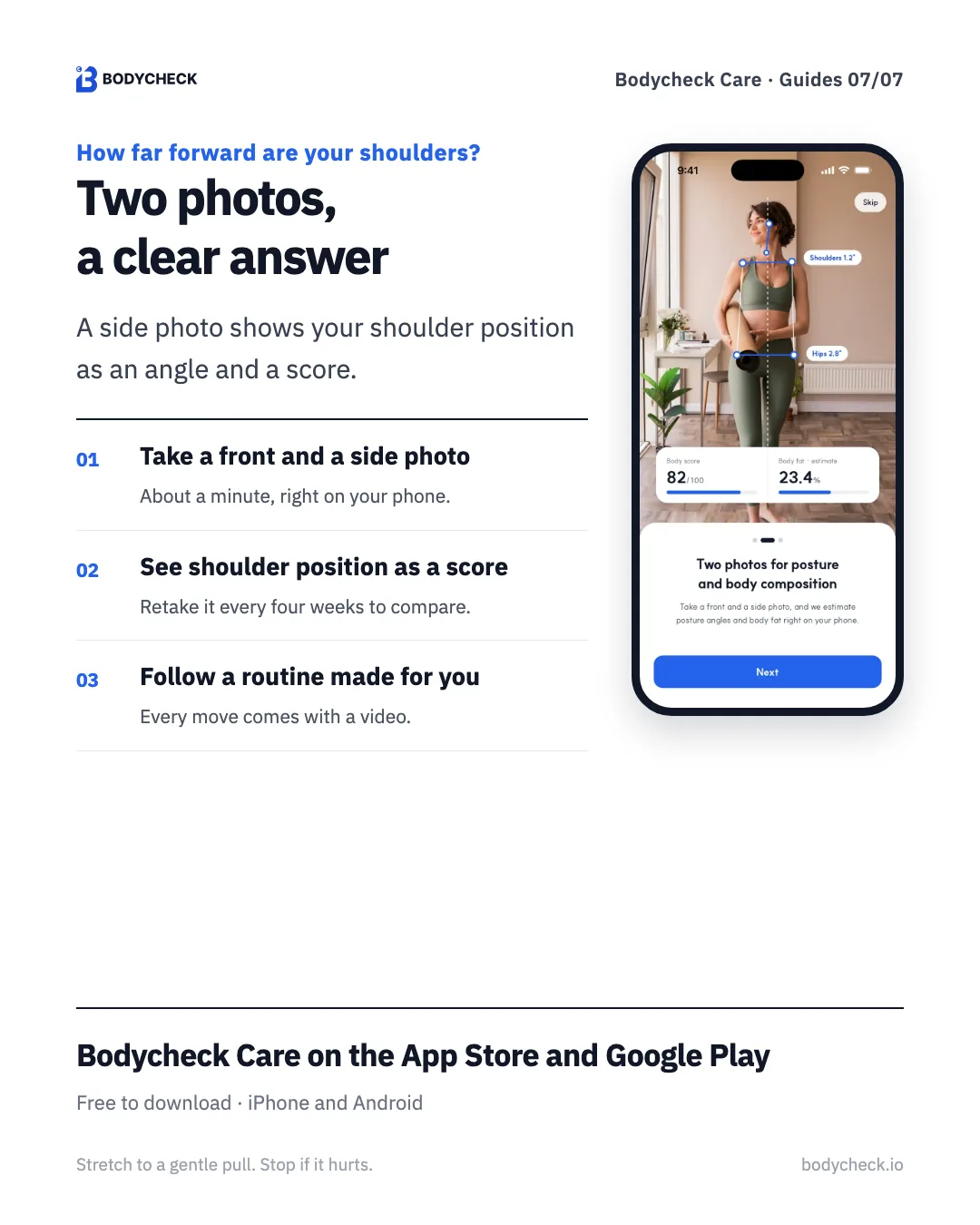
Take a front and a side photo in Bodycheck Care. The side photo shows your shoulder position, and the front photo shows your shoulder balance, both as angles and a score. You'll also see head position and pelvic tilt.
- Get the app and take a full-body front photo and side photo.
- See your shoulder position and shoulder balance as a score.
- Follow the moves picked for your result, each with a video.
- Retake the photos after four weeks and compare.
The mirror check is a feeling. This is a number. Like me with that side photo, actually seeing it is a good push to get started.
Bodycheck Care · Free
See how far forward your shoulders sit, from two photos
Take a front and a side photo to see how far your head and shoulders sit forward as a score, then follow moves picked for your result, each with a video.
The 10-minute routine for rounded shoulders
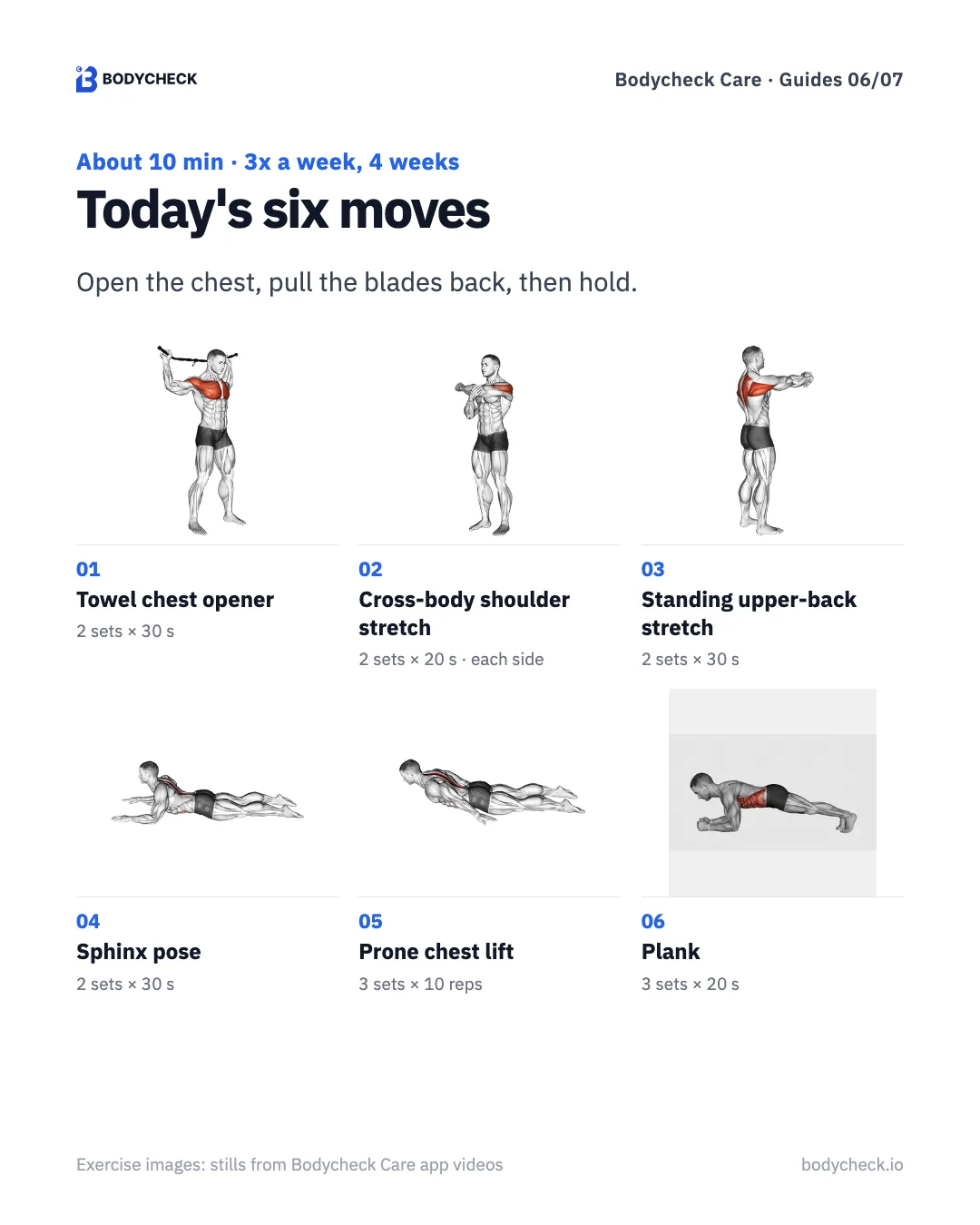
Open the chest (moves 1 and 2), loosen and then squeeze the upper back (moves 3 to 5), and finish by holding your shoulders in place (move 6). Do it three times a week on alternate days, for four weeks. A towel and a mat are all you need.
1. Towel chest opener · 2 sets × 30 s
- Stand tall holding a towel or long stick wider than your shoulders.
- Keep your arms straight and raise them slowly overhead.
- Take them behind your head only as far as they move freely, opening the chest and front shoulders.
- Come back slowly and repeat for 30 seconds. If your shoulders catch, widen your grip.
2. Cross-body shoulder stretch · 2 sets × 20 s · each side
- Stand tall and reach one arm across your chest.
- With the other hand, pull it in just above the elbow.
- Hold 20 seconds where you feel the back of the shoulder stretch. Keep the shoulder away from your ear.
- Switch sides.
3. Standing upper-back stretch · 2 sets × 30 s
- Stand with feet shoulder-width apart.
- Interlace your fingers and reach forward at shoulder height.
- Push your hands far forward and round your upper back so the shoulder blades spread.
- Breathe out slowly and hold 30 seconds. Loosening this area first makes the squeeze in the next moves easier.
4. Sphinx pose · 2 sets × 30 s
- Lie face down with your elbows right under your shoulders.
- Brace your stomach lightly and lift your chest off the floor. Lift the chest, not the lower back.
- Keep your neck long and your eyes on the floor just ahead.
- Hold 30 seconds, then lower slowly.
5. Prone chest lift · 3 sets × 10 reps
- Lie face down, legs straight, hands by your head or by your sides.
- Squeeze your shoulder blades toward the middle of your back.
- Lift your chest slightly off the floor and pause for one second. Eyes on the floor, no arching the lower back.
- Lower slowly. Repeat 10 times.
6. Plank · 3 sets × 20 s
- Lie face down with your elbows right under your shoulders.
- Lift onto your toes so your body makes a straight line from head to heels.
- Brace your stomach and glutes and breathe evenly. Push the floor away so your shoulders don't sag.
- Hold 20 seconds. If it's too hard, drop your knees to the floor.
At a glance
| # | Move | Sets |
|---|---|---|
| 1 | Towel chest opener | 2 × 30 s |
| 2 | Cross-body shoulder stretch | 2 × 20 s · each side |
| 3 | Standing upper-back stretch | 2 × 30 s |
| 4 | Sphinx pose | 2 × 30 s |
| 5 | Prone chest lift | 3 × 10 reps |
| 6 | Plank | 3 × 20 s |
Moves can be hard to follow from text alone. In Bodycheck Care every move has a video, and the app counts the time and sets for you.
Frequently asked questions
How often should I do exercises for rounded shoulders? Three times a week, on alternate days, for four weeks. Once the moves feel familiar, you can also do moves 1 and 2 on their own during a sitting break.
Are rounded shoulders the same as forward head posture? They often show up together, but they look at different things. Forward head posture is about the head sitting in front of the shoulders. Rounded shoulders is about the shoulders rolling in front of the torso.
Can I check for rounded shoulders at home? Stand with your arms relaxed and see if the backs of your hands face forward in a mirror. Lie on your back and see if your shoulders float off the floor. In a side photo, see if your shoulder tip sits well in front of your ear. It is a self-check, not a diagnosis.
What if a plank is too hard? Drop your knees to the floor. Keep your elbows right under your shoulders and push the floor away so your shoulder blades don't pop up.
Can I see how far forward my shoulders are as a number? Bodycheck Care measures shoulder position from a side photo and shoulder balance from a front photo, and shows them as angles and a score. It is free on iPhone and Android, and you can retake the photos every four weeks to compare.
Before you start
- Stretch to a gentle pull. Stop right away if anything hurts or tingles.
- Don't hold your breath. Breathe out as you push.
- In the first week it's fine to drop one set from each move.
- This is exercise guidance. If you have shoulder pain when you move or numbness in your arms, see a doctor before you exercise.
Why not start with the mirror today and check which way your hands face? In four weeks, check again in the same spot and retake your photos to see them side by side.
Bodycheck Care · Free
Take two photos and get moves picked for your shoulders
Take a front and a side photo to see how far your head and shoulders sit forward as a score, then follow moves picked for your result, each with a video.
References
- Yang L, Cao C, Kantor ED, et al. Trends in sedentary behavior among the US population, 2001–2016. JAMA, 2019;321(16):1587-1597.
- Photos: Pexels (free license). Exercise images and app screens: Bodycheck Care app.