Knee Valgus (Knees Caving In When You Squat): A Self-Check and 12-Minute Routine
Check whether your knees cave in on squats and stairs with a simple mirror test, standing and in a shallow squat, then work your hips, thighs and calves in a 12-minute routine.
Short answer: Knee direction shows up more when you bend than when you stand still. In front of a mirror, check two positions, standing relaxed and in a shallow squat, and see whether your kneecaps follow your toes and whether both sides look alike. Leg shape varies, so don't judge from this alone. Then work your hips, thighs and calves with the six moves below, about 12 minutes, three times a week for four weeks.
Hi, I'm an editor on the Bodycheck Care team. A while ago the elevator in my building was down for maintenance, so I walked down twelve floors. On every step, my right knee seemed to fold inward a little. That evening I propped up my phone and filmed myself squatting. Sure enough, only my right knee drifted inside my big toe.
That alone doesn't mean anything is "wrong" with my knee. So today let's look at how to check for yourself where your knees go when you move, and a 12-minute routine that uses your hips and legs together so your knees follow your toes. Leg shape while standing, like bow legs, gets its own guide later.
When do caving knees show up?
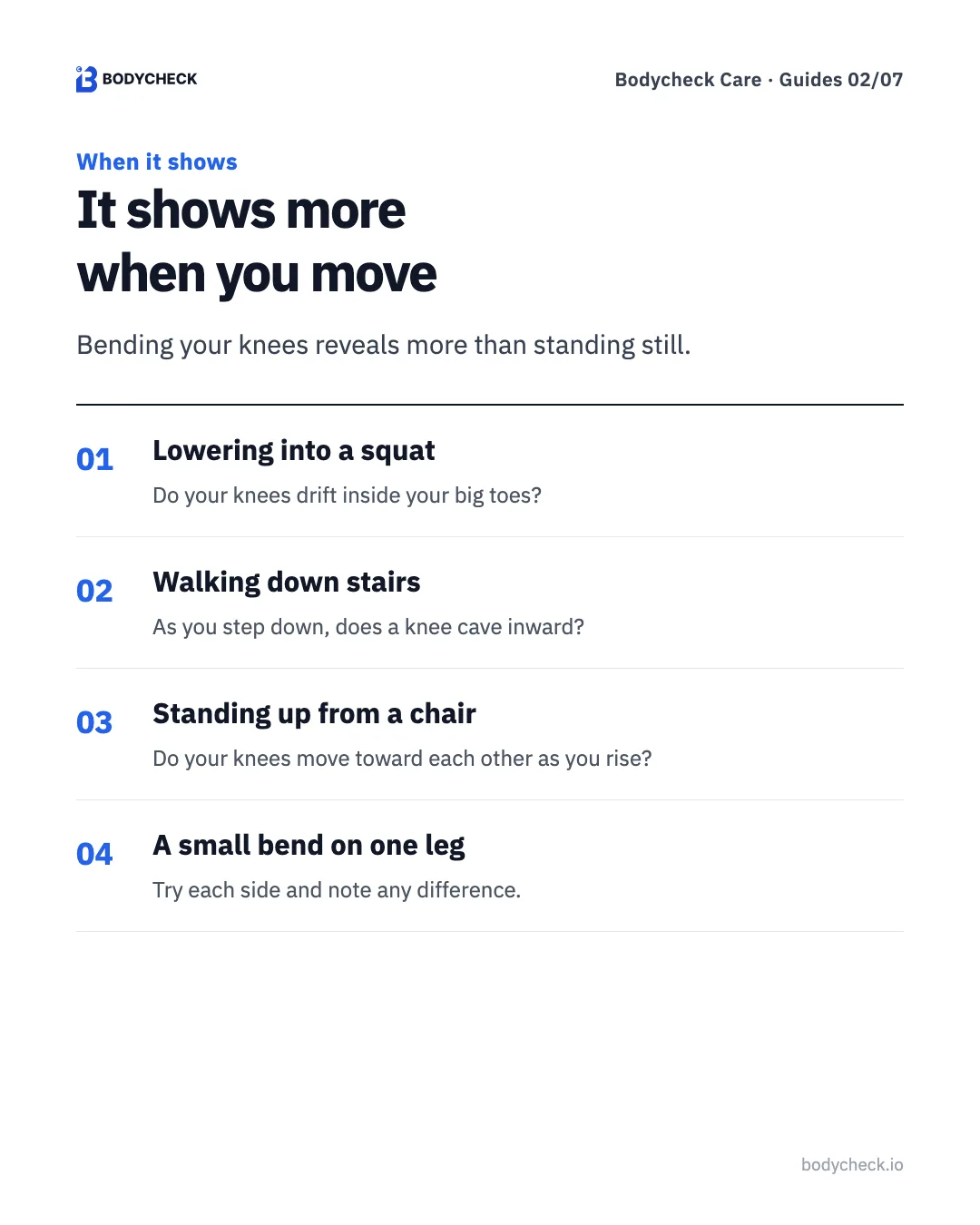
Often you won't notice anything standing still. It shows when your knee bends and takes your weight. Think about these everyday moments.
- Lowering into a squat. Do your knees drift inside your big toes?
- Walking down stairs. As you step down, does a knee feel like it caves in?
- Standing up from a chair. Do your knees move toward each other as you rise?
- A small bend on one leg. Try each side and note which one wobbles more or drifts in.
Do the one-leg check next to a wall or chair so you don't lose your balance.
How do you check in the mirror?
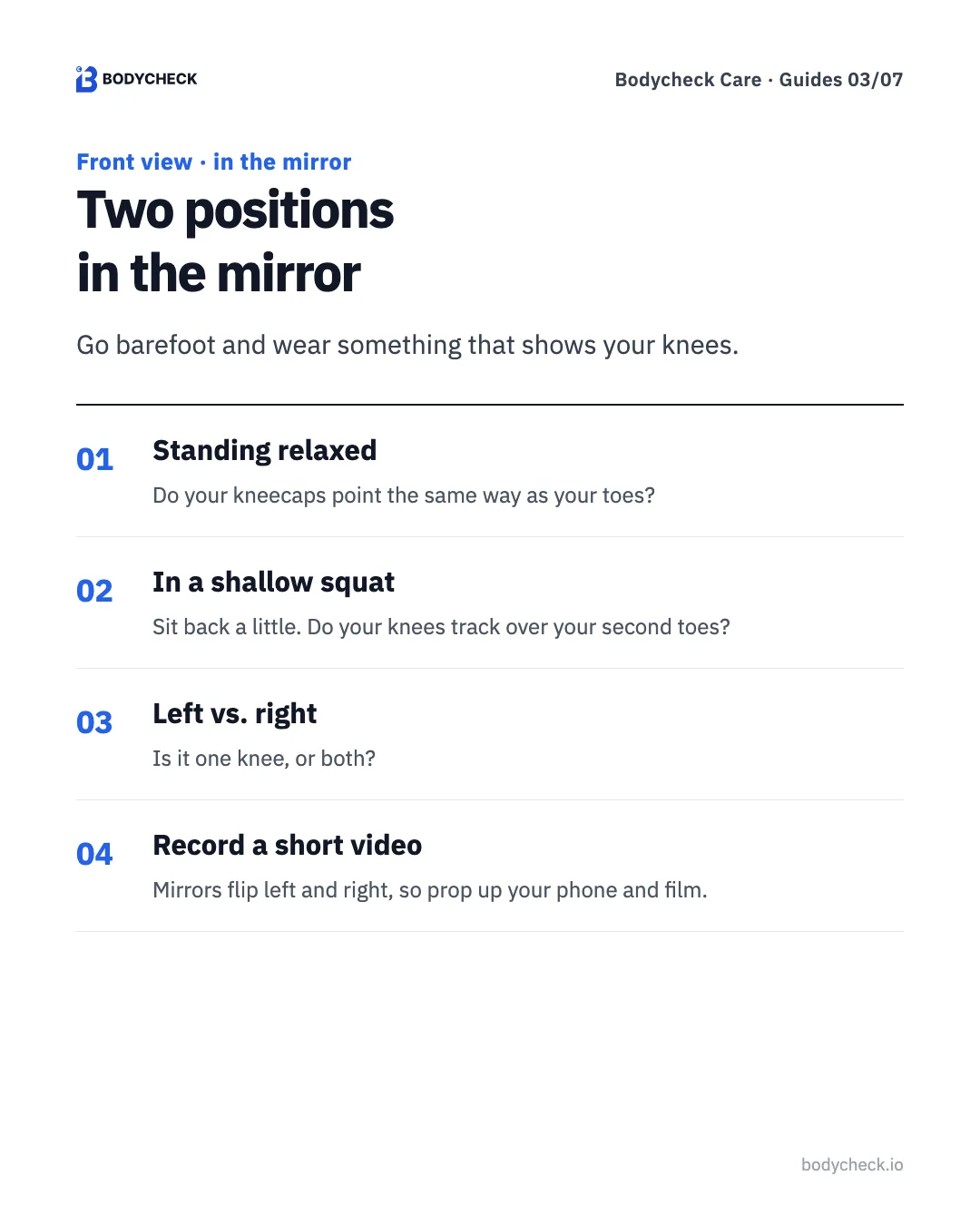
Stand barefoot in front of a full-length mirror. Shorts or fitted clothes make your knees easier to see. Feet shoulder-width apart, toes turned out a little if that's comfortable.
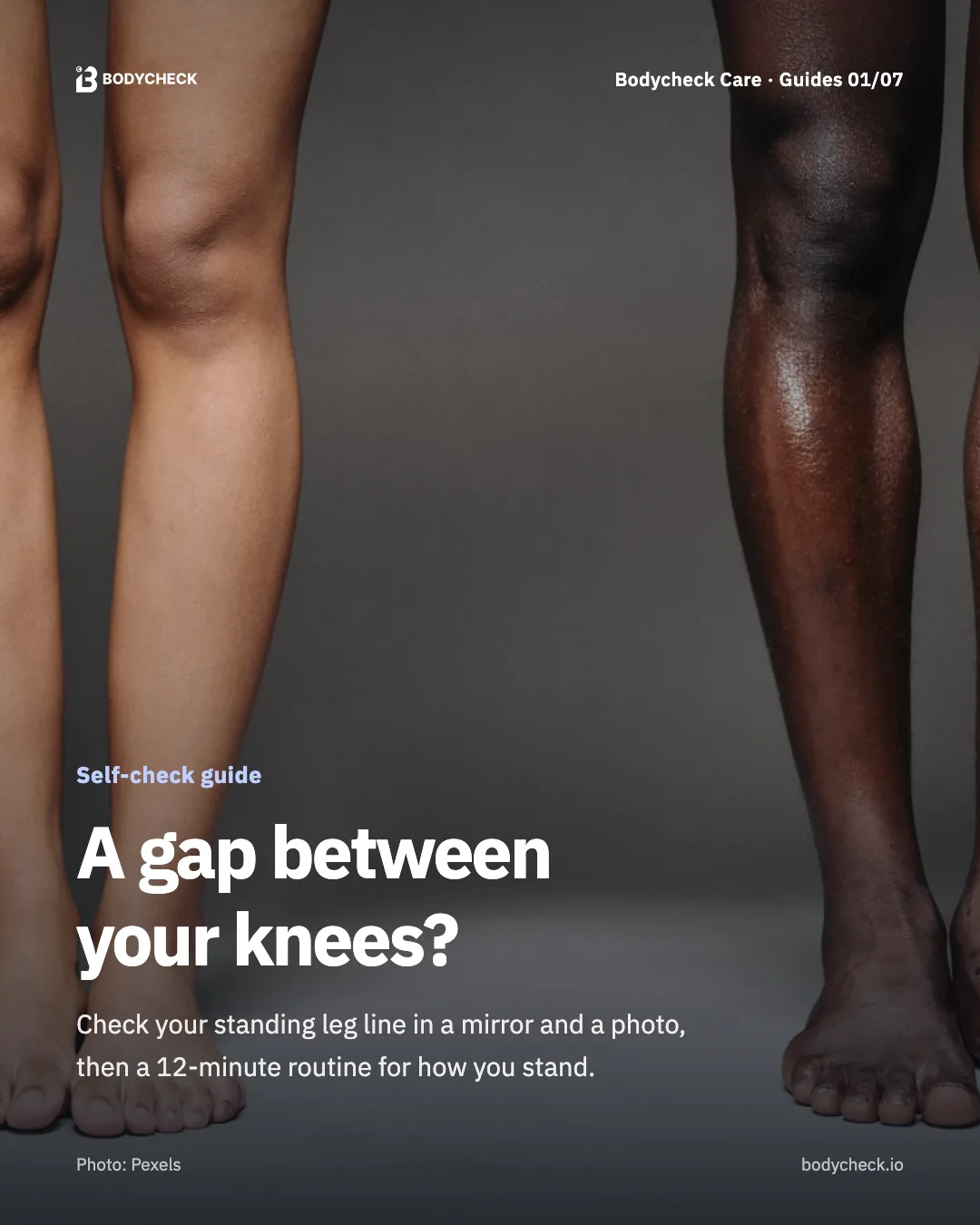
- Standing relaxed. Do your kneecaps point the same way as your toes? Don't try to stand extra straight. Stand the way you usually do.
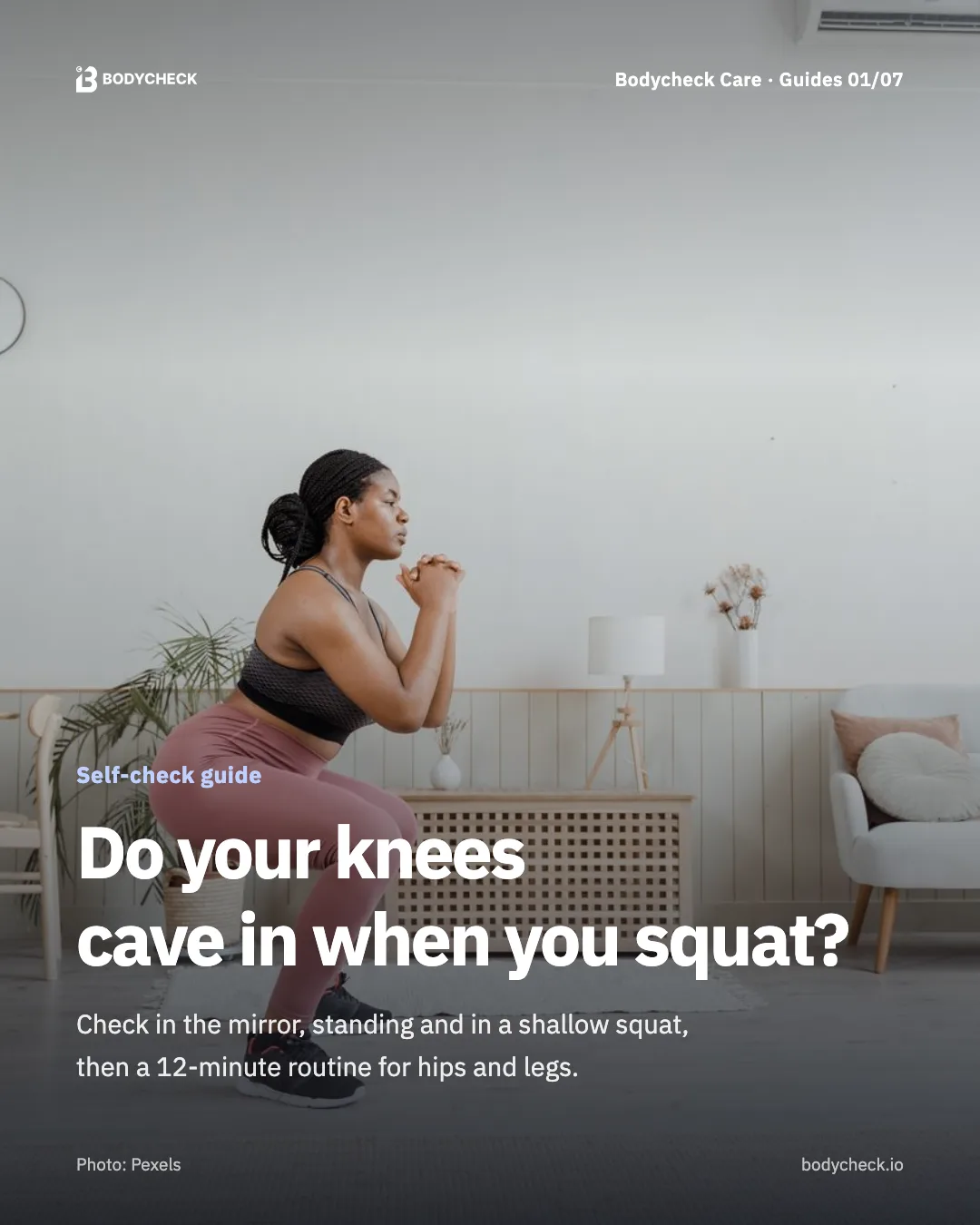
- In a shallow squat. Push your hips back as if sitting in a chair and go down just a little. Do your knees track over your second toes, or drift inward?
- Left vs. right. Is it one knee, or both? For me it was only one.
- Record a short video. Mirrors flip left and right. Prop your phone at knee height and film three or four squats so you can compare later.
You don't need to go deep. Stop at a depth that feels comfortable.
What should you notice on the stairs?
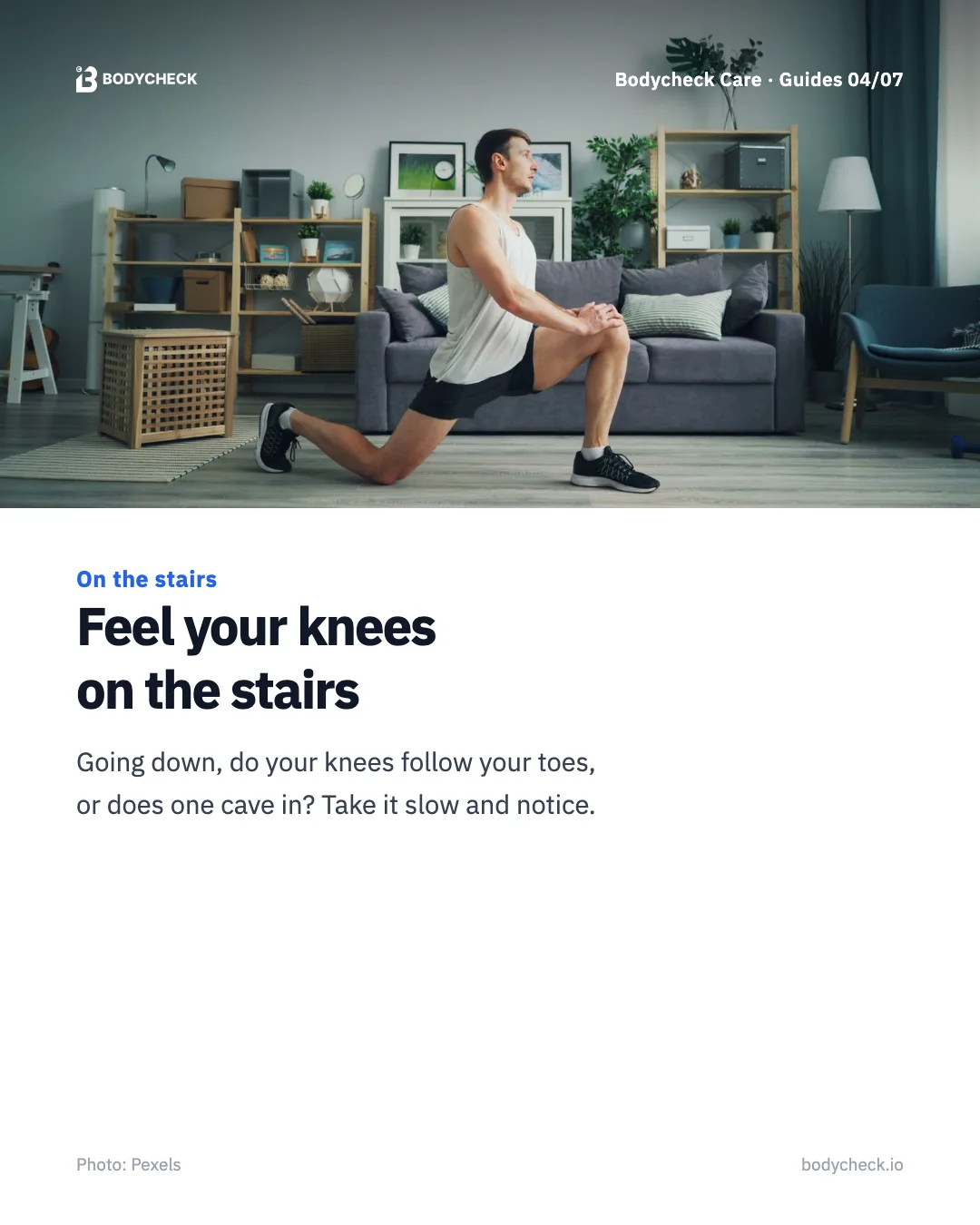
Stairs are a one-leg squat you do every day. Going down is where knee direction is easiest to feel, because one leg bends while taking your weight.
Hold the rail and go down slower than usual. Does the knee you land on follow your toes, or fold inward? Compare stepping down on your left foot and your right. For moves that build stair-climbing strength, see the 15-minute leg routine for easier stairs.
Which muscles keep your knees on track?
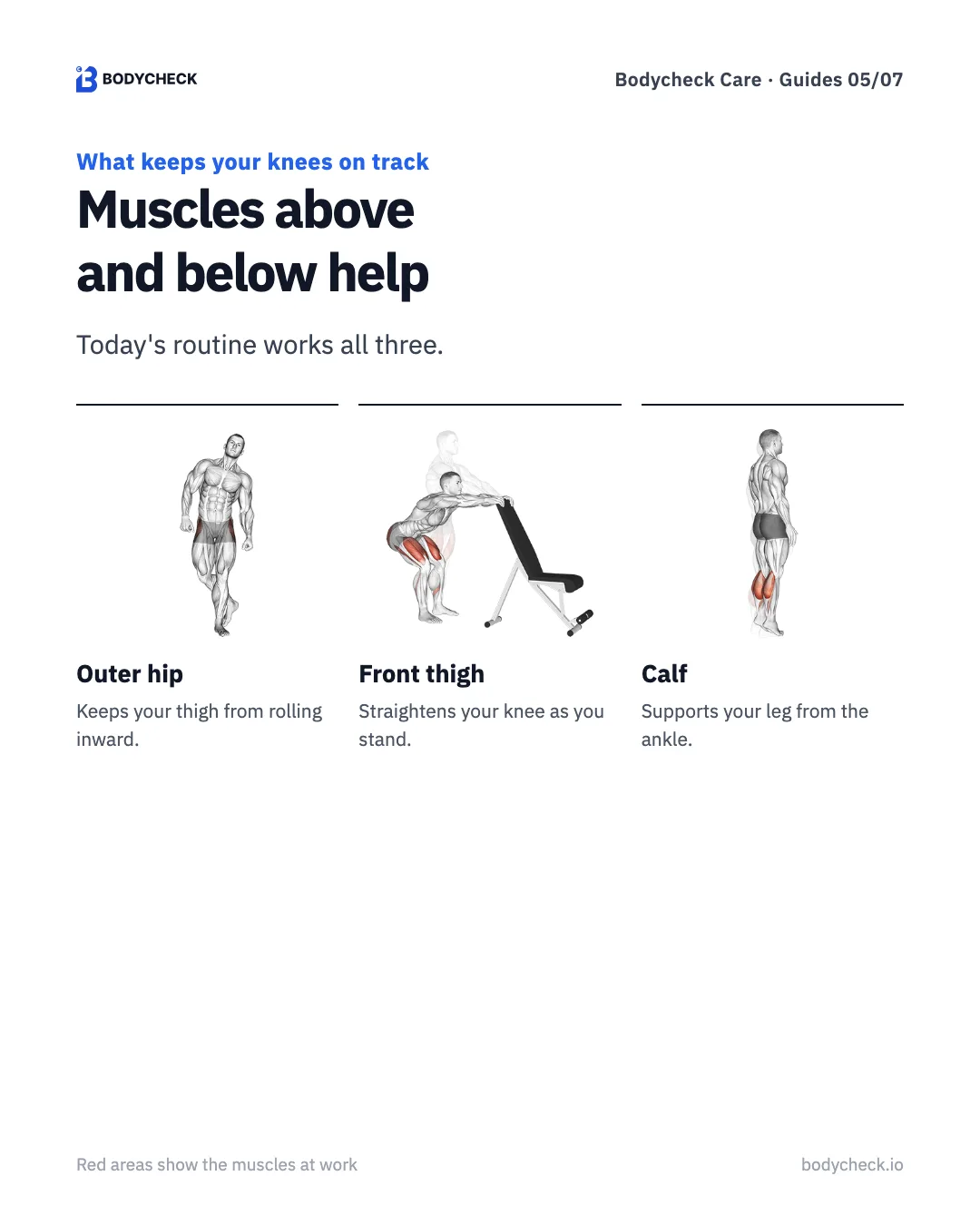
Your knee sits between your thigh bone above and your shin bone below, so muscles above and below help steer it. Three areas are worth remembering.
- Outer hip (gluteus medius): Keeps your thigh from rolling inward. When it isn't doing much, your knee may drift in more easily on one leg.
- Front thigh: The big muscle that straightens your knee as you stand up from a squat.
- Calf: Supports your leg from the ankle.
Very tight hamstrings can also make squatting feel awkward, so the routine ends with a hamstring stretch.
How can you see your knee balance as a number?
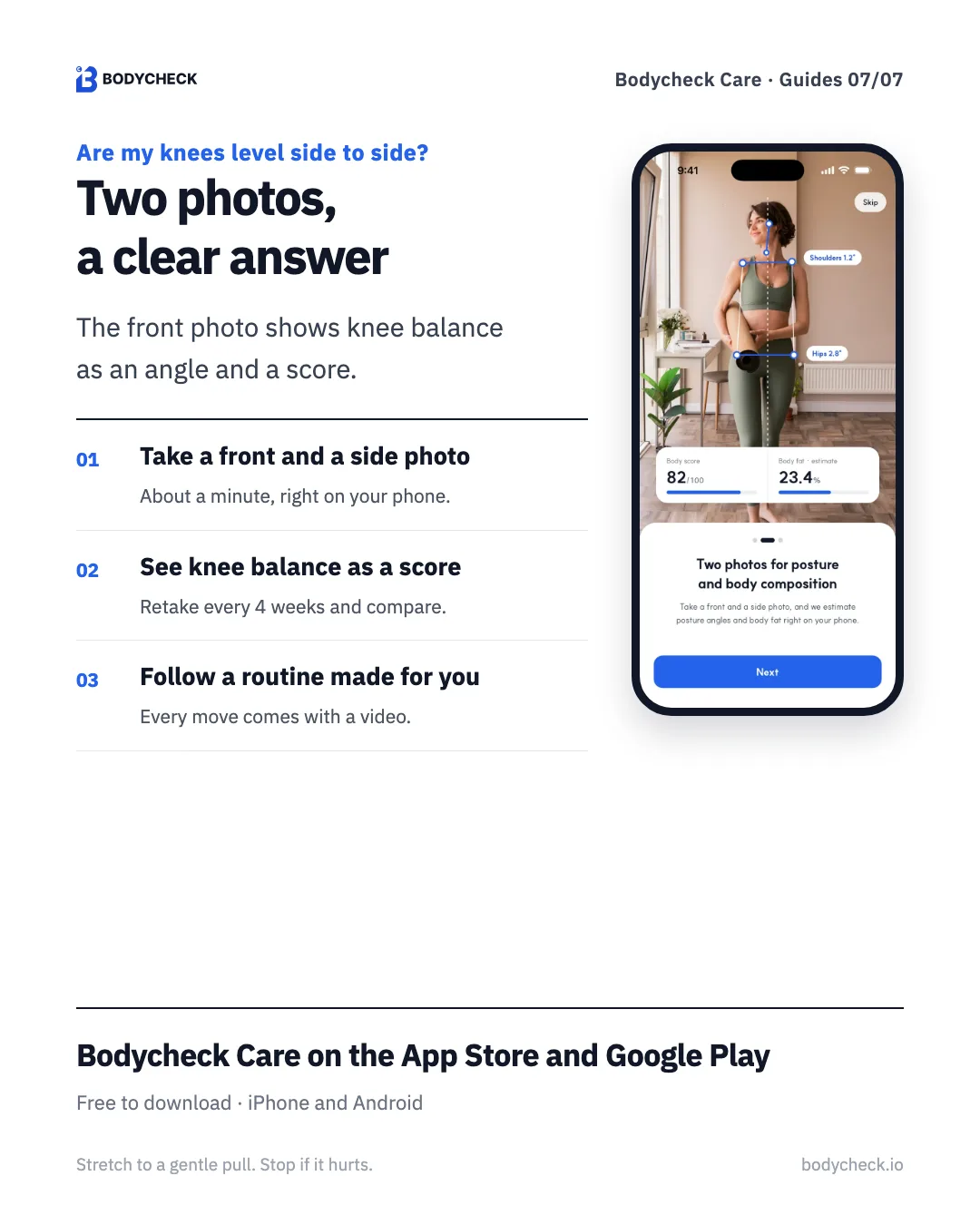
Mirror checks and videos change a little with where you stand and how high the camera is. If you want the same yardstick every time, measuring from photos is easier. In Bodycheck Care you take a front and a side full-body photo, and the front photo shows your knee balance as an angle and a score, along with head tilt, shoulder balance and hip balance.
- Get the app and take a front and a side full-body photo.
- Check knee balance as an angle and score in the front view results.
- Follow the moves picked for your result, each with a video.
- Retake the photos in the same spot after four weeks and compare.
The app is not a medical device. It's a way to track your posture with the same yardstick.
Bodycheck Care · Free
Check your knee balance with two photos
Take a front and a side photo to see how far your head and shoulders sit forward as a score, then follow moves picked for your result, each with a video.
The 12-minute routine to help your knees track
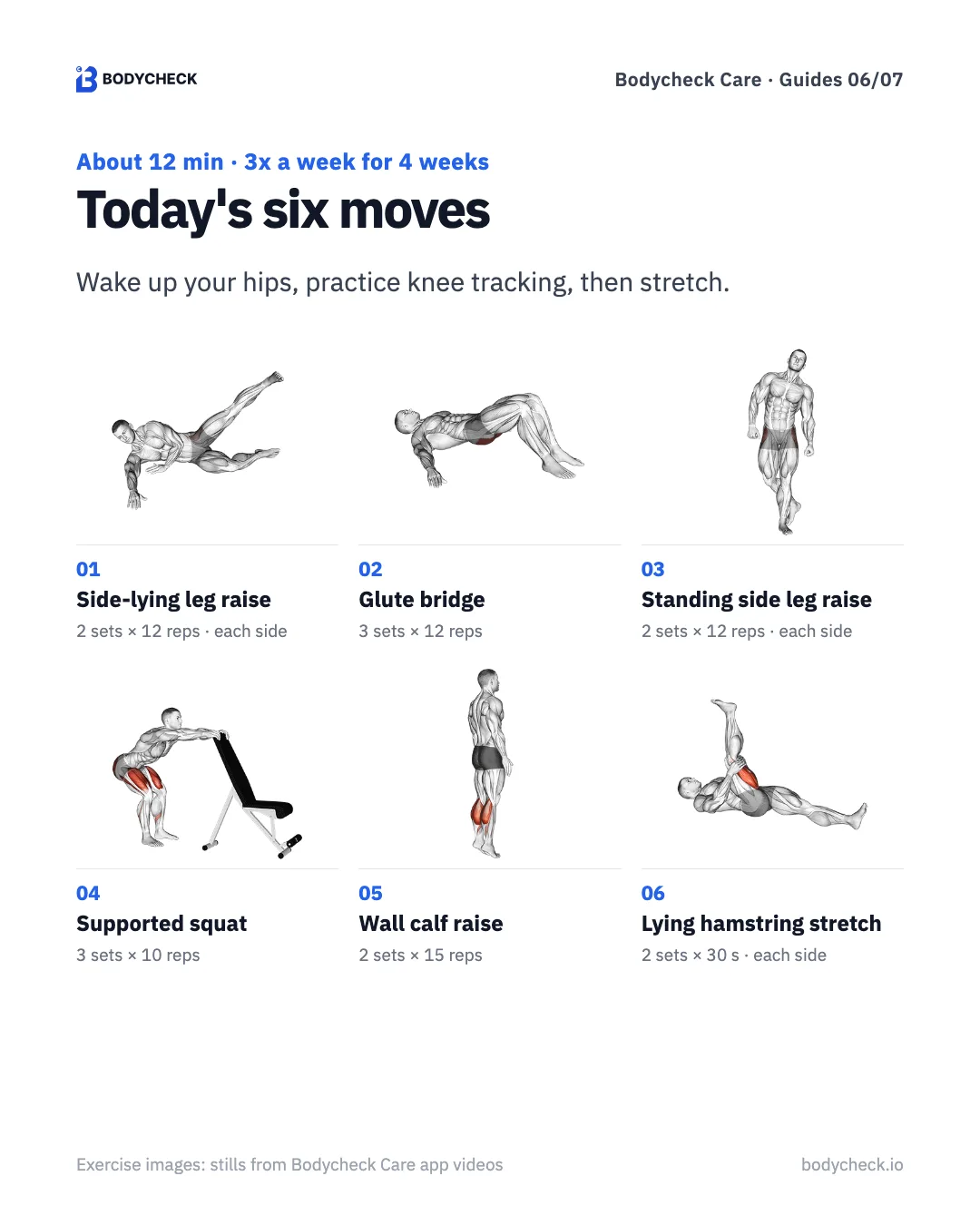
Wake up the side and back of your hips lying down, lift your leg to the side standing up, practice knee direction with a squat in front of the mirror, then finish with calves and hamstrings. A mat and a chair are enough. Do it three times a week on alternate days, for four weeks. For one-side moves, do the same reps on each side.
1. Side-lying leg raise · 2 sets × 12 reps · each side
- Lie on your side, propped on your elbow.
- Keep the bottom leg on the floor and the top leg straight.
- With your toes pointing forward, slowly lift the top leg.
- Lower slowly. After 12 reps, switch sides.
2. Glute bridge · 3 sets × 12 reps
- Lie with knees bent and arms by your sides. Feet and knees hip-width apart.
- Push through your heels and lift your hips.
- Squeeze your glutes for one second with knees, hips and shoulders in a line. Don't let your knees fall in.
- Lower slowly. Repeat 12 times.
3. Standing side leg raise · 2 sets × 12 reps · each side
- Stand tall, with one hand on the wall if needed.
- Without leaning, lift one straight leg out to the side.
- Lift only until you feel the side of your hip working, then lower slowly.
- After 12 reps, switch sides.
4. Supported squat · 3 sets × 10 reps
- Face the mirror, hold a chair back or wall, feet shoulder-width apart.
- Push your hips back as if sitting into a chair.
- Let your knees follow your toes and keep your chest up. Watch in the mirror that your knees don't cave in.
- Press through your heels to stand. 10 reps.
5. Wall calf raise · 2 sets × 15 reps
- Hands on the wall, feet shoulder-width apart.
- Shift your weight forward and lift your heels.
- Pause one second at the top.
- Lower slowly. Repeat 15 times.
6. Lying hamstring stretch · 2 sets × 30 s · each side
- Lie on your back and lift one leg toward the ceiling.
- Hold behind your thigh or calf with both hands.
- Straighten your knee only as far as it goes and gently pull the leg toward you.
- Hold 30 seconds, then switch sides.
At a glance
| # | Move | Sets |
|---|---|---|
| 1 | Side-lying leg raise | 2 × 12 reps · each side |
| 2 | Glute bridge | 3 × 12 reps |
| 3 | Standing side leg raise | 2 × 12 reps · each side |
| 4 | Supported squat | 3 × 10 reps |
| 5 | Wall calf raise | 2 × 15 reps |
| 6 | Lying hamstring stretch | 2 × 30 s · each side |
When I do the squats, I prop my phone up and film just the last set. In Bodycheck Care every move has a video, and the app counts the time and sets for you.
Frequently asked questions
My knees cave in when I squat. Does that mean something is wrong? Not necessarily. Leg shape varies from person to person, and foot width, squat depth and how tired you are can all change what you see. Repeat the check under the same conditions for a few days and compare left and right.
Will these exercises stop my knees from caving in? The routine works your hips, thighs and calves so you can practice keeping your knees in line with your toes. It can't promise to change your body's shape. If your knee hurts, swells, gives way, or one side looks very different from the other, see a doctor first.
Is it bad if my knees go past my toes in a squat? This guide looks at side-to-side direction, not forward and back. First check that your knees track over your second toes. Hold a chair or wall and only go as deep as feels comfortable.
Can I use this to check for bow legs? This guide looks at where your knees go while you move. Leg shape while standing is a separate topic, and if you're concerned, a doctor can check it.
Can I see my knee balance as a number? Bodycheck Care takes a front and a side full-body photo and shows knee balance from the front view as an angle and a score, along with head, shoulder and hip balance. You can retake the photos every four weeks to compare. The app is free.
Before you start
- Self-checks are a rough guide. Leg shape varies, so don't judge your body from one result.
- Only squat as deep as feels comfortable. Stop right away if your knee hurts.
- Don't hold your breath. Breathe out as you push.
- This is exercise guidance. If your knee hurts or swells, gives way when you walk, or one side looks very different from the other, see a doctor before you exercise.
How about filming just three shallow squats today? Retake them in the same spot in four weeks and you'll have something to compare.
Bodycheck Care · Free
Take two photos and get moves picked for you
Take a front and a side photo to see how far your head and shoulders sit forward as a score, then follow moves picked for your result, each with a video.
References
- Photos: Pexels (free license). Exercise images and app screens: Bodycheck Care app.