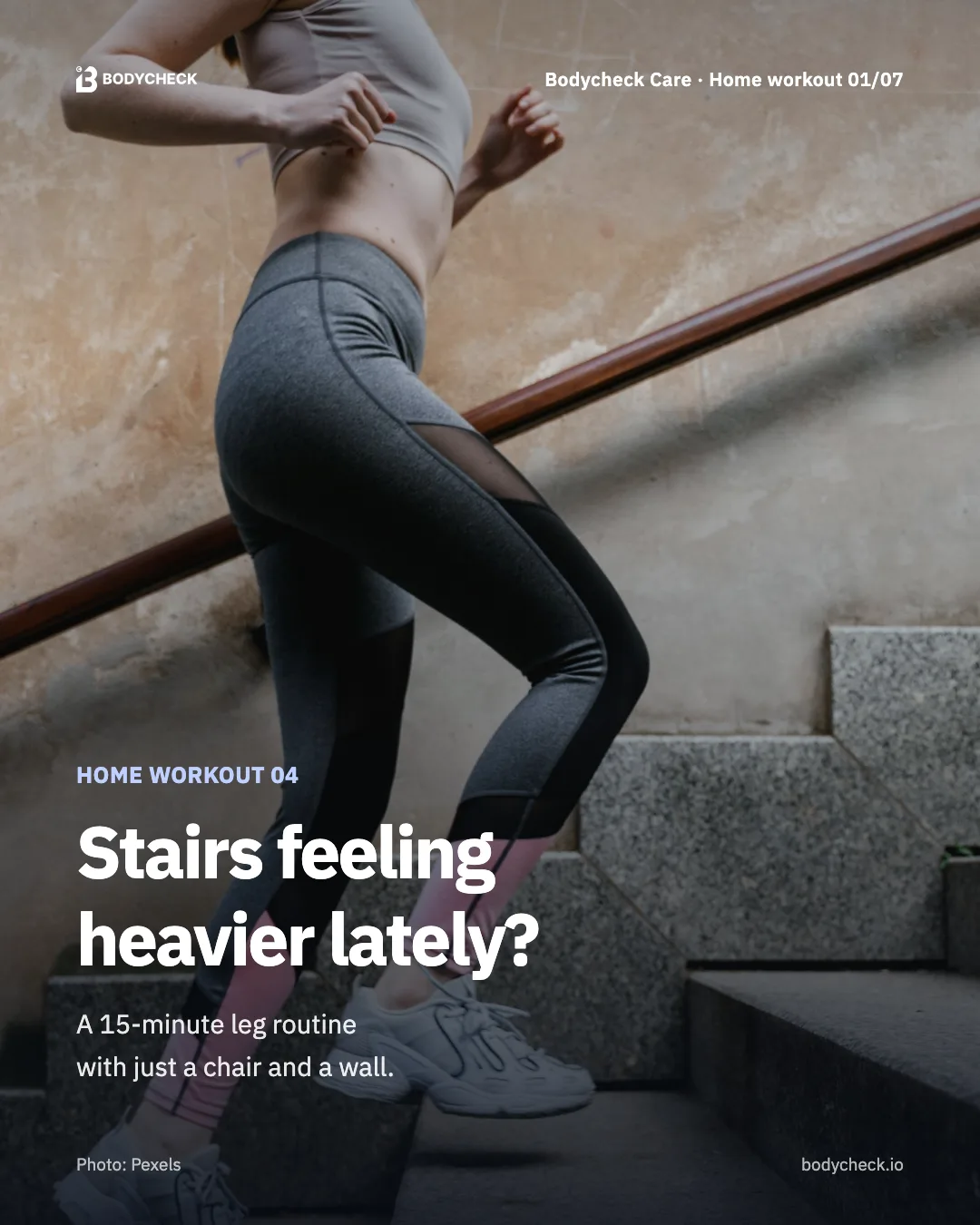
Stairs Feeling Heavier? A 15-Minute Leg Routine With a Chair and a Wall
After 30, muscle mass drops about 3 to 8% per decade. See which muscles work together on the stairs, take the 30-second sit-to-stand check, and do six supported leg moves at home.
Short answer: Heavier stairs aren't only about age. Muscle you don't use fades, and muscle you use comes back. On the stairs, the front of the thigh, the back of the thigh and glutes, and the calves all work together, so train all three. Do the six supported moves below for about 15 minutes, three times a week for four weeks.
Hi, I'm an editor on the Bodycheck Care team. Last month our office elevator was out for maintenance and I walked up five floors. By the third, my thighs were already burning, which was a bit of a wake-up call.
Do you get tired after a short walk? The good news is that muscle comes back when you use it. Below: why muscle fades, which muscles team up on the stairs, and a 15-minute leg routine that needs only a chair and a wall.
How much muscle do we lose with age?
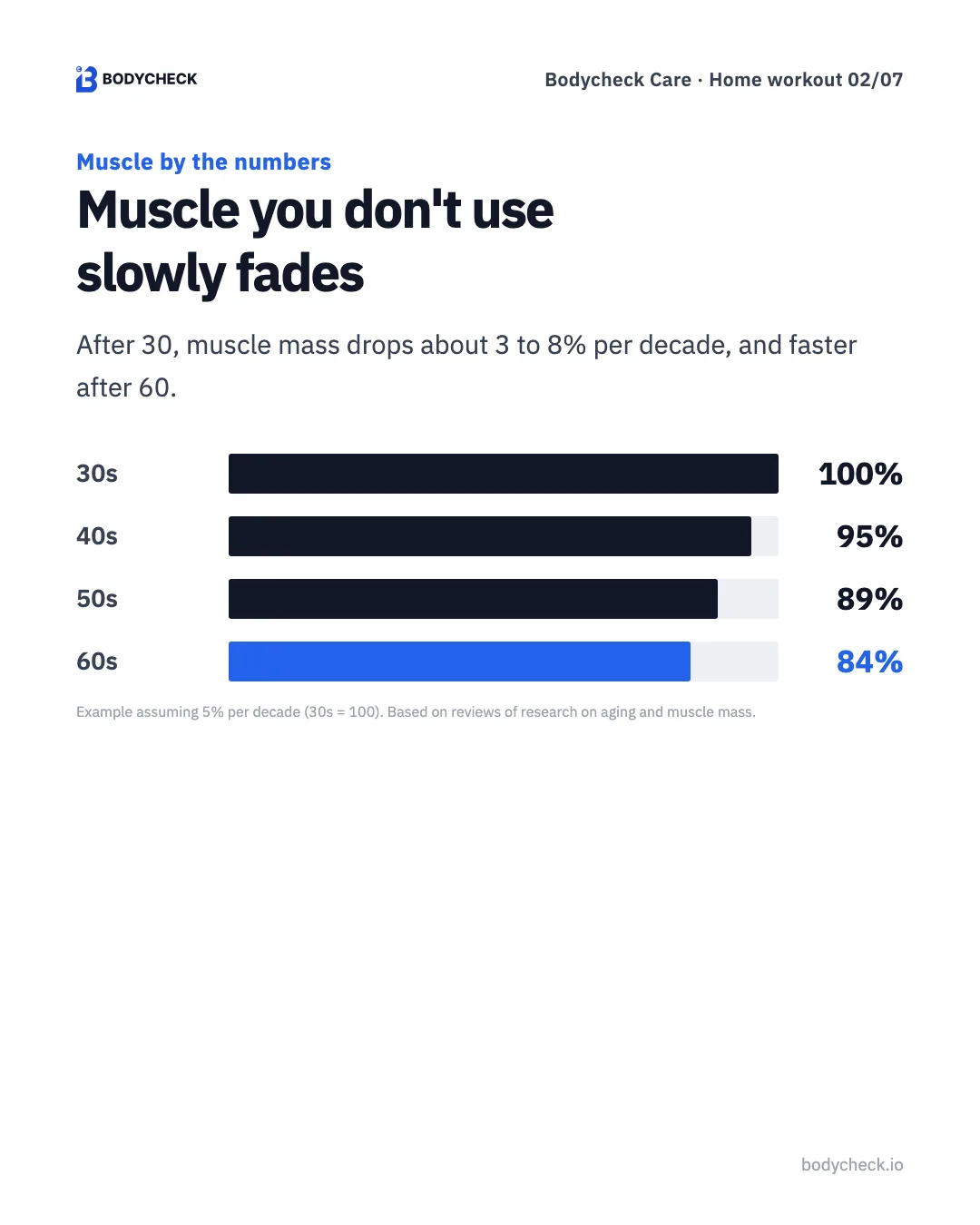
Research reviews put it at roughly 3 to 8% of muscle mass per decade after age 30, and faster after 60.
The chart assumes 5% per decade as an example. Call your 30s 100 and your 60s land around 84. The upside: muscle responds to steady use at any age. The best time to start is now.
Which muscles work when you climb stairs?
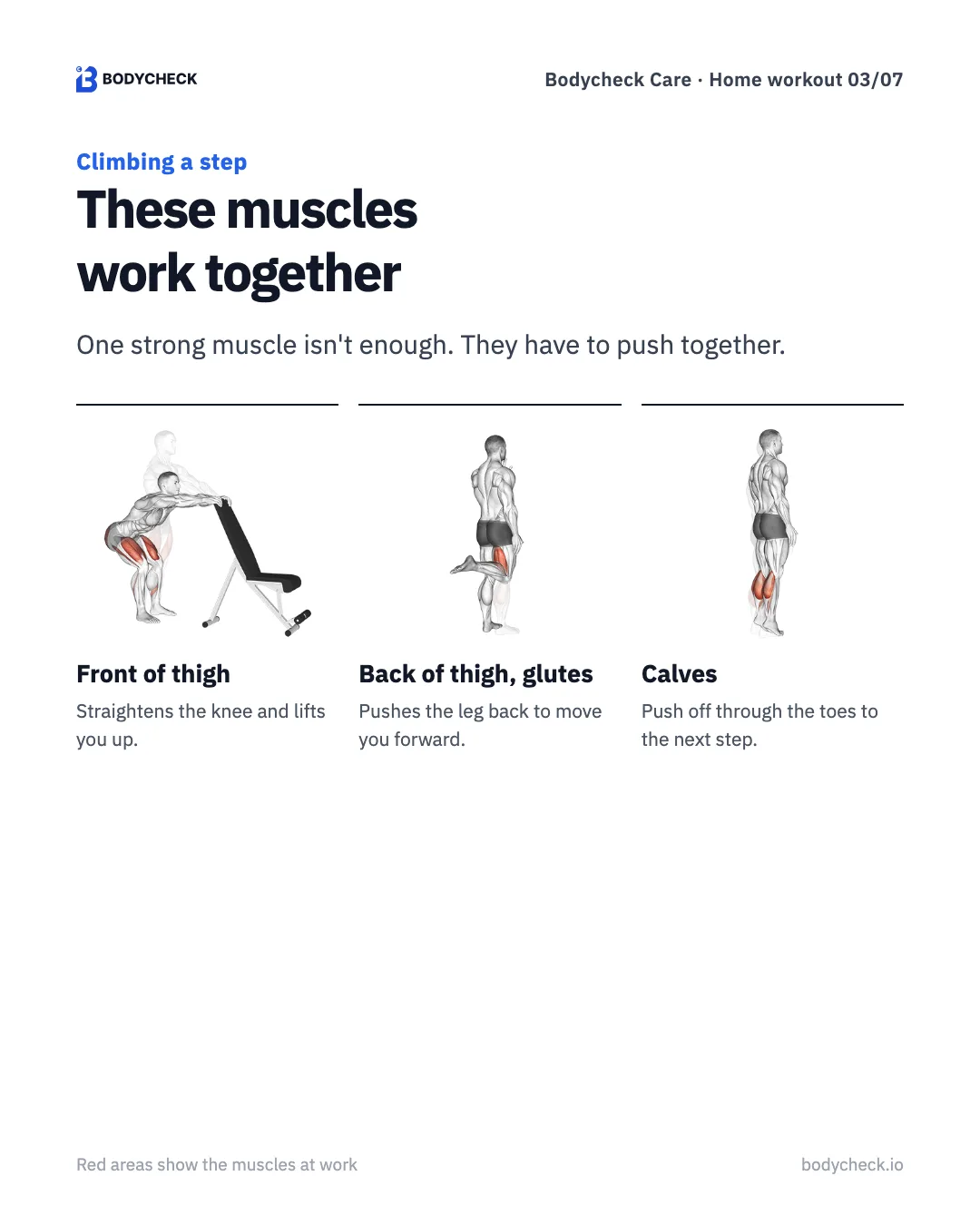
Even one step is a team effort.
- Front of the thigh: straightens the bent knee and lifts you up.
- Back of the thigh and glutes: push the leg back to move you forward.
- Calves: push off through the toes to the next step.
One strong muscle isn't enough. That's why the routine mixes squats (front of thigh, glutes), leg curls (back of thigh) and calf raises.
30-second check: sit-to-stand from a chair
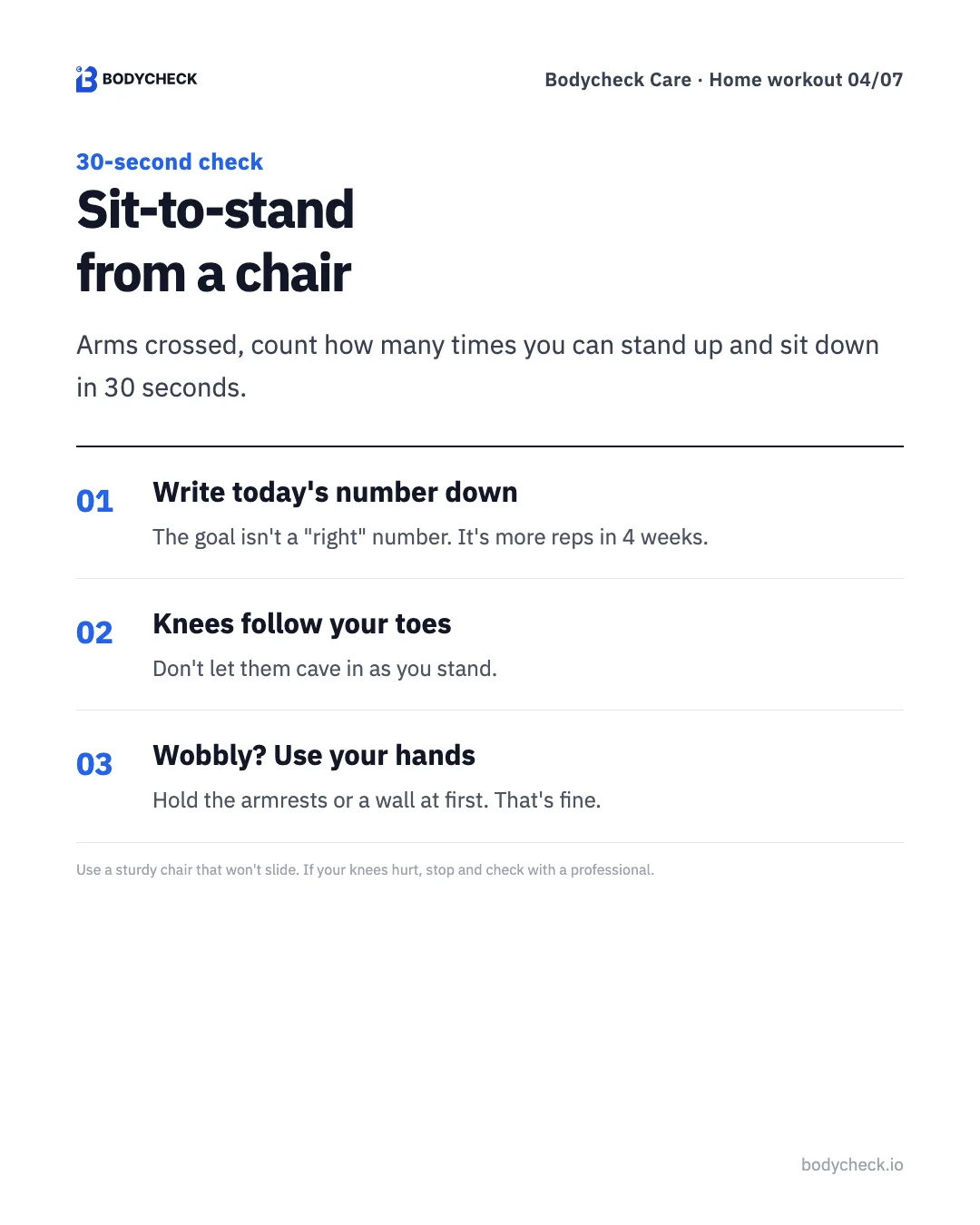
With arms crossed, count how many times you can stand up from a chair and sit back down in 30 seconds. Use a sturdy chair that won't slide.
- Write today's number down. There's no "right" number. What matters is more reps in four weeks.
- Knees follow your toes. Don't let them cave in as you stand.
- Wobbly? Use your hands. Holding the armrests or a wall at first is fine.
I keep the date and my count in my phone's notes app. Having a number makes the four-week retest something to look forward to.
Why hold a chair or a wall?
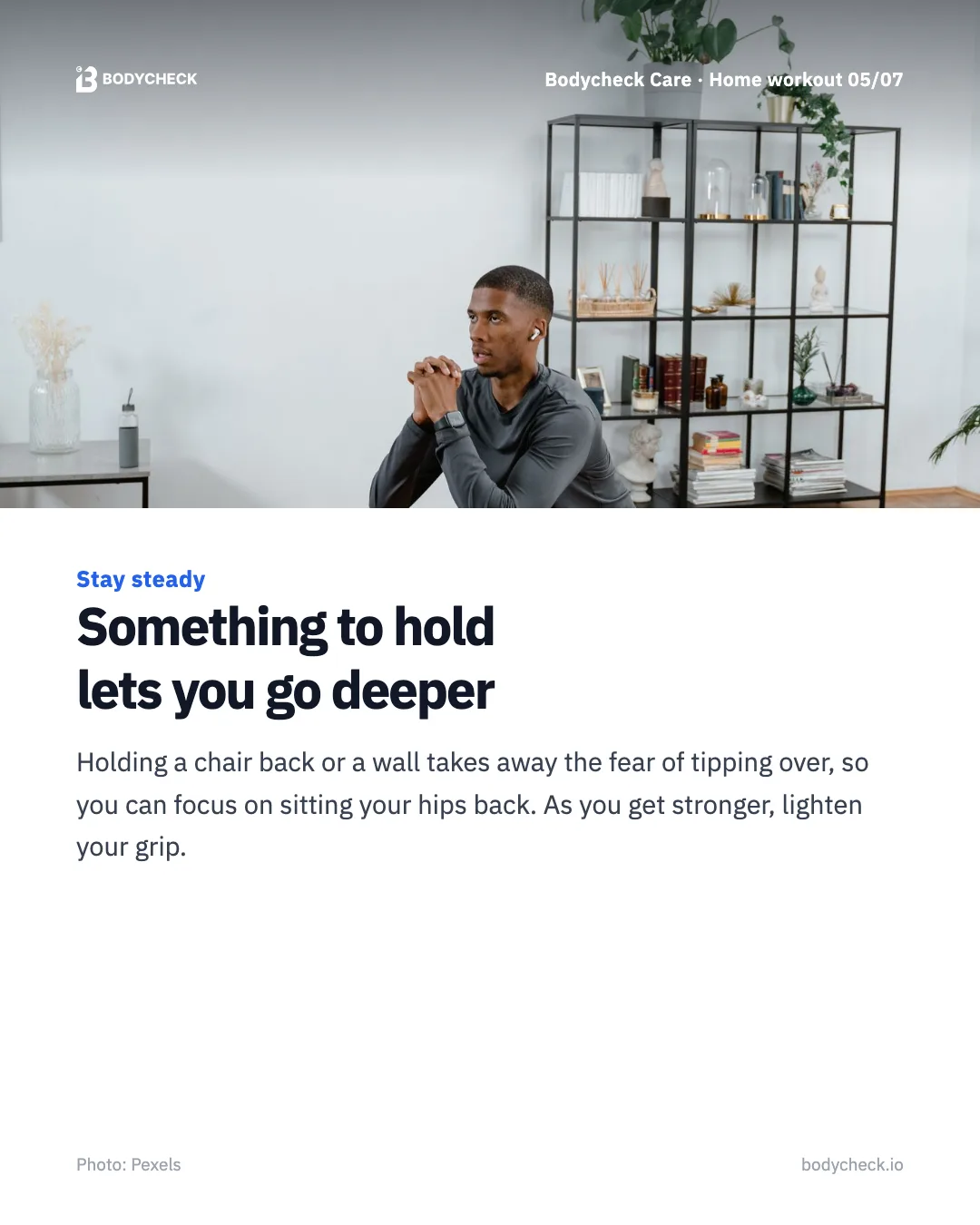
Most people avoid squats because they feel like they'll tip backward. Holding a chair back or a wall removes that worry, so you can focus on sitting your hips back.
As you get stronger, lighten your grip: two hands at first, then one, then none.
How can you see where your body stands?
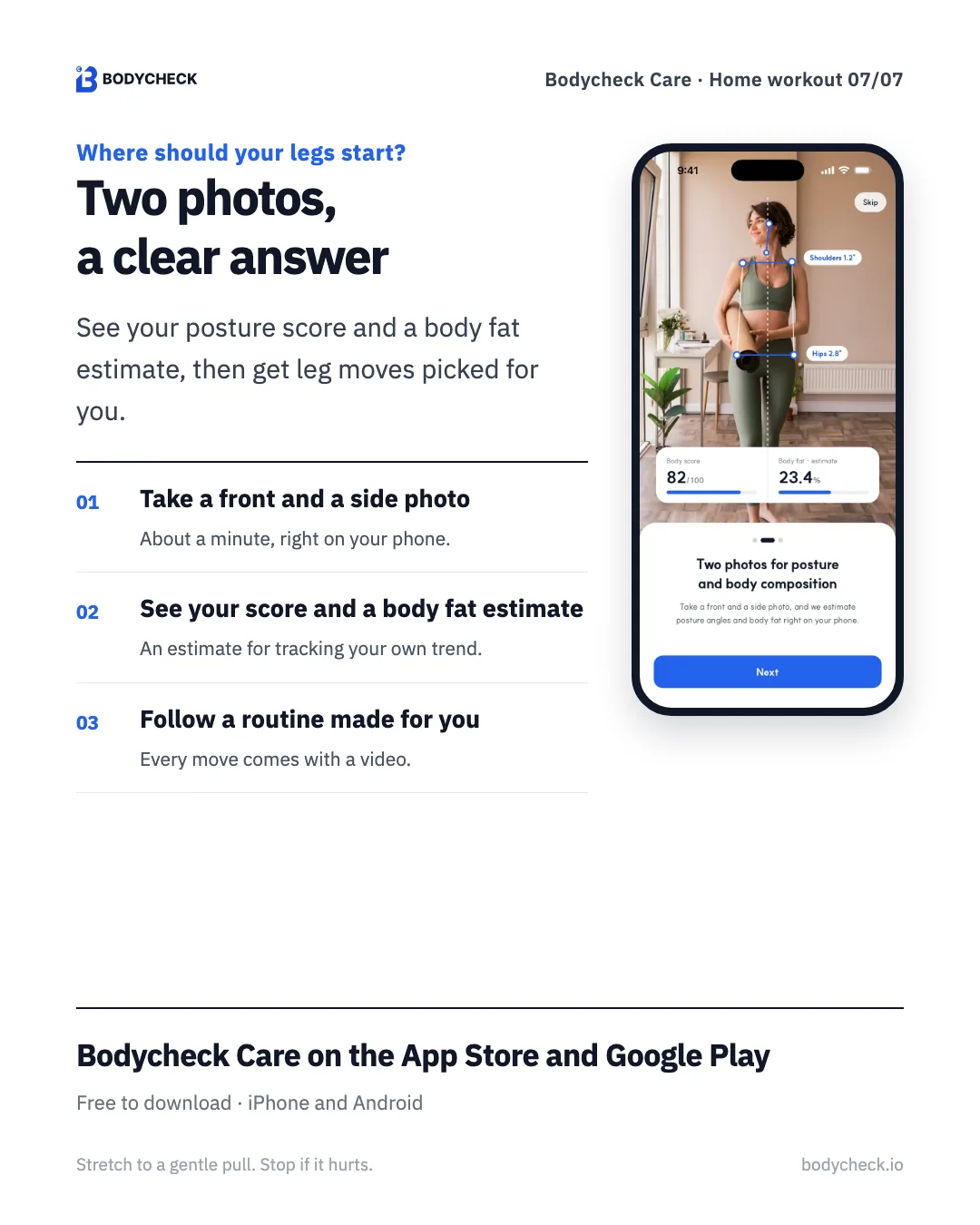
The chair check measures strength. Bodycheck Care puts numbers on your body. Take a front and a side photo and you'll see a posture score and a body fat estimate, then get leg moves picked for your result.
- Get the app and take a front and a side full-body photo.
- See your posture score and a body fat estimate. It's an estimate for tracking your own trend, not a measurement.
- Follow the moves picked for your result, each with a video.
- Retake the photos after four weeks and compare.
Bodycheck Care · Free
See your posture score and a body fat estimate, from two photos
Take a front and a side photo to see how far your head and shoulders sit forward as a score, then follow moves picked for your result, each with a video.
The 15-minute leg routine
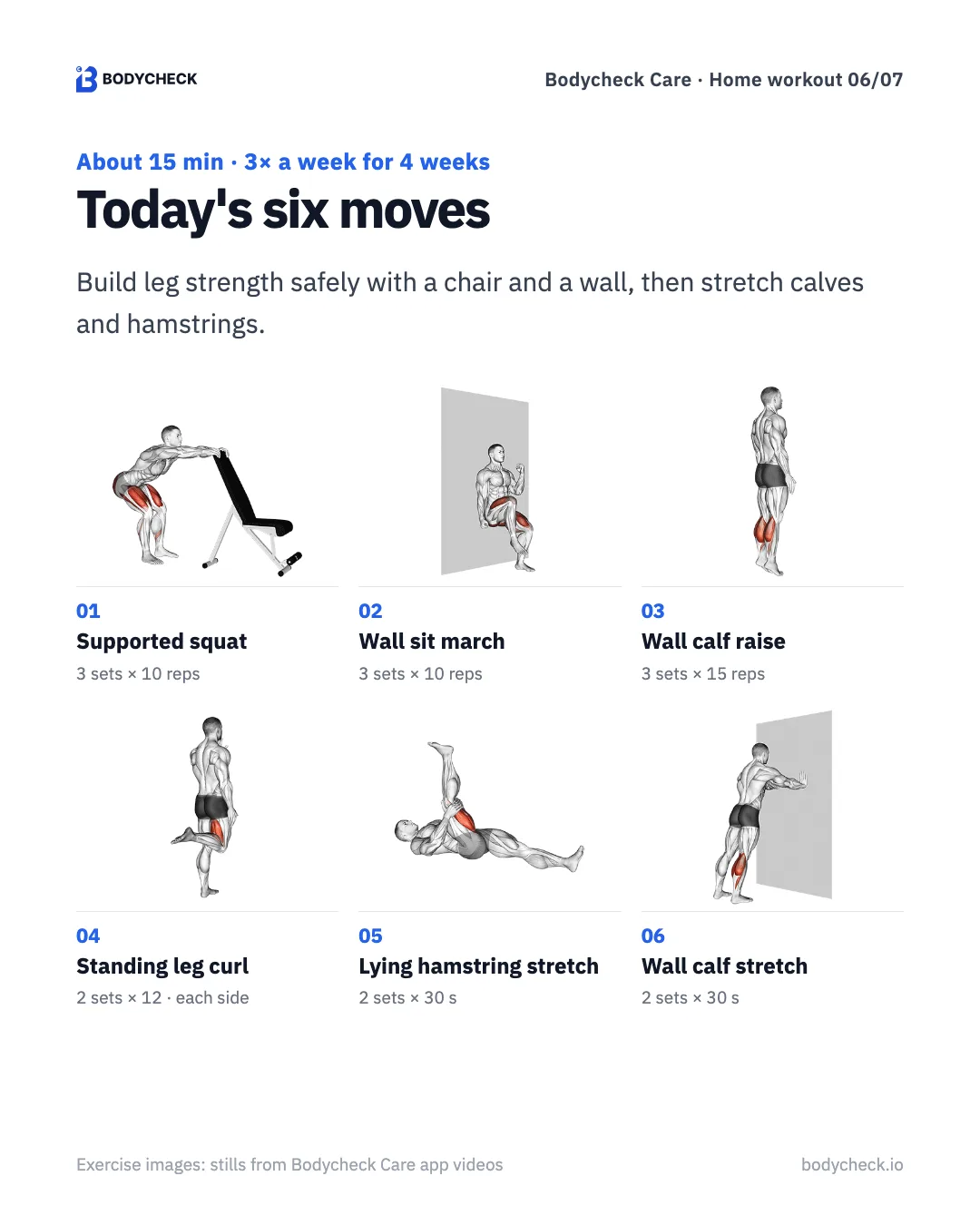
Build leg strength safely with a chair and a wall, then stretch your calves and hamstrings. Keep your knees in line with your toes, and stop if anything hurts. Do it three times a week on alternate days, for four weeks.
1. Supported squat · 3 sets × 10 reps
- Hold a chair back or a wall with feet shoulder-width apart.
- Sit your hips back as if sitting into a chair.
- Keep your chest up and your knees following your toes.
- Push through your heels to stand. 10 reps.
2. Wall sit march · 3 sets × 10 reps
- Stand with your back against a wall, feet hip-width apart.
- Slide down to a comfortable depth. The deeper, the harder.
- Holding that position, lift one foot slightly and set it down.
- Alternate for 10 reps.
3. Wall calf raise · 3 sets × 15 reps
- Hold a wall with feet shoulder-width apart.
- Shift your weight to the balls of your feet and raise your heels.
- Pause for one second at the top.
- Lower slowly. Repeat 15 times.
4. Standing leg curl · 2 sets × 12 reps · each side
- Stand tall holding a chair.
- Bend one knee to bring your heel toward your glutes.
- Keep your thigh still and move only the lower leg.
- Lower slowly. After 12 reps, switch sides.
5. Lying hamstring stretch · 2 sets × 30 s
- Lie on your back and lift one leg toward the ceiling.
- Hold the back of your thigh or calf with both hands.
- Straighten the knee only as far as is comfortable and gently pull the leg toward you.
- Hold 30 seconds, then switch sides.
6. Wall calf stretch · 2 sets × 30 s
- Face a wall with both hands on it.
- Step one foot back and press that heel into the floor.
- Bend the front knee and lean toward the wall to stretch the calf.
- Hold 30 seconds, then switch legs.
At a glance
| # | Move | Sets |
|---|---|---|
| 1 | Supported squat | 3 × 10 reps |
| 2 | Wall sit march | 3 × 10 reps |
| 3 | Wall calf raise | 3 × 15 reps |
| 4 | Standing leg curl | 2 × 12 reps · each side |
| 5 | Lying hamstring stretch | 2 × 30 s |
| 6 | Wall calf stretch | 2 × 30 s |
You can do the calf raises while brushing your teeth. In Bodycheck Care every move has a video, and the app counts the time and sets for you.
Frequently asked questions
Is it bad if my knees go past my toes? A little is fine. What matters more is that your knees follow the direction of your toes and don't cave inward.
Why train the calves? Your calves give the final push forward when you walk or climb stairs, and they help keep your ankles steady.
The wall sit is too hard. Sit less deep. The less you bend your knees, the easier it gets. Go a little lower as it becomes familiar.
How can I check my leg strength at home? With arms crossed, count how many times you can stand up from a chair and sit back down in 30 seconds, and write it down. What matters is whether the number goes up when you retest in four weeks.
What does Bodycheck Care show? From a front and a side photo it shows a posture score and a body fat estimate, then picks moves for your result with a video for each. It is free, and body fat is an estimate for tracking your own trend, not a measurement.
Before you start
- Stretch to a gentle pull. Stop right away if anything hurts or tingles.
- Don't hold your breath. Breathe out as you push.
- In the first week it's fine to drop one set from each move.
- Use a sturdy chair. If your knees hurt, see a doctor before you exercise.
Try the 30-second chair check today. That number is your starting line for the next four weeks.
Bodycheck Care · Free
Take two photos and get moves picked for you
Take a front and a side photo to see how far your head and shoulders sit forward as a score, then follow moves picked for your result, each with a video.
References
- Reviews of research on aging and muscle mass (about 3–8% per decade after 30, faster after 60), e.g. Volpi E, Nazemi R, Fujita S. Muscle tissue changes with aging. Current Opinion in Clinical Nutrition and Metabolic Care, 2004;7(4):405-410.
- Photos: Pexels (free license). Exercise images and app screens: Bodycheck Care app.