Bad Posture Habits: 7 Everyday Habits That Pull Your Posture Off, and Easy Swaps
Your phone at chest height, always crossing the same leg, a bag on one shoulder, slumping on the sofa edge, standing on one leg, sleeping on your stomach and a wallet in your back pocket. Seven habits that can be connected to posture, a simple swap for each, and a 12-minute full-body routine.
Short answer: Seven everyday habits that can be connected to posture are looking at your phone at chest height, always crossing the same leg, slumping on the sofa edge, sitting on a wallet in your back pocket, carrying a bag on one shoulder, standing on one leg and sleeping on your stomach. None of them can be pinned as the cause, but most keep you leaning forward or to one side for a long time. Swap one habit a week, and do the six moves below for about 12 minutes, three times a week for four weeks. If you have pain or numbness, see a doctor before you exercise.
Hi, I'm an editor on the Bodycheck Care team. On the train home a few days ago, I caught my reflection in the door glass. All my weight was on my right leg with my hip pushed out to the side. My phone was at chest height in my left hand, and my head was dropped way down to see it. My bag? Right shoulder, as usual.
That night I wrote down the positions I fall into without thinking. The list was longer than I expected. No single habit like this can be said to change your posture. But time spent in the same shape, on the same side, can add up. So today I'll share seven everyday habits that can be connected to posture, an easy swap for each one, and a 12-minute routine that works your front, back and sides evenly.
What happens to your neck when your phone sits at chest height?
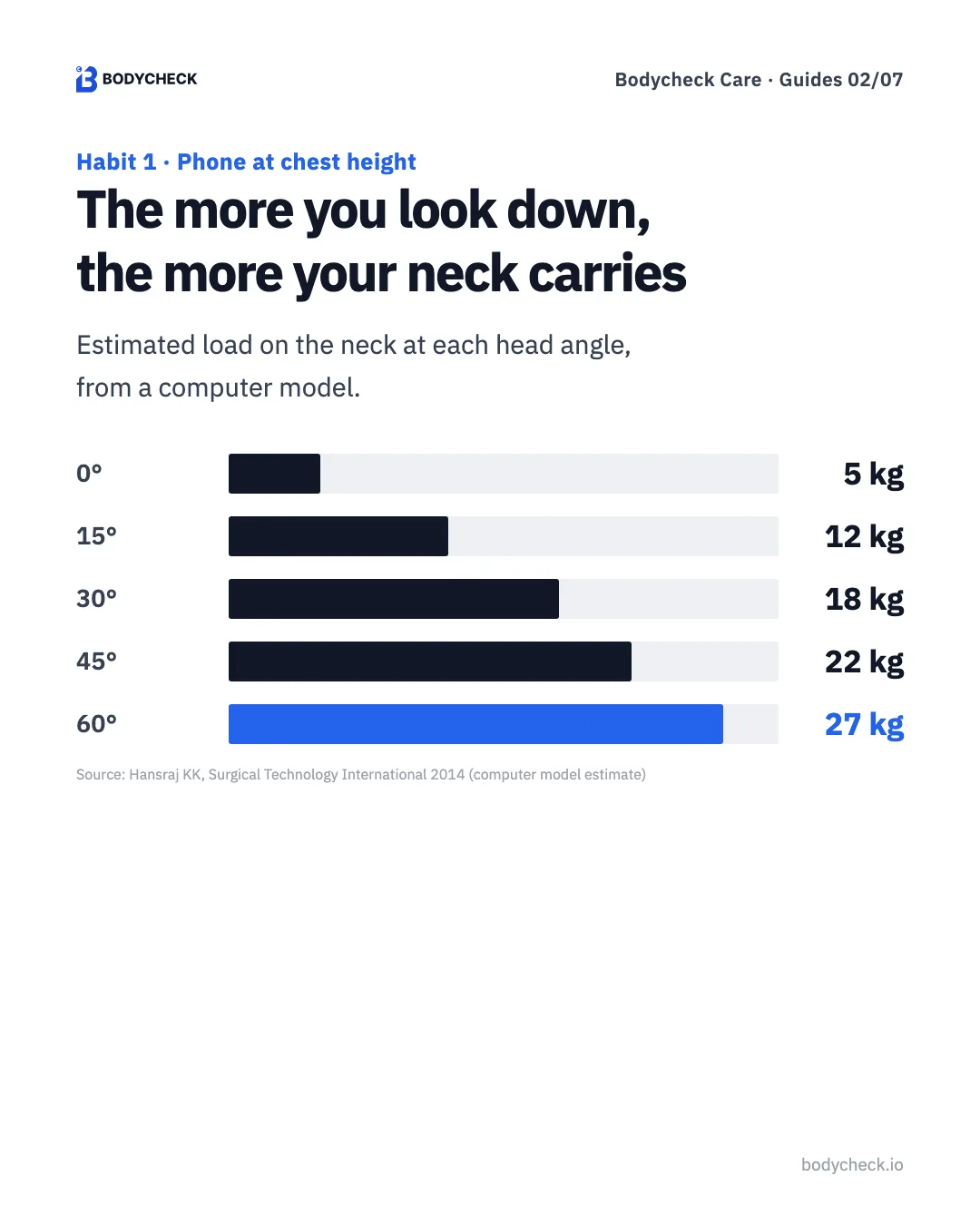
Habit 1. Looking at your phone at chest height. Hold your phone in front of your chest or belly and your head drops forward to see the screen. One study used a computer model to estimate the load: about 5 kg on the neck with your head upright, about 12 kg at 15 degrees, about 18 kg at 30 degrees, about 22 kg at 45 degrees and about 27 kg at 60 degrees. Keep in mind these are model estimates, not measurements from real bodies.
- The swap: Raise your phone closer to eye level. If your arm gets tired, support that elbow with your other hand, or use a stand when you're at a desk.
- One more: For long reads or videos, a laptop or tablet on a stand lets you look down less than a phone does.
Which sitting habits are worth a look?
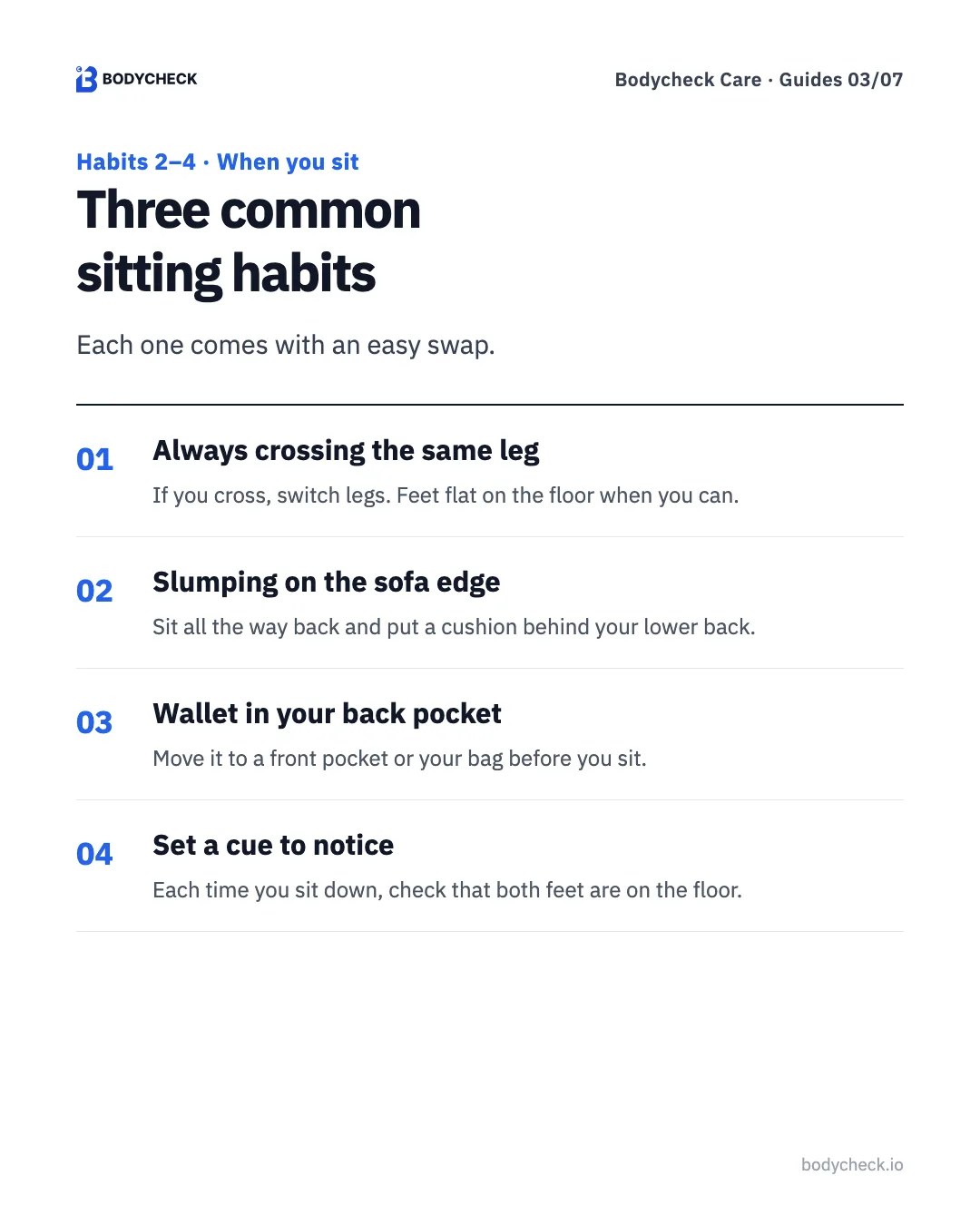
We sit a lot, so sitting habits pile up fast. Here are three.
- Habit 2. Always crossing the same leg: If it's always the right leg on top, or always the left, you may spend more time sitting tilted toward one side. The swap: If you want to cross, switch legs. Keep both feet on the floor when you can.
- Habit 3. Slumping on the sofa edge: Slide your hips forward and round your back against the cushion, and your lower back goes unsupported for a long time. The swap: Sit all the way back and put a cushion or folded towel in the gap behind your lower back.
- Habit 4. Sitting on a wallet in your back pocket: You may end up sitting with one hip raised by the thickness of the wallet. The swap: Move it to a front pocket or your bag before you sit.
My cue is a quick check every time I sit down: are both feet on the floor? Having one cue tends to bring the others to mind too.
What about carrying, standing and sleeping?
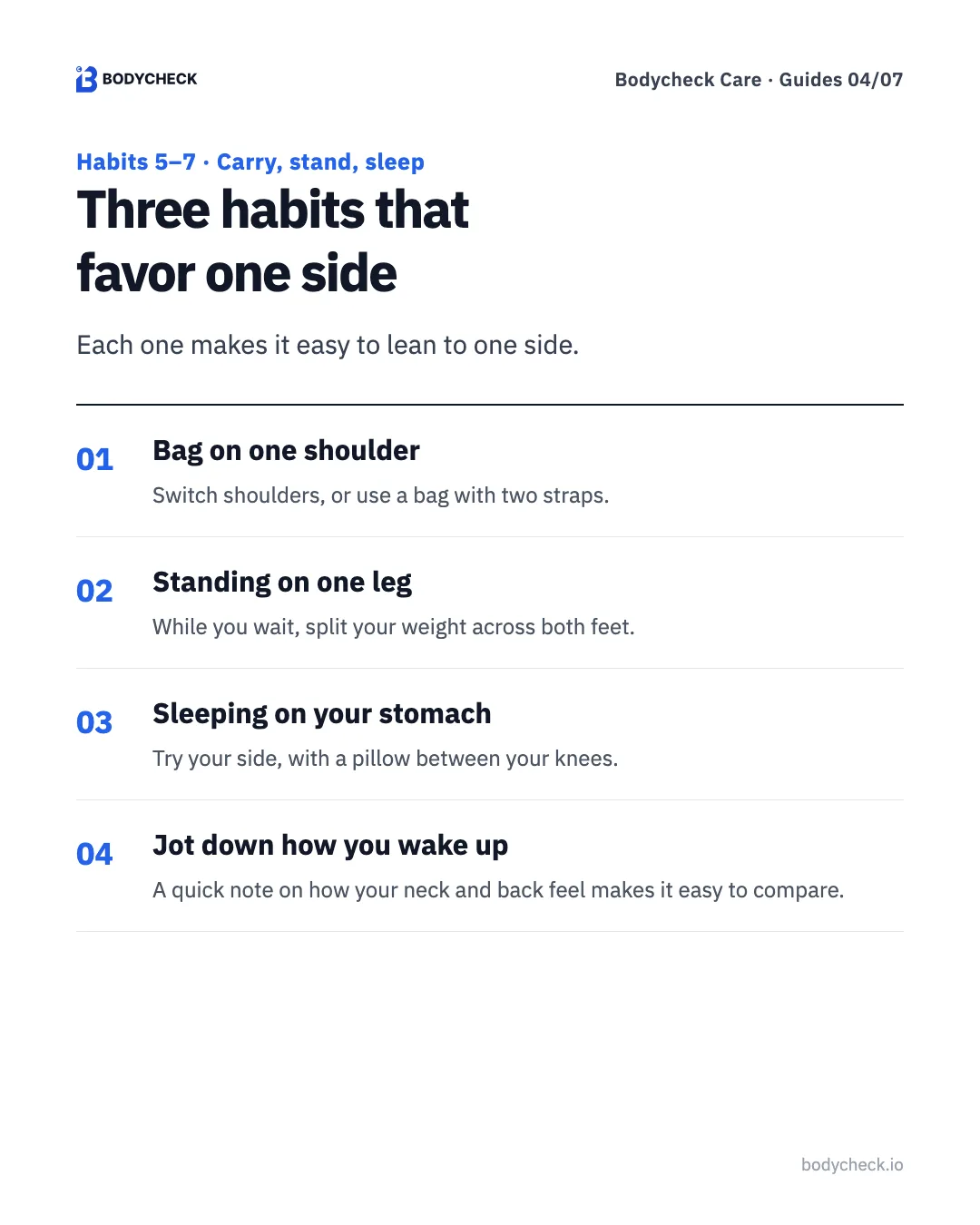
Even when you're not sitting, some habits pull you to one side.
- Habit 5. Carrying a bag on one shoulder: You may hike that shoulder up a little so the strap won't slip. The swap: Switch shoulders every other day, or use a bag with two straps. I covered shoulder height in how to check whether one shoulder sits higher.
- Habit 6. Standing on one leg: In line or on the platform, it's easy to put all your weight on one leg and push that hip out. The swap: While you wait, stand with feet hip-width apart and split your weight across both feet.
- Habit 7. Sleeping on your stomach: To breathe, you keep your head turned to one side for hours. The swap: Try your side with a pillow between your knees, or your back with a pillow under your knees.
Sleep habits don't change overnight. Jot down one line each morning about how your neck and back feel, so you can compare before and after.
How do you make a new habit stick?
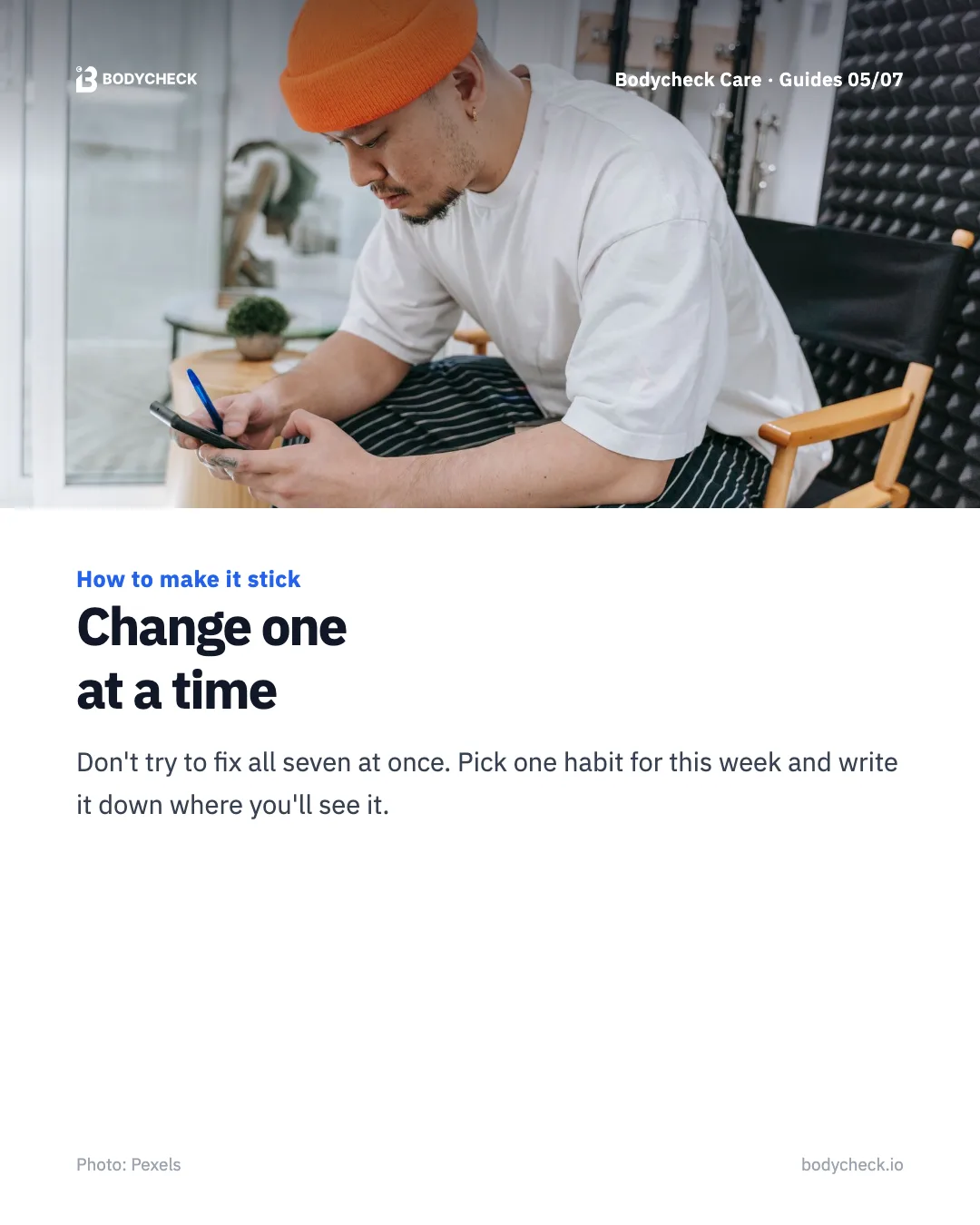
Try to fix all seven at once and it lasts a few days. That's what happened to me. Here's what I'd suggest instead.
- Pick one habit for this week. Choose the one that shows up most in your day.
- Write it where you'll see it. Your lock screen, next to your monitor, by the front door: wherever that habit happens.
- Decide what to do instead. Not "don't cross my legs" but "switch legs when I cross." Name the new action, not just the old one.
- Move on after a week. Once it feels normal, pick the next one.
Changing habits cuts the time you spend leaning one way. Working the muscles on your front, back and sides evenly is what exercise is for. Doing both works well together.
How can you see your posture as numbers?
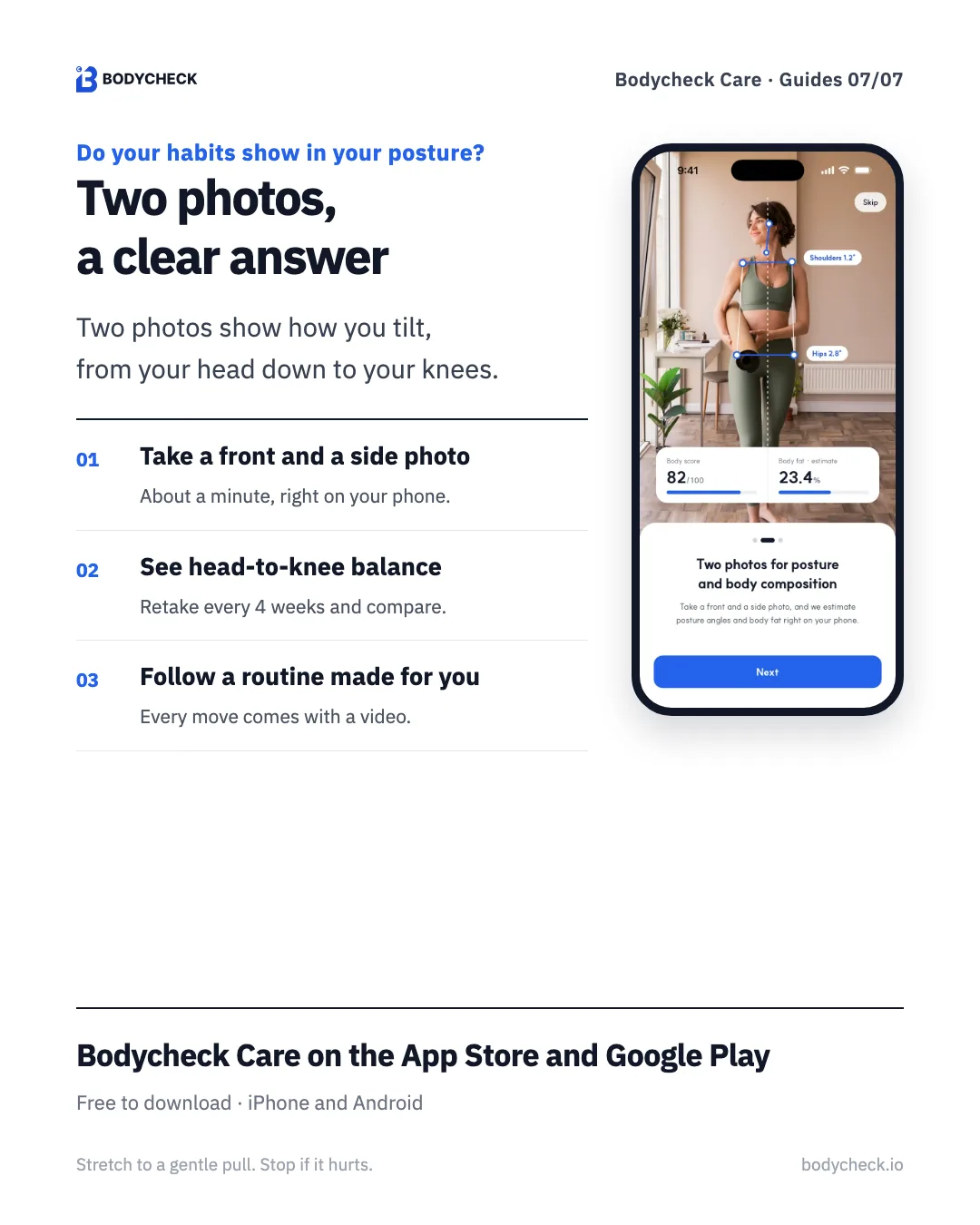
While you swap habits, you may want to check your posture with the same yardstick each time. Try Bodycheck Care. Take a front and a side full-body photo. From the front, the app shows head tilt, shoulder balance, hip balance and knee balance. From the side, it shows forward head position, forward shoulder position and pelvic tilt, all as angles and scores. If most of your habits lean to one side, watch the front-view balance. If you look down a lot, watch the side view.
- Get the app and take a front and a side full-body photo.
- See how you tilt, from head to knees, as angles and scores.
- Follow the moves picked for your result and where you work out, each with a video.
- Retake the photos in the same spot after four weeks and compare.
The app is not a medical device. It's a way to record your posture with the same yardstick each time.
Bodycheck Care · Free
See whether your habits show in your posture, from two photos
Take a front and a side photo to see how far your head and shoulders sit forward as a score, then follow moves picked for your result, each with a video.
The 12-minute routine for your front, back and sides
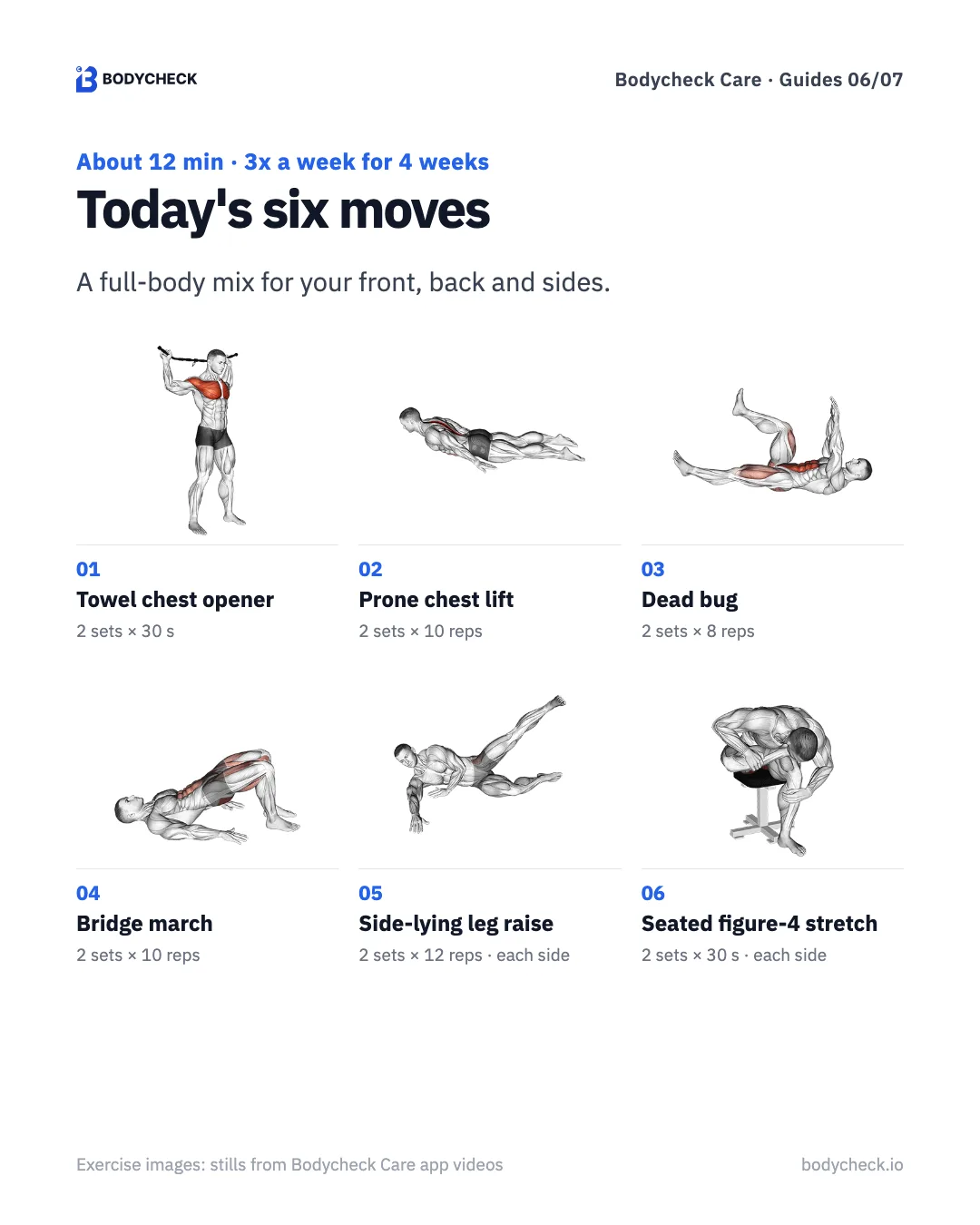
Open up your chest, wake up your back, hold your trunk steady with your abs and glutes, then work the side of your hips and finish with a deep hip stretch. A mat, a towel and a chair are all you need. Do it three times a week on alternate days, for four weeks. For one-sided moves, keep reps equal on both sides.
1. Towel chest opener · 2 sets × 30 s
- Stand tall holding a towel or long stick wider than your shoulders.
- With straight arms, raise it slowly overhead.
- Take it behind your head only as far as it goes freely, to stretch the front of your chest and shoulders. If your shoulders catch, widen your grip.
- Bring it slowly back to the front and repeat for 30 seconds.
2. Prone chest lift · 2 sets × 10 reps
- Lie face down with legs straight and hands by your head or at your sides.
- Squeeze your shoulder blades toward the middle of your back.
- Lift your chest slightly off the floor and hold one second. Eyes on the floor, don't arch your lower back.
- Lower slowly and repeat 10 times.
3. Dead bug · 2 sets × 8 reps
- Lie on your back with arms toward the ceiling and hips and knees bent to 90 degrees.
- Keep your lower back on the floor and slowly reach one arm and the opposite leg away.
- Stop before your back lifts and return to the start.
- Alternate sides for 8 reps.
4. Bridge march · 2 sets × 10 reps
- Lie on your back with knees bent and lift your hips into a bridge.
- Keep your hips at the same height and lift one knee toward your chest.
- Lower that foot and lift the other.
- Alternate 10 times without letting your hips tip.
5. Side-lying leg raise · 2 sets × 12 reps · each side
- Lie on your side and prop yourself up on your elbow.
- Keep your bottom leg on the floor and your top leg straight.
- With toes pointing forward, lift your top leg slowly.
- Lower it slowly. Do 12, then switch sides.
6. Seated figure-4 stretch · 2 sets × 30 s · each side
- Sit on a chair and rest one ankle on the opposite knee.
- Keep your back straight and lean your chest forward.
- Turn your upper body slightly toward the raised leg to stretch deep in your hip.
- Hold 30 seconds, then switch sides.
At a glance
| # | Move | Sets |
|---|---|---|
| 1 | Towel chest opener | 2 × 30 s |
| 2 | Prone chest lift | 2 × 10 reps |
| 3 | Dead bug | 2 × 8 reps |
| 4 | Bridge march | 2 × 10 reps |
| 5 | Side-lying leg raise | 2 × 12 reps · each side |
| 6 | Seated figure-4 stretch | 2 × 30 s · each side |
My habit for this week is "stand on both feet on the train." Every time I catch my reflection in the door, it's an easy reminder. In Bodycheck Care every move has a video, and the app counts the time and sets for you.
Frequently asked questions
Does crossing my legs throw my hips out of line? You can't say that for sure. But if you always cross the same leg for long stretches, you may spend more time sitting tilted to one side. If you want to cross, switch legs, and keep both feet on the floor when you can.
I'm comfortable sleeping on my stomach. Do I have to change? On your stomach, your head stays turned to one side for hours. If your neck often feels stiff in the morning, try lying on your side with a pillow between your knees, or on your back with a pillow under your knees. Sleep habits change slowly, and that's fine.
Do I need to change all seven at once? No. Pick the one that shows up most in your day and work on it for a week. Once it feels normal, move on to the next. Trying to change everything at once usually doesn't last.
If I change my habits, do I still need to exercise? They do different jobs. Changing habits cuts the time you spend leaning one way. Exercise works the muscles on your front, back and sides evenly. Try the 12-minute routine below three times a week for four weeks alongside your habit swaps.
Can I see whether my habits show in my posture as numbers? Bodycheck Care takes a front and a side full-body photo and shows head tilt, shoulder balance, hip balance and knee balance, plus forward head position, forward shoulder position and pelvic tilt, as angles and scores. You can retake the photos every four weeks to compare. It is free on iPhone and Android.
Before you start
- Habits are only one of many things connected to posture. Don't judge your body by any single habit.
- Stretch to a gentle pull. Stop right away if anything hurts or tingles.
- Don't hold your breath. Breathe out as you push.
- This is exercise guidance. If you have pain in your neck, back or shoulders, numbness in your arms or legs, or pain that doesn't ease with rest, see a doctor before you exercise.
How about counting how many of these seven show up in your day today? Then pick just one to swap this week.
Bodycheck Care · Free
Take two photos and get moves picked for you
Take a front and a side photo to see how far your head and shoulders sit forward as a score, then follow moves picked for your result, each with a video.
References
- Hansraj KK. Assessment of stresses in the cervical spine caused by posture and position of the head. Surgical Technology International. 2014;25:277-279. (computer model estimate)
- Photos: Pexels (free license). Exercise images and app screens: Bodycheck Care app.