Stiff Neck After Sleep or a Long Workday: Daily Habits and an 8-Minute Desk Routine
Wake up with a stiff neck, or feel it tighten by the end of the workday? Here are everyday habits that can be connected, the signs that mean see a doctor first, and a gentle 8-minute routine you can do next to your desk.
Short answer: A stiff neck in the morning or at the end of the workday can be connected to everyday habits: your pillow and sleeping position, hours of looking down at a screen, and shoulders that creep up when you're tense. The cause is hard to pin on one thing. Pain spreading into the arm, numbness or weakness, pain after an injury, a fever with a stiff neck, or pain that keeps getting worse means see a doctor first. Otherwise, try the six gentle moves below for about 8 minutes, three times a week for four weeks.

Hi, I'm an editor on the Bodycheck Care team. Not long ago I reached over to turn off my alarm, turned my head, and froze halfway. The night before, I'd fallen asleep face down while scrolling in bed. For the rest of that day, I turned my whole body every time I wanted to look sideways.
Since then I've paid more attention to when my neck gets stiff. Below I'll go through everyday habits that can be connected, the signs that mean a doctor comes before exercise, and the 8-minute routine I do next to my desk. A chair and a towel are all you need.
When does a stiff neck tend to show up?
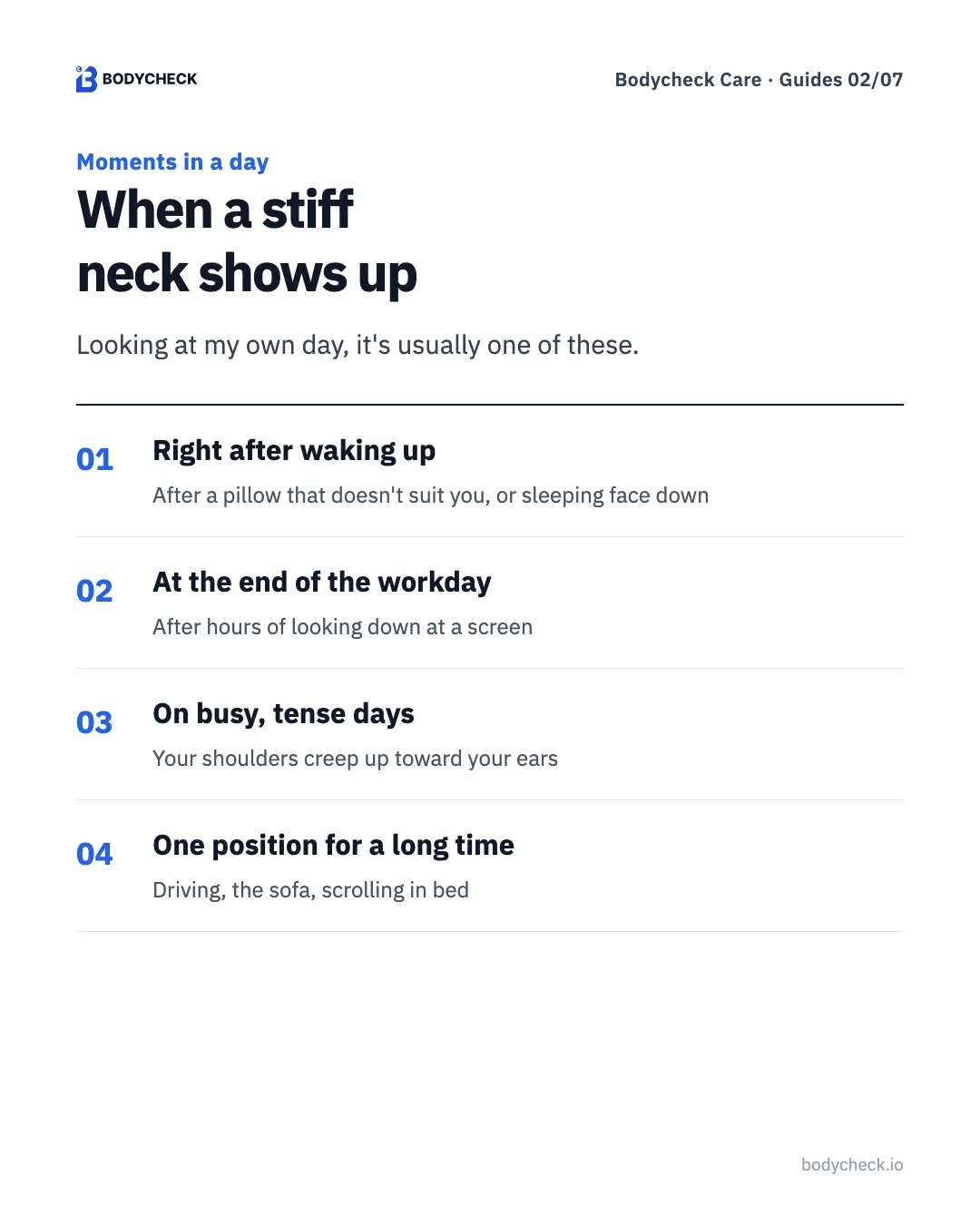
Looking back at my own days, it was usually one of four moments.
- Right after waking up. After a pillow that was too high or too low, or a night face down with my head turned to one side.
- At the end of the workday. After hours of looking down at a screen.
- On busy, tense days. Near a deadline, my shoulders creep up toward my ears without my noticing.
- After one position for a long time. A long drive, the sofa, scrolling in bed.
Sleep is one place where small changes are easy to try. Many people find a pillow comfortable when it keeps the head and neck roughly in line with the body. To break my face-down habit, I put a cushion between my knees when I lie on my side. On a stiff morning, I don't crank my head around right away. I take a warm shower first, then start with small, slow movements.
This is just a list of moments from my own life. It can't tell you what is behind your stiff neck.
How hard does your neck work at a screen?
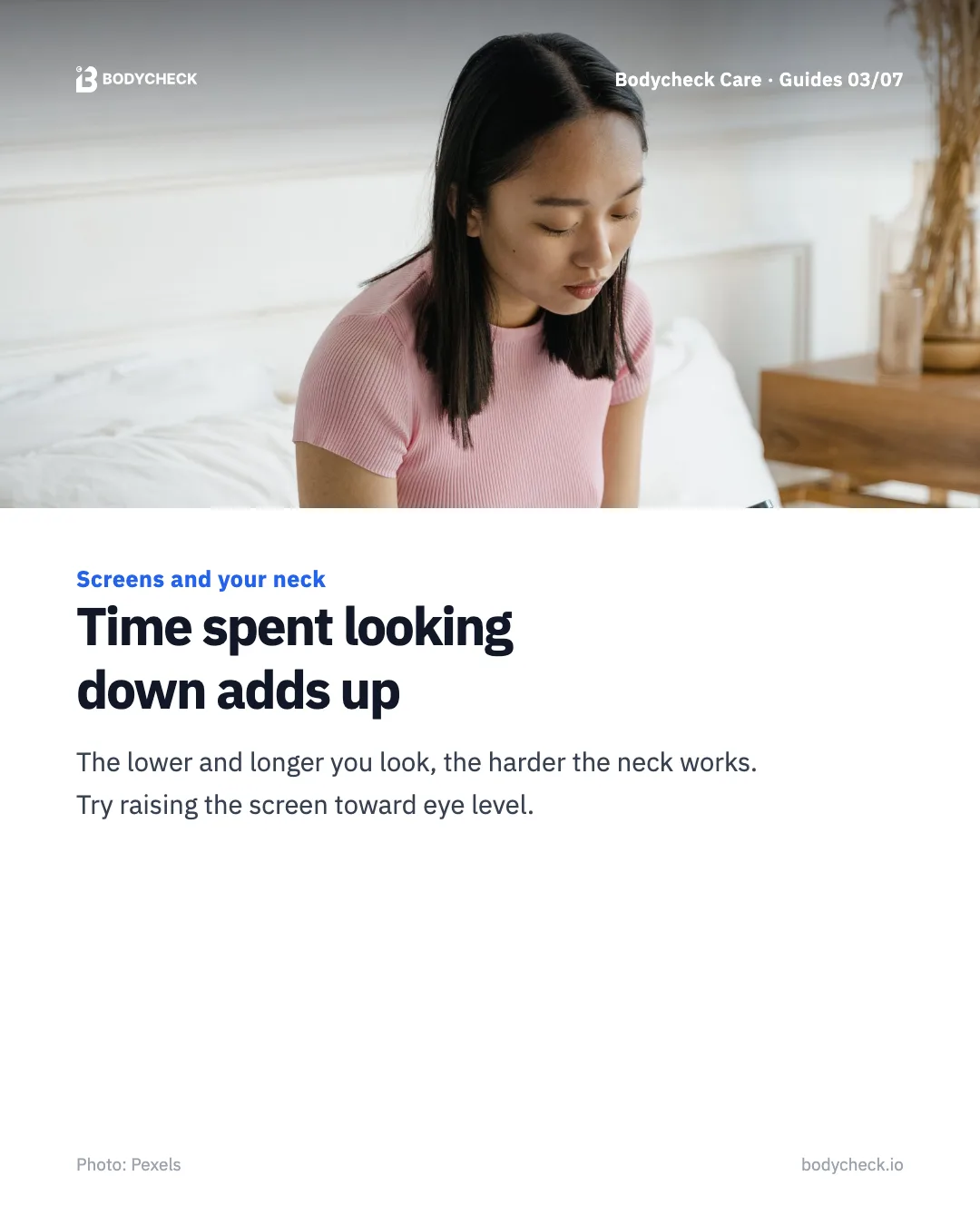
Phones and laptops usually sit below eye level, so your head drops the moment you look at them. A 2014 study used a computer model to estimate that the load on the neck, about 5 kg (11 lb) with the head upright, could rise to about 18 kg (40 lb) at a 30-degree tilt and about 27 kg (60 lb) at 60 degrees. These are model estimates, not measurements inside a real neck. Just keep the direction in mind: the lower and longer you look down, the harder the back of your neck works.
So before any exercise, I moved my screens.
- Put the laptop on a stand so the top of the screen sits near eye level.
- Lift your phone toward your eyes instead of dropping your head.
- About once an hour, stand up, roll your shoulders and get some water.
- When you use your phone in bed, sit back against something instead of lying face down, and hold it a bit higher.
Why do your shoulders tighten up when you're tense?
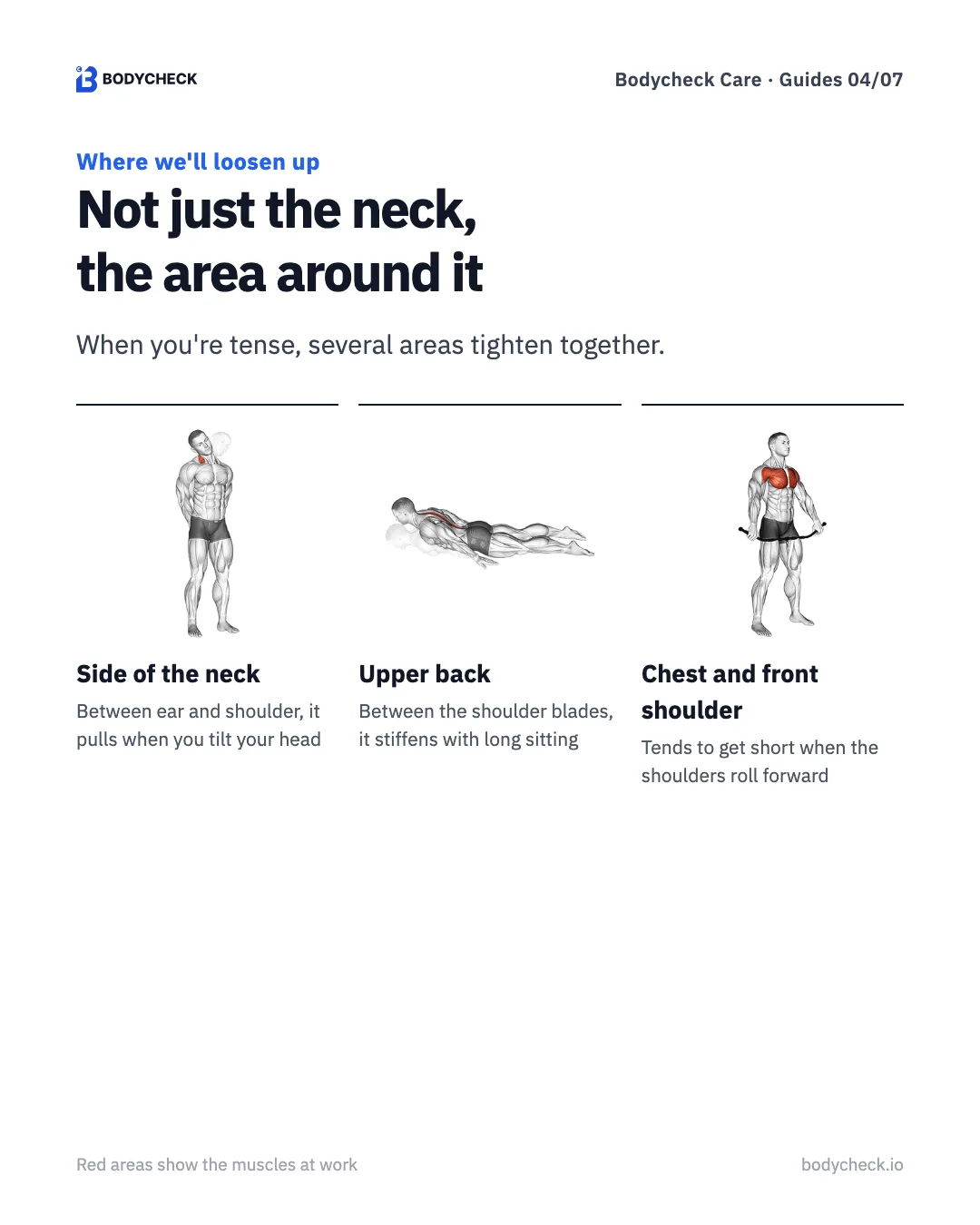
On busy days I catch myself in the mirror with my shoulders up near my ears and my breathing shallow. A lot of people tense their neck and shoulders when they're stressed or focused. Hold that for a few hours and the stiffness can spread from the side of the neck to between the shoulder blades and across the chest.
That's why today's routine doesn't just pull on the neck. It goes side of the neck, back of the shoulder, upper back, then chest, loosening the whole area around the neck, and ends with the hips and back that have been sitting all day. While you stretch, focus less on pushing and more on long, slow breaths out. I start by breathing out and letting my shoulders drop.
When should you see a doctor before exercising?
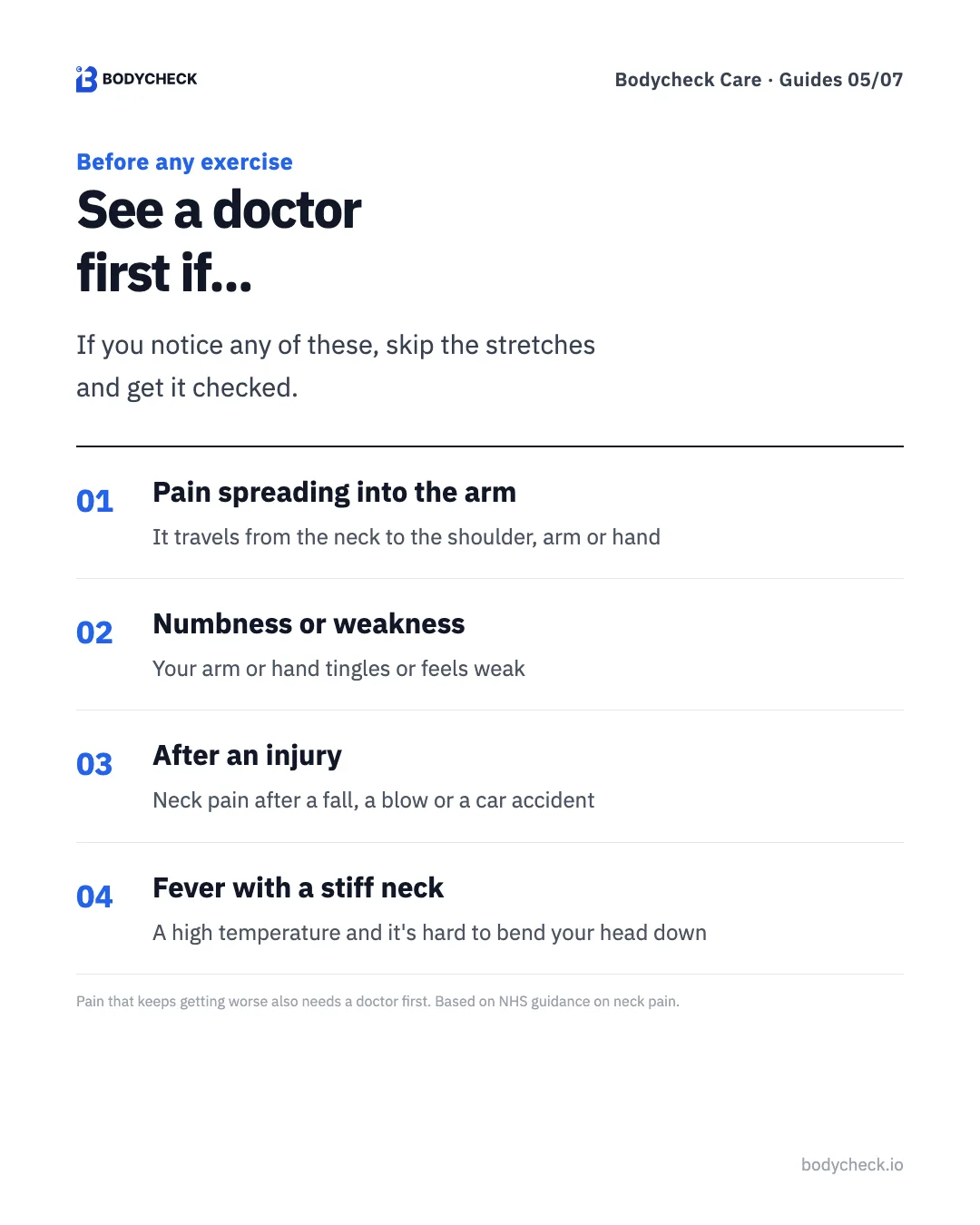
Please read this part. If you notice any of these, skip the stretches and get it checked by a doctor.
- Pain spreading into the arm. It travels from your neck into your shoulder, arm or hand.
- Numbness or weakness. Your arm or hand tingles, goes numb, or feels weak.
- After an injury. Neck pain after a fall, a blow or a car accident.
- A fever with a stiff neck. A high temperature and a neck so stiff it's hard to bend your head down. Get medical help right away.
On top of these, pain that keeps getting worse, pain that isn't easing after a few days, or pain bad enough to keep you awake also calls for a doctor before exercise. This is general guidance. A doctor decides your case.
How can you see where your head and shoulders sit?
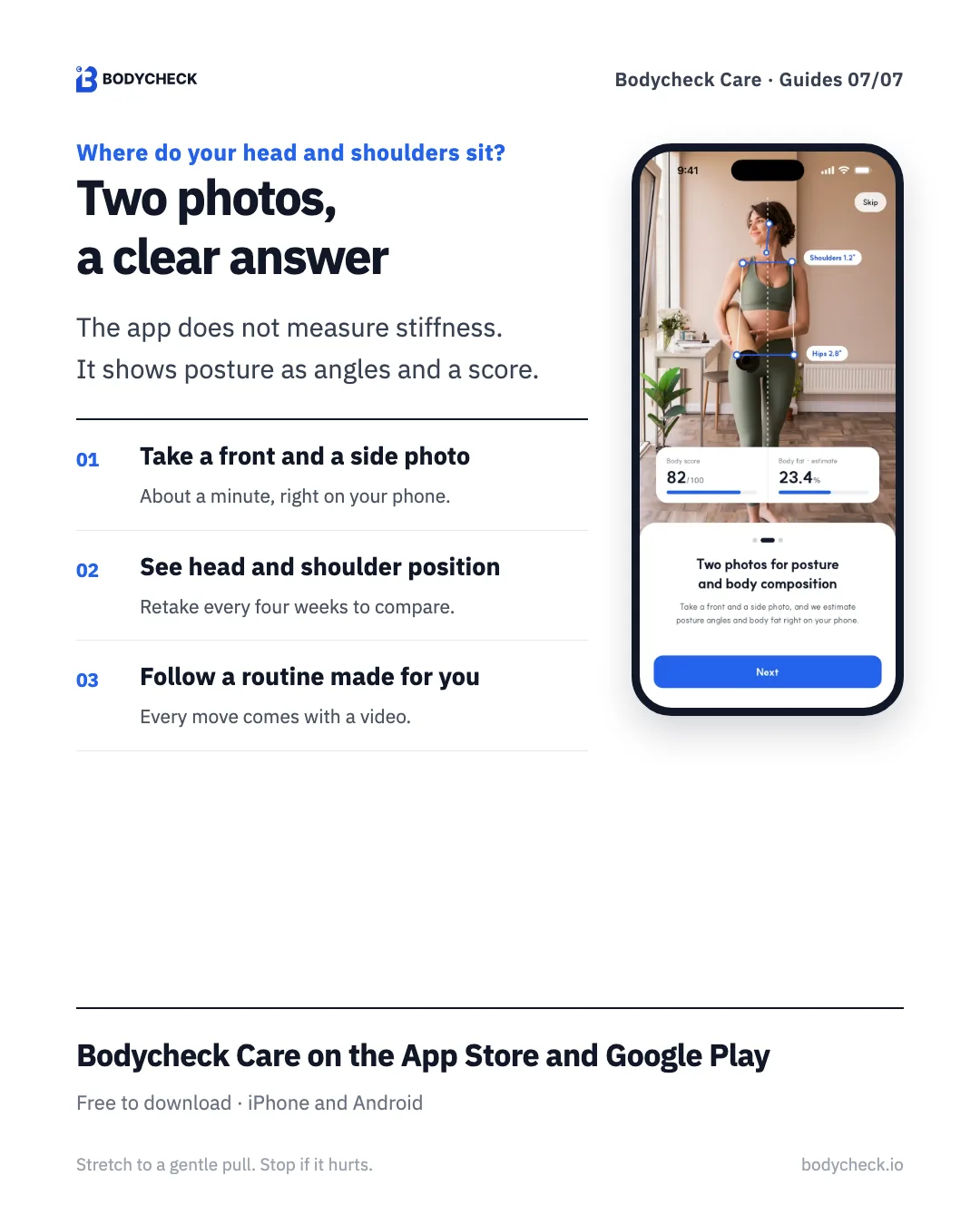
To be clear up front: Bodycheck Care does not measure stiffness. What it can show is your everyday posture, as numbers. Take a front and a side photo, and the app shows how far forward your head and shoulders sit, plus head tilt and shoulder balance, as angles and a score.
- Get the app and take a front and a side full-body photo. It takes about a minute.
- See head position, shoulder position, head tilt and shoulder balance as a score.
- Follow a routine picked for your result from more than 1,300 exercise videos.
- Retake the photos every four weeks and compare.
Raise your screen, do the stretches, and retake the photos in four weeks. It gives you a baseline for how your habits show up in your posture. It's free on iPhone and Android. It's not a medical device, so treat the results as a reference.
Bodycheck Care · Free
See where your head and shoulders sit, from two photos
Take a front and a side photo to see how far your head and shoulders sit forward as a score, then follow moves picked for your result, each with a video.
The 8-minute desk routine for a stiff neck
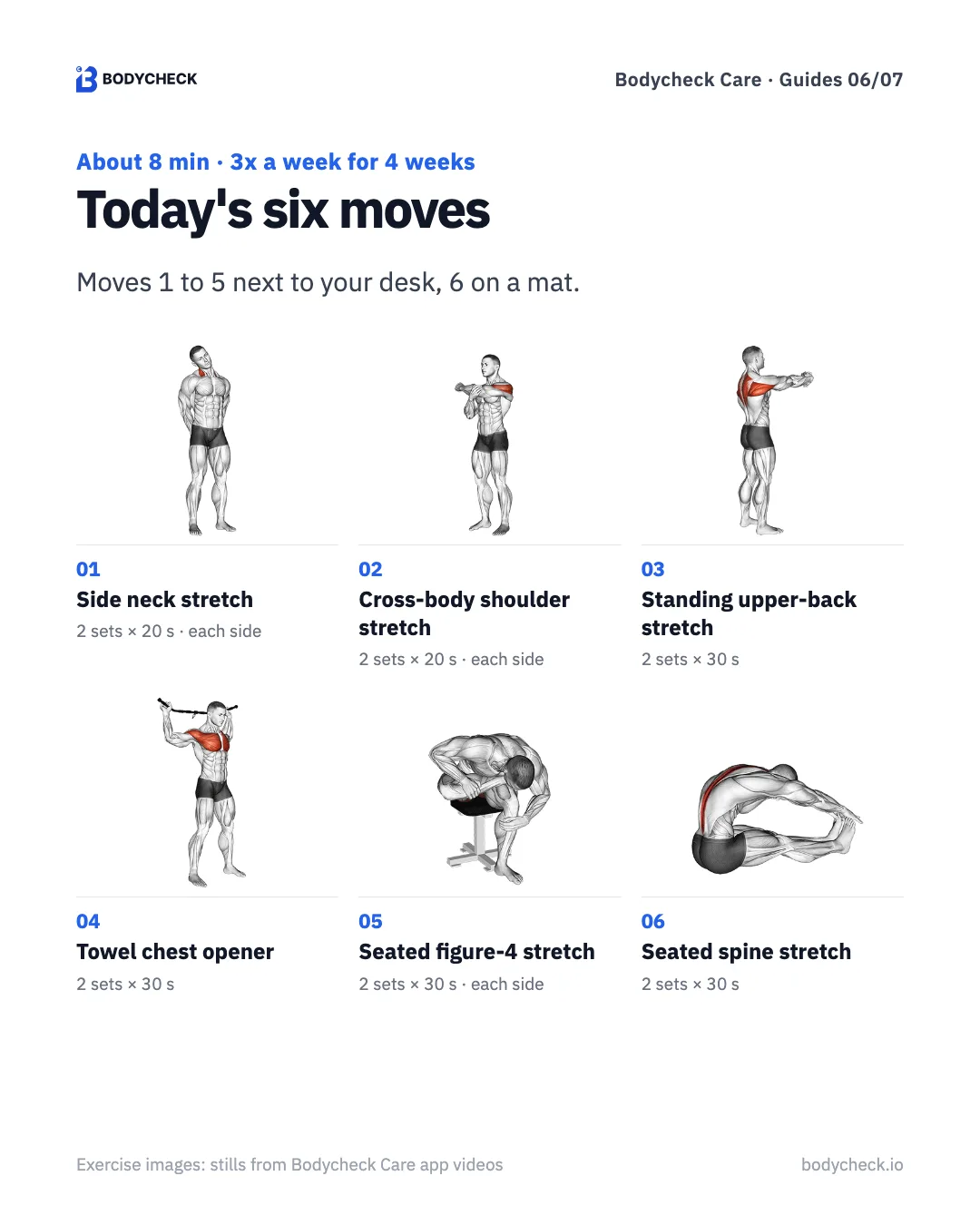
Do moves 1 to 5 next to your chair, standing or seated, and move 6 on a mat at home. Don't pull hard. Go to a gentle pull and breathe out slowly. Try it three times a week on alternate days, for four weeks. Moves 1 to 3 on their own make a good break right before you log off. If a stiff neck often comes with a heavy head, the post on forward head posture and headaches may help too.
1. Side neck stretch · 2 sets × 20 s · each side
- Stand or sit tall with relaxed shoulders.
- Rest a hand on the side of your head and tilt your ear toward your shoulder. Don't press hard with your hand.
- Keep the opposite shoulder pressed down so it doesn't rise.
- Hold 20 seconds, then switch sides.
2. Cross-body shoulder stretch · 2 sets × 20 s · each side
- Stand tall and reach one arm across your chest.
- With the other hand, pull it in just above the elbow.
- Hold 20 seconds where you feel the back of the shoulder stretch.
- Switch sides.
3. Standing upper-back stretch · 2 sets × 30 s
- Stand with feet shoulder-width apart.
- Interlace your fingers and reach forward at shoulder height.
- Push your hands far forward and round your upper back so the shoulder blades spread.
- Breathe out slowly and hold 30 seconds.
4. Towel chest opener · 2 sets × 30 s
- Stand tall holding a towel or long stick wider than your shoulders.
- Keep your arms straight and raise them slowly overhead.
- Take them behind your head only as far as they move freely, opening the chest and front shoulders.
- Come back slowly and repeat for 30 seconds. If your shoulders catch, widen your grip.
5. Seated figure-4 stretch · 2 sets × 30 s · each side
- Sit on a chair and rest one ankle on the opposite knee.
- Keep your back straight and lean your chest forward.
- Turn your upper body slightly toward the raised leg to stretch deep in the hip.
- Hold 30 seconds, then switch sides.
6. Seated spine stretch · 2 sets × 30 s
- Sit on a mat with your legs straight out and your arms reaching forward.
- Sit tall first.
- Breathe out and round forward one segment at a time, starting from your head.
- Hold 30 seconds, then roll back up slowly.
At a glance
| # | Move | Sets |
|---|---|---|
| 1 | Side neck stretch | 2 × 20 s · each side |
| 2 | Cross-body shoulder stretch | 2 × 20 s · each side |
| 3 | Standing upper-back stretch | 2 × 30 s |
| 4 | Towel chest opener | 2 × 30 s |
| 5 | Seated figure-4 stretch | 2 × 30 s · each side |
| 6 | Seated spine stretch | 2 × 30 s |
Moves can be hard to follow from text alone. In Bodycheck Care every move has a video, and the app counts the time and sets for you.
Frequently asked questions
Why do I wake up with a stiff neck? There isn't one single cause, but it can be connected to a pillow that's too high or too low, or to sleeping face down with your head turned to one side for hours. If it isn't getting better after a few days, or keeps getting worse, see a doctor.
Is it okay to stretch a stiff neck? If it just feels stiff, stretch gently to a light pull and keep the range small. Stop if anything hurts or tingles. If pain spreads into your arm, you have numbness or weakness, it started after an injury, or you have a fever with a stiff neck, skip exercise and see a doctor first.
Will these stretches get rid of my stiff neck? We can't promise that. This routine gently moves a neck, shoulders and upper back that have held one position for a long time. If stiffness keeps coming back or doesn't ease, see a doctor before relying on exercise.
What can I change about my pillow and screen? Many people find a pillow comfortable when it keeps the head and neck roughly in line with the body. Raise your laptop toward eye level, lift your phone instead of dropping your head, and stand up about once an hour to roll your shoulders.
Can I see where my head and shoulders sit? Bodycheck Care measures posture from a front and a side photo and shows how far forward your head and shoulders sit, plus head tilt and shoulder balance, as angles and a score. It is free on iPhone and Android. It does not measure stiffness and is not a medical device.
Before you start
- Stretch to a gentle pull. Stop right away if anything hurts or tingles.
- No fast turns or bouncing. Start small and widen the range slowly.
- Don't hold your breath. Breathe out long as you stretch.
- This is exercise guidance. If you have pain spreading into your arm, numbness or weakness, pain after an injury, a fever with a stiff neck, or pain that keeps getting worse, see a doctor before you exercise.
Before you log off today, why not stand up and do just moves 1 to 3? And tonight, take a look at your pillow and how you hold your phone in bed.
Bodycheck Care · Free
Take two photos and get moves picked for you
Take a front and a side photo to see how far your head and shoulders sit forward as a score, then follow moves picked for your result, each with a video.
References
- Hansraj KK. Assessment of stresses in the cervical spine caused by posture and position of the head. Surgical Technology International, 2014;25:277-279. (Computer model estimates)
- NHS. Neck pain. nhs.uk (General guidance on when to see a doctor)
- Photos: Pexels (free license). Exercise images and app screens: Bodycheck Care app.