Neck Stretches at Your Desk: Three 2-Minute Breaks for Office Workers
Neck stretches you can do at your desk, no floor needed. Split the workday into three 2-minute breaks with two moves each, set up your monitor, laptop, chair and calls, and use calendar reminders so you actually do them.
Short answer: On busy days, even a 10-minute routine gets pushed to "after work" and never happens. So this guide splits the day into three breaks: right after you get in, after lunch, and an hour or two before you leave. Each one is about two minutes, two moves. Every move is done standing next to your desk or holding a chair or wall, so there's nothing on the floor. Set up your monitor, laptop, chair and calls first, then let calendar reminders do the remembering.
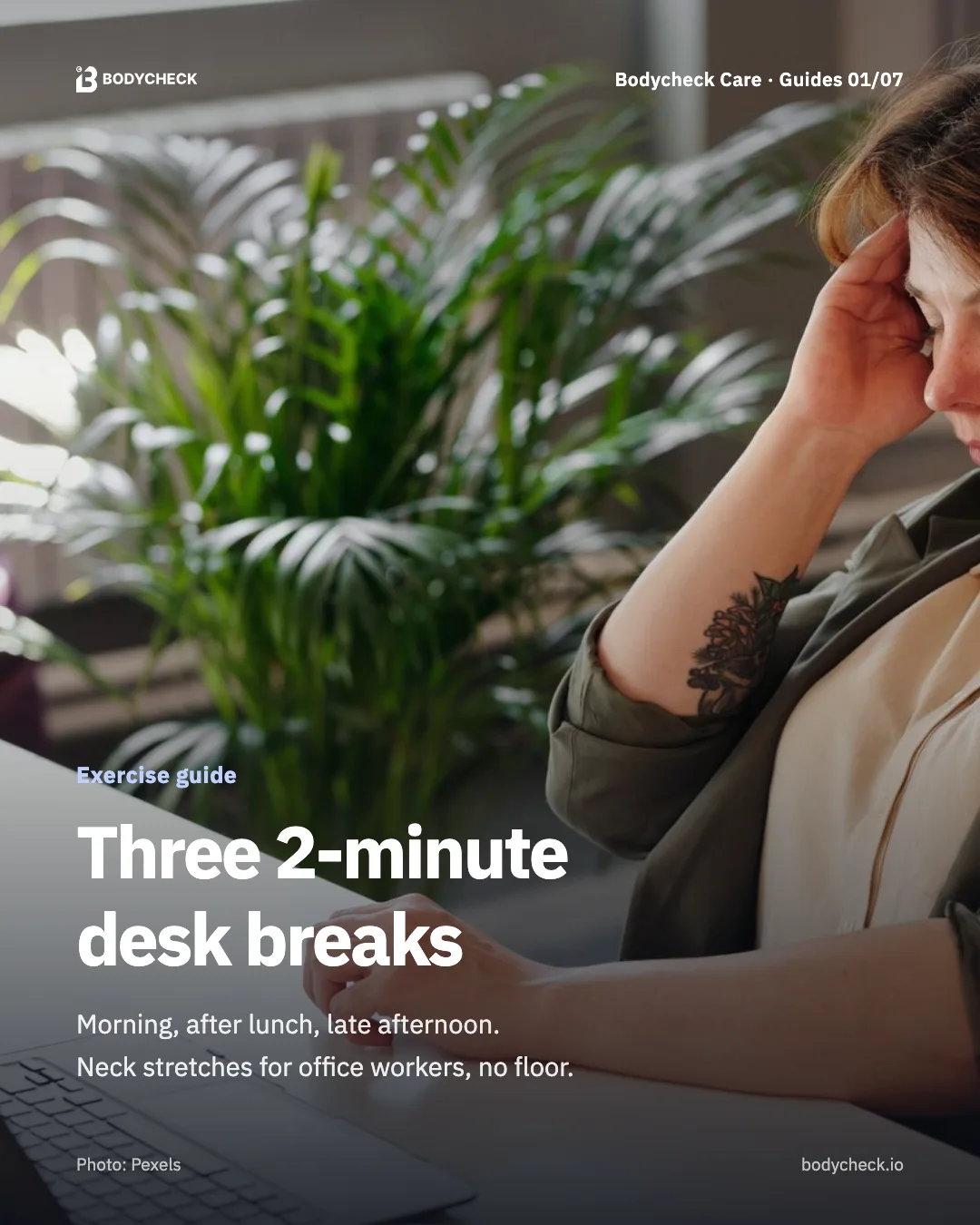
Hi, I'm an editor on the Bodycheck Care team. I have a habit of taking notes during phone calls. Phone wedged between my ear and shoulder, both hands on the keyboard. On days with back-to-back afternoon calls, one side of my neck feels noticeably stiff by the last one. And the "10-minute neck routine" I saved on my phone? That gets moved to "after work" again.
So I tried a different approach. Three short breaks instead of one long session, and next to my desk instead of on a mat. Below I'll walk through how to split the day, how to set up your desk so you look down less, and the reminder tricks I use so I don't forget.
Why three 2-minute breaks instead of 10 minutes at once?
US adults sit about 6.4 hours a day (2015-2016 survey), up from 5.5 hours in 2007, according to a study in JAMA. If you work at a desk, most of that time is probably in front of a screen.
A stiff neck can have more to do with how long you stay in one position than with any single posture. So at the office, breaking up long stretches of sitting is often more realistic than one long session. Two minutes fits between meetings or right after you send an email.
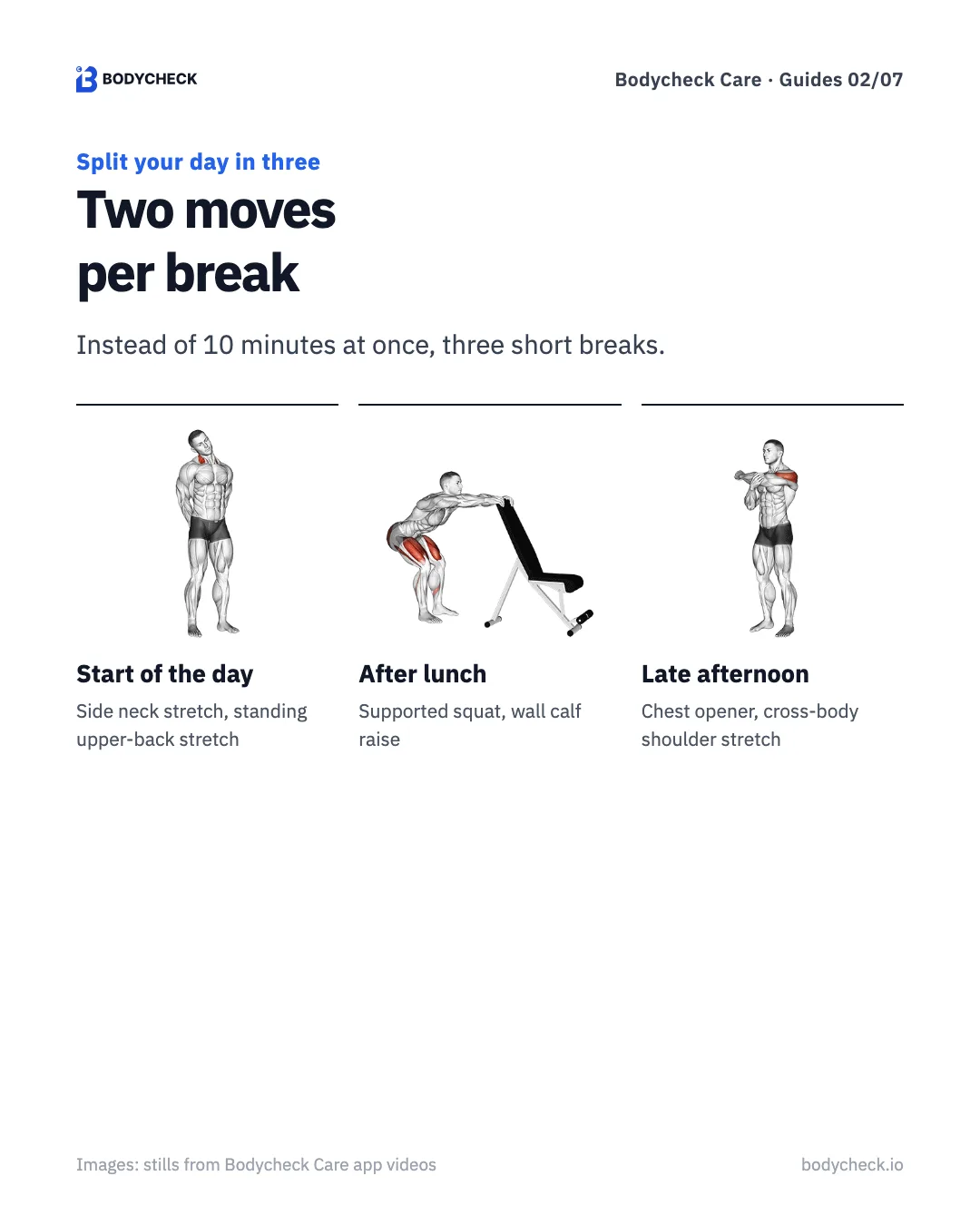
- Start of the day: Before you settle in, loosen the side of your neck and your upper back.
- After lunch: When the afternoon slump hits, stand up and move your legs. It's a reset after a long sit.
- Late afternoon: Your shoulders are probably at their most rounded, so stretch the chest and the back of the shoulders.
Is it OK to check your phone on a break?
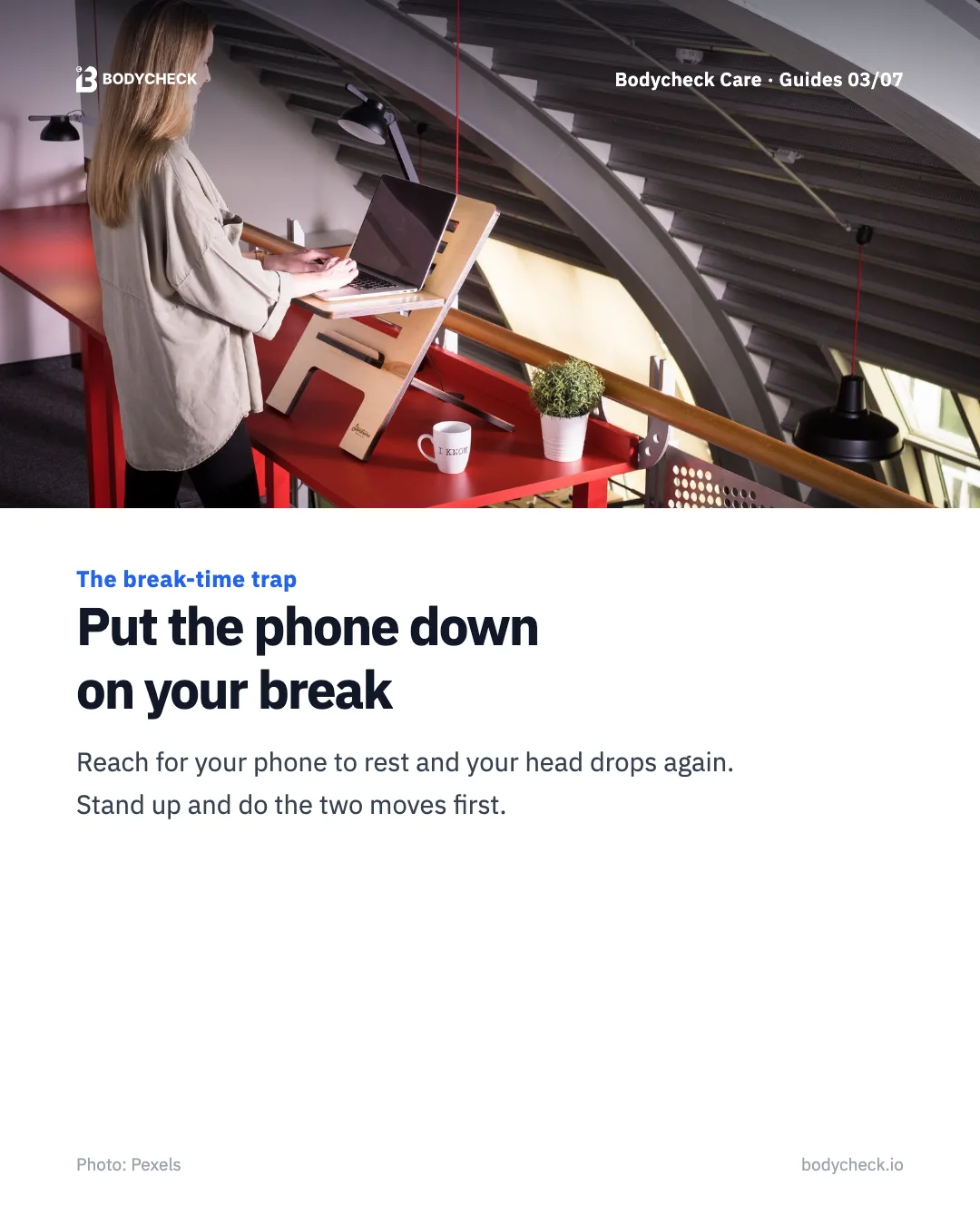
Honestly, the moment I think "quick break," my hand goes for my phone. But phones usually sit well below eye level, so those two minutes away from the screen turn into two more minutes of looking down.
A 2014 study used a computer model to estimate the load on the neck. An upright head weighs about 5 kg (11 lb). Tilted 30 degrees, the estimated load was about 18 kg (40 lb), and at 60 degrees about 27 kg (60 lb). These are model estimates, not measurements, so don't take the numbers literally. The direction is what matters: the further you look down, the harder the back of your neck works.
So on your 2-minute break, put the phone on the desk and stand up and do the two moves first. Your messages will still be there.
What should you fix at your desk first?
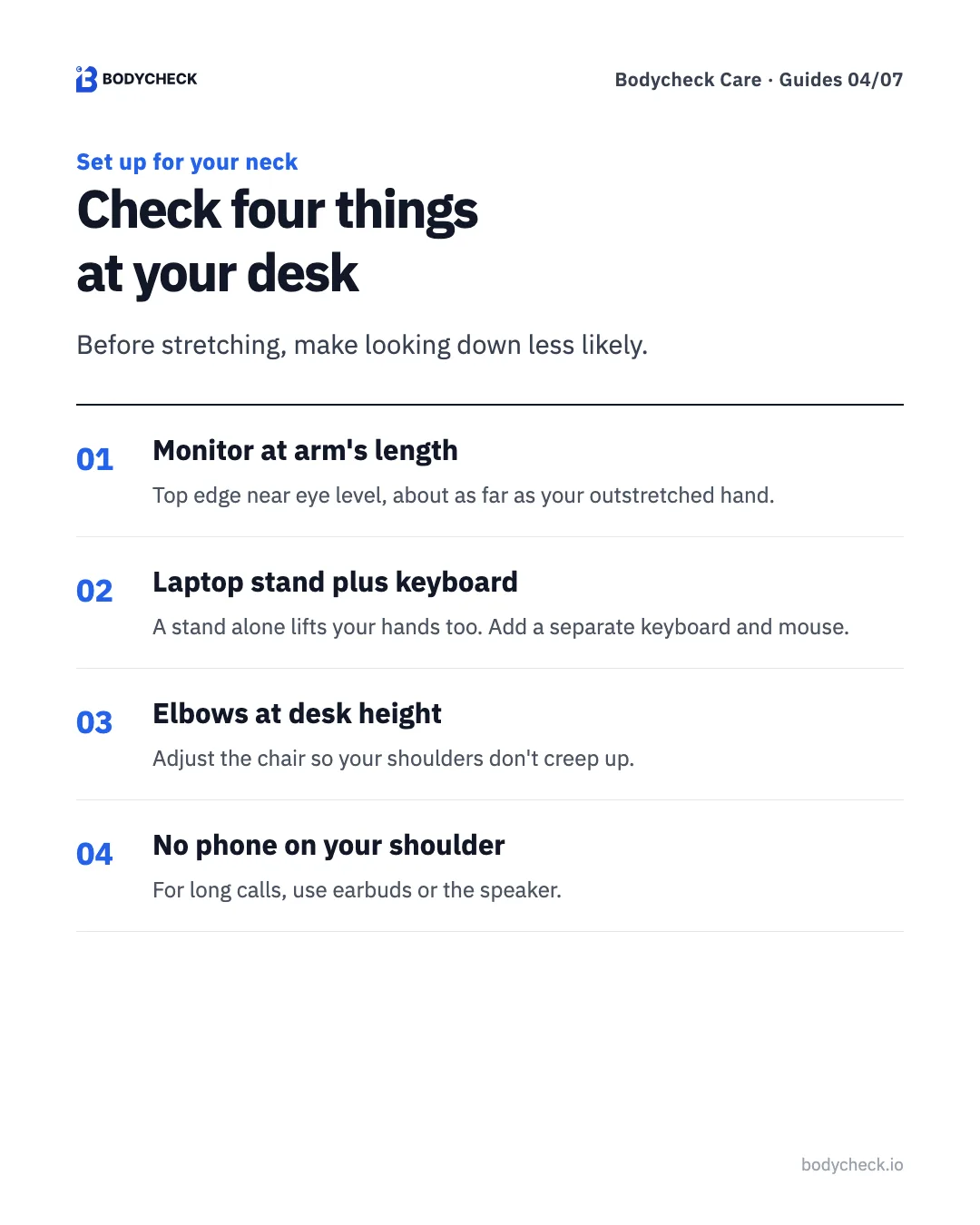
Your setup matters as much as the stretches. Two minutes of stretching won't do much if you spend the rest of the hour looking down. Laptops are the tricky one: the screen and keyboard are attached, so when your hands are comfortable, the screen sits well below your eyes. You don't need new furniture. Check these four things with your neck in mind.
- Monitor at arm's length: Top edge of the screen near eye level, about as far as your fingertips when you reach out. Too close and your head creeps toward it.
- Laptop stand plus a separate keyboard: A stand on its own lifts your hands too, and your shoulders follow. Add an external keyboard and mouse. No stand? A few thick books work.
- Elbows at desk height: Adjust your chair so your shoulders stay down when your hands are on the keyboard. If your feet don't reach the floor, use a footrest.
- No phone on your shoulder: This was my habit. Wedging the phone means holding your head tilted to one side for minutes at a time. For long calls, use earbuds or the speaker.
If your neck feels stiff often, my post on stiff neck stretches and daily habits covers pillow and screen habits and the signs that mean see a doctor first.
What if you keep forgetting?
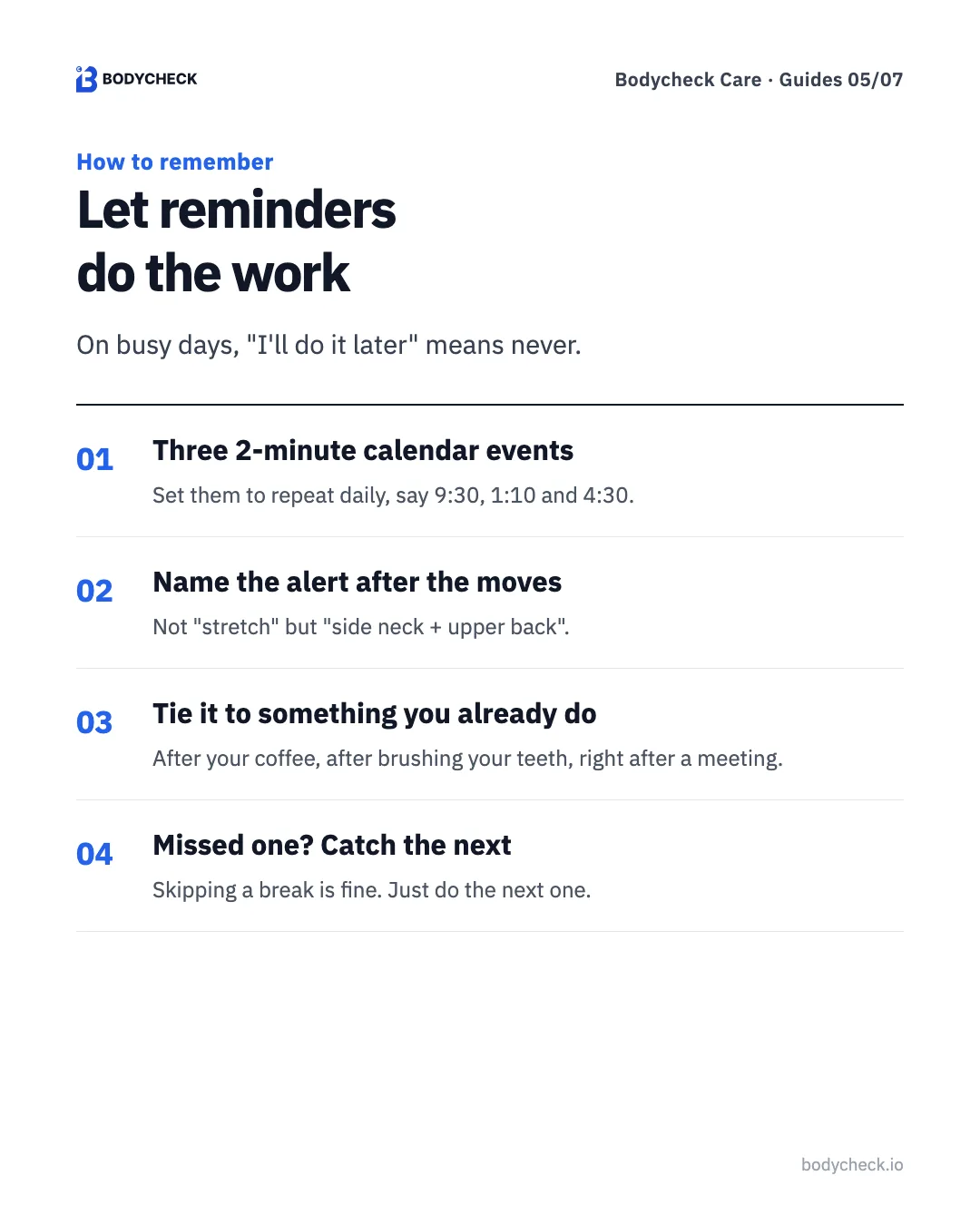
On busy days, "I'll do it later" usually means never. Reminders work better than willpower.
- Three 2-minute calendar events: Set them to repeat every weekday, say 9:30, 1:10 and 4:30. They show up between your meetings, so they're hard to miss.
- Name the alert after the moves: Instead of "stretch," write "side neck + upper back." When it pops up, you already know what to do.
- Tie it to something you already do: After your coffee, after brushing your teeth post-lunch, right after an afternoon meeting. Less to remember.
- Missed one? Catch the next: Skipping a break is fine. No guilt. Just do it when the next alert goes off.
How can you see how far forward your head really sits?
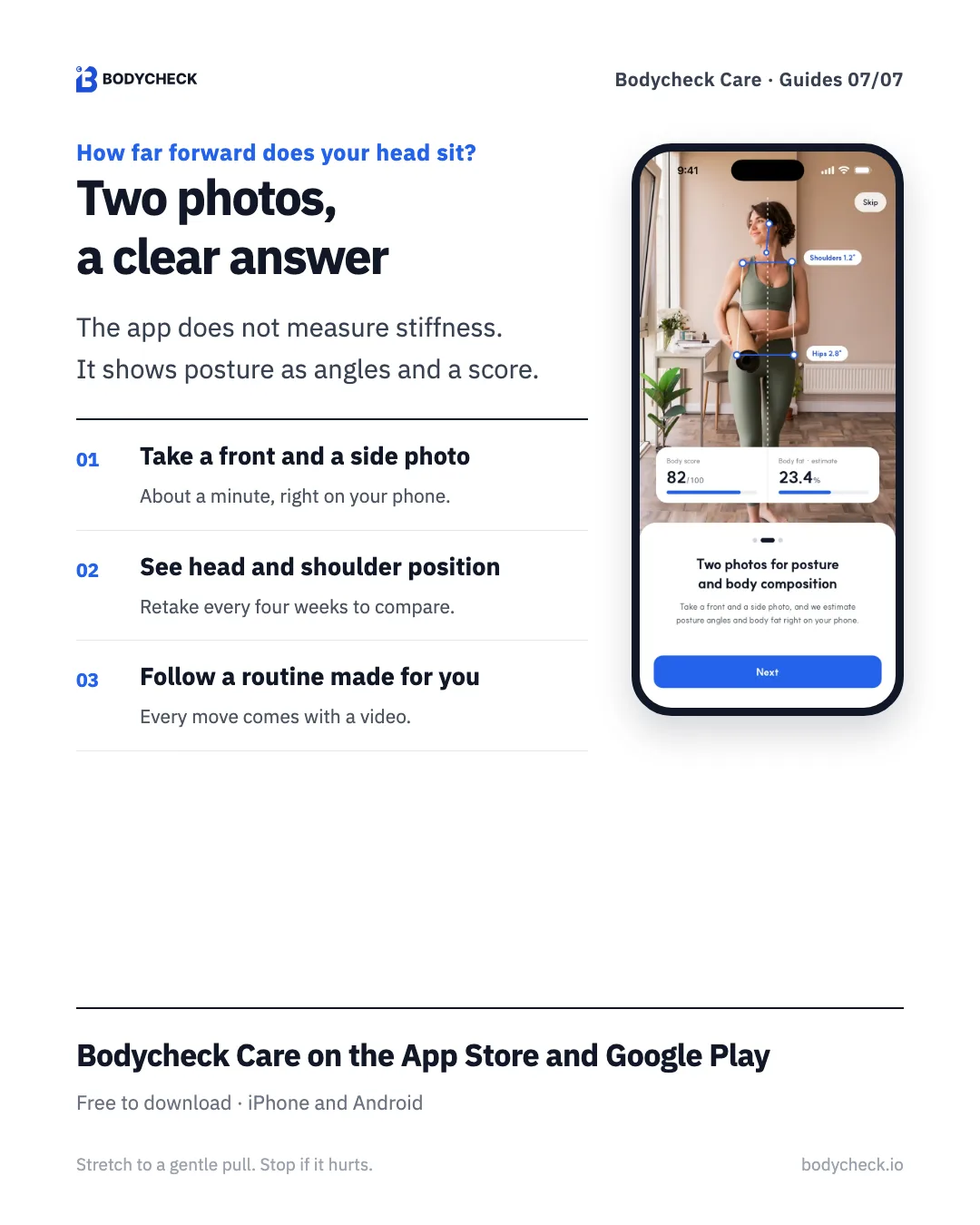
Even with a good setup and regular breaks, it's hard to see your own posture in a mirror. How far your head sits forward only shows from the side.
Take a front and a side photo in Bodycheck Care and it shows your head position, shoulder position and shoulder and hip tilt as angles and a score. It doesn't measure stiffness. It shows your posture as numbers.
- Get the app and take a front and a side full-body photo.
- See your head and shoulder position and side-to-side tilt as a score.
- Follow the moves picked for your result, each with a video.
- Retake the photos after four weeks and compare.
Bodycheck Care · Free
See how far forward your head sits, from two photos
Take a front and a side photo to see how far your head and shoulders sit forward as a score, then follow moves picked for your result, each with a video.
The three-break desk routine
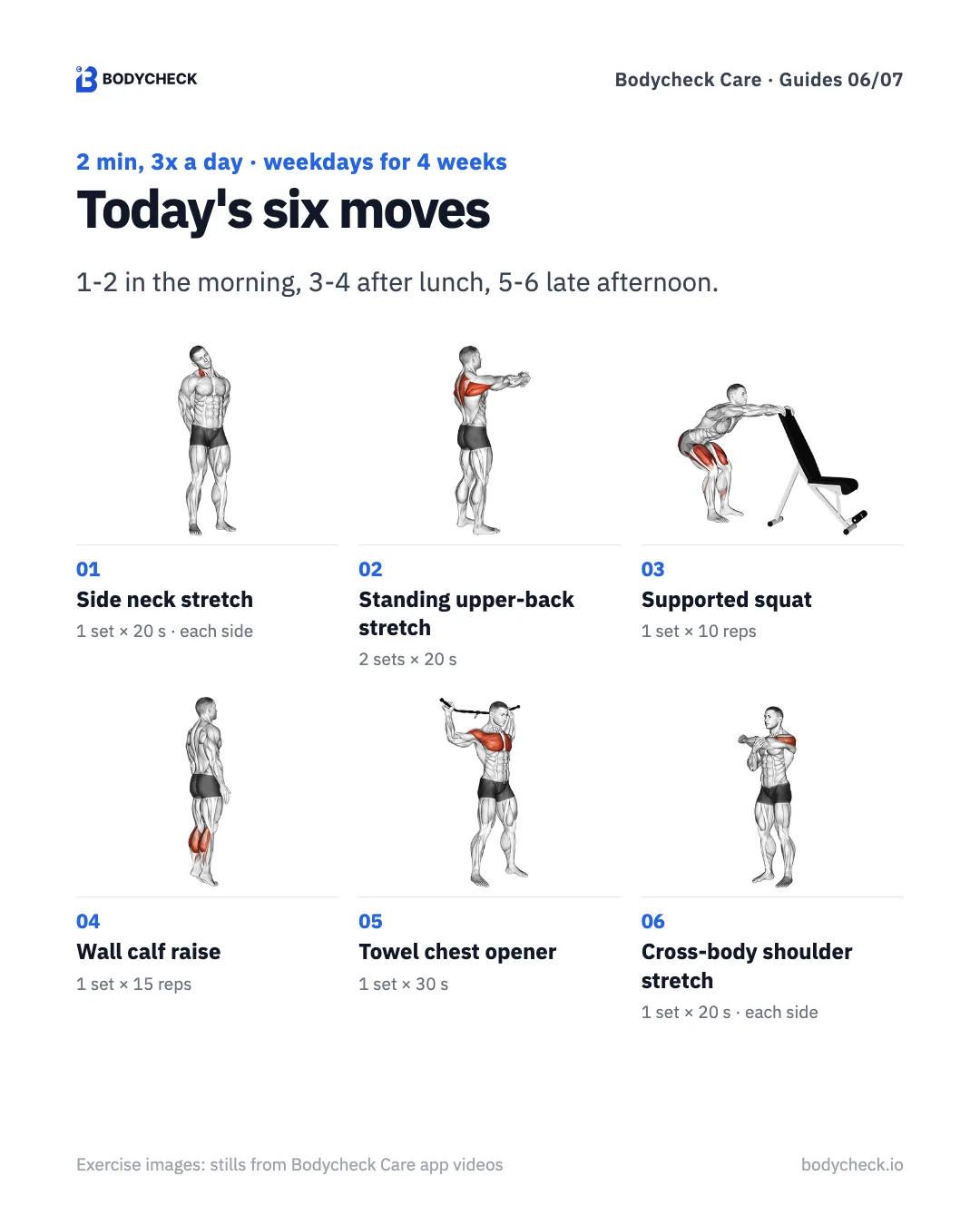
Moves 1 and 2 right after you get in, 3 and 4 after lunch, 5 and 6 an hour or two before you leave. About two minutes each time, on weekdays for four weeks. Everything is done standing next to your desk or holding a chair or wall.
Start of the day · about 2 minutes
1. Side neck stretch · 1 set × 20 s · each side
- Stand or sit tall with relaxed shoulders.
- Rest a hand on the side of your head and tilt your ear toward your shoulder.
- Keep the opposite shoulder pressed down so it doesn't rise.
- Hold 20 seconds, then switch sides.
2. Standing upper-back stretch · 2 sets × 20 s
- Stand next to your desk with feet shoulder-width apart.
- Interlace your fingers and reach forward at shoulder height.
- Push your hands far forward and round your upper back so the shoulder blades spread.
- Breathe out slowly and hold 20 seconds.
After lunch · about 2 minutes
3. Supported squat · 1 set × 10 reps
- Hold a chair back or a wall, feet shoulder-width apart. If your chair has wheels, use the wall instead.
- Push your hips back and lower as if sitting into a chair.
- Keep your knees in line with your toes and your chest up.
- Press through your heels to stand. 10 reps.
4. Wall calf raise · 1 set × 15 reps
- Put your hands on a wall, feet shoulder-width apart.
- Shift your weight onto the balls of your feet and lift your heels.
- Pause one second at the top.
- Lower slowly. Repeat 15 times.
Late afternoon · about 2 minutes
5. Towel chest opener · 1 set × 30 s
- Stand tall holding a towel or long stick wider than your shoulders. At the office, a long umbrella or a yardstick works.
- Keep your arms straight and raise them slowly overhead.
- Take them behind your head only as far as they move freely, opening the chest and front shoulders.
- Come back slowly and repeat for 30 seconds. If your shoulders catch, widen your grip.
6. Cross-body shoulder stretch · 1 set × 20 s · each side
- Stand tall and reach one arm across your chest.
- With the other hand, pull it in just above the elbow.
- Hold 20 seconds where you feel the back of the shoulder stretch.
- Switch sides.
At a glance
| When | # | Move | Sets |
|---|---|---|---|
| Start of the day | 1 | Side neck stretch | 1 × 20 s · each side |
| Start of the day | 2 | Standing upper-back stretch | 2 × 20 s |
| After lunch | 3 | Supported squat | 1 × 10 reps |
| After lunch | 4 | Wall calf raise | 1 × 15 reps |
| Late afternoon | 5 | Towel chest opener | 1 × 30 s |
| Late afternoon | 6 | Cross-body shoulder stretch | 1 × 20 s · each side |
Moves can be hard to follow from text alone. In Bodycheck Care every move has a video, and the app counts the time and sets for you.
Frequently asked questions
How often should I stretch during the workday? This guide uses three short breaks: right after you get in, after lunch, and an hour or two before you leave. About two minutes each, on weekdays, for four weeks.
Can I do these without looking odd at the office? Yes. All six moves are done standing, or holding a desk, chair or wall. Nothing on the floor. A break room or a hallway wall works fine.
What if I don't have a towel for the chest opener? Use anything long you can hold wider than your shoulders, like a long umbrella or a yardstick. If your shoulders catch, widen your grip.
How high should my monitor be? Put the top edge of the screen near eye level, about an arm's length away. For a laptop, use a stand plus a separate keyboard and mouse so your hands don't rise with it.
How can I tell how far forward my head sits? Bodycheck Care measures it from a front and a side photo and shows head and shoulder position as angles and a score. It is free on iPhone and Android, and you can retake the photos every four weeks to compare.
Before you start
- Stretch to a gentle pull. Stop right away if anything hurts or tingles.
- A chair with wheels can roll during squats. Hold a fixed chair or a wall.
- Don't hold your breath. Breathe out slowly as you stretch.
- This is exercise guidance. If you have pain spreading from your neck into your arm, or numbness or weakness in your arm or hand, see a doctor before you exercise.
Tomorrow morning, before you sit down, why not open your calendar and add three 2-minute events? In four weeks, retake your photos and compare them side by side.
Bodycheck Care · Free
Take two photos and get moves picked for you
Take a front and a side photo to see how far your head and shoulders sit forward as a score, then follow moves picked for your result, each with a video.
References
- Hansraj KK. Assessment of stresses in the cervical spine caused by posture and position of the head. Surgical Technology International, 2014;25:277-279. (Computer model estimates)
- Yang L, Cao C, Kantor ED, et al. Trends in sedentary behavior among the US population, 2001–2016. JAMA, 2019;321(16):1587-1597.
- Photos: Pexels (free license). Exercise images and app screens: Bodycheck Care app.