Pain Between Your Shoulder Blades? Why It Often Starts in the Neck (Dorsal Scapular Nerve)
Why pain along the inner edge of the shoulder blade often comes from the neck, what the dorsal scapular nerve is, why massage alone may not last, and a 10-minute upper-back routine.
Short answer: Pain along the inner edge of the shoulder blade is often blamed on a tight muscle or bad posture, but it frequently starts in the neck: pain referred from a lower neck disc or joint, or irritation of the dorsal scapular nerve, which leaves the neck around C5 and runs to the muscles between the shoulder blades. That is why massaging the spot may help only for a day. Getting the upper back moving again takes load off the lower neck and is a good place to start. Sudden or severe pain, or pain with chest symptoms, needs urgent care.

It's one of the most common complaints among people who sit at a desk, study for long hours or spend long days rehearsing or on set. They point to the inner edge of one shoulder blade and say, "It's this muscle. I've had it massaged, I stretch it, and it keeps coming back."
When it keeps coming back, the sore spot is usually where you feel the pain, not where it starts. Below are the three common sources, why the neck is so often involved, and a 10-minute routine that works on the part people usually forget: the upper back.
Where does pain between the shoulder blades come from?
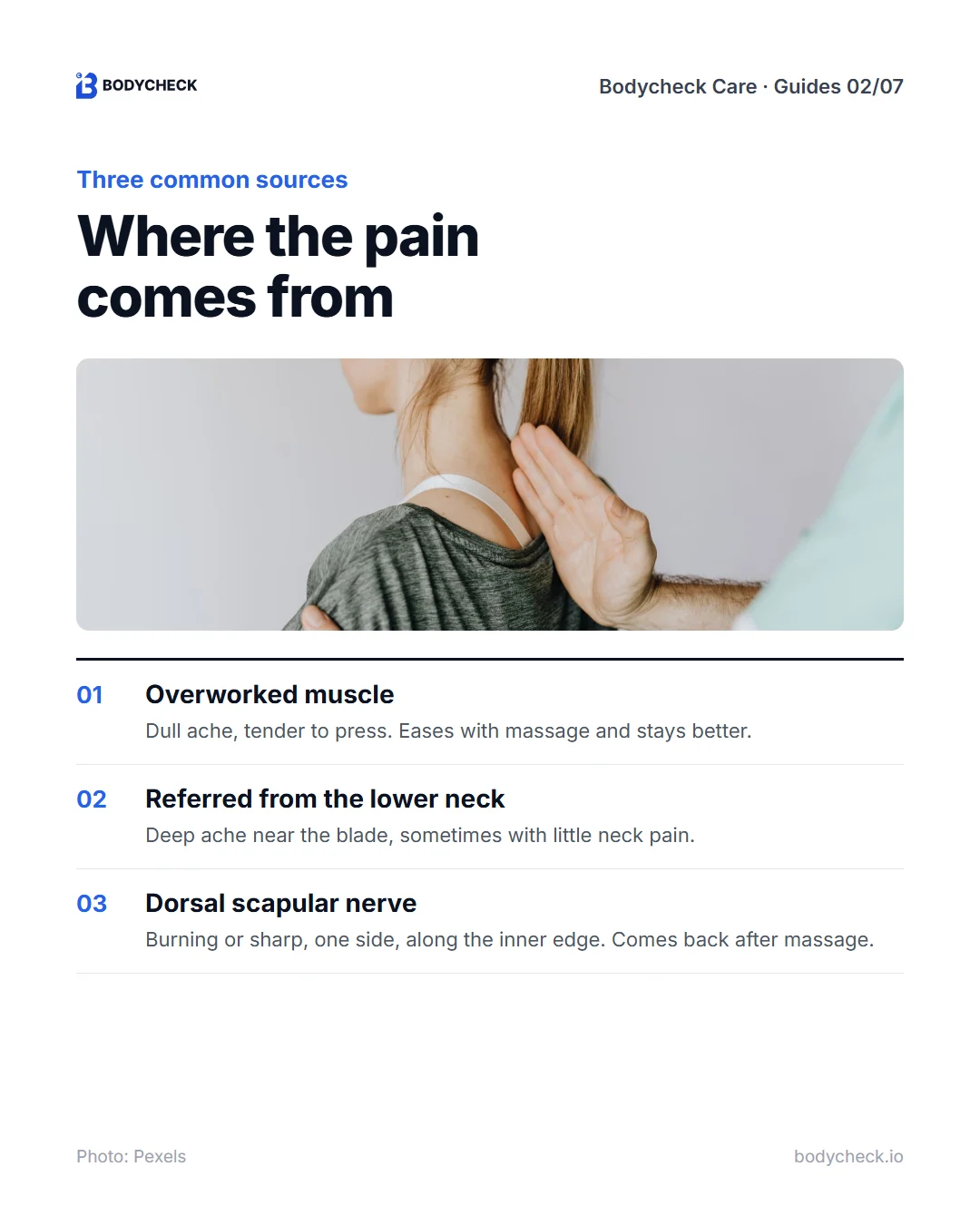
| Source | How it often feels | Clues |
|---|---|---|
| Overworked muscle | Dull ache, tender to press | Eases with movement, heat or massage, and stays better |
| Referred from the lower neck (disc or joint) | Deep ache near the inner edge of the blade | Changes when you move or load the neck; can happen with little neck pain |
| Dorsal scapular nerve irritation | Burning, sharp or stabbing, usually one side | Along the inner edge of the blade, sometimes with neck pain; comes back after massage |
These overlap, and more than one can be going on. A clinician sorts them out with an exam. What matters for you is this: if the muscle keeps getting sore no matter how much you treat it, look higher up.
One more thing before we go on. Pain between the shoulder blades isn't always from the spine. The heart, lungs, gallbladder and the large blood vessel in the chest can also cause it. Sudden, severe or tearing pain, or pain with chest pressure, shortness of breath, sweating or nausea, needs emergency care.
Why the neck sends pain to the shoulder blade
Back in 1959, the surgeon Ralph Cloward stimulated cervical discs in patients and found that many felt the pain near the inner border of the shoulder blade on the same side, not in the neck. Later mapping studies found pain between the shoulder blades from several lower neck levels. In other words, the brain often reports lower-neck problems as shoulder blade pain.
That's why this kind of pain can't be judged from a neck photo alone. The neck can look fine and still be the source.
What is the dorsal scapular nerve?
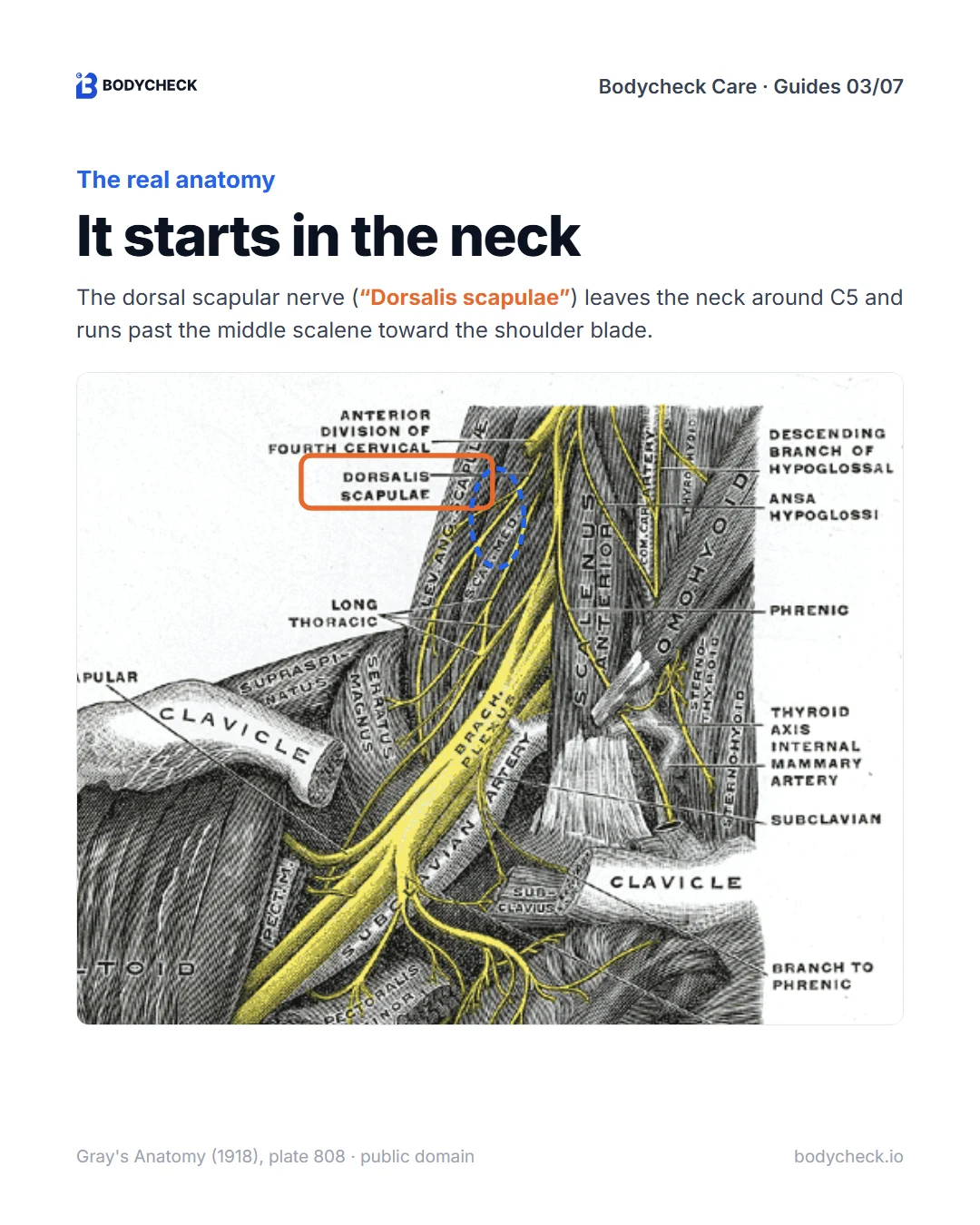
The dorsal scapular nerve (DSN) comes mainly from the C5 level of the neck. It often runs through a neck muscle called the middle scalene, then travels down to the levator scapulae and rhomboids, the muscles along the inner edge of the shoulder blade.
When it is irritated, at the neck, in the scalene or further along, people typically describe:
- burning, sharp or stabbing pain along the inner edge of one shoulder blade
- pain that may come with neck pain or a tight feeling on the side of the neck
- pain that returns soon after massage of the shoulder blade area
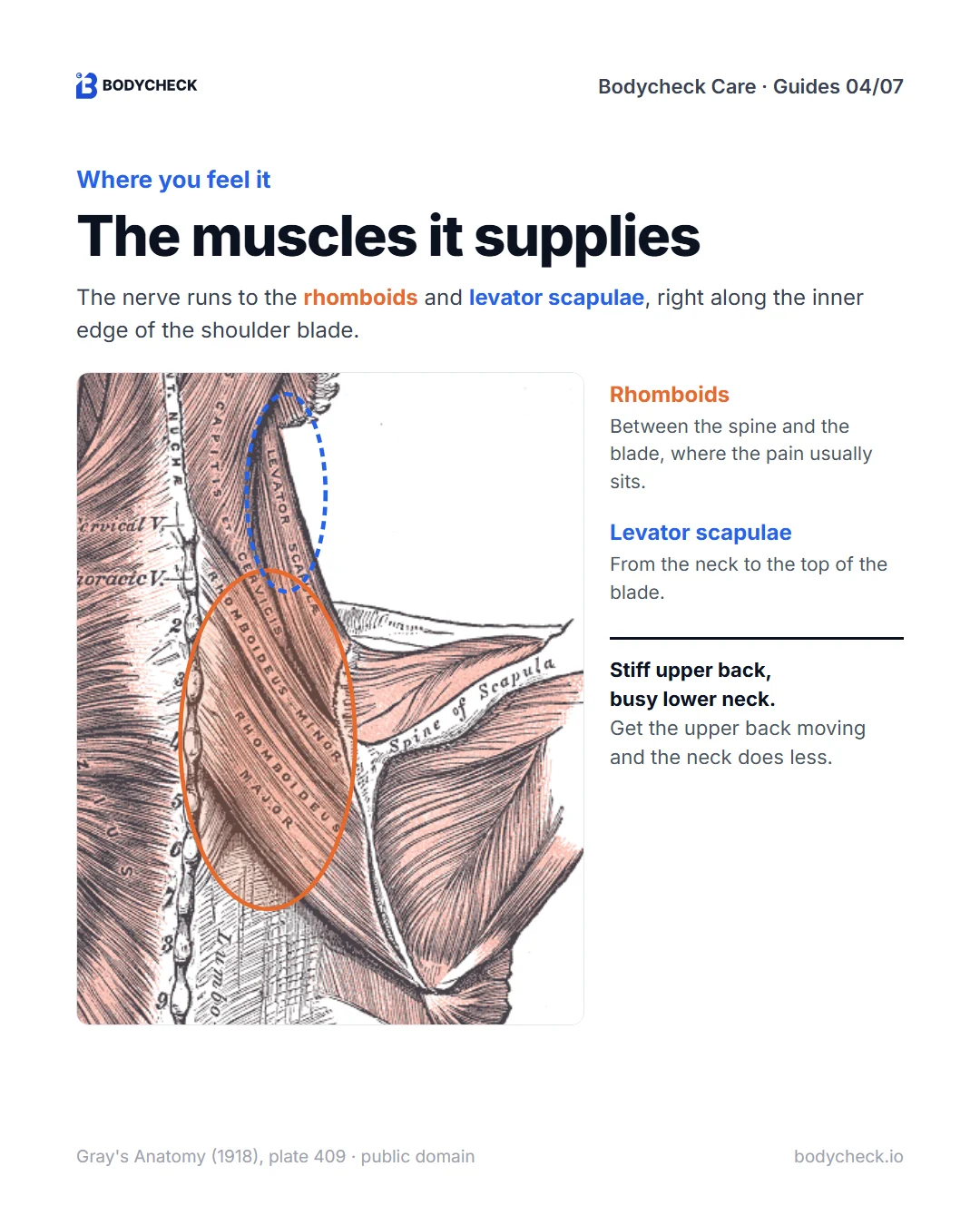
It's considered under-recognized because it looks so much like "just a tight rhomboid". It is diagnosed by a clinician, not by a photo or an app.
Why massage alone often doesn't last
Massage and stretching the sore spot can feel great. But if the pain is coming from the neck, the source keeps being loaded every time you look down at a screen or sit for hours, and the pain is back by the next day.
So the question becomes: why is the lower neck taking so much load?
Why the lower neck takes the load: the upper back
Discs and joints get irritated where the load is highest. In the neck, that is usually the lower segments, right where the neck meets the upper back.
When the upper back (thoracic spine) is stiff, from long hours rounded over a desk or phone, it stops sharing the movement. Every time you look up, turn or reach, the lower neck has to move more to make up for it. Over months, that extra work adds up.
That's why the upper back deserves as much attention as the neck. Studies on treating the upper back in people with neck pain have reported short-term improvements, and getting the thoracic spine moving again is a common, low-risk place to start. Instead of only stretching or cracking the neck, help it by giving the upper back its movement back.
A quick self-check
None of these diagnoses anything, but they help you describe the pain to a professional:
- Does turning, tilting or looking down change the shoulder blade pain?
- Is it on one side, and does it burn or stab rather than ache?
- Does it ease after massage but come back within a day or two?
- Do you notice any tingling, numbness or weakness in the arm or hand?
If you answer yes to the first three, the neck is worth a closer look. If you answer yes to the fourth, see a professional before you exercise.
How can you see your posture as numbers?
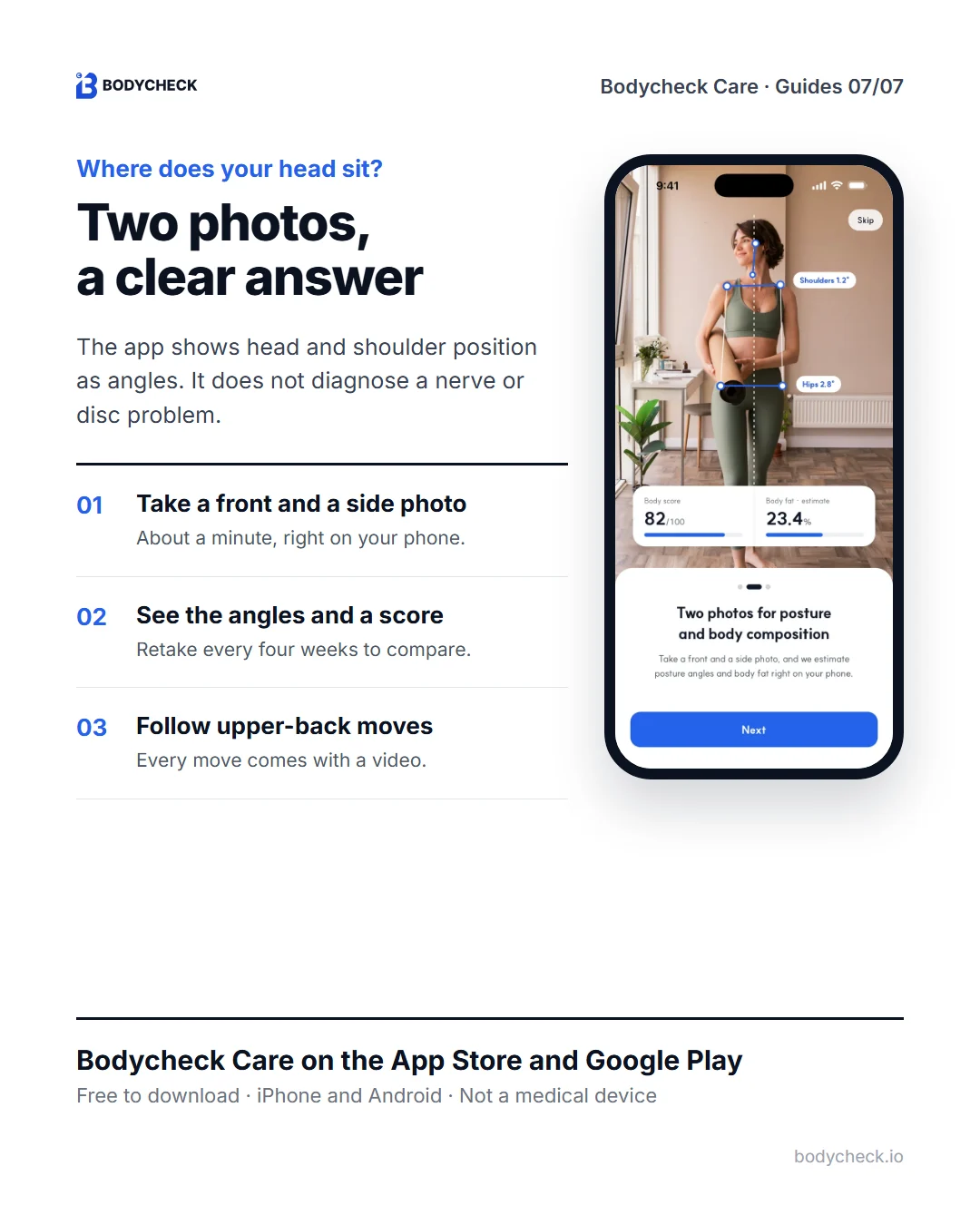
Bodycheck Care can't tell you whether a nerve is involved, and it doesn't try to. What it does is show how your neck and upper body are sitting: from a front and a side photo, the app shows head forward position and shoulder forward position as angles and a score, in about a minute.
- Take a front and a side photo.
- See where your head and shoulders sit, as angles.
- Follow upper-back and neck moves, each with a video.
- Retake the photos every four weeks and compare.
It's free on iPhone and Android and it is not a medical device. You can also try the free posture test in your browser; the photos aren't uploaded.
Bodycheck Care · Free
See where your head and shoulders sit from two photos
Take a front and a side photo to see how far your head and shoulders sit forward as a score, then follow moves picked for your result, each with a video.
The 10-minute upper-back routine
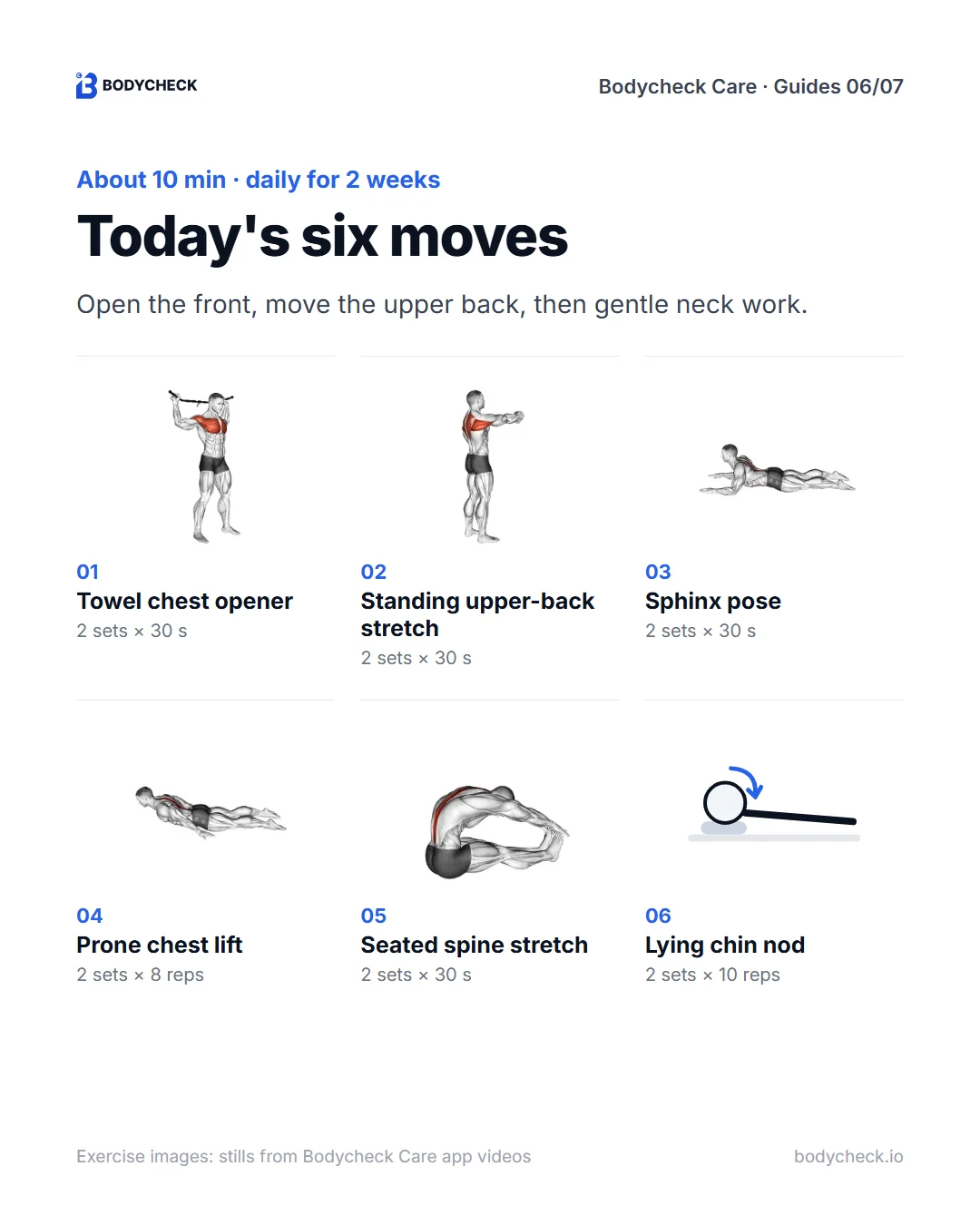
Open the front, move the upper back in both directions, then add small, gentle neck work. Try it once a day for two weeks, then three times a week. Everything should feel like a gentle stretch or light effort. If any move sends pain, tingling or numbness down your arm, stop it.
1. Towel chest opener · 2 sets × 30 s
- Stand tall holding a towel or stick wider than your shoulders.
- Raise straight arms overhead.
- Take them back only as far as they move freely. Keep your ribs down.
- Return slowly and repeat for 30 seconds.
2. Standing upper-back stretch · 2 sets × 30 s
- Interlace your fingers at shoulder height.
- Push your hands forward and let your upper back round so the shoulder blades spread apart.
- Breathe slowly into the space between the blades.
- Hold 30 seconds.
3. Sphinx pose · 2 sets × 30 s
- Lie face down and prop yourself on your forearms, elbows under your shoulders.
- Let your chest lift gently, eyes on the floor, neck long.
- Breathe and let the upper back open. No pinching in the lower back.
- Hold 30 seconds.
4. Prone chest lift · 2 sets × 8 reps
- Lie face down, legs straight.
- Squeeze your shoulder blades toward the middle of your back.
- Lift your chest slightly and pause for one second. Keep the neck long.
- Lower slowly.
5. Seated spine stretch · 2 sets × 30 s
- Sit on the mat with your legs out in front.
- Sit tall first, then breathe out and round forward one section of the back at a time.
- Hold, breathing into the upper back.
- Roll back up slowly.
6. Lying chin nod · 2 sets × 10 reps
- Lie on your back with a thin pillow under your head.
- Make a small "yes" nod, as if lengthening the back of your neck.
- Hold three seconds, then relax.
- Keep it small and comfortable. It's not a hard chin tuck.
At a glance
| # | Move | Sets |
|---|---|---|
| 1 | Towel chest opener | 2 × 30 s |
| 2 | Standing upper-back stretch | 2 × 30 s |
| 3 | Sphinx pose | 2 × 30 s |
| 4 | Prone chest lift | 2 × 8 reps |
| 5 | Seated spine stretch | 2 × 30 s |
| 6 | Lying chin nod | 2 × 10 reps |
A few habits help the routine stick: raise your screen to eye level, avoid long stretches of looking down at your phone, and get up every 30–50 minutes. For more on screens and the neck, see tech neck and neck stretches at your desk.
When to see a doctor or physical therapist
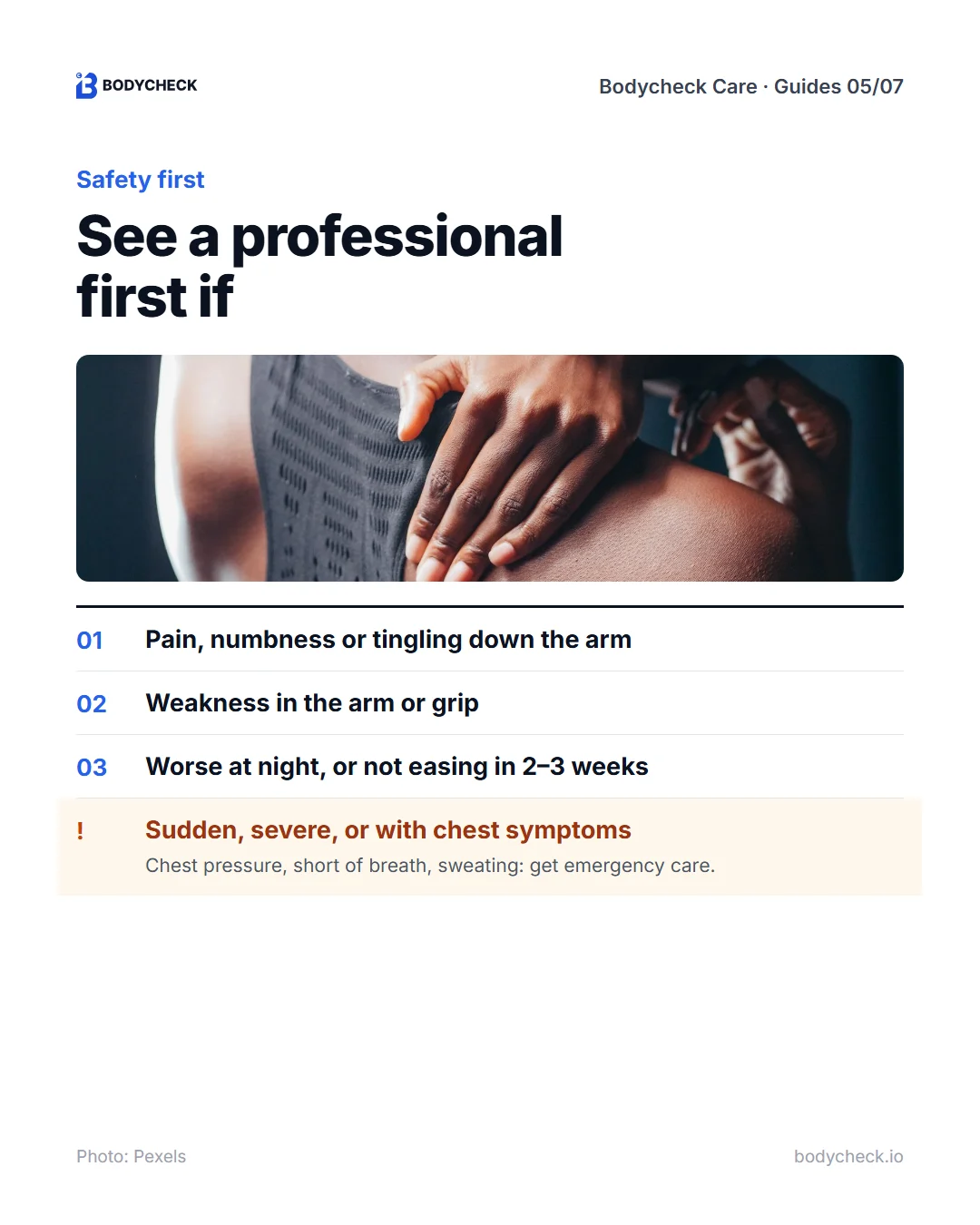
Get emergency care for sudden, severe or tearing pain between the shoulder blades, or pain with chest pressure, shortness of breath, sweating, nausea or dizziness.
Book an appointment if you have:
- pain, numbness or tingling running down the arm or into the hand
- weakness in the arm or grip
- pain that is worse at night or doesn't ease with rest or position changes
- fever, unexplained weight loss, or a recent injury
- pain that hasn't improved after two to three weeks
A proper exam, sometimes with imaging, is the only way to tell a nerve problem from a disc, joint or muscle problem.
Frequently asked questions
Why do I have pain between my shoulder blades? Common sources are overworked muscles, pain referred from the lower neck, and irritation of the dorsal scapular nerve. Less commonly the cause is outside the spine, so sudden or severe pain needs urgent care.
Can a neck problem cause pain between the shoulder blades? Yes. Pain from the lower neck is often felt near the inner edge of the shoulder blade, sometimes with little or no neck pain.
What is dorsal scapular nerve entrapment? Irritation of the nerve that leaves the neck around C5, often passes through the middle scalene and supplies the rhomboids and levator scapulae. It typically causes one-sided burning or sharp pain along the inner edge of the shoulder blade and is diagnosed by a clinician.
Why does massage only help for a day? If the pain is referred from the neck or a nerve, the sore spot is where you feel it, not where it starts, so the pain returns while the source is still loaded.
What exercises help pain between the shoulder blades? When the neck is involved, start by getting the upper back moving: chest openers, upper-back stretches, gentle extension lying face down and small chin nods. Stop anything that sends symptoms down the arm.
Before you start
- Move slowly. Aim for a gentle stretch or light effort, never sharp pain.
- Don't crack or force your neck, and avoid strong neck stretches while the pain is irritable.
- Breathe out during the effort; don't hold your breath.
- This is general exercise guidance, not a diagnosis or treatment. If anything on the list above applies to you, see a professional first.
Bodycheck Care · Free
Take two photos and get moves picked for you
Take a front and a side photo to see how far your head and shoulders sit forward as a score, then follow moves picked for your result, each with a video.
References
- Cloward RB. Cervical diskography: a contribution to the etiology and mechanism of neck, shoulder and arm pain. Annals of Surgery, 1959;150(6):1052-1064.
- Slipman CW, Plastaras C, Patel R, et al. Provocative cervical discography symptom mapping. The Spine Journal, 2005;5(4):381-388.
- Muir B. Dorsal scapular nerve neuropathy: a narrative review of the literature. Journal of the Canadian Chiropractic Association, 2017;61(2):128-144.
- Sultan HE, Younis El-Tantawi GA. Role of dorsal scapular nerve entrapment in unilateral interscapular pain. Archives of Physical Medicine and Rehabilitation, 2013;94(6):1118-1125.
- Masaracchio M, Kirker K, States R, et al. Thoracic spine manipulation for the management of mechanical neck pain: a systematic review and meta-analysis. PLoS ONE, 2019;14(2):e0211877.
- Images: photos from Pexels (free license); anatomy plates 808 and 409 from Gray's Anatomy of the Human Body, 20th ed. (1918), public domain via Wikimedia Commons; exercise images and app screens from the Bodycheck Care app.