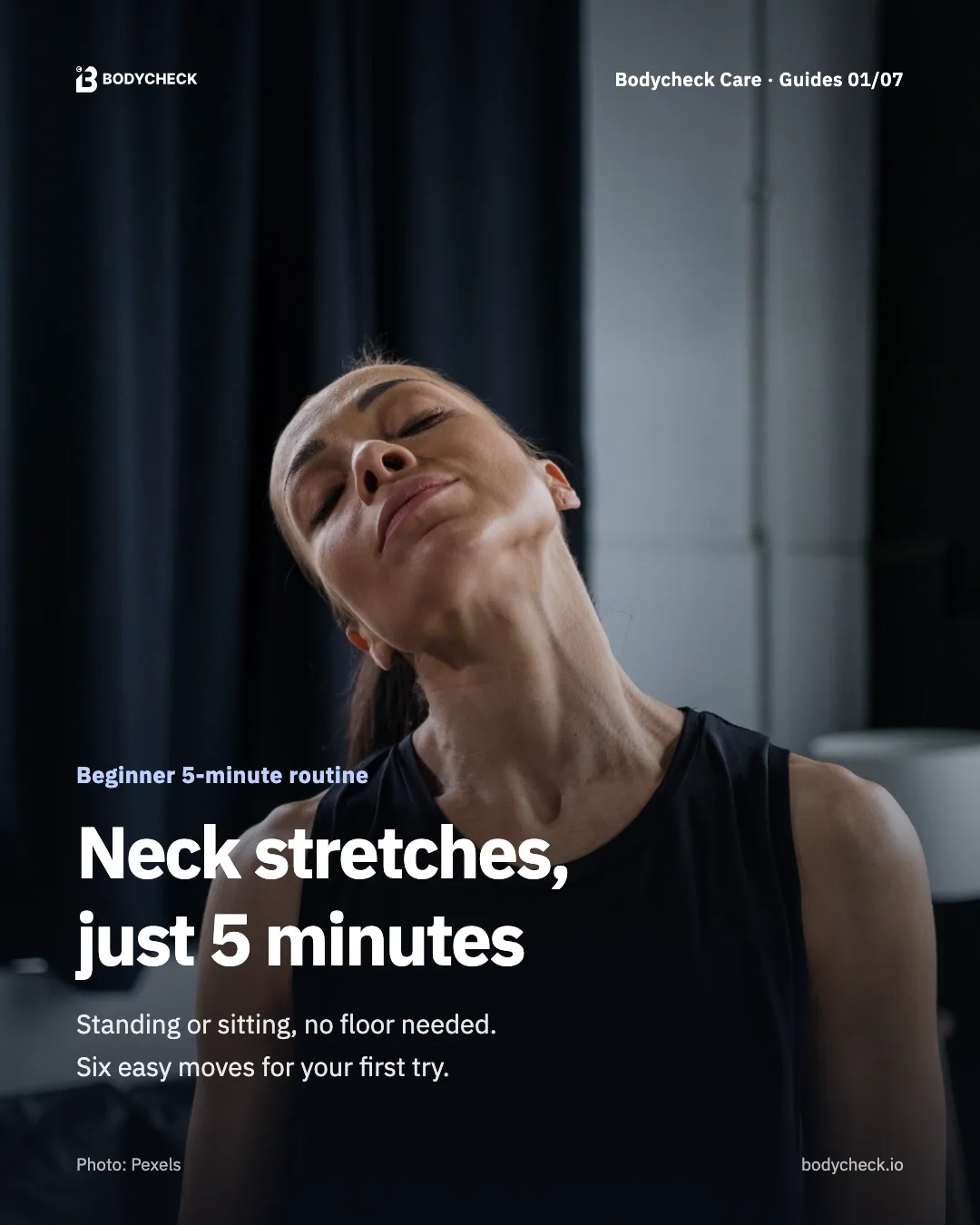
Tech Neck (Text Neck): What It Is, the Neck Hump, and a 5-Minute Routine
Tech neck and text neck are everyday names for the head drifting forward and down at screens. What they mean, how much more the neck holds when you look down, the neck hump, screen habits that help, and a 5-minute routine.
Short answer: Tech neck and text neck are everyday names for the head drifting forward and down while you look at screens. They are not medical diagnoses. Changing a few screen habits and spending a few minutes on neck, chest and upper-back moves can change how you hold your head over time. How much, and how fast, differs from person to person.
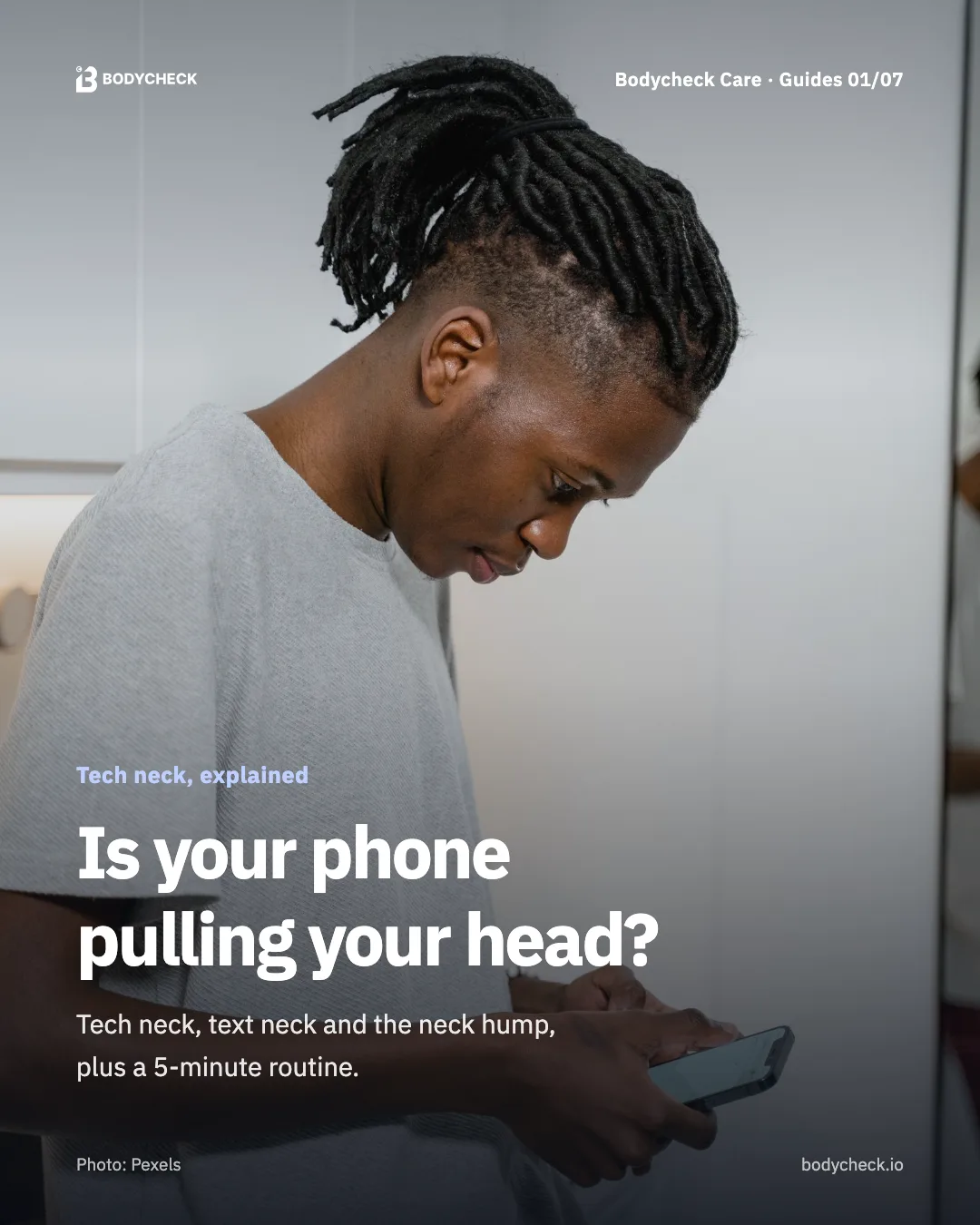
Hi, I'm an editor on the Bodycheck Care team. Last week a friend sent me a photo she took while we waited for a train. I was reading something on my phone, and from the side my head was a good way out in front of my shoulders, as if I was trying to read the screen with my nose. I hadn't noticed at all.
That posture has a name now: tech neck. Below I'll sort out what the name means, what it doesn't mean, what people ask about it most, and a 5-minute routine you can do standing up and then on a mat.
Tech neck vs text neck vs forward head posture: what's the difference?
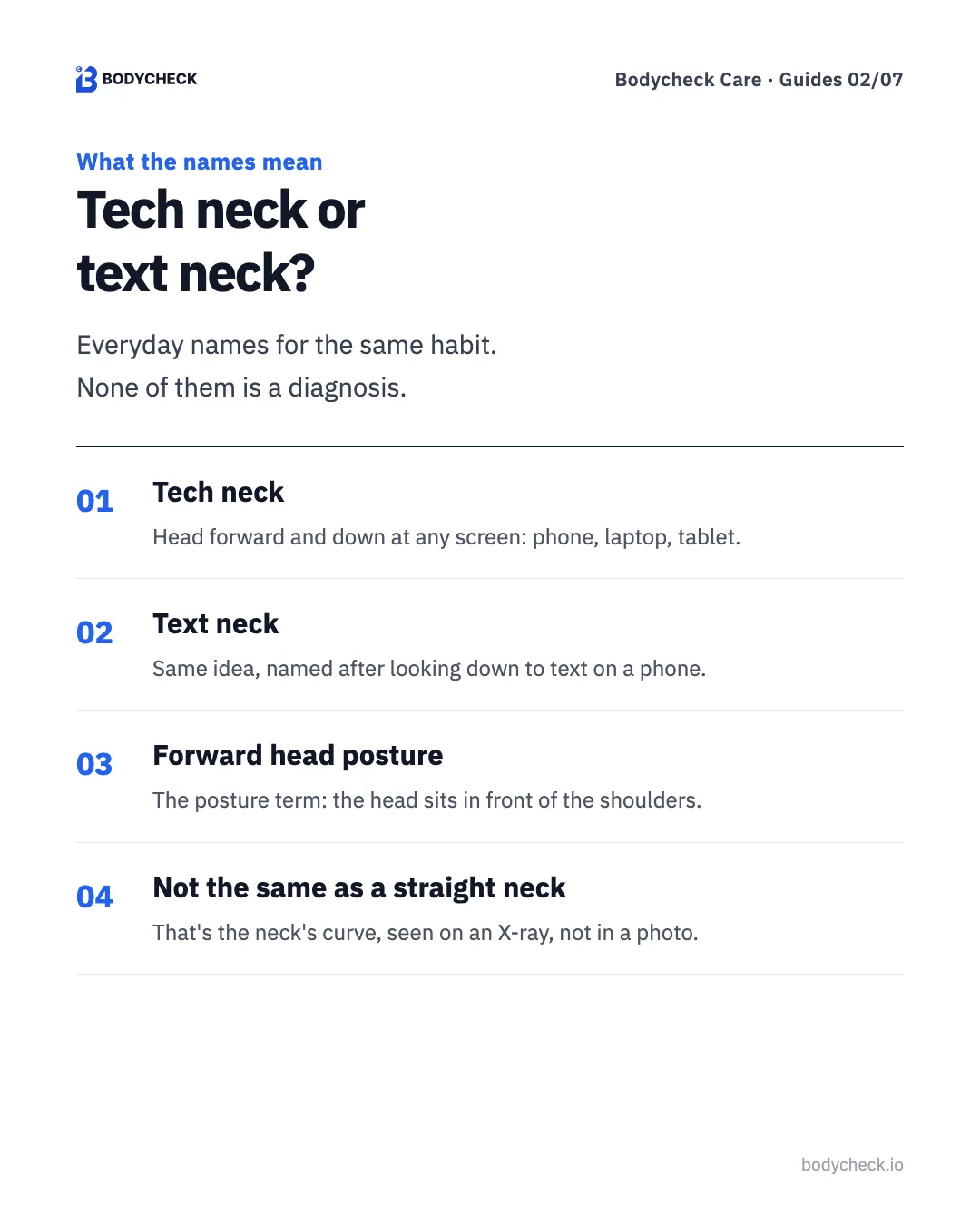
These names overlap a lot. Here's how they are usually used.
| Name | What it usually means | A diagnosis? |
|---|---|---|
| Tech neck | Head drifting forward and down at any screen: phone, laptop, tablet | No, an everyday name |
| Text neck | The same idea, named after looking down to text on a phone | No, an everyday name |
| Forward head posture | The posture term: from the side, the head sits in front of the shoulders | No, a description of posture |
So if you've read about forward head posture, you already know most of what tech neck is. The newer names just point at the cause most of us share: screens that sit below eye level.
One thing that is not the same: a "straight neck" (loss of the neck's natural curve). That is about the shape of the spine and is seen on an X-ray, not in a photo.
How much more does your neck hold when you look down?
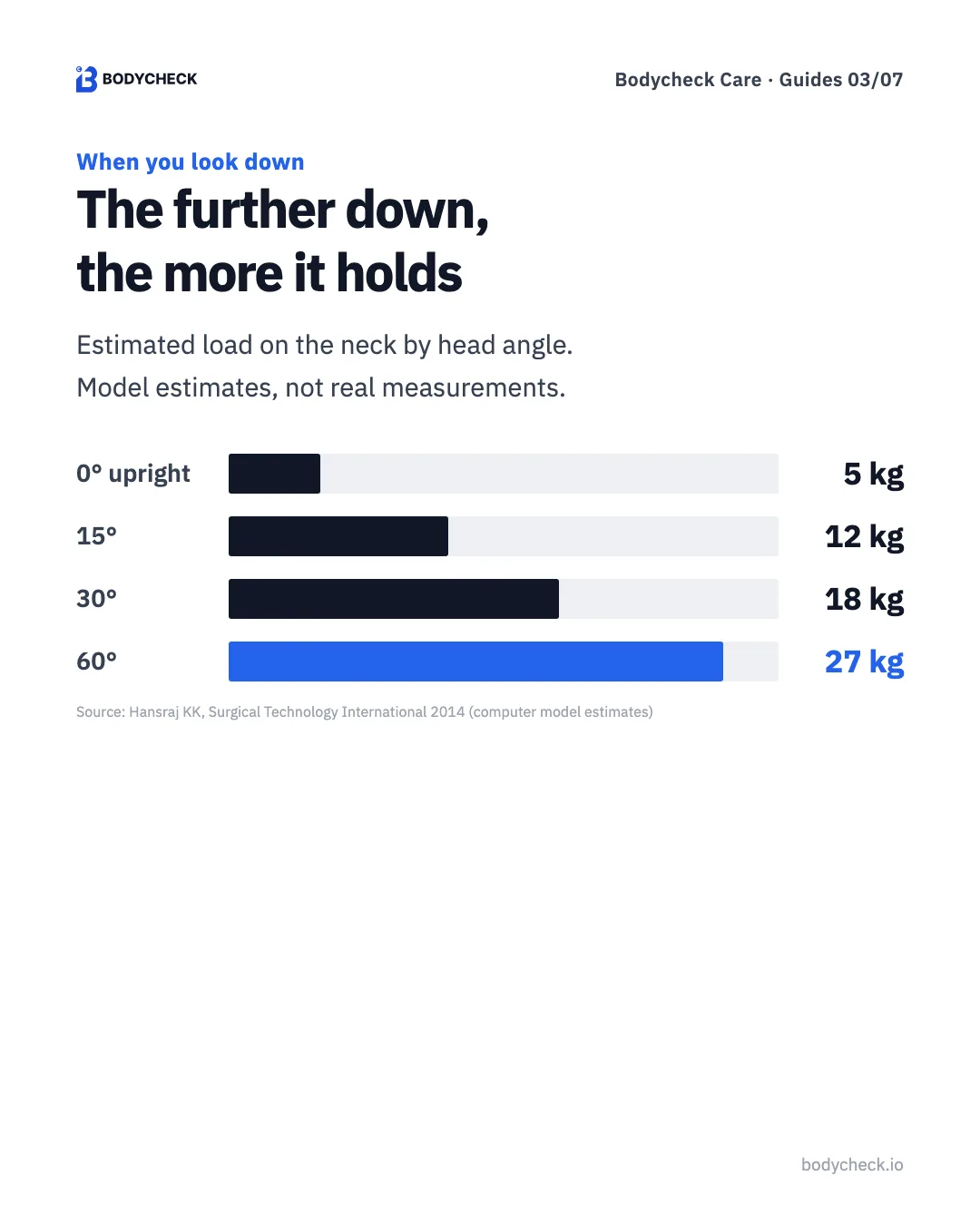
An adult head weighs about 5 kg (11 lb). When it sits upright over the shoulders, the neck doesn't have to work very hard to hold it.
Tilt it forward and the work goes up. A 2014 study used a computer model to estimate the force on the neck at different head angles.
| Head angle | Estimated load on the neck |
|---|---|
| 0° (upright) | about 5 kg (11 lb) |
| 15° | about 12 kg (27 lb) |
| 30° | about 18 kg (40 lb) |
| 60° | about 27 kg (60 lb) |
These are model estimates, not measurements taken inside a real neck, so don't read them too literally. The direction is what matters: the further and the longer you look down, the harder the back of your neck works.
Can tech neck be reversed?
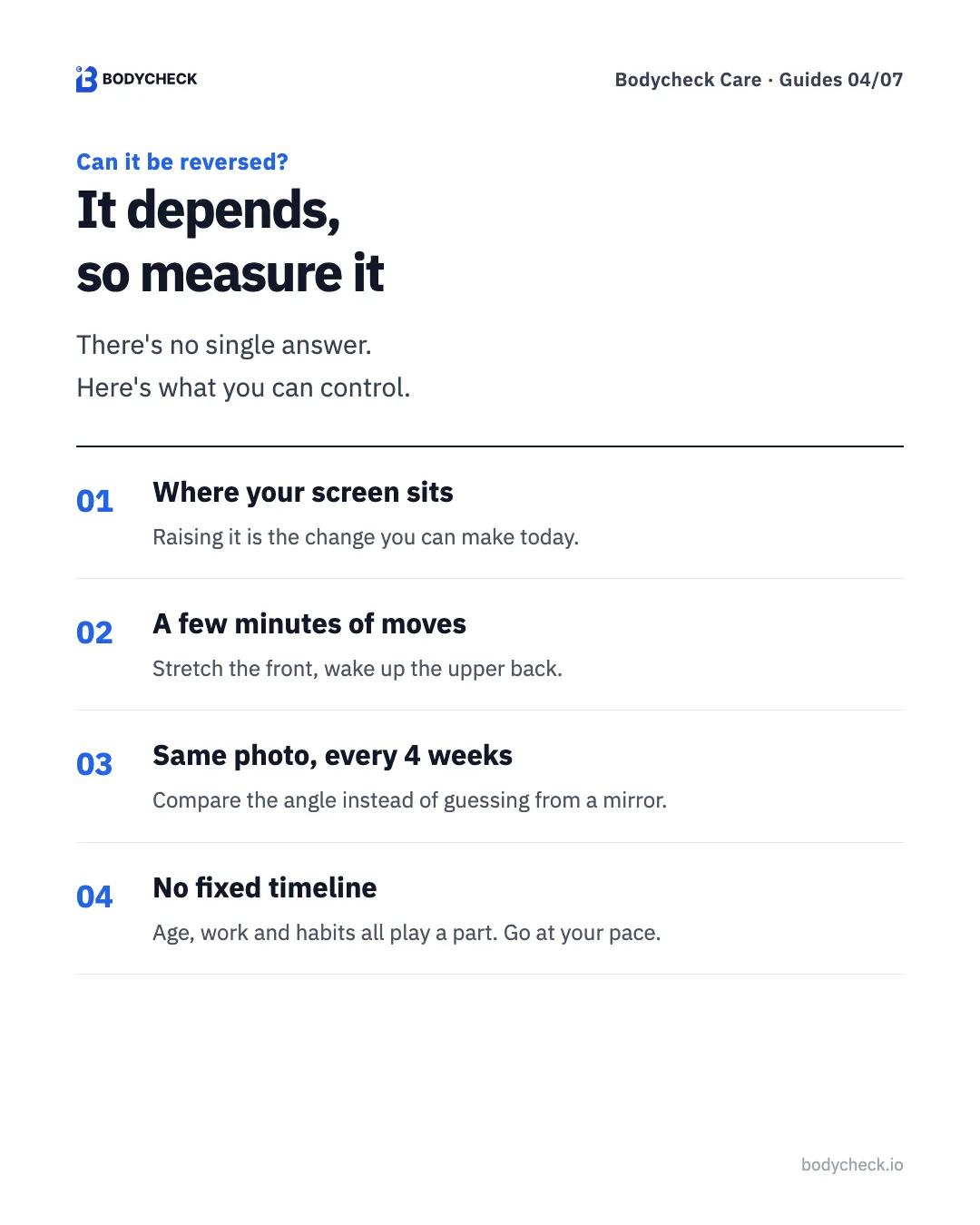
The honest answer is that it depends on the person. Age, the kind of work you do, how many hours you spend at a screen and how long the habit has been there all play a part. I can't promise you a result, and I'd be wary of anyone who does.
Does it go away on its own? The habit usually doesn't, because the screens don't go away. What you can control is this:
- Where your screen sits. This is the change you can make today.
- A few minutes of moves. Stretch the front of the body, wake up the upper back.
- The same photo every four weeks. Compare the angle instead of guessing from a mirror.
That third point is the one people skip. Without it, you're relying on how your posture feels, and posture you've had for years feels normal.
What is the neck hump, and is it tech neck?
Some people notice a soft bump at the base of the back of the neck and search for "tech neck hump." A bump there can be linked to long-term posture, but it can also have other causes, such as fat tissue or changes in the spine itself. You can't tell which from a mirror.
If the bump is new, growing, or comes with pain or numbness, see a doctor first, before you try exercises for it. Moves like the ones below are for how you hold your head. They are not a way to remove a lump.
How can you check for tech neck in 30 seconds?
Stand with your heels about a hand-width from a wall and see whether the back of your head touches without lifting your chin. Then have someone take a photo of you from the side while you look at your phone the way you normally do. Compare where your ear sits against your shoulder in the two positions.
It's a self-check, not a diagnosis. I wrote a full walk-through of the wall test and how to take a good side photo in the forward head posture self-check.
Which screen habits help?
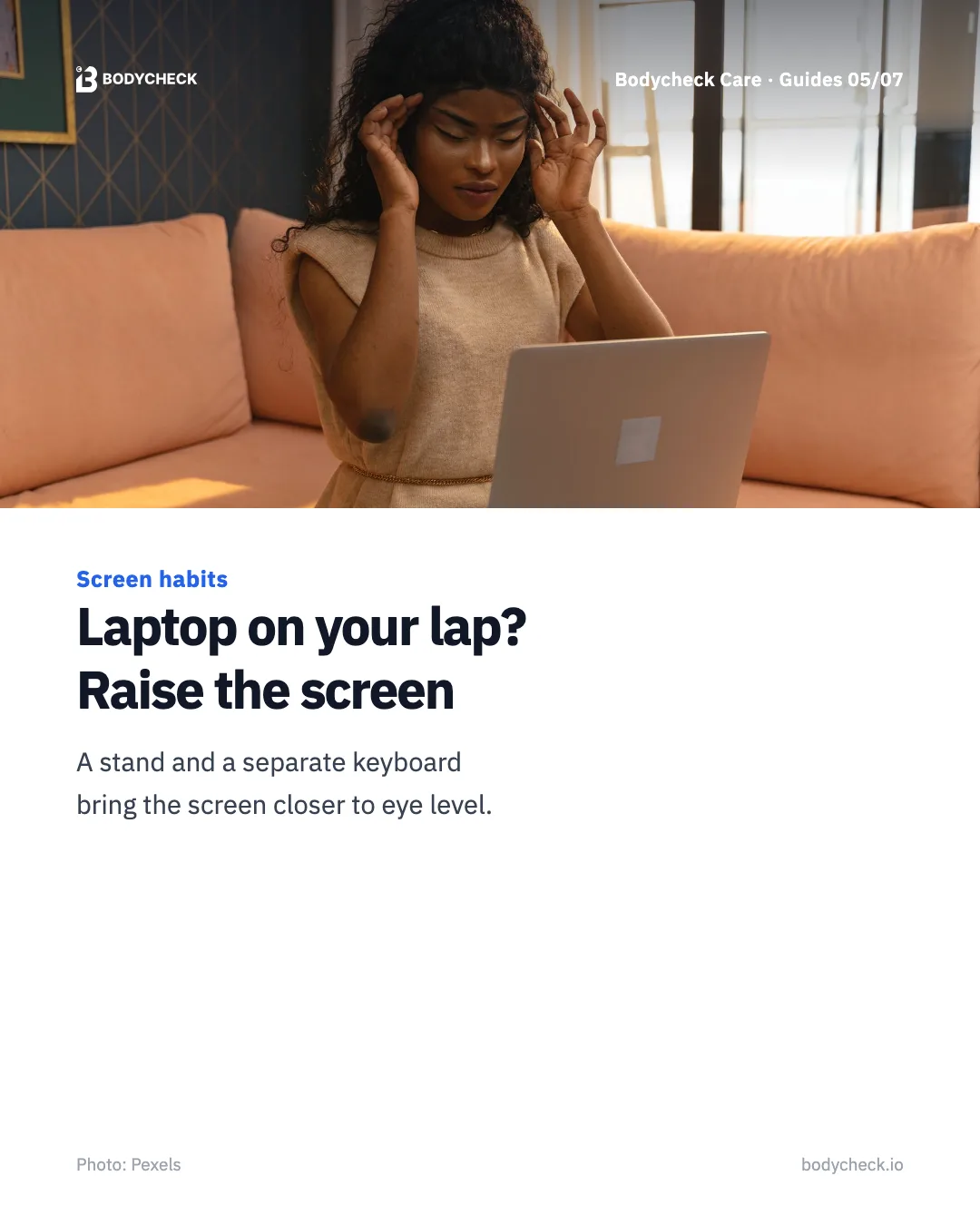
Most of tech neck comes from where the screen is, so start there.
- Raise your phone. Bring it up toward eye level and let your eyes, not your whole head, do more of the looking down.
- Laptop stand and a separate keyboard. A laptop on your lap or flat on a desk puts the screen well below your eyes. Raise the screen and type on a separate keyboard.
- A break every 50 minutes. Stand up, roll your shoulders and look at something far away for a minute.
- Hands-free calls. Use earbuds or the speaker instead of pinning the phone between your ear and shoulder.
None of these is dramatic. They work by changing the hours, and the hours are where tech neck comes from.
How can you see your tech neck as a number?
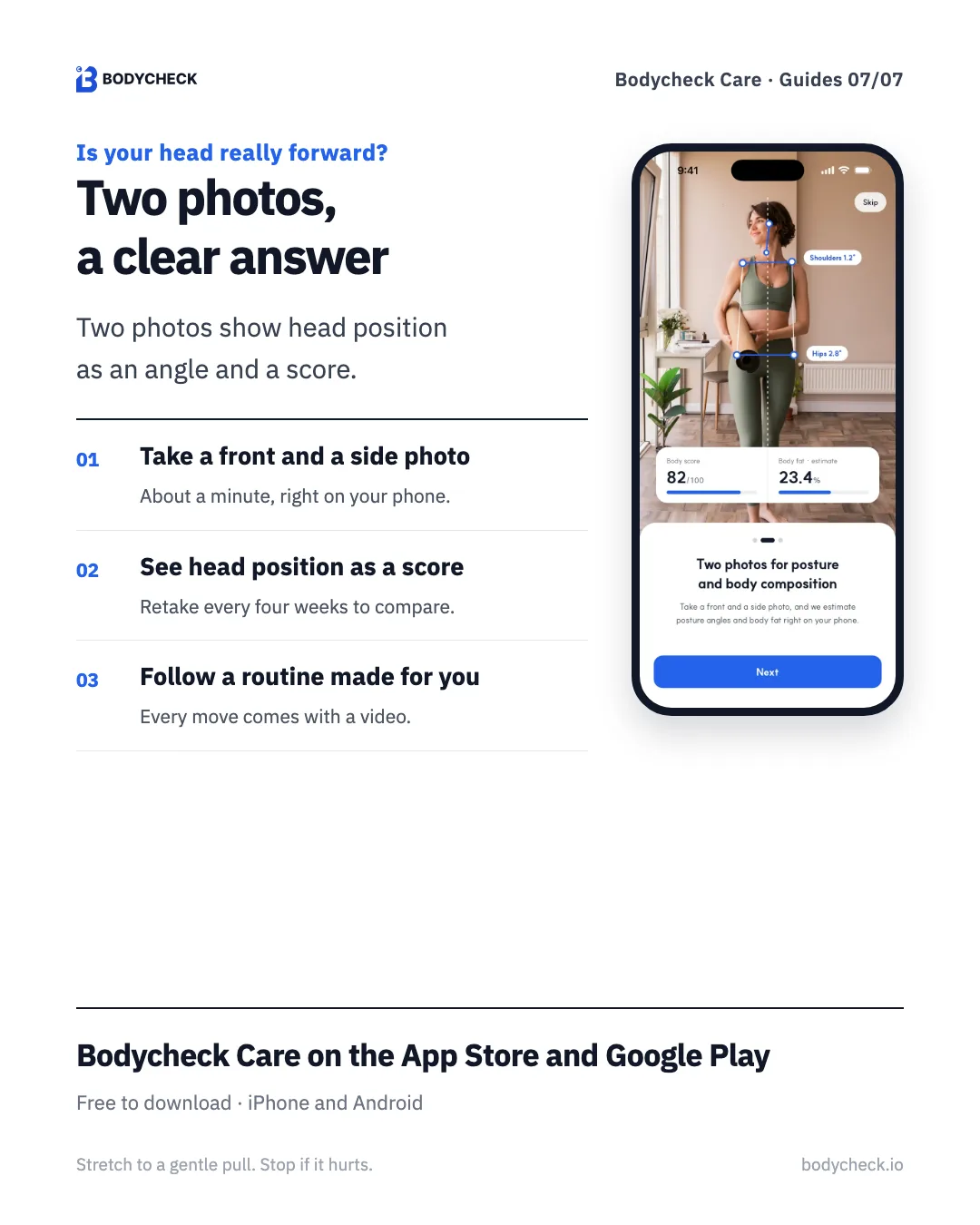
In Bodycheck Care you take a front and a side full-body photo, and the app shows your head forward position as an angle and a score, along with shoulder position and pelvic tilt. It takes about a minute on your phone.
- Get the app and take a front and a side photo.
- See your head forward position as an angle and a score.
- Follow the moves picked for your result, each with a video.
- Retake the photos every four weeks and compare.
It's free on iPhone and Android, and it is not a medical device. What it gives you is a number to compare against next month, which is exactly what the wall test can't.
Bodycheck Care · Free
See your head forward position from two photos
Take a front and a side photo to see how far your head and shoulders sit forward as a score, then follow moves picked for your result, each with a video.
The 5-minute tech neck routine
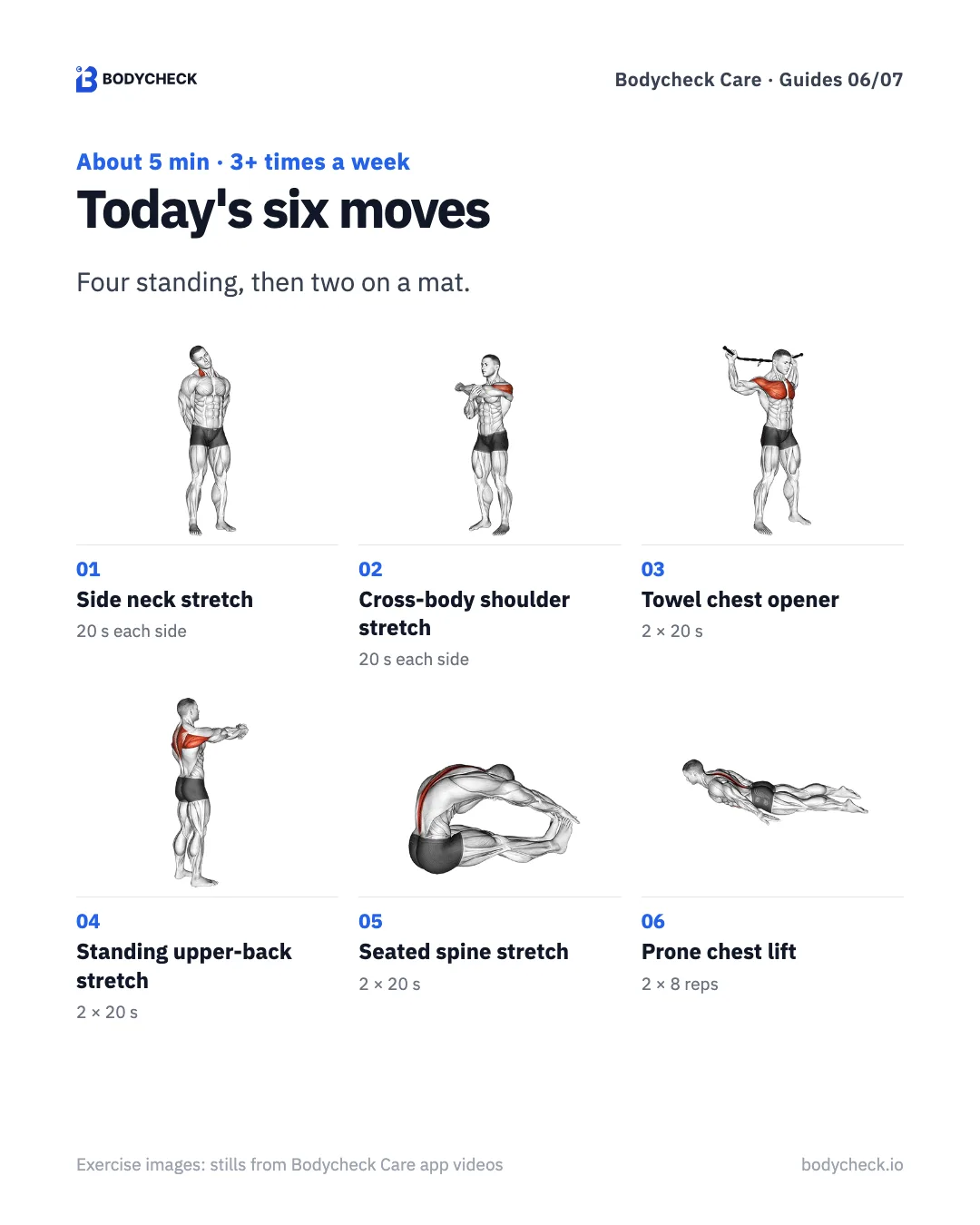
Four moves standing, then two on a mat. Neck and shoulders first, then the chest, then the upper back. Try it at least three times a week for four weeks. On workdays it fits into a coffee break. If you want a longer version later, the 11-minute routine uses a similar order with more time on the floor.
1. Side neck stretch · 20 s · each side
- Stand or sit tall with relaxed shoulders.
- Rest a hand on the side of your head and tilt your ear toward your shoulder.
- Keep the opposite shoulder pressed down so it doesn't rise.
- Hold 20 seconds, then switch sides.
2. Cross-body shoulder stretch · 20 s · each side
- Stand tall and reach one arm across your chest.
- With the other hand, pull it in just above the elbow.
- Hold 20 seconds where you feel the back of the shoulder stretch.
- Switch sides.
3. Towel chest opener · 2 sets × 20 s
- Stand tall holding a towel or long stick wider than your shoulders.
- Keep your arms straight and raise them slowly overhead.
- Take them behind your head only as far as they move freely, opening the chest and front shoulders.
- Come back slowly and repeat for 20 seconds. If your shoulders catch, widen your grip.
4. Standing upper-back stretch · 2 sets × 20 s
- Stand with feet shoulder-width apart.
- Interlace your fingers and reach forward at shoulder height.
- Push your hands far forward and round your upper back so the shoulder blades spread.
- Breathe out slowly and hold 20 seconds.
5. Seated spine stretch · 2 sets × 20 s
- Sit on the mat with your legs out in front and your arms reaching forward.
- Sit up tall first, lengthening your back.
- Breathe out and round forward, head first, one section of your back at a time.
- Hold 20 seconds, then roll back up slowly.
6. Prone chest lift · 2 sets × 8 reps
- Lie face down, legs straight, hands by your head or by your sides.
- Squeeze your shoulder blades toward the middle of your back.
- Lift your chest slightly off the floor and pause for one second. Eyes on the floor, no arching the lower back.
- Lower slowly. Repeat 8 times.
At a glance
| # | Move | Sets |
|---|---|---|
| 1 | Side neck stretch | 20 s · each side |
| 2 | Cross-body shoulder stretch | 20 s · each side |
| 3 | Towel chest opener | 2 × 20 s |
| 4 | Standing upper-back stretch | 2 × 20 s |
| 5 | Seated spine stretch | 2 × 20 s |
| 6 | Prone chest lift | 2 × 8 reps |
Moves can be hard to follow from text alone. In Bodycheck Care every move has a video, and the app counts the time and sets for you.
Frequently asked questions
Is tech neck the same as forward head posture? Mostly, yes. Tech neck and text neck are everyday names for the head drifting forward and down at screens. Forward head posture is the posture term for the head sitting in front of the shoulders. None of them is a medical diagnosis.
Does tech neck make you look shorter? It can make you look a little shorter in photos, because the head and shoulders sit forward and lower. It doesn't change your actual height.
How do I fix tech neck while sleeping? There is no single right pillow. Look for one that keeps your head roughly in line with your body, on your back or your side, and avoid scrolling in bed with your head propped up on a stack of pillows.
Can tech neck be reversed? It depends on the person. Raising your screen and doing a few minutes of neck, chest and upper-back moves can change how you hold your head over time, but there is no fixed timeline. Take the same side photo every four weeks to see where you are.
Is there an app that checks tech neck? Bodycheck Care measures head forward position from a front and a side photo and shows it as an angle and a score. It is free on iPhone and Android, and you can retake the photos every four weeks to compare. It is not a medical device.
Before you start
- Stretch to a gentle pull. Stop right away if anything hurts or tingles.
- Don't hold your breath. Breathe out as you push.
- Move your head slowly. No big tilts back and no fast turns.
- This is exercise guidance. If you have pain, numbness or tingling in your arms, or a lump on your neck that is new or growing, see a doctor before you exercise.
Next time you catch yourself reading your phone with your nose, raise the screen a little. Then give your neck five minutes tonight.
Bodycheck Care · Free
Take two photos and get moves picked for you
Take a front and a side photo to see how far your head and shoulders sit forward as a score, then follow moves picked for your result, each with a video.
References
- Hansraj KK. Assessment of stresses in the cervical spine caused by posture and position of the head. Surgical Technology International, 2014;25:277-279. (Computer model estimates)
- Photos: Pexels (free license). Exercise images and app screens: Bodycheck Care app.