5-Minute Neck Stretches for Beginners: Six Moves Standing or Sitting
A beginner neck stretch routine that takes about 5 minutes and needs no floor. Timing for each move, what you should and shouldn't feel, and a 1-minute version for busy days.
Short answer: If you're new to neck stretches, start with something short and easy. The six moves below are all done standing or sitting, no floor, and take about 5 minutes back to back. Go neck, then back and chest, then legs. On days you only have a minute, do moves 1 and 3.
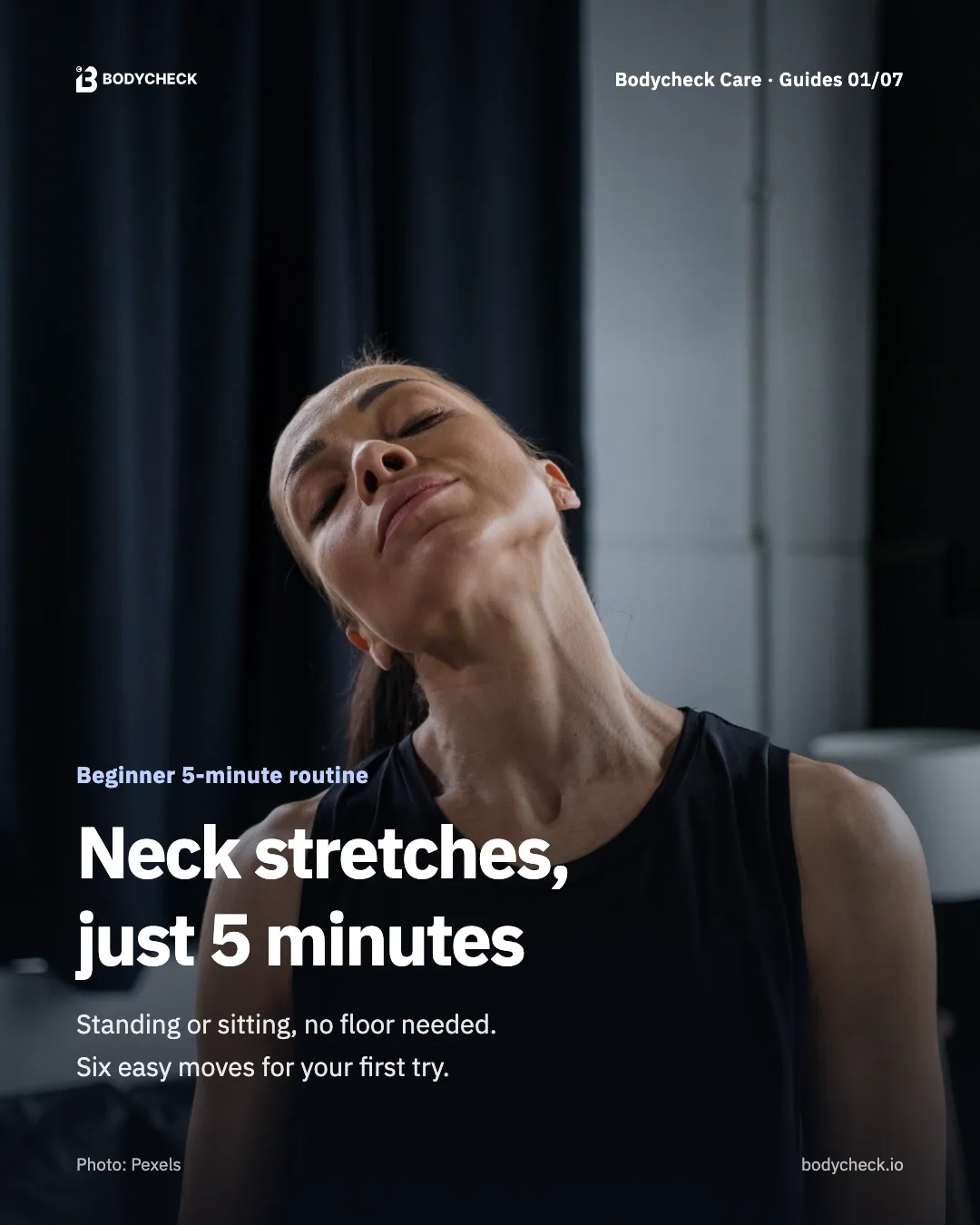
Hi, I'm an editor on the Bodycheck Care team. I'm the person who plans to exercise "when I have real time" and then never does. One day at work I put my lunch in the office microwave and, instead of staring at the timer for two minutes, I did a side neck stretch. Now the microwave is my stretching spot.
So today I'm sharing a 5-minute neck stretch routine that needs no mat and no big plan. Do it right where you're standing, or in the chair you're sitting in.
Why a 5-minute routine?
A long routine on day one is easy to drop by day three. If it's easy to start, you're more likely to do it again tomorrow.
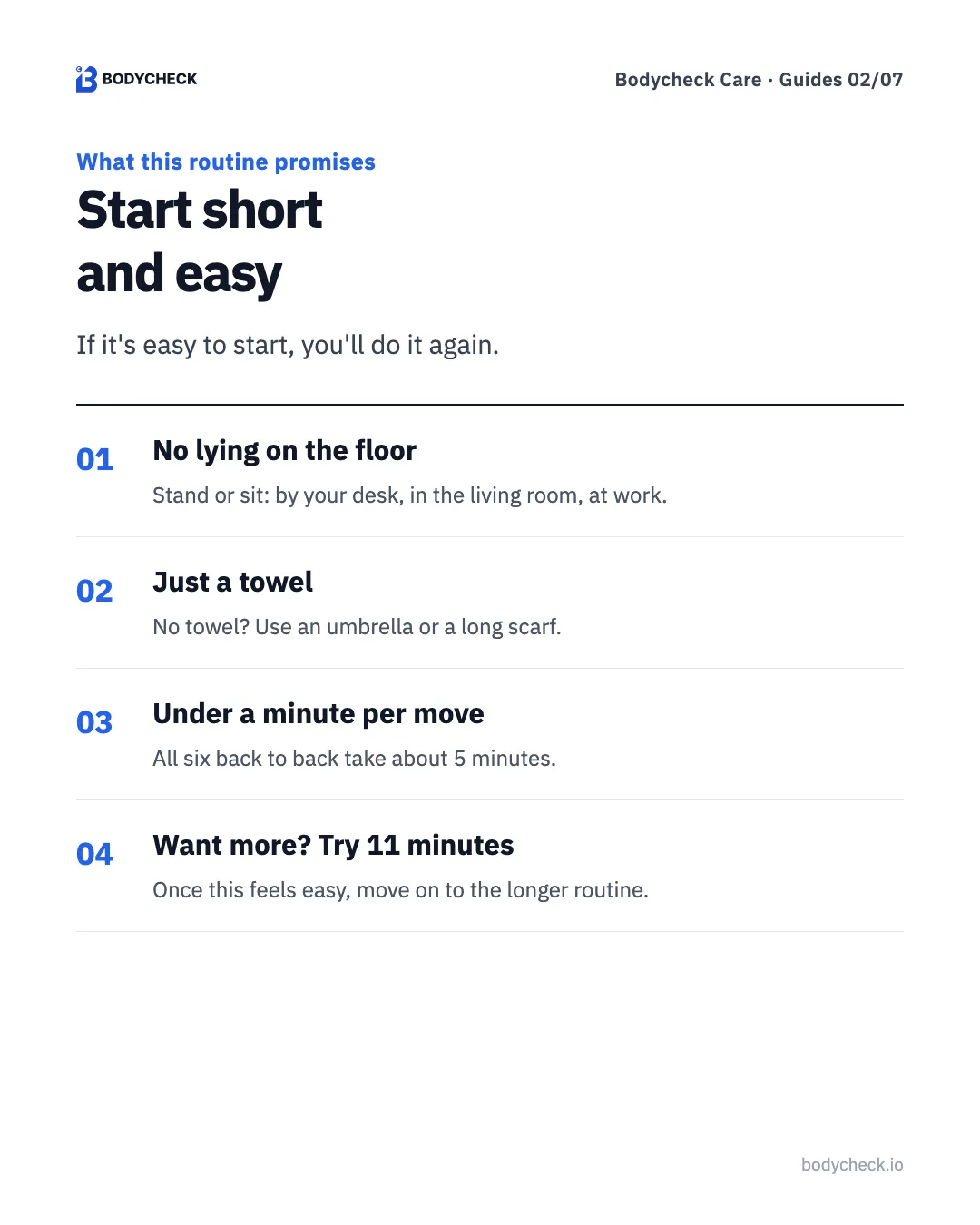
This one keeps three rules.
- No lying on the floor. Stand or sit: by your desk, in the living room, in the office kitchen.
- Just a towel. No towel? An umbrella or a long scarf works.
- Under a minute per move. All six, including moving between them, take about 5 minutes.
When this starts to feel easy and you want more, try the 11-minute forward head posture routine. It adds floor moves to work the neck, chest and upper back more deeply.
How strong should a stretch feel?
This is the part beginners ask about most. Harder is not better when you stretch.
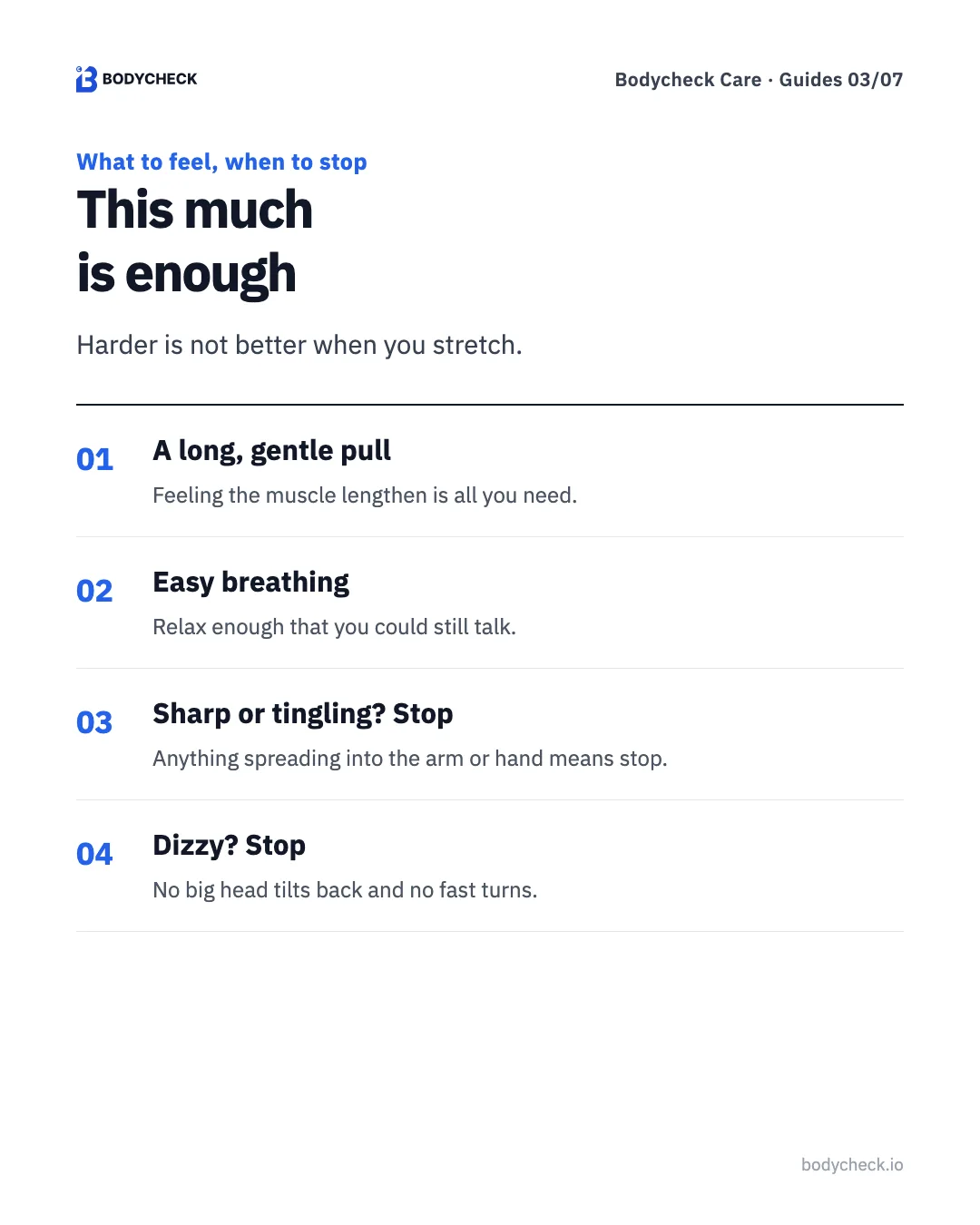
- What you should feel: the muscle lengthening, a gentle pull. You should be able to breathe easily and still talk.
- What you shouldn't feel: anything sharp or tingling, a feeling that spreads into your arm or hand, or dizziness. If that happens, shorten the range or stop.
With the neck in particular, skip big tilts back and fast turns. In the routine below, each move has its own "good sign" and "stop sign."
Why legs in a neck routine?
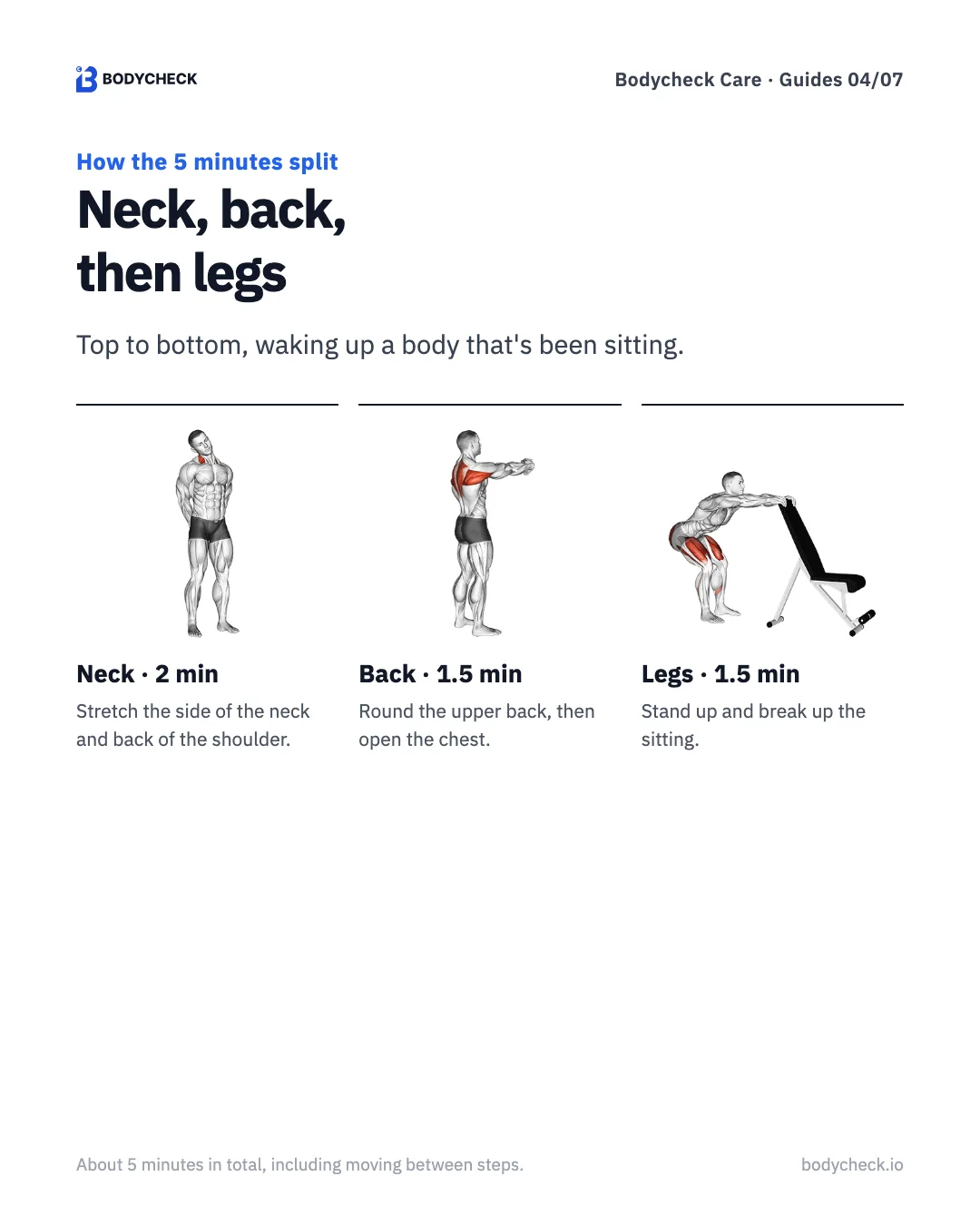
Your head usually drifts forward while you sit and look at a screen. If you stretch your neck and sit straight back down, it's easy to slide right back into the same position.
So this routine works from top to bottom.
- Neck and shoulders, about 2 min: stretch the side of the neck and the back of the shoulder, one side at a time.
- Back and chest, about 1.5 min: round the upper back, then open the chest.
- Legs, about 1.5 min: stand up and break up the sitting.
The leg moves aren't really "neck exercises." They're a quick way to wake up the whole body before you sit back down.
What if you only have one minute?
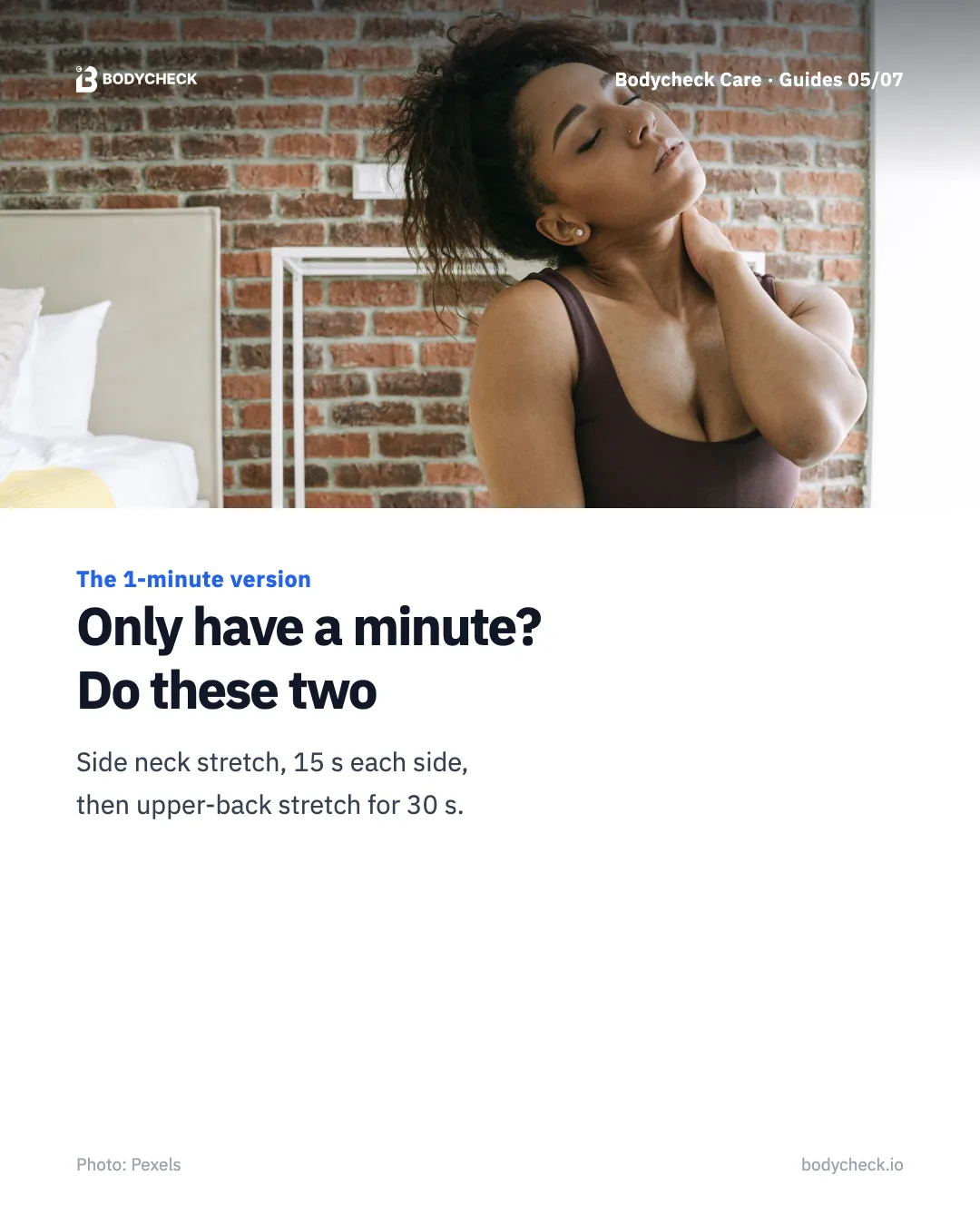
Back-to-back meetings, waiting for the elevator: when you truly have one minute, do just two moves.
- Side neck stretch · 15 s each side (30 s): ear toward shoulder, other shoulder down.
- Standing upper-back stretch · 30 s: push your clasped hands far forward, round your back, breathe out slowly.
The side of the neck and the upper back tend to tighten together while you look down, so even these two give you a real break. A good moment to start is when you notice your head has sunk low over your phone.
Want to see how far forward your head sits, as a number?
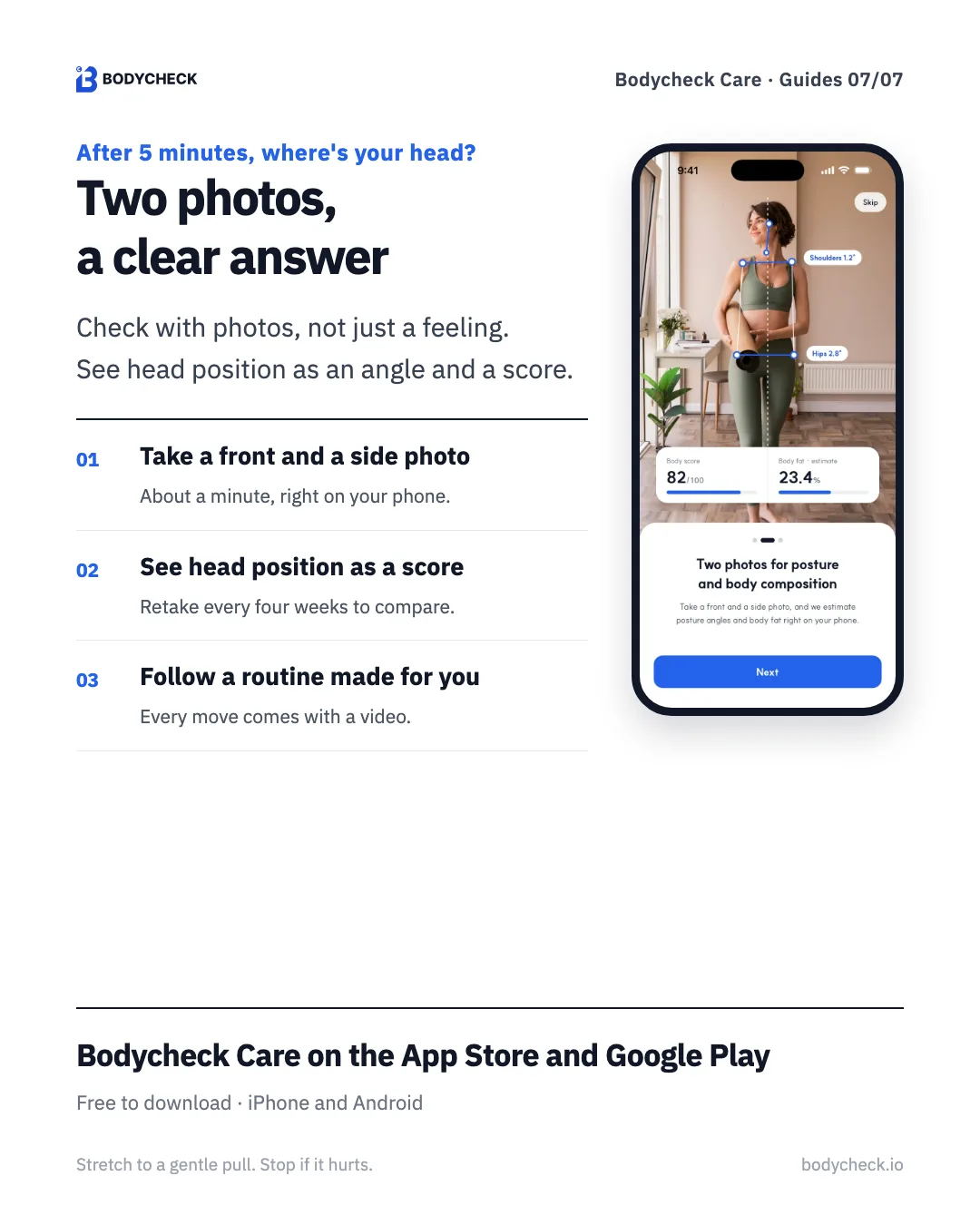
After stretching you might feel looser, but it's hard to tell how far in front of your shoulders your head actually sits. In Bodycheck Care, take a front and a side full-body photo and the app shows head position, shoulder position, and shoulder and hip tilt as angles and a score.
- Download the app and take a front and a side photo. It takes about a minute.
- See your head position as a score.
- Follow moves picked for your result and where you'll exercise, each with a video.
- Retake the photos after four weeks and compare.
The app is free on iPhone and Android. It is not a medical device. Use it to check in on your own posture.
Bodycheck Care · Free
Before you stretch, check your head position from two photos
Take a front and a side photo to see how far your head and shoulders sit forward as a score, then follow moves picked for your result, each with a video.
The 5-minute neck stretch routine
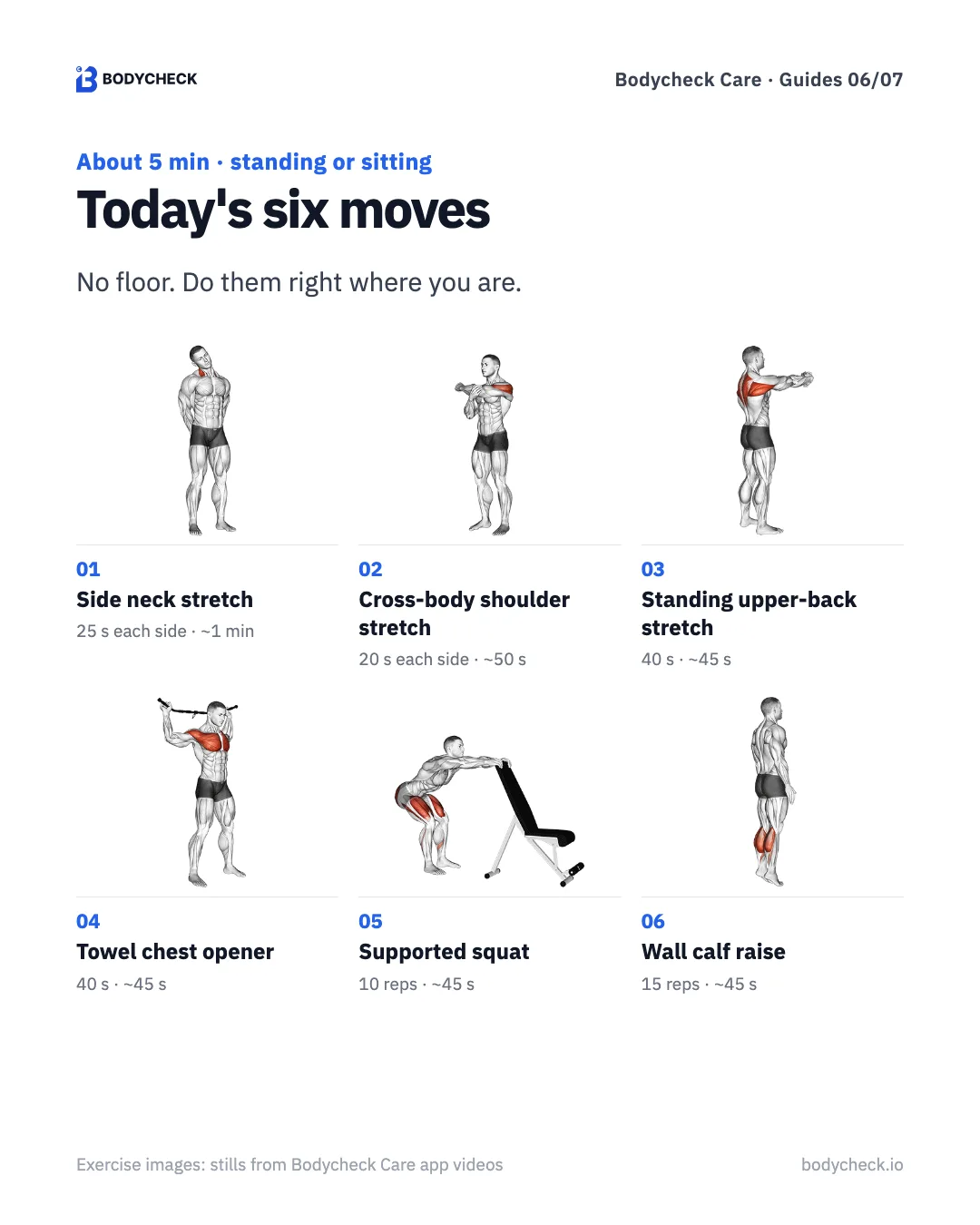
Every move is done standing or sitting. For the first four weeks, try it once on every workday. Times include moving into the next move, so they are approximate.
1. Side neck stretch · 25 s each side · about 1 min
- Stand or sit tall with relaxed shoulders.
- Rest a hand on the side of your head and tilt your ear toward your shoulder.
- Keep the opposite shoulder pressed down so it doesn't rise.
- Hold 25 seconds, then switch sides.
- Good sign: a long pull from below your ear down to your shoulder.
- Stop sign: tingling or a sharp feeling in your arm or fingertips. Don't press with your hand; just let it rest there.
2. Cross-body shoulder stretch · 20 s each side · about 50 s
- Stand or sit tall and reach one arm across your chest.
- With the other hand, pull it in just above the elbow.
- Hold 20 seconds where you feel the back of the shoulder stretch.
- Switch sides.
- Good sign: the back of the shoulder you're pulling opens up.
- Stop sign: a pinching pain at the front of the shoulder. Lower the arm a little and try again.
3. Standing upper-back stretch · 40 s · about 45 s
- Stand with feet shoulder-width apart. Sitting works too.
- Interlace your fingers and reach forward at shoulder height.
- Push your hands far forward and round your upper back so the shoulder blades spread.
- Breathe out slowly and hold 40 seconds.
- Good sign: the space between your shoulder blades widens.
- Stop sign: your lower back hurts or you're holding your breath. Let your head rest easily between your arms instead of dropping it hard.
4. Towel chest opener · 40 s · about 45 s
- Stand tall holding a towel wider than your shoulders. An umbrella or long scarf works too.
- Keep your arms straight and raise them slowly overhead.
- Take them behind your head only as far as they move freely, opening the chest and front shoulders.
- Come back slowly and repeat for 40 seconds.
- Good sign: the chest and front of the shoulders open up.
- Stop sign: your shoulders catch, or it hurts with a click. Widen your grip and make the movement smaller.
5. Supported squat · 10 reps · about 45 s
- Hold the back of a chair or a wall, feet shoulder-width apart.
- Push your hips back as if sitting into a chair.
- Let your knees follow your toes and keep your chest up.
- Press through your heels to stand. Do 10.
- Good sign: you feel your glutes and the front of your thighs working. Go only as low as is comfortable.
- Stop sign: pain inside or at the front of the knee. Make the squat shallower.
6. Wall calf raise · 15 reps · about 45 s
- Hold a wall or a desk, feet shoulder-width apart.
- Shift your weight onto the balls of your feet and lift your heels.
- Pause for one second at the top.
- Lower slowly. Repeat 15 times.
- Good sign: your calves tighten and legs that have been sitting wake up.
- Stop sign: your calf feels like it's about to cramp. Rest a moment and do fewer reps.
At a glance
| # | Move | Time | Where you feel it |
|---|---|---|---|
| 1 | Side neck stretch | 25 s each side · ~1 min | Side of neck |
| 2 | Cross-body shoulder stretch | 20 s each side · ~50 s | Back of shoulder |
| 3 | Standing upper-back stretch | 40 s · ~45 s | Between shoulder blades |
| 4 | Towel chest opener | 40 s · ~45 s | Chest, front of shoulders |
| 5 | Supported squat | 10 reps · ~45 s | Glutes, thighs |
| 6 | Wall calf raise | 15 reps · ~45 s | Calves |
| Total | about 5 min |
1-minute version: move 1, side neck stretch, 15 s each side, plus move 3, standing upper-back stretch, 30 s.
Moves can be hard to follow from text alone. In Bodycheck Care every move has a video, and the app counts the time and reps for you.
Frequently asked questions
How often should I do the 5-minute routine? Once a day on workdays for the first four weeks. On busy days, the 1-minute version is fine.
How strong should a stretch feel? A long, gentle pull is enough. If you feel anything sharp or tingling, or get dizzy, stop right away.
Can I do it sitting at my desk? Moves 1 to 4 work in a chair. For moves 5 and 6, stand up and hold the back of a chair, a desk or a wall.
What if I don't have a towel? For the towel chest opener, an umbrella or a long scarf works. If your shoulders catch, widen your grip.
How can I tell how far forward my head sits? Bodycheck Care measures it from a front and a side photo and shows head position as an angle and a score. It is free on iPhone and Android, and you can retake the photos every four weeks to compare.
Before you start
- Stretch to a gentle pull. Stop right away if anything hurts or tingles.
- No big tilts back or fast turns of the head. If you feel dizzy, sit down and rest.
- Don't hold your breath. Keep it steady.
- This is exercise guidance. If you have neck pain that won't go away, or numbness in your arms or hands, see a doctor before you exercise.
At the microwave or at the elevator, start with one minute today.
Bodycheck Care · Free
Take two photos and get moves picked for where you are
Take a front and a side photo to see how far your head and shoulders sit forward as a score, then follow moves picked for your result, each with a video.
References
- Exercises: Bodycheck Care app exercise video library.
- Photos: Pexels (free license). Exercise images and app screens: Bodycheck Care app.