Forward Head Posture and Headaches: Is There a Link? Plus a 10-Minute Routine
A stiff neck and a heavy head after a long screen day can be connected to posture, but headaches have many causes. Check the signs that need a doctor first, then try a gentle 10-minute neck and upper-back routine.
Short answer: If your neck feels stiff and your head feels heavy after a long day at a screen, forward head posture and neck and shoulder tension can be connected to that feeling. But posture is not proven to cause headaches, and headaches have many causes. A sudden, severe headache, or one that comes with numbness or vision changes, needs a doctor first, not exercise. Otherwise, try the six gentle moves below for about 10 minutes, three times a week for four weeks.
Hi, I'm an editor on the Bodycheck Care team. On deadline weeks I'm on my laptop all day, then on the couch with a tablet at night. Around 10 p.m. I catch myself with both hands wrapped around the back of my neck. The neck feels stiff, and my head feels like I'm wearing an extra hat.
So I got curious. Is that heavy feeling really about posture? Below I'll look at how forward head posture and headaches might be linked, which headaches need a doctor before any stretching, and the 10-minute routine I do in the evening. All you need is a mat.
Do you get a stiff neck and a heavy head by late afternoon?
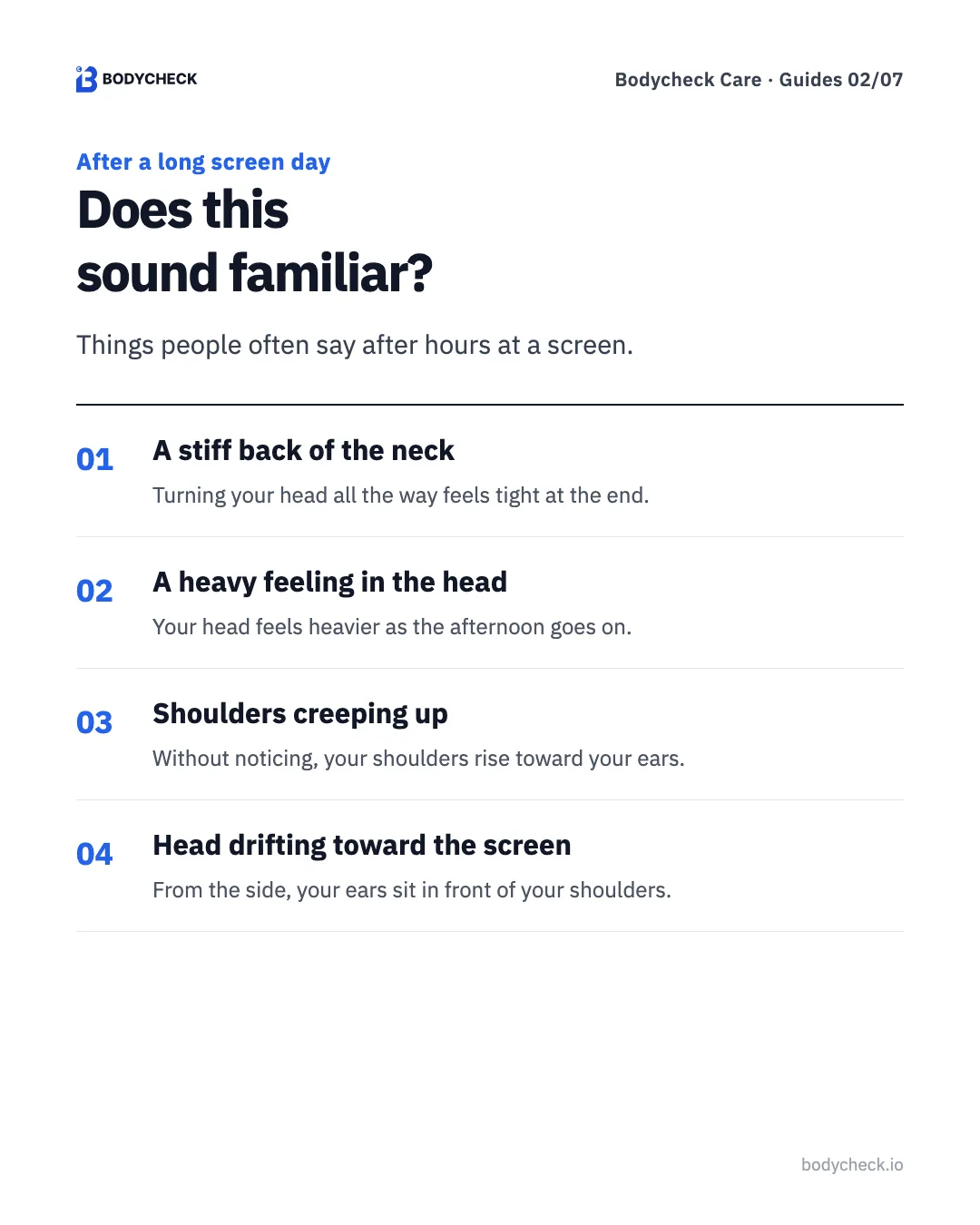
These come up a lot from people who spend long days at a screen.
- A stiff back of the neck. Turning your head all the way feels tight at the end.
- A heavy feeling in the head. Your head feels heavier as the afternoon goes on.
- Shoulders creeping up. Without noticing, your shoulders rise toward your ears.
- Head drifting toward the screen. From the side, your ears sit in front of your shoulders.
If a few of these sound familiar, you may have spent a lot of the day with your head pushed forward. This is just a list of common feelings, though. It can't tell you what is going on in your body.
How long do we sit each day?
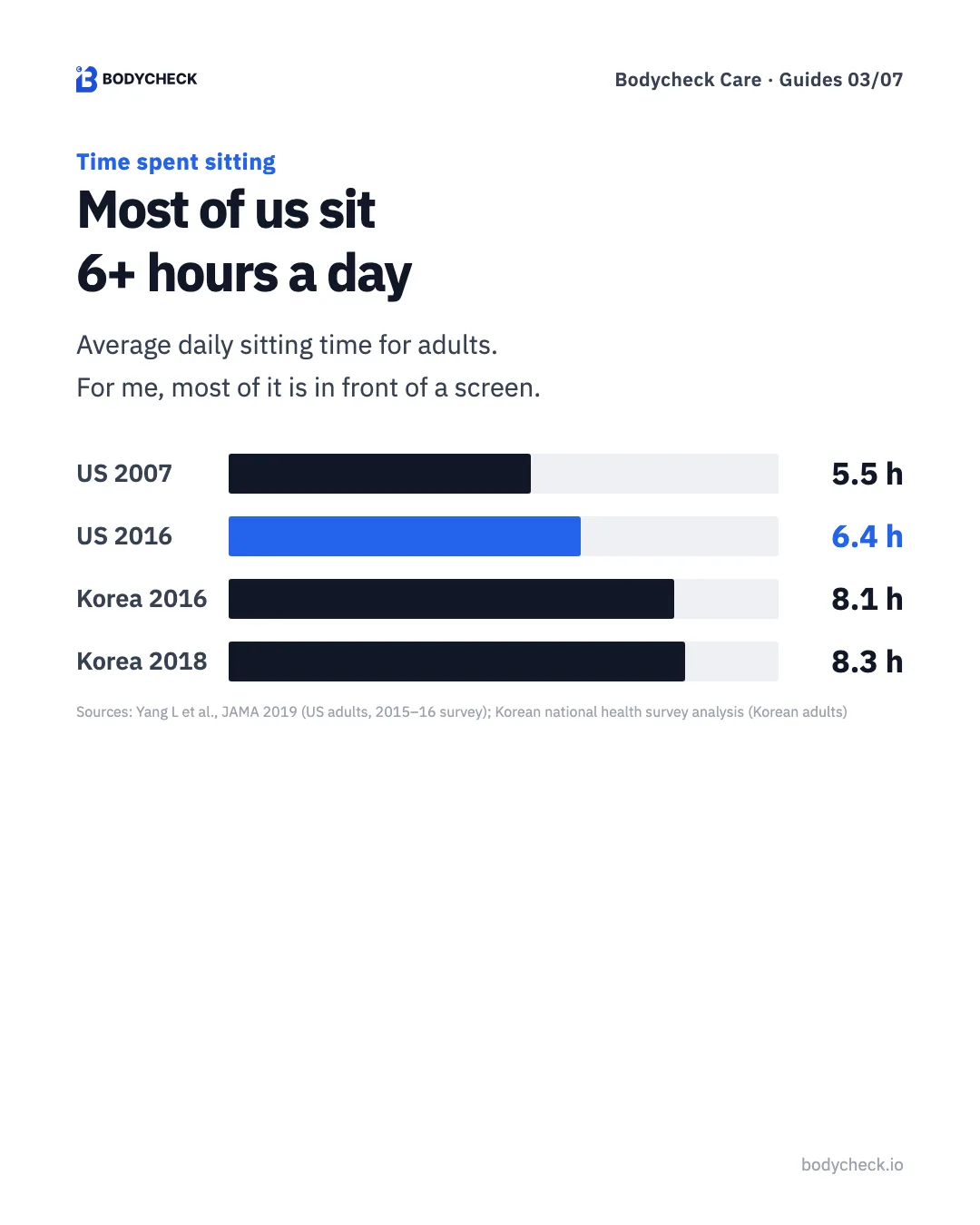
A 2019 study in JAMA found that US adults sat about 6.4 hours a day in 2015-2016, up from 5.5 hours in 2007. In Korea, an analysis of national health survey data put adult sitting time at 8.1 hours in 2016 and 8.3 hours in 2018.
| Survey | Average daily sitting time |
|---|---|
| US adults, 2007 | 5.5 hours |
| US adults, 2015-2016 | 6.4 hours |
| Korean adults, 2016 | 8.1 hours |
| Korean adults, 2018 | 8.3 hours |
Not all of that is screen time. Still, when I look at my own day, most of my sitting happens in front of a laptop or a phone. When a screen sits below eye level, your head slides forward and down, and over hours the back of the neck and the shoulders keep working to hold it there.
Does forward head posture cause headaches?
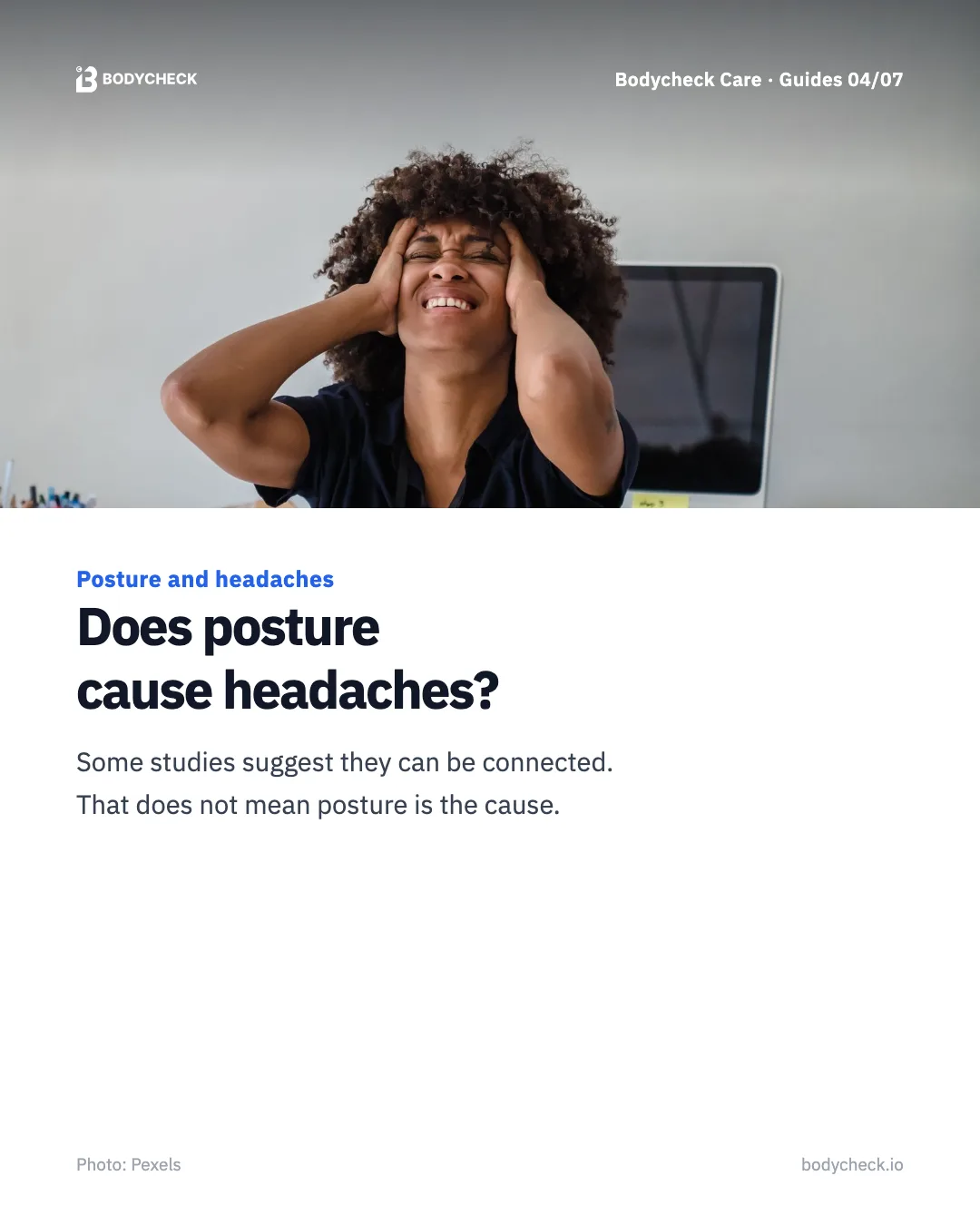
The honest answer: it can be connected, but no one can say it is the cause.
One small study found that people with chronic tension-type headache tended to have a more forward head position than people without it. It is also common to hear that tight neck and shoulder muscles from long hours of looking down can be connected to a heavy, squeezing feeling in the head.
But studies like this only show that the two show up together. They can't tell us whether posture led to the headaches, the headaches changed posture, or something else affected both. Headaches are also linked to sleep, stress, eye strain and many other things, so finding the cause is a job for a doctor.
That's why I don't think of this routine as a headache remedy. I think of it as time to loosen up a neck and upper back that have been sitting all day. A few everyday habits help too:
- Put your laptop on a stand so the top of the screen is close to eye level.
- Bring your phone up toward your eyes instead of dropping your head to it.
- About once an hour, stand up, roll your shoulders and get some water.
- On the couch, keep your back against the cushions and raise the screen a little.
When should you see a doctor before exercising?
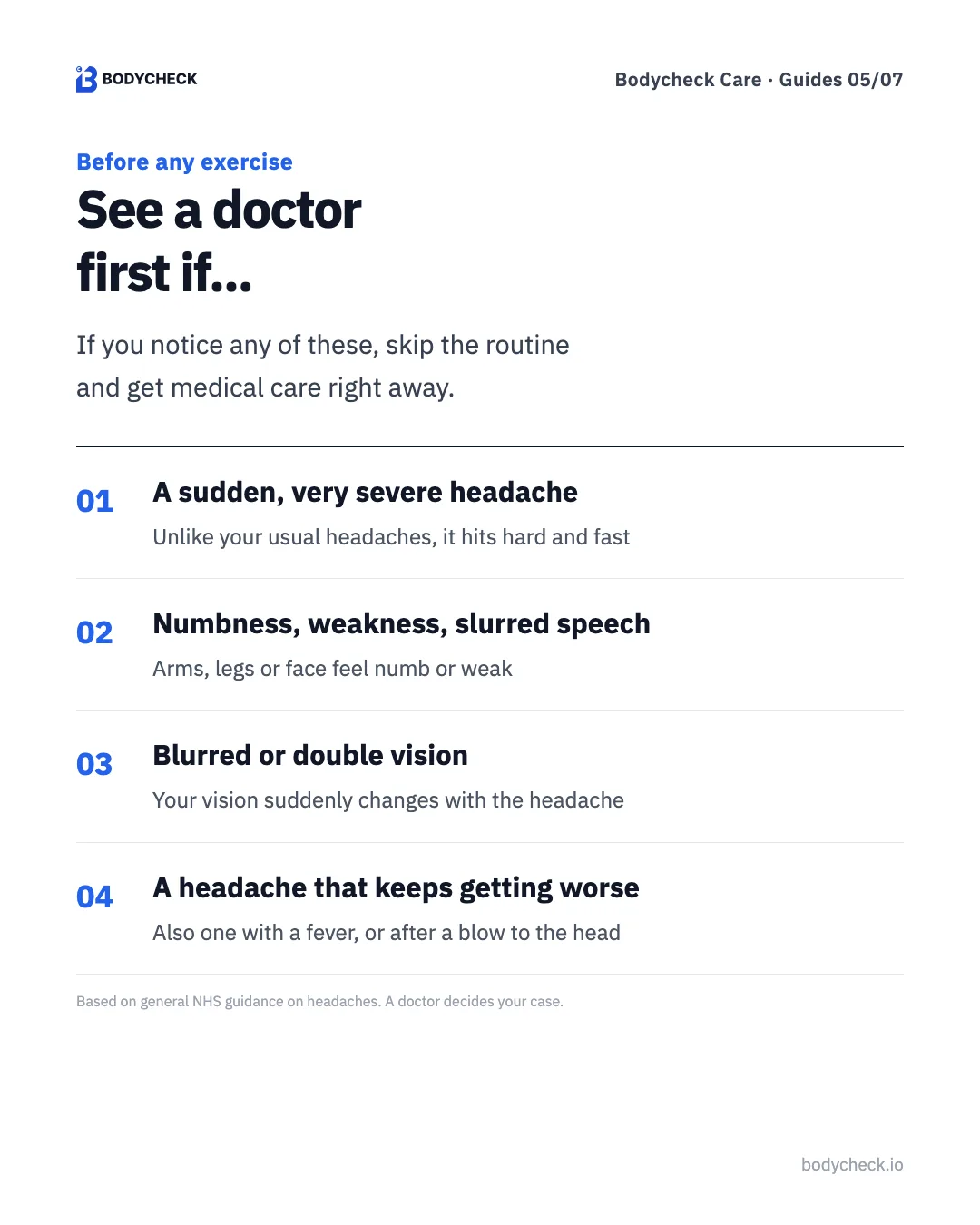
Please read this part. If you notice any of the following, skip the stretches and get medical care right away.
- A sudden, very severe headache. It hits hard and fast and feels nothing like your usual headaches.
- Numbness, weakness or slurred speech. Your arms, legs or face feel numb or weak, or words won't come out right.
- Blurred or double vision. Your vision suddenly changes along with the headache.
- A headache that keeps getting worse. The same goes for a headache with a fever or a stiff neck that makes it hard to bend your head forward, and one after a blow to the head.
Even without these signs, if your headaches are frequent, keep coming back after pain relievers, or get in the way of daily life, see a doctor rather than trying to push through with exercise. This is general guidance. A doctor decides what applies to you.
How can you see how far forward your head really is?
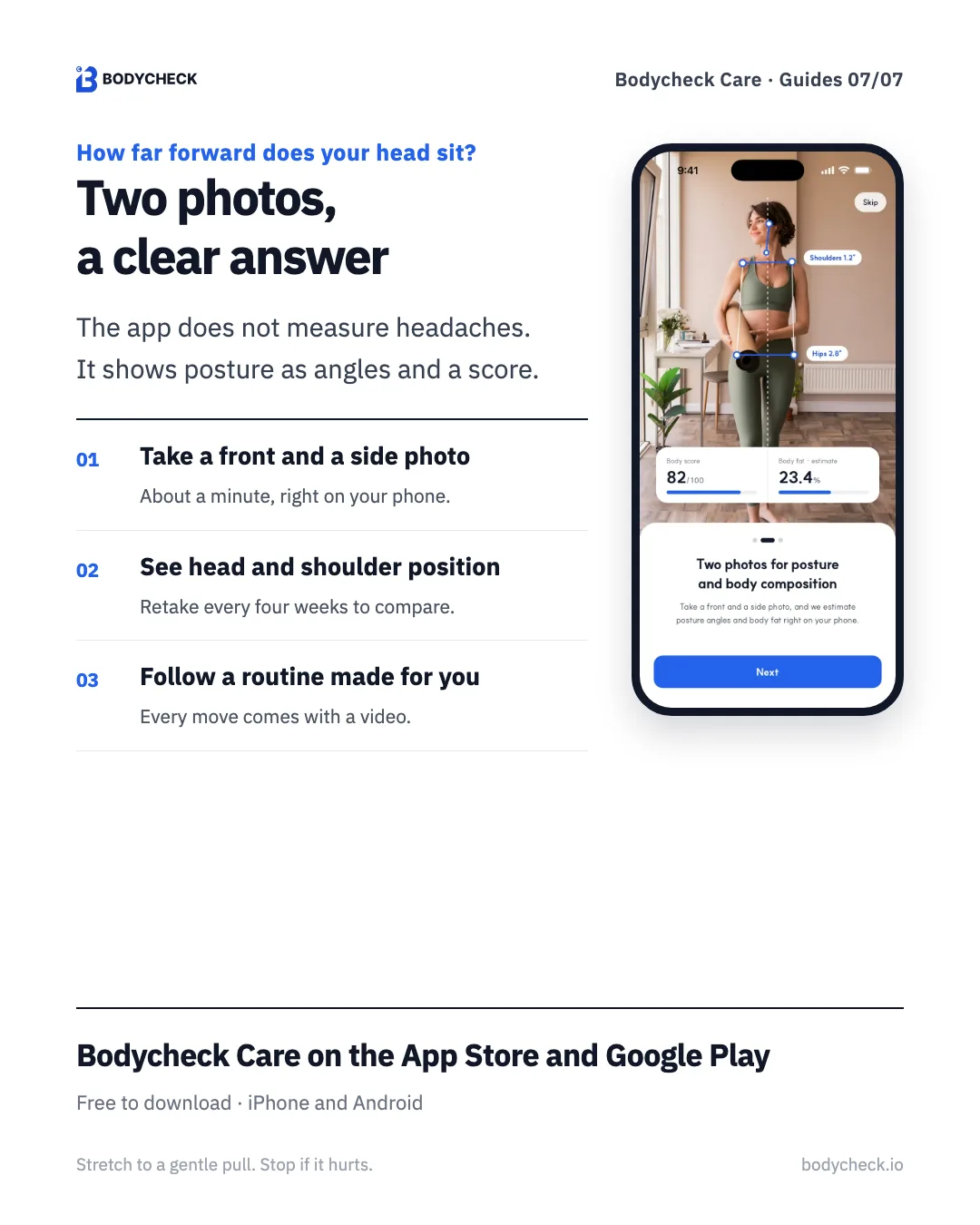
To be clear up front: Bodycheck Care does not measure headaches. What it can show you is your posture, in numbers. Take a front and a side photo, and the app shows how far your head and shoulders sit forward and which way your head and shoulders tilt, as angles and a score.
- Get the app and take a front and a side full-body photo. It takes about a minute.
- See head position, shoulder position, head tilt and shoulder balance as a score.
- Follow a routine picked for your result from more than 1,300 exercise videos.
- Retake the photos every four weeks and compare.
Turning "my posture feels off lately" into a number gives you a starting point when you change your habits. It is free on iPhone and Android. It is not a medical device, so treat the results as a reference.
Bodycheck Care · Free
See how far forward your head sits, from two photos
Take a front and a side photo to see how far your head and shoulders sit forward as a score, then follow moves picked for your result, each with a video.
The 10-minute neck and upper-back routine
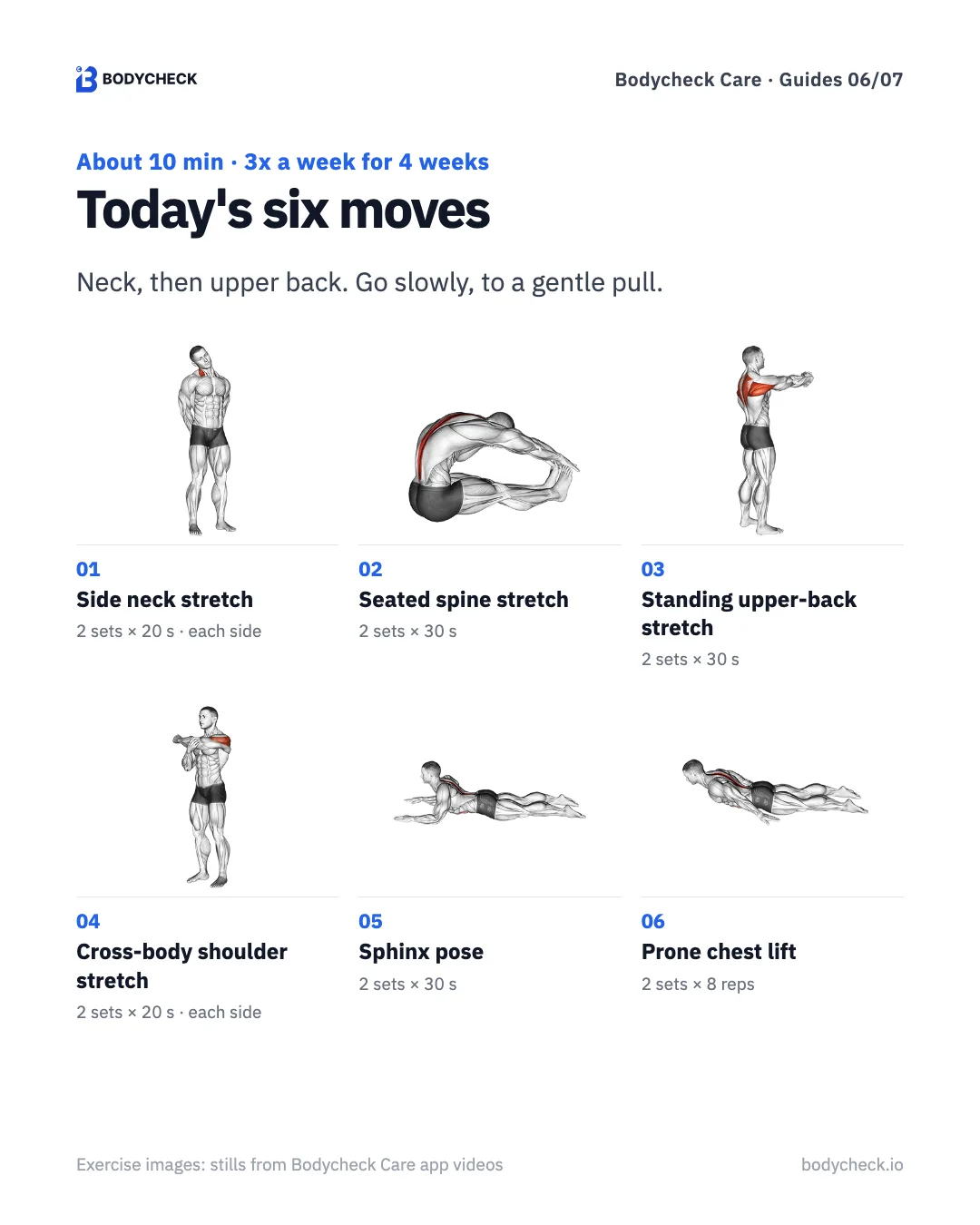
Neck first, then upper back. The goal is to go slowly and breathe out long, not to push hard. Do it three times a week on alternate days, for four weeks. I roll out a mat in the evening before my shower. If you also want to work on the chest and back strength side of posture, see the 11-minute forward head posture routine.
1. Side neck stretch · 2 sets × 20 s · each side
- Stand or sit tall with relaxed shoulders.
- Rest a hand on the side of your head and tilt your ear toward your shoulder. Don't press hard with your hand.
- Keep the opposite shoulder pressed down so it doesn't rise.
- Hold 20 seconds, then switch sides.
2. Seated spine stretch · 2 sets × 30 s
- Sit with your legs straight out in front and your arms reaching forward.
- Sit up tall first.
- Breathe out and round forward from your head down, one segment at a time.
- Hold 30 seconds, then slowly roll back up.
3. Standing upper-back stretch · 2 sets × 30 s
- Stand with feet shoulder-width apart.
- Interlace your fingers and reach forward at shoulder height.
- Push your hands far forward and round your upper back so the shoulder blades spread.
- Breathe out slowly and hold 30 seconds.
4. Cross-body shoulder stretch · 2 sets × 20 s · each side
- Stand tall and reach one arm across your chest.
- With the other hand, pull it in just above the elbow.
- Hold 20 seconds where you feel the back of the shoulder stretch.
- Switch sides.
5. Sphinx pose · 2 sets × 30 s
- Lie face down with your elbows right under your shoulders.
- Brace your stomach lightly and lift your chest off the floor. Lift the chest, not the lower back.
- Keep your neck long and your eyes on the floor just ahead.
- Hold 30 seconds, then lower slowly.
6. Prone chest lift · 2 sets × 8 reps
- Lie face down, legs straight, hands by your head or by your sides.
- Squeeze your shoulder blades toward the middle of your back.
- Lift your chest slightly off the floor and pause for one second. Eyes on the floor, no arching the lower back.
- Lower slowly. Repeat 8 times.
At a glance
| # | Move | Sets |
|---|---|---|
| 1 | Side neck stretch | 2 × 20 s · each side |
| 2 | Seated spine stretch | 2 × 30 s |
| 3 | Standing upper-back stretch | 2 × 30 s |
| 4 | Cross-body shoulder stretch | 2 × 20 s · each side |
| 5 | Sphinx pose | 2 × 30 s |
| 6 | Prone chest lift | 2 × 8 reps |
Moves can be hard to follow from text alone. In Bodycheck Care every move has a video, and the app counts the time and sets for you.
Frequently asked questions
Does forward head posture cause headaches? Not necessarily. Some studies suggest forward head posture and neck and shoulder tension can be connected to headaches, but that does not show posture is the cause. Headaches have many possible causes, so if they are frequent or keep coming back, see a doctor.
Will this routine get rid of my headaches? We can't promise that. This routine loosens up a neck and upper back that have been sitting all day and builds better posture habits. If headaches keep happening, see a doctor before relying on exercise.
Can I do the routine while I have a headache? If your head hurts a lot, skip the exercise and rest. If your neck just feels stiff, you can do moves 1 and 2 slowly with a smaller range. Stop right away if anything gets worse.
Which headaches mean I should see a doctor first? A sudden, very severe headache; numbness or weakness in the arms, legs or face; slurred speech; blurred or double vision; a headache with a fever or after a blow to the head; or a headache that keeps getting worse. In any of these cases, skip the routine and get medical care right away.
Can I see how far forward my head sits? Bodycheck Care measures it from a front and a side photo and shows head and shoulder position as angles and a score. It is free on iPhone and Android. The app does not measure headaches, and it is not a medical device.
Before you start
- Stretch to a gentle pull. Stop right away if anything hurts or tingles.
- Don't roll your neck fast or press hard with your hand. Start slow and small.
- Don't hold your breath. Breathe out long as you stretch.
- On days when your head hurts a lot, skip the routine.
- This is exercise guidance. If you have a sudden severe headache, numbness or weakness, vision changes, or headaches that keep coming back, see a doctor before you exercise.
Why not turn off the screen tonight and give your neck and upper back 10 minutes? In four weeks, retake your photos and put them side by side to see how your posture looks.
Bodycheck Care · Free
Take two photos and get moves picked for you
Take a front and a side photo to see how far your head and shoulders sit forward as a score, then follow moves picked for your result, each with a video.
References
- Fernández-de-las-Peñas C, Alonso-Blanco C, Cuadrado ML, Pareja JA. Forward head posture and neck mobility in chronic tension-type headache: a blinded, controlled study. Cephalalgia, 2006;26(3):314-319.
- Yang L, et al. Trends in sedentary behavior among the US population, 2001-2016. JAMA, 2019;321(16):1587-1597.
- Analysis of Korea National Health and Nutrition Examination Survey data on adult sitting time (8.1 hours in 2016, 8.3 hours in 2018).
- NHS. Headaches (nhs.uk). General guidance on headache warning signs.
- Photos: Pexels (free license). Exercise images and app screens: Bodycheck Care app.