A 10-Minute Morning Stretch Routine: Start in Bed, Finish Standing
Stiff when you wake up? Loosen up in order: lying down, then sitting, then standing. Six gentle stretches you can do with a bed and a wall, plus easy ways to fit them into a busy morning.
Short answer: Morning stiffness may come from spending hours in similar positions overnight with very little movement. So instead of jumping up and moving big, loosen up in order: lying down, then sitting, then standing. Do the six moves below in about 10 minutes. Keep the first set small and open up a little on the second.

Hi, I'm an editor on the Bodycheck Care team. I can tell how my body feels by the time I put on my socks. I sit on the edge of the bed, bend forward, and some mornings my toes feel much farther away than they did the night before. On those days, even the first few steps to the front door feel a little careful.
Sound familiar? Below I'll look at why the body can feel stiff in the morning, then share the 10-minute morning stretch I split up between turning off the alarm and getting in the shower. A bed or a mat and a wall are all you need.
Why does your body feel stiff in the morning?
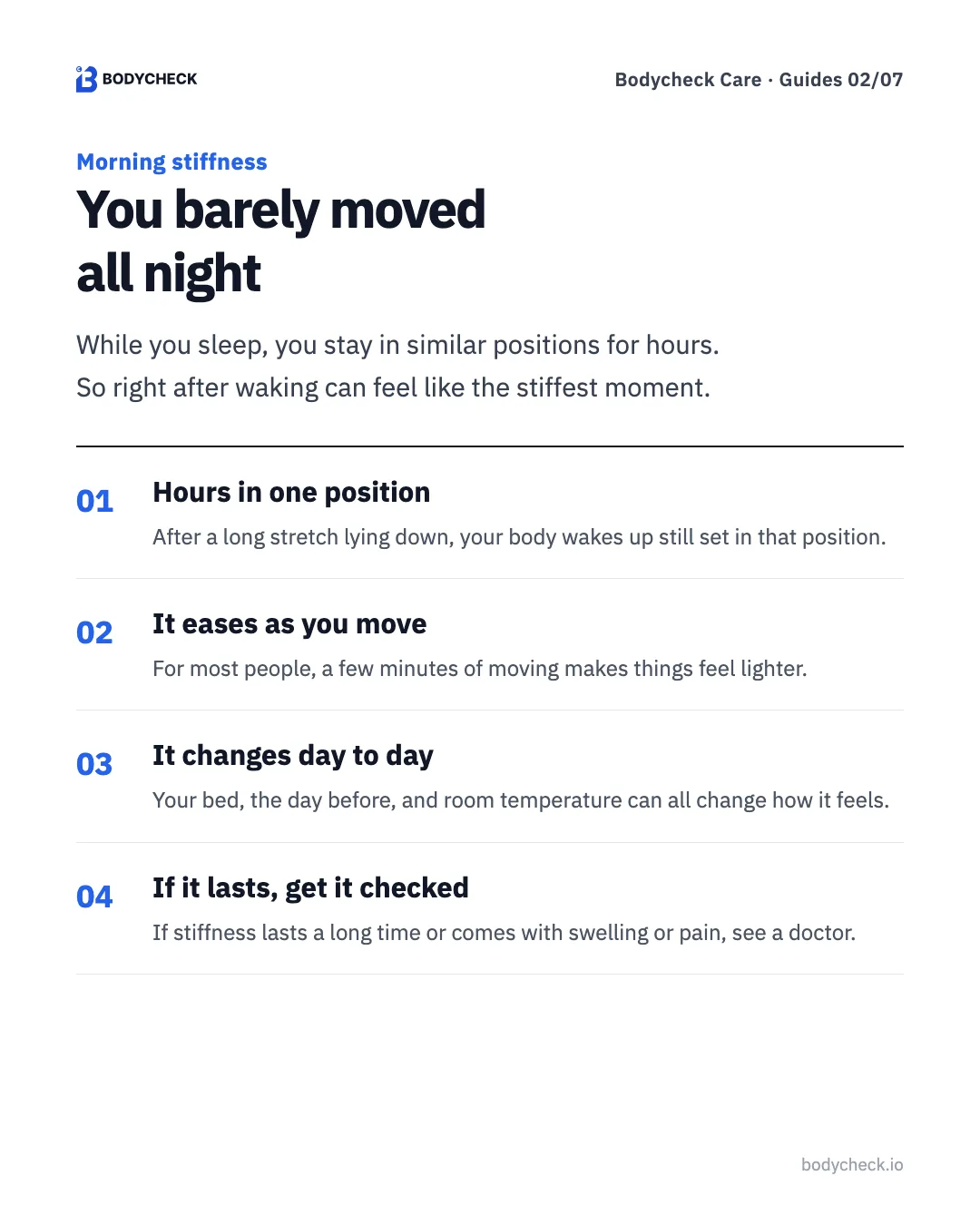
While you sleep, you stay in similar positions for hours. There is no walking, no standing up and sitting down like during the day, so your body wakes up still set in that lying-down shape. That's why the moment right after waking can feel like the stiffest part of the day.
The good news: for most people, a few minutes of moving makes things feel lighter. How it feels can also change with your bed, how active you were the day before, and how cool the room is. If stiffness lasts a long time, or your joints are swollen or painful, don't try to stretch through it. See a doctor.
Why start lying down and finish standing?
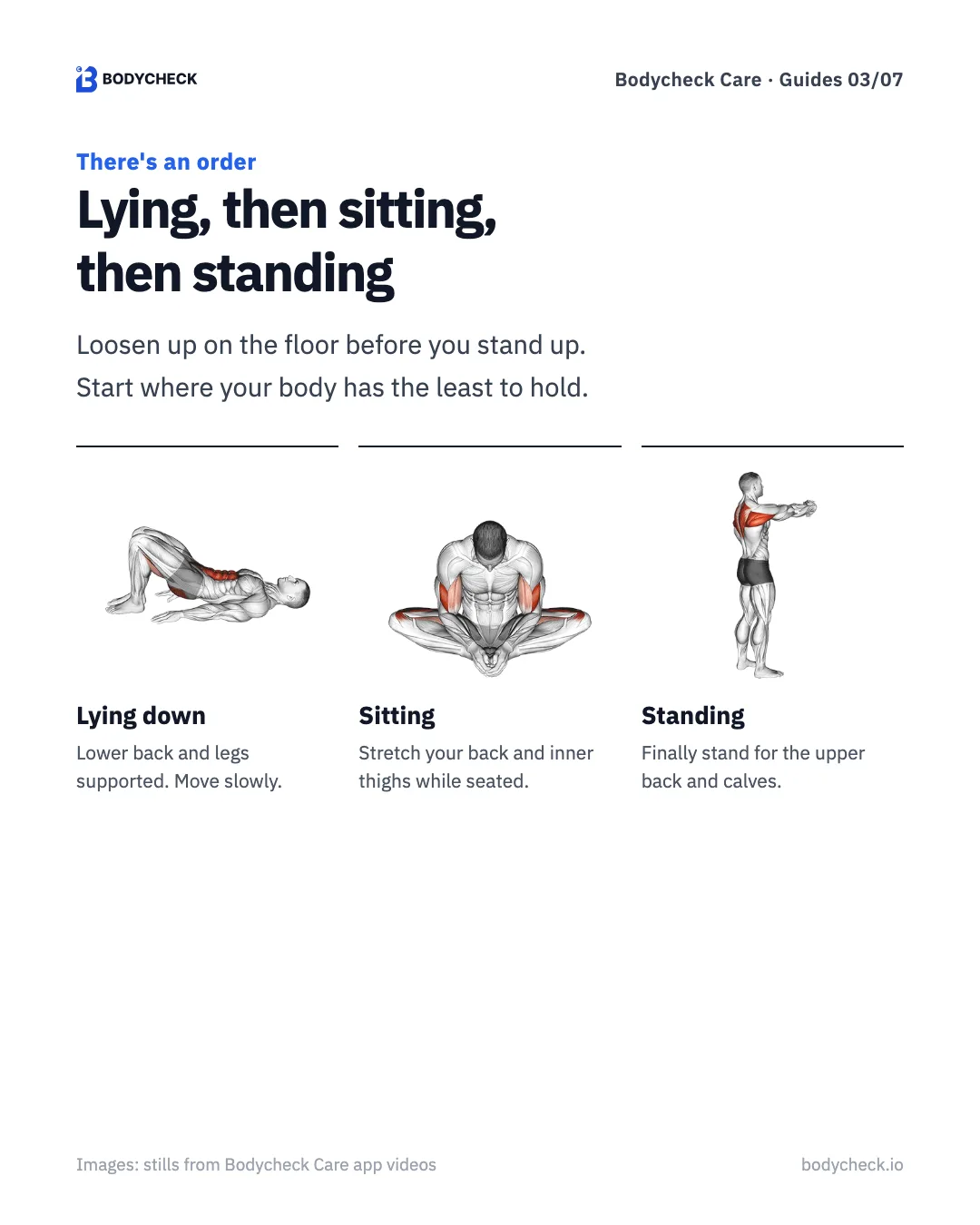
If you get up and bend deeply right away, a stiff body has to hold your full weight at the same time. So the routine has an order.
- Lying down: your lower back and legs are supported, so there is almost nothing to hold. Move slowly.
- Sitting: stretch your back and inner thighs while seated.
- Standing: finally stand up for the upper back and calves.
You raise your body one level at a time. A nice side effect: a third of the routine is done before you even leave the bed, which makes it much easier to start.
How hard should a morning stretch be?
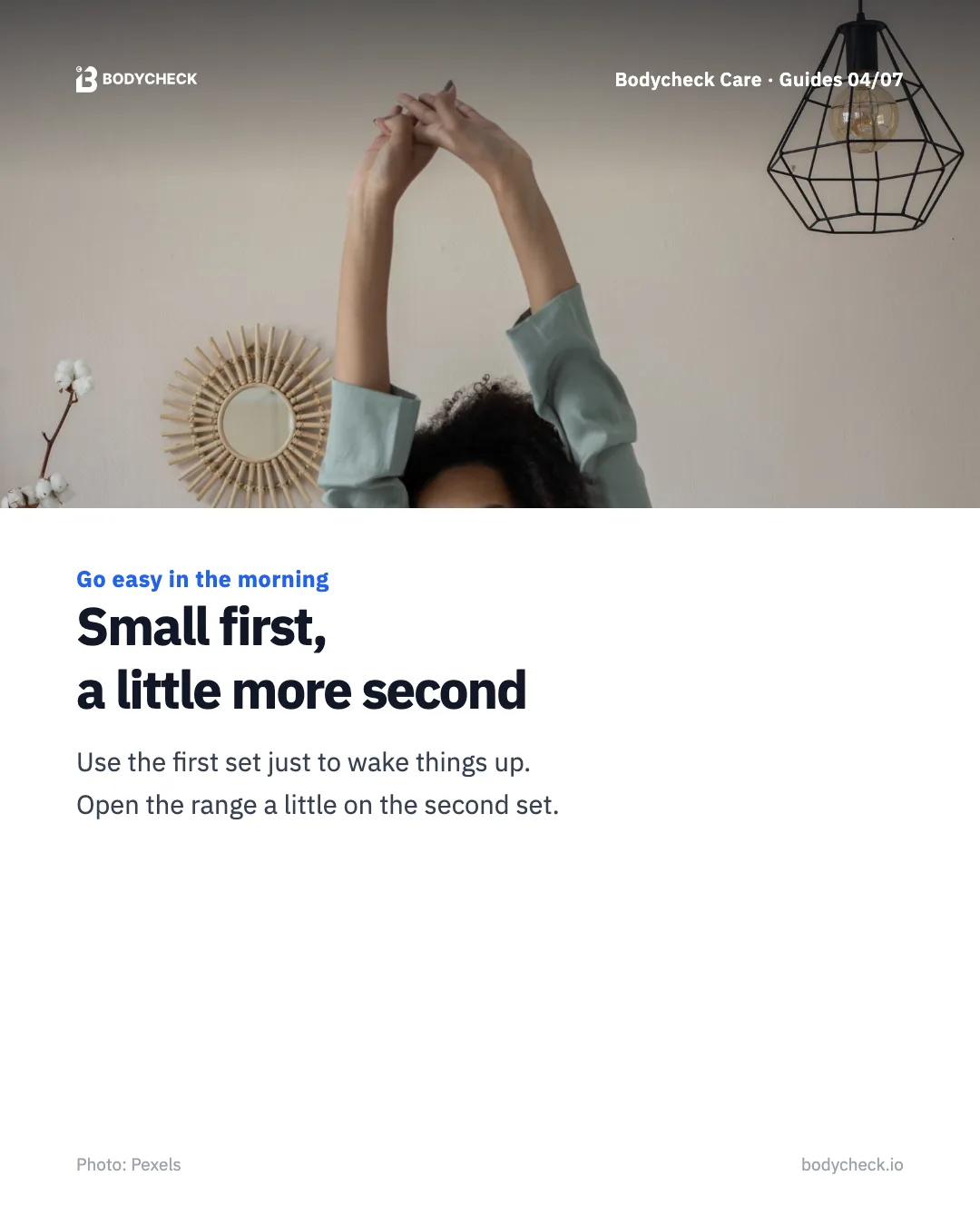
Go easier in the morning than you would in the evening. I keep one rule: small first, a little more second.
- On the first set, just wake things up. Stop at about half your usual range.
- On the second set, open up a little, to a gentle pull.
- No bouncing and no forcing the end range. Breathe out slowly.
Stretching isn't a contest to see how far you can fold. Think of the morning as a few minutes to check in on how your body feels today.
When can you fit it into a busy morning?
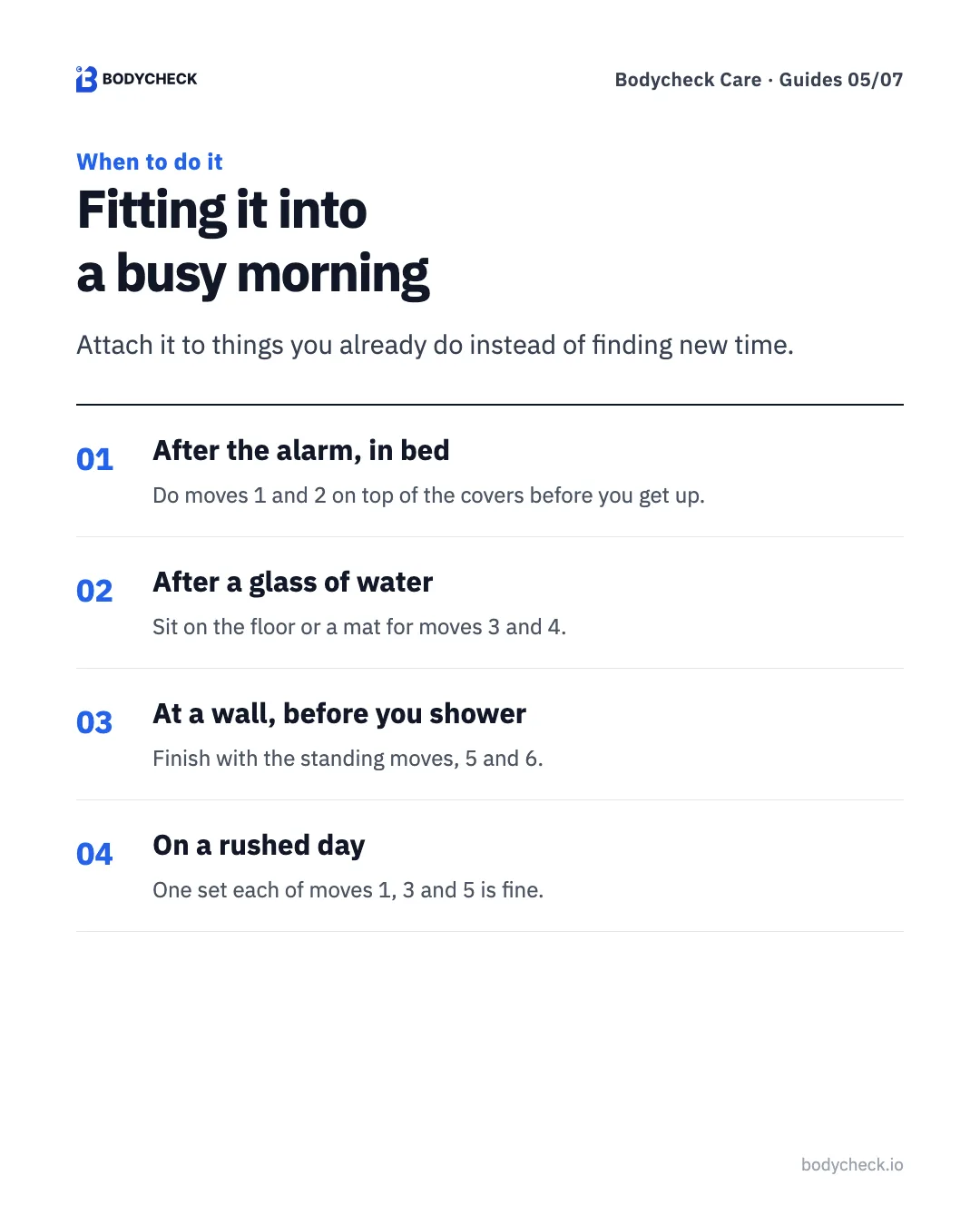
Finding 10 extra minutes in the morning is hard. So I attached the moves to things I already do.
| When | Moves |
|---|---|
| After the alarm, in bed | 1 and 2 (lying down) |
| After a glass of water, on the floor or a mat | 3 and 4 (sitting) |
| At a wall, before you shower | 5 and 6 (standing) |
| On a rushed day | One set each of 1, 3 and 5 |
Instead of making "stretch time," link it: "after water, butterfly stretch." It's much easier to remember. If your lower back feels tight after a long day of sitting, try the 13-minute core routine for the lower back with just a mat, too.
How can you see which way your body leans?
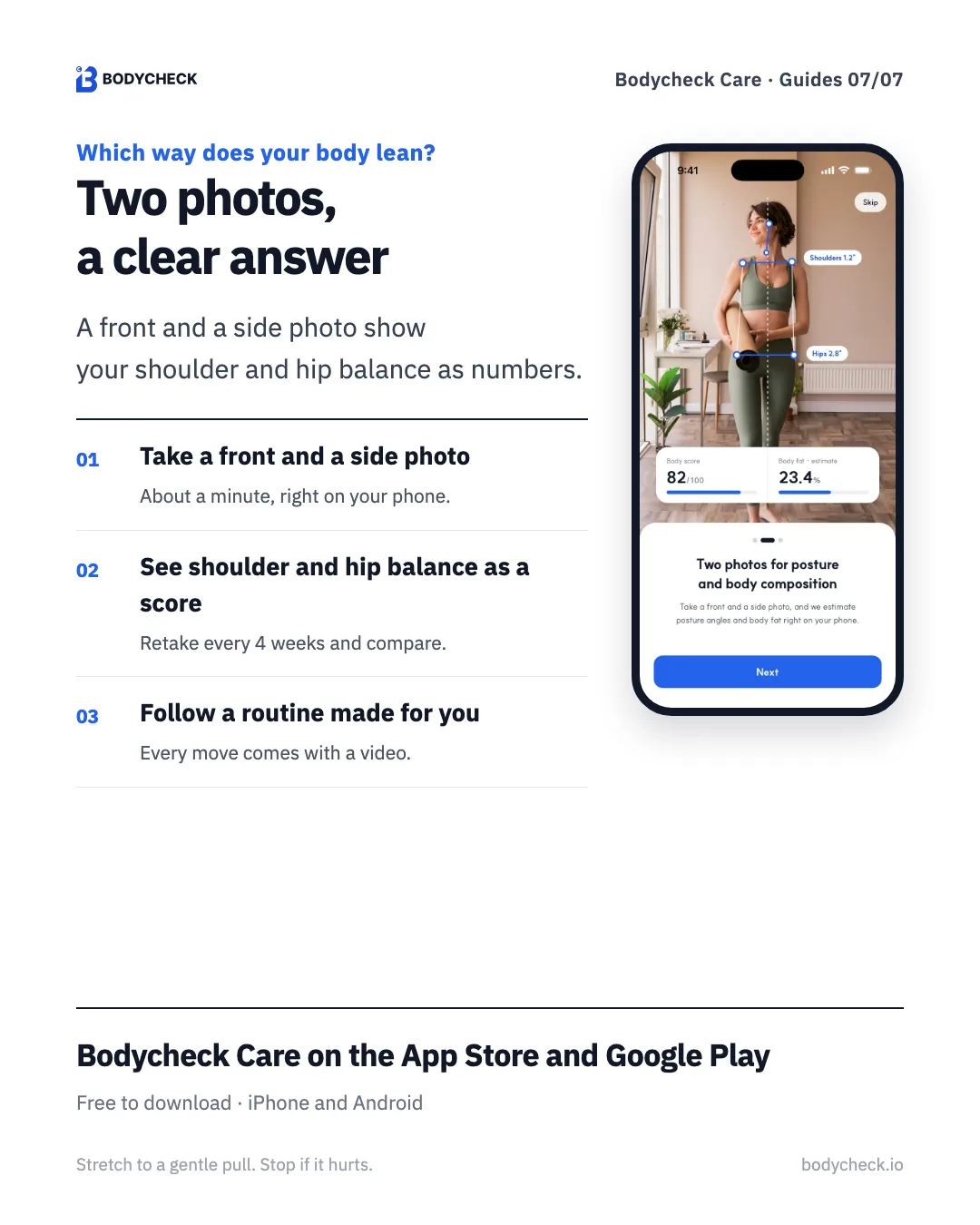
Stretch every morning and you may start to wonder why one side always feels tighter. In Bodycheck Care you take a front and a side photo, and the app shows head tilt, shoulder, hip and knee balance, and how far your head and shoulders sit forward, as angles and a score. It takes about a minute on your phone.
- Get the app and take a front and a side full-body photo.
- See your shoulder and hip balance and head position as a score.
- Follow the moves picked for your result and where you work out, each with a video.
- Retake the photos after four weeks and compare.
Morning stiffness is a feeling. This is a number. It isn't a medical device, so use it as a steady reference for checking in on your body, not as a verdict.
Bodycheck Care · Free
See which way your shoulders and hips lean, from two photos
Take a front and a side photo to see how far your head and shoulders sit forward as a score, then follow moves picked for your result, each with a video.
The 10-minute morning stretch routine
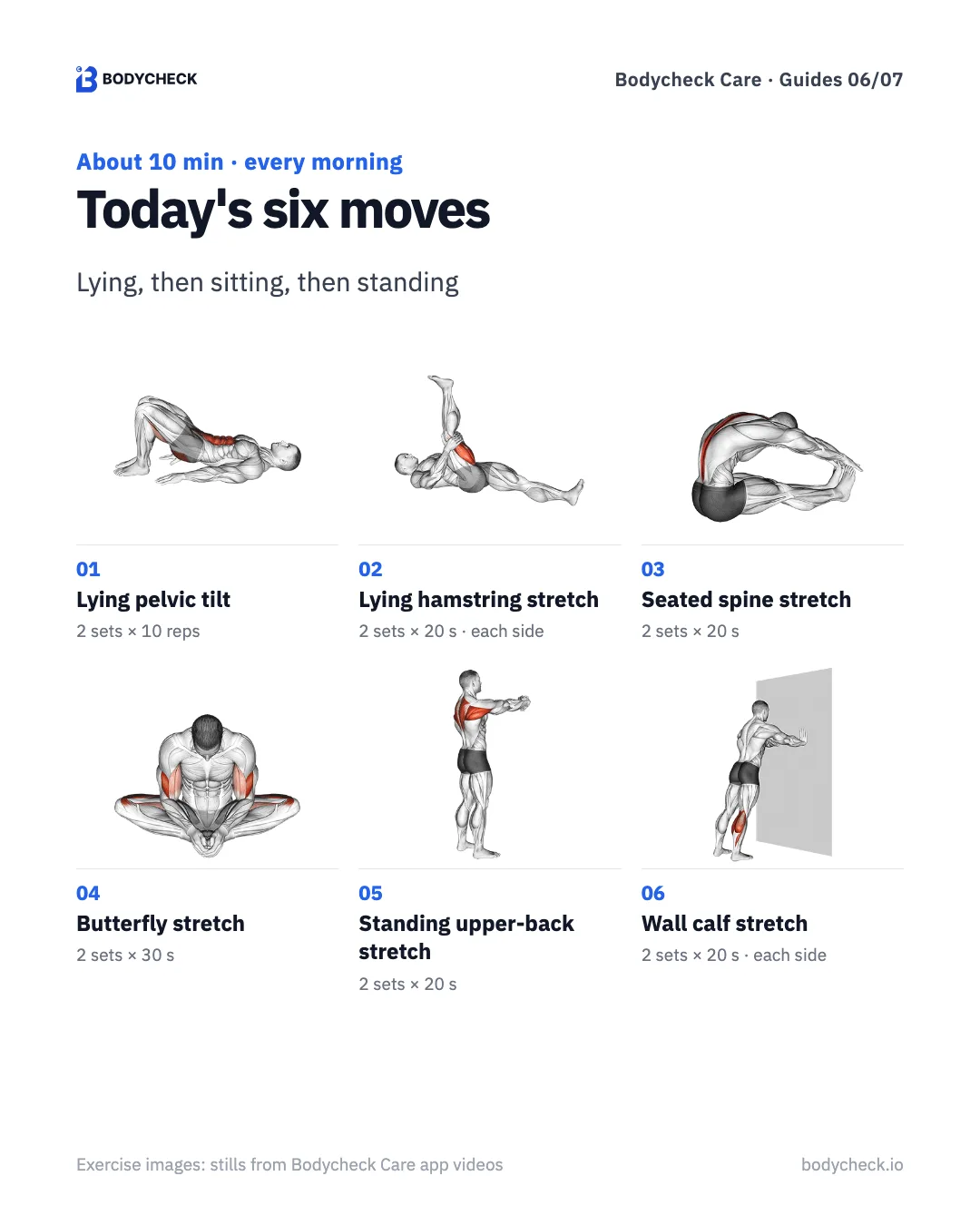
Lying down, then sitting, then standing. These are gentle stretches with no hard pulling, so you can do them every morning. With a breath or two between moves, it comes to about 10 minutes.
1. Lying pelvic tilt · 2 sets × 10 reps
- Lie on your back with knees bent and feet flat. It's fine to do this in bed.
- Breathe out, brace your stomach and gently press your lower back toward the floor.
- Pause for two seconds where your pelvis tucks slightly.
- Breathe in and release. Repeat 10 times.
2. Lying hamstring stretch · 2 sets × 20 s · each side
- Lie on your back and raise one leg toward the ceiling.
- Hold the back of your thigh or your calf with both hands.
- Straighten the knee only as far as it goes and draw the leg gently toward you. On the first set, a slight bend in the knee is fine.
- Hold 20 seconds, then switch sides.
3. Seated spine stretch · 2 sets × 20 s
- Sit with your legs straight out in front and your arms reaching forward.
- Sit up tall first.
- Breathe out and round forward one section at a time, starting from your head.
- Hold 20 seconds, then roll slowly back up.
4. Butterfly stretch · 2 sets × 30 s
- Sit on the floor with the soles of your feet together.
- Hold your feet and sit up straight.
- Let your knees lower slowly toward the floor to stretch your inner thighs. No bouncing.
- Breathe and hold for 30 seconds.
5. Standing upper-back stretch · 2 sets × 20 s
- Stand up with feet shoulder-width apart.
- Interlace your fingers and reach forward at shoulder height.
- Push your hands far forward and round your upper back so the shoulder blades spread.
- Breathe out slowly and hold 20 seconds.
6. Wall calf stretch · 2 sets × 20 s · each side
- Face a wall and place both hands on it.
- Step one foot back and keep that heel on the floor.
- Bend your front knee and lean toward the wall to stretch the calf.
- Hold 20 seconds, then switch legs.
At a glance
| # | Move | Sets |
|---|---|---|
| 1 | Lying pelvic tilt | 2 × 10 reps |
| 2 | Lying hamstring stretch | 2 × 20 s · each side |
| 3 | Seated spine stretch | 2 × 20 s |
| 4 | Butterfly stretch | 2 × 30 s |
| 5 | Standing upper-back stretch | 2 × 20 s |
| 6 | Wall calf stretch | 2 × 20 s · each side |
Moves can be hard to follow from text alone. In Bodycheck Care every move has a video, and the app counts the time and sets for you.
Frequently asked questions
Can I stretch right after I wake up? Yes, but start small and lying down. Use the first set just to wake things up, then open the range a little on the second set.
Is it OK to do morning stretches every day? These are gentle stretches with no hard pulling, so every day is fine. On heavy or rushed days, one set each of moves 1, 3 and 5 is enough.
Can I do these stretches in bed? Moves 1 and 2, done lying down, work well in bed. For the seated moves 3 and 4, a very soft mattress makes it hard to sit tall, so use the floor or a mat.
Why do I feel so stiff in the morning? It may be because you spend hours in similar positions while you sleep, barely moving. For most people it eases after a few minutes of moving. If stiffness lasts a long time or comes with swelling or pain, see a doctor.
Is the Bodycheck Care app free? Yes. Search for Bodycheck Care on the App Store or Google Play. It measures your posture from a front and a side photo and gives you moves with videos based on your result.
Before you start
- Stretch to a gentle pull. Stop right away if anything hurts or tingles.
- Don't fold deeply the moment you get up. Start with the lying-down moves and go slowly.
- Don't hold your breath. Breathe out slowly as you stretch.
- This is exercise guidance. If your morning stiffness lasts a long time or your joints are swollen or painful, see a doctor before you exercise.
Tomorrow morning, why not turn off the alarm and do ten pelvic tilts under the covers?
Bodycheck Care · Free
Take two photos and get moves picked for you
Take a front and a side photo to see how far your head and shoulders sit forward as a score, then follow moves picked for your result, each with a video.
References
- The order and doses in this post are general exercise guidance. No statistics are used.
- Photos: Pexels (free license). Exercise images and app screens: Bodycheck Care app.