Scoliosis Signs You Might Notice at Home, and When to See a Doctor
Scoliosis is a sideways curve and twist of the spine that a doctor confirms, usually with an X-ray. Learn how it differs from uneven shoulders caused by habits, which signs are worth a checkup, and a 10-minute routine for general trunk strength.
Short answer: Scoliosis is a sideways curve and twist of the spine. A doctor confirms it with an exam, usually with an X-ray. At home you might notice one shoulder or shoulder blade sitting higher, an uneven waist, or one side of the back rising higher when you bend forward. These are reasons to see a doctor, not a test that tells you whether you have it. Exercise and posture habits don't straighten a scoliotic curve. The 10-minute routine below is general trunk strength and flexibility work.
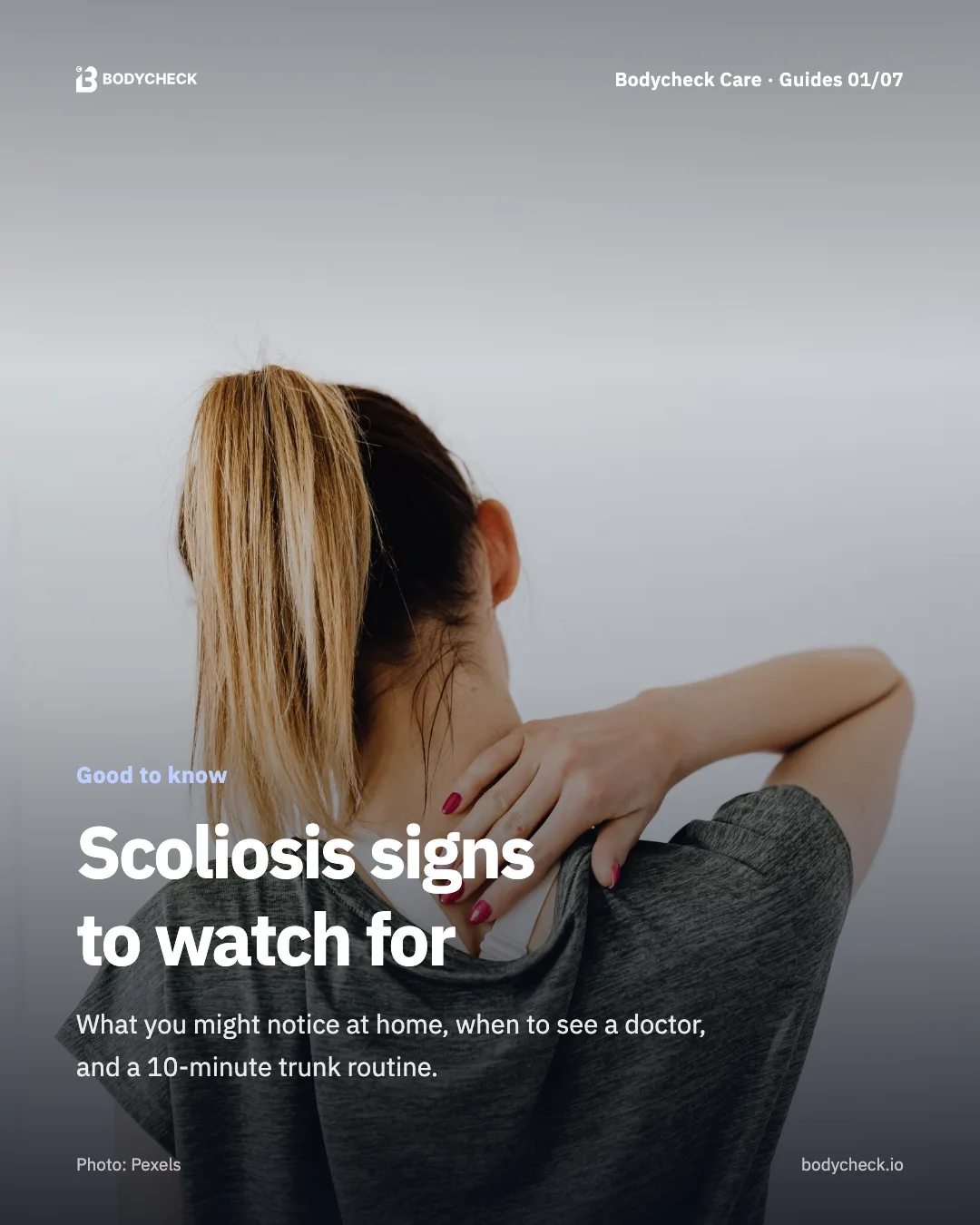
Hi, I'm an editor on the Bodycheck Care team. I've started swimming at a local pool, and the big mirror in the changing room shows me a view I almost never see: my own back. Out of curiosity I searched for how to check for scoliosis at home, and plenty of pages promised a quick answer.
The official medical pages told a more careful story. So today let's cover what scoliosis is and how it differs from posture habits, signs worth noticing, when to see a doctor, and a 10-minute routine for general trunk strength and flexibility. To be clear up front: this is not a way to find out on your own whether you have scoliosis.
What exactly is scoliosis?
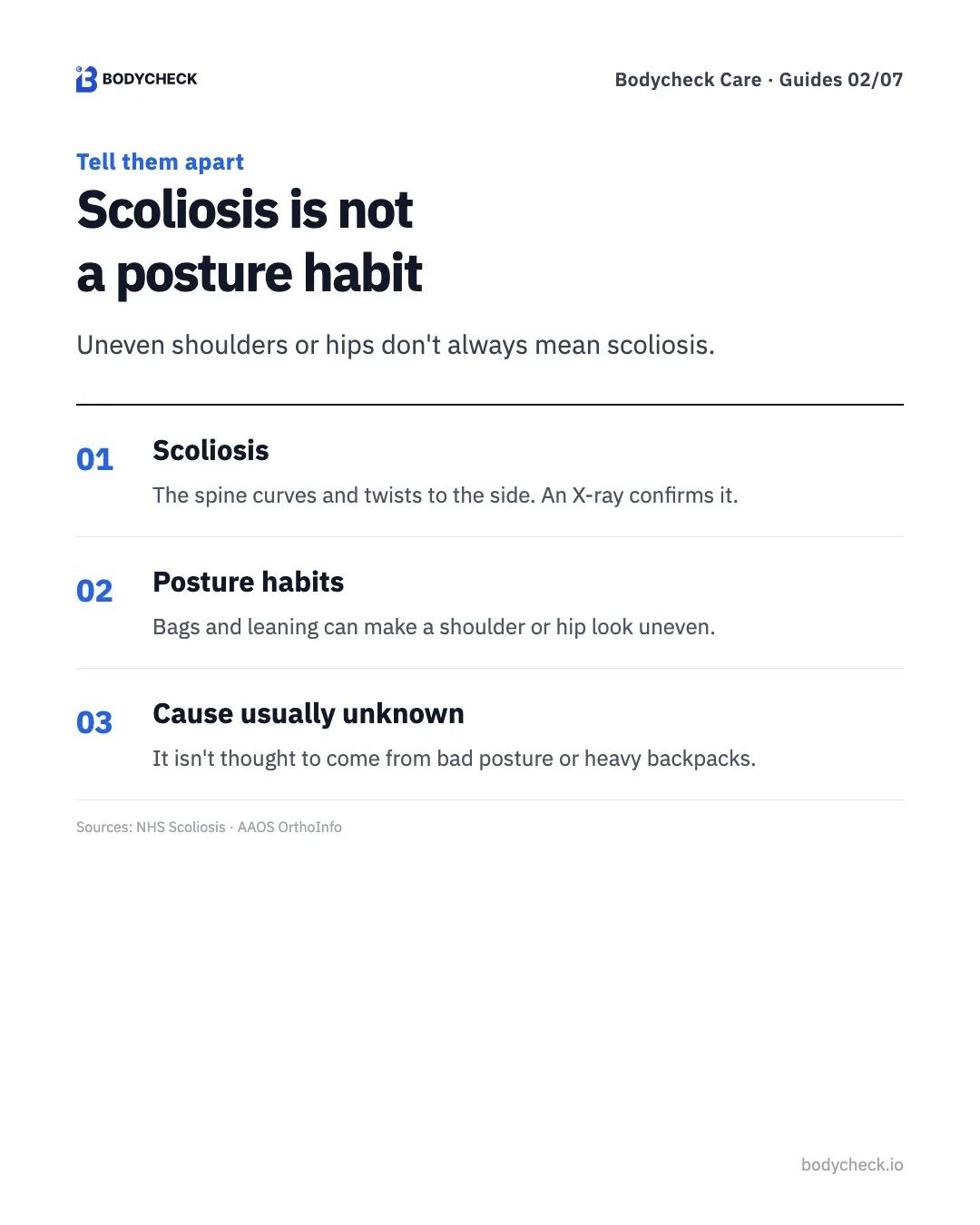
The UK's NHS describes scoliosis as a spine that twists and curves to the side. It can affect anyone from babies to adults, but it most often starts in children aged 10 to 15.
Here's the key distinction. A shoulder or hip that looks lower because of habits, like always carrying a bag on one side or leaning on one elbow, is not the same thing as scoliosis. I wrote about habit-related shoulder differences in checking uneven shoulders at home.
Scoliosis, on the other hand, usually has no known cause. Both the American Academy of Orthopaedic Surgeons (AAOS) and the NHS say it isn't caused by bad posture or carrying heavy backpacks. So there's no reason to blame yourself for it, and no reason to assume fixing your posture will take care of it.
Which signs are worth a doctor's visit?
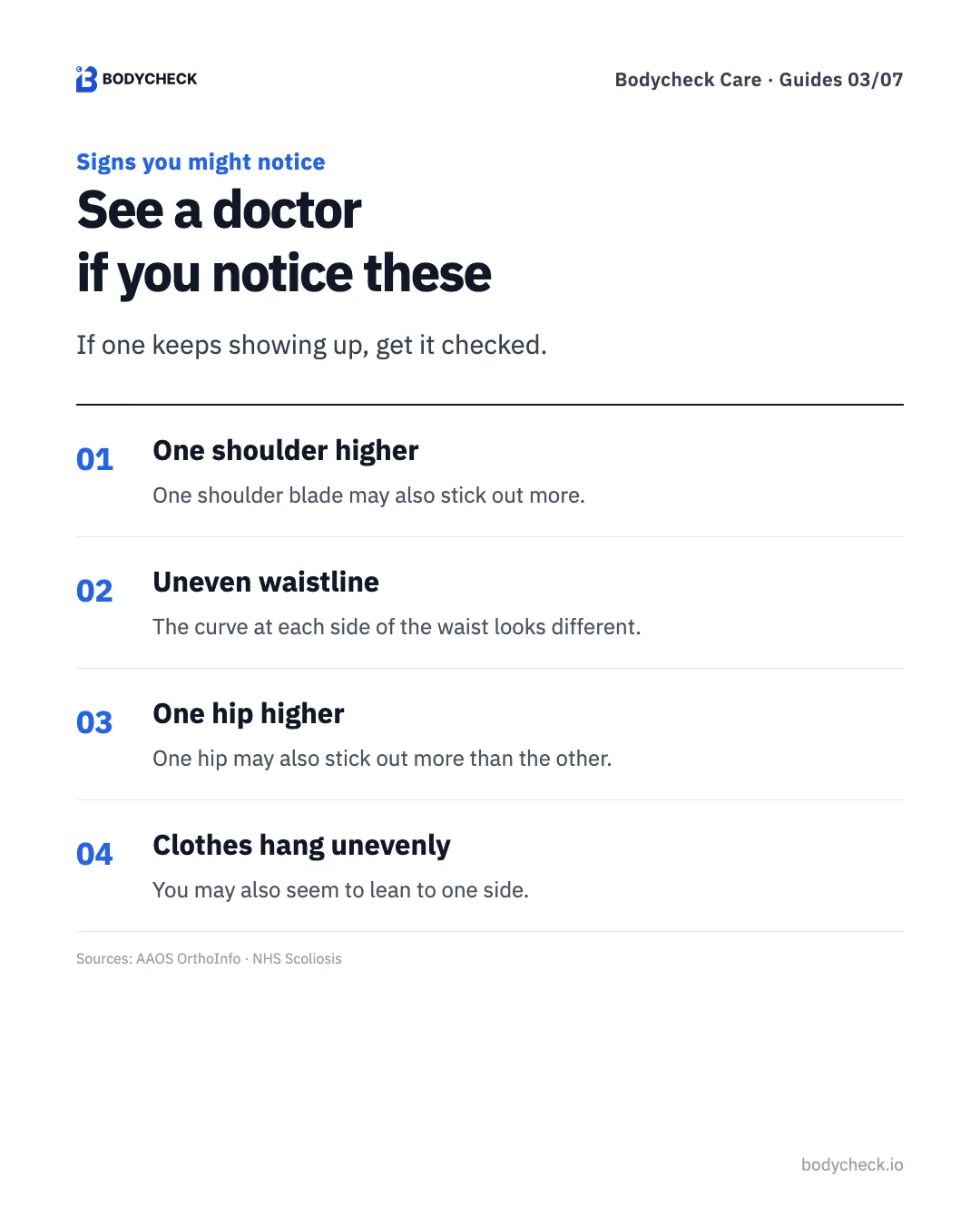
These are the signs AAOS and the NHS say you or your family might notice:
- One shoulder looks higher. One shoulder blade may also stick out more than the other.
- The waistline is uneven. The curve at one side of the waist looks deeper or flatter.
- One hip looks higher. One hip may also stick out more.
- Clothes don't hang or fit evenly. You may also seem to lean to one side.
You can see some of these without having scoliosis. Still, if one keeps showing up, especially in a growing child, don't try to settle it at home. Have a doctor take a look. The NHS also advises seeing a doctor if you think you or your child has scoliosis. The same goes if you also have back pain.
How does the forward bend check work?
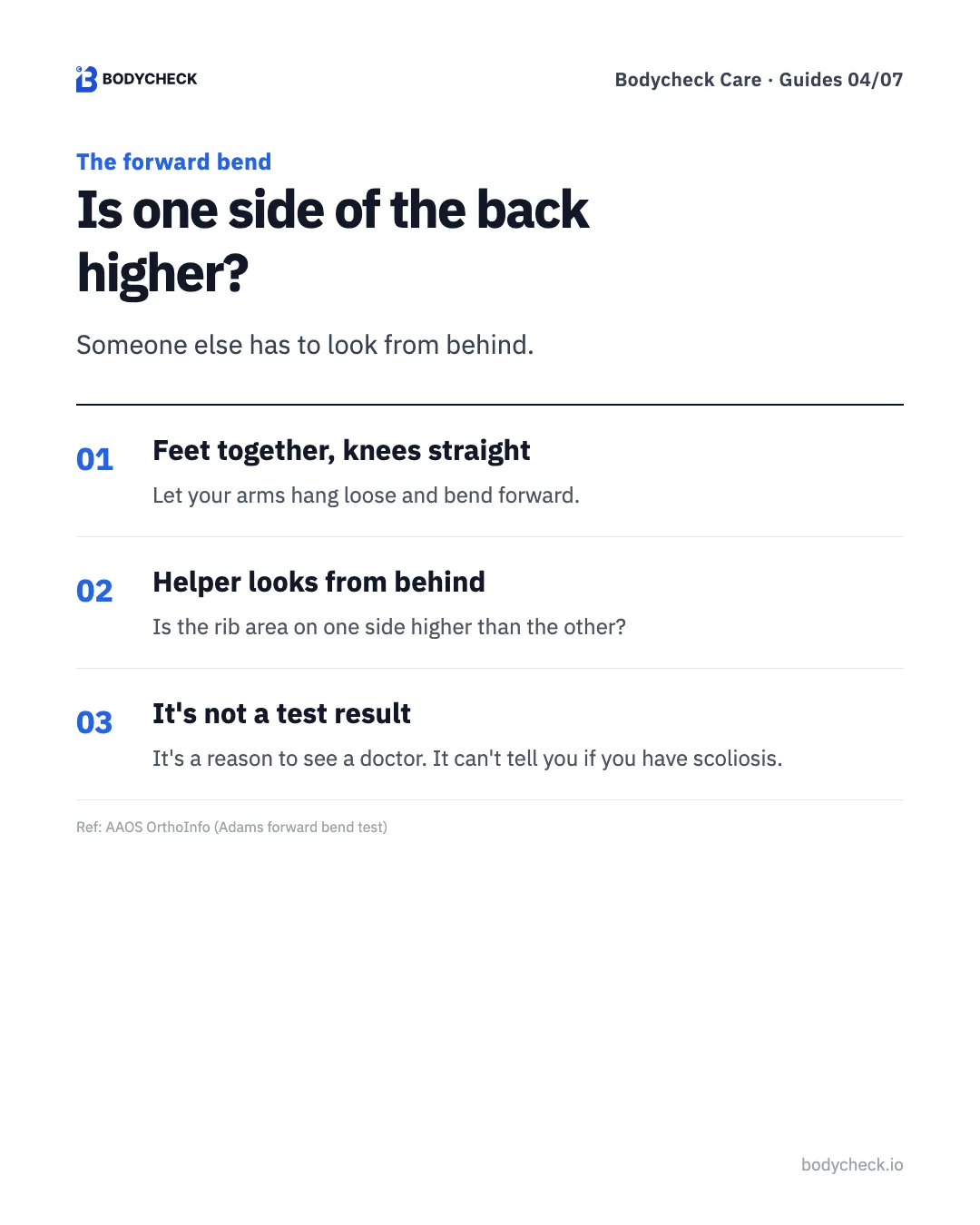
One screening method doctors use is the Adams forward bend test. If you want to look in a similar way at home:
- Wear close-fitting clothes and stand with feet together and knees straight.
- Let your arms hang loose and slowly bend forward.
- A helper looks from behind to see whether the ribs or back on one side sit higher than the other. You can't see this yourself.
The important part: this is not a test result. One side looking higher doesn't mean you have scoliosis, and seeing nothing doesn't rule it out. A doctor examines you and, if needed, takes an X-ray to measure where the spine curves and by how much.
Can exercise straighten a curved spine?
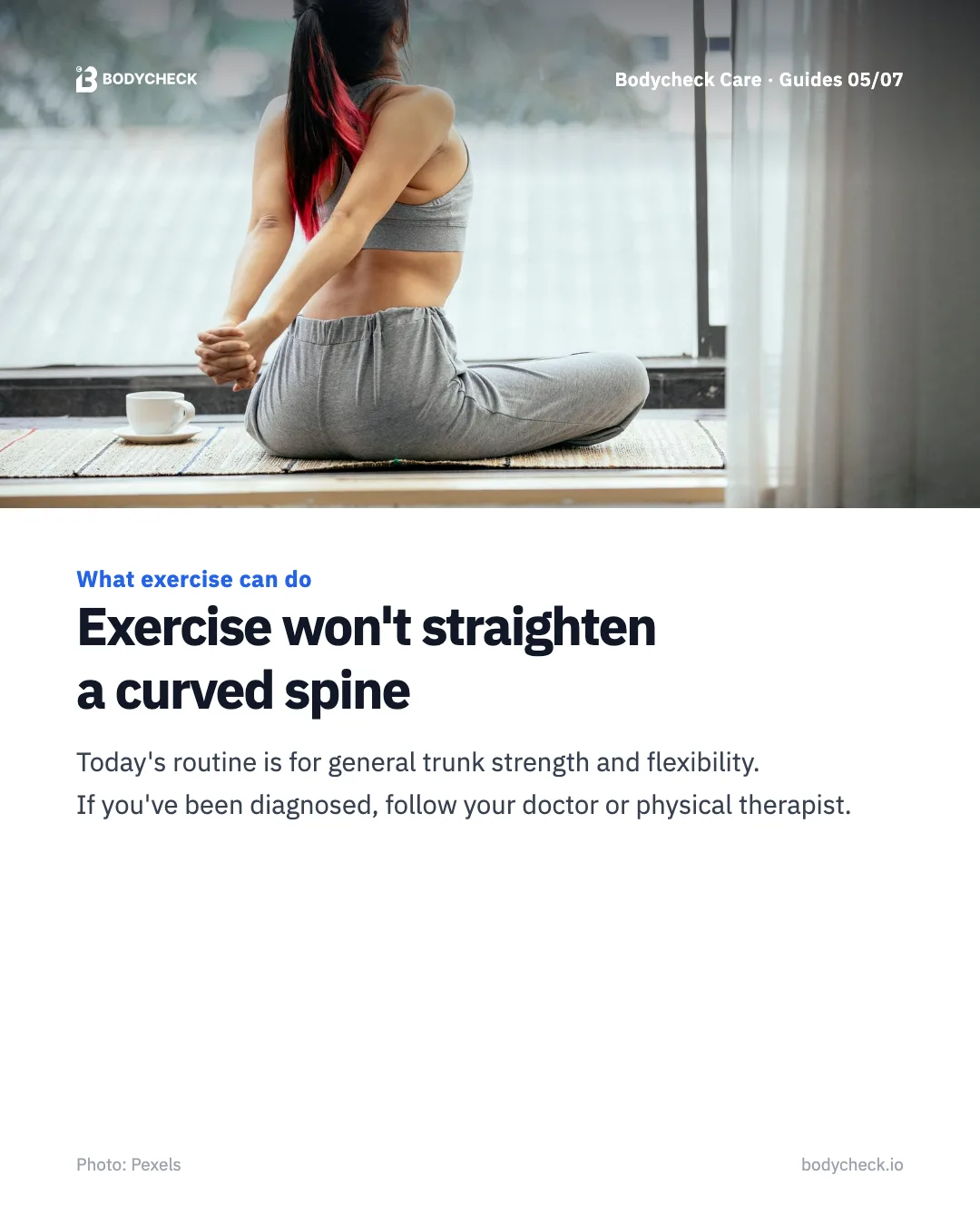
Let me be straight with you. Exercise and posture habits don't straighten a scoliotic curve. The NHS notes it isn't clear whether back exercises improve scoliosis itself. Whether to watch it, brace it or treat it another way is your doctor's call, based on things like the size of the curve and your age.
That doesn't make exercise pointless. Trunk strength and flexibility in your back and chest are good basics for anyone, and that's all today's routine is for. If you've already been diagnosed with scoliosis, follow the exercises your doctor or physical therapist gives you before anything in this post.
How can you see your shoulder and hip balance as numbers?
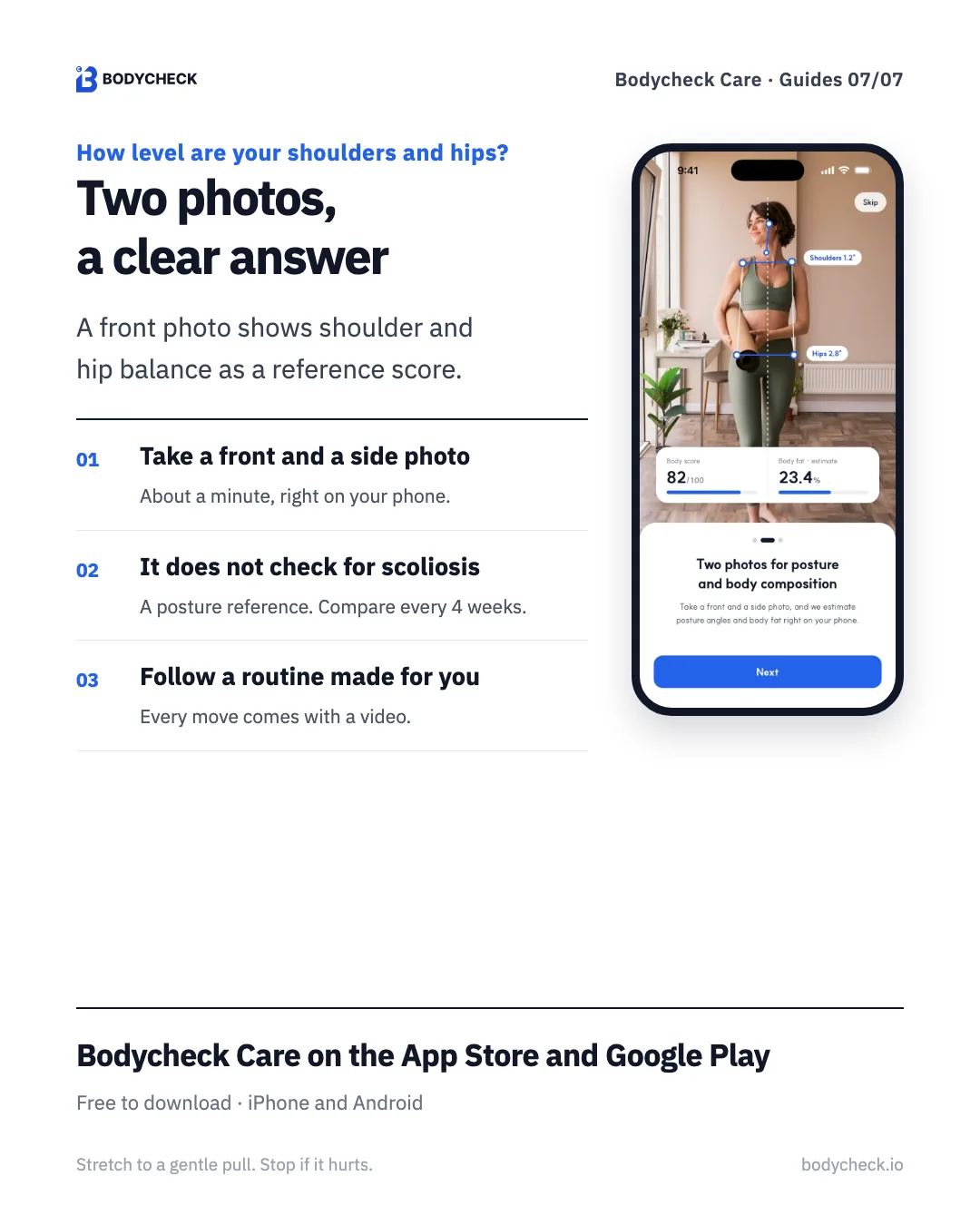
First, to be clear: the Bodycheck Care app does not detect or diagnose scoliosis. It is not a medical device.
What it does is give you a reference for your everyday posture. You take a front and a side photo. From the front photo it shows head tilt and left-right shoulder, hip and knee balance; from the side photo it shows forward head and shoulder position and pelvic tilt, all as angles and a score. These numbers are a general posture reference and say nothing about whether you have scoliosis.
- Get the app and take a front and a side full-body photo.
- See your shoulder and hip balance as a reference angle and score.
- Follow the moves picked for your result, each with a video.
- Retake the photos after four weeks and compare.
Bodycheck Care · Free
See your shoulder and hip balance from two photos, as a reference
Take a front and a side photo to see how far your head and shoulders sit forward as a score, then follow moves picked for your result, each with a video.
The 10-minute trunk routine
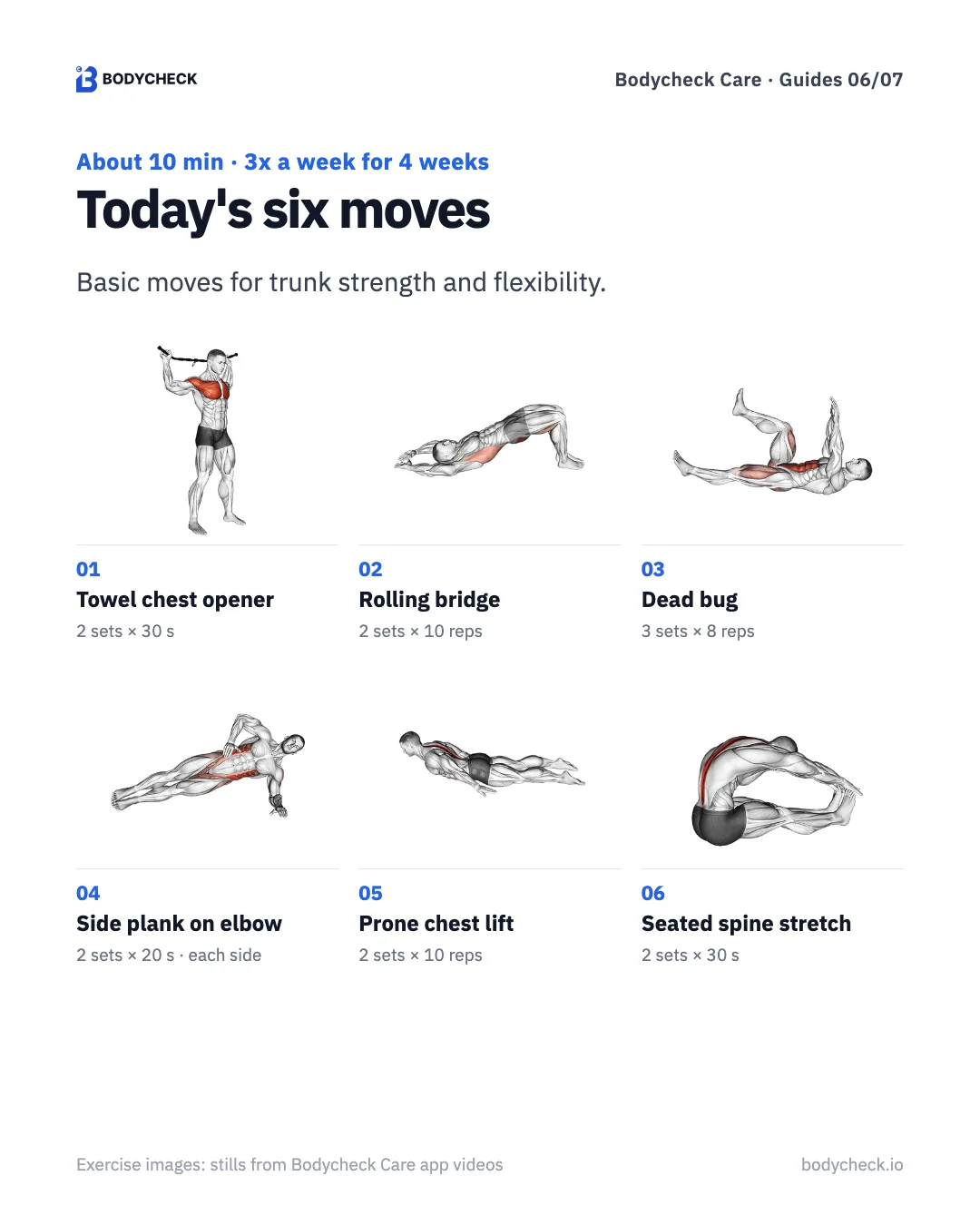
Open up your chest and back gently, then work the front, sides and back of your trunk while lying down. A mat and a towel are all you need. Do it three times a week on alternate days, for four weeks. Do one-sided moves with equal reps on each side.
1. Towel chest opener · 2 sets × 30 s
- Hold a towel or long stick wider than your shoulders and stand tall.
- Keep your arms straight and raise them slowly overhead.
- Take them back only as far as is comfortable to stretch the front of your chest and shoulders.
- Bring them forward slowly and repeat for 30 seconds. If your shoulders catch, widen your grip.
2. Rolling bridge · 2 sets × 10 reps
- Lie with knees bent and arms by your sides.
- Tuck your pelvis slightly to press your lower back to the floor.
- Lift from your tailbone up, one section at a time, into a bridge.
- Roll back down one section at a time. 10 reps.
3. Dead bug · 3 sets × 8 reps
- Lie with arms reaching to the ceiling and hips and knees bent to 90 degrees.
- Keeping your lower back on the floor, slowly reach one arm and the opposite leg out.
- Stop before your back lifts, then return.
- Alternate sides for 8 reps.
4. Side plank on elbow · 2 sets × 20 s · each side
- Lie on your side with your elbow right under your shoulder.
- Stack your legs straight.
- Lift your hips so your body forms a straight line from head to feet.
- Hold 20 seconds, then switch sides. Bend your knees to the floor if it's too hard.
5. Prone chest lift · 2 sets × 10 reps
- Lie face down with legs straight and hands by your head or your sides.
- Draw your shoulder blades toward the middle of your back.
- Lift your chest slightly off the floor and pause for one second. Eyes on the floor, don't arch your lower back.
- Lower slowly. Repeat 10 times.
6. Seated spine stretch · 2 sets × 30 s
- Sit with legs straight and arms reaching forward.
- Sit tall first.
- Breathe out and roll your head and back forward one section at a time.
- Hold 30 seconds, then roll back up slowly.
At a glance
| # | Move | Sets |
|---|---|---|
| 1 | Towel chest opener | 2 × 30 s |
| 2 | Rolling bridge | 2 × 10 reps |
| 3 | Dead bug | 3 × 8 reps |
| 4 | Side plank on elbow | 2 × 20 s · each side |
| 5 | Prone chest lift | 2 × 10 reps |
| 6 | Seated spine stretch | 2 × 30 s |
"One section at a time" in the rolling bridge is hard to picture from text. In Bodycheck Care every move has a video, and the app counts the time and sets for you.
Frequently asked questions
One of my shoulders looks higher in the mirror. Do I have scoliosis? You can't tell from that alone. No body is perfectly symmetrical, and habits like carrying a bag on one side or leaning on one elbow can make a shoulder look higher. If a shoulder blade also sticks out, or your waist or hips look uneven too, get it checked by a doctor.
During the forward bend, one side of my back looked higher. That doesn't mean you have scoliosis. Looking at home only gives you a reason to see a doctor. A doctor will examine you and, if needed, use an X-ray to see how much the spine curves.
Can exercise straighten a curved spine? No. Exercise and posture habits don't straighten a scoliotic curve. The routine here is general trunk strength and flexibility work. Your doctor decides whether you need treatment.
I've been diagnosed with scoliosis. Can I do this routine? Ask your doctor or physical therapist first. If you've been diagnosed, follow the exercises and precautions they give you.
Can the Bodycheck Care app tell me if I have scoliosis? No. The app does not detect or diagnose scoliosis. It shows left-right shoulder and hip balance from a front photo as an angle and score, as a general posture reference only. It is not a medical device.
Before you start
- Stretch to a gentle pull. Stop right away if anything hurts or tingles.
- Don't hold your breath. Breathe out as you push.
- In the first week it's fine to drop one set from each move.
- If you've been diagnosed with scoliosis, follow your doctor or physical therapist before this routine.
- This is exercise guidance. If you notice the signs above, or have back pain or numbness in your legs, see a doctor before you exercise.
How about asking someone at home to take one look at your back today? If something catches their eye, the next step isn't a workout. It's booking a checkup.
Bodycheck Care · Free
Take two photos and get moves picked for you
Take a front and a side photo to see how far your head and shoulders sit forward as a score, then follow moves picked for your result, each with a video.
References
- NHS, "Scoliosis." https://www.nhs.uk/conditions/scoliosis/ (definition; most often starts at ages 10 to 15; signs; not thought to be linked to bad posture, exercise or diet; X-ray to check the curve; unclear whether back exercises help)
- AAOS OrthoInfo, "Idiopathic Scoliosis in Children and Adolescents." https://www.orthoinfo.org/en/diseases--conditions/idiopathic-scoliosis-in-children-and-adolescents/ (signs parents may notice; Adams forward bend test; exam and X-ray; not related to heavy backpacks or poor posture)
- Photos: Pexels (free license). Exercise images and app screens: Bodycheck Care app.