Lower Back Discomfort Self-Check: Notice Your Pattern and Know When to See a Doctor
Write down when your lower back bothers you, after sitting, lifting or first thing in the morning, and check your posture with a side photo. Plus the signs that mean see a doctor first, and a gentle 10-minute routine.
Short answer: Back discomfort can have many causes, so instead of guessing, start by writing down when it shows up (after sitting, after lifting, in the morning, after standing) and taking a side photo of your posture. But if you have pain spreading down a leg, numbness or weakness, trouble with bladder or bowel control, fever or unexplained weight loss, pain after a fall, or pain that's severe at night or keeps getting worse, see a doctor before you exercise.

Hi, I'm an editor on the Bodycheck Care team. Every Saturday I do the grocery run and carry a case of water up the stairs. One day I noticed my back always felt stiff on Sunday morning. Since then I've kept a one-line note on my phone: when, and after doing what.
When your back bothers you, it's tempting to jump to a cause. Is it a disc? Is it my posture? But that's not something you can figure out from an article or at home. So today, instead of guessing, here's how to look at your own day and posture, and when to see a doctor before you exercise. At the end there's a gentle 10-minute routine you can do in a comfortable range.
When does it usually show up?
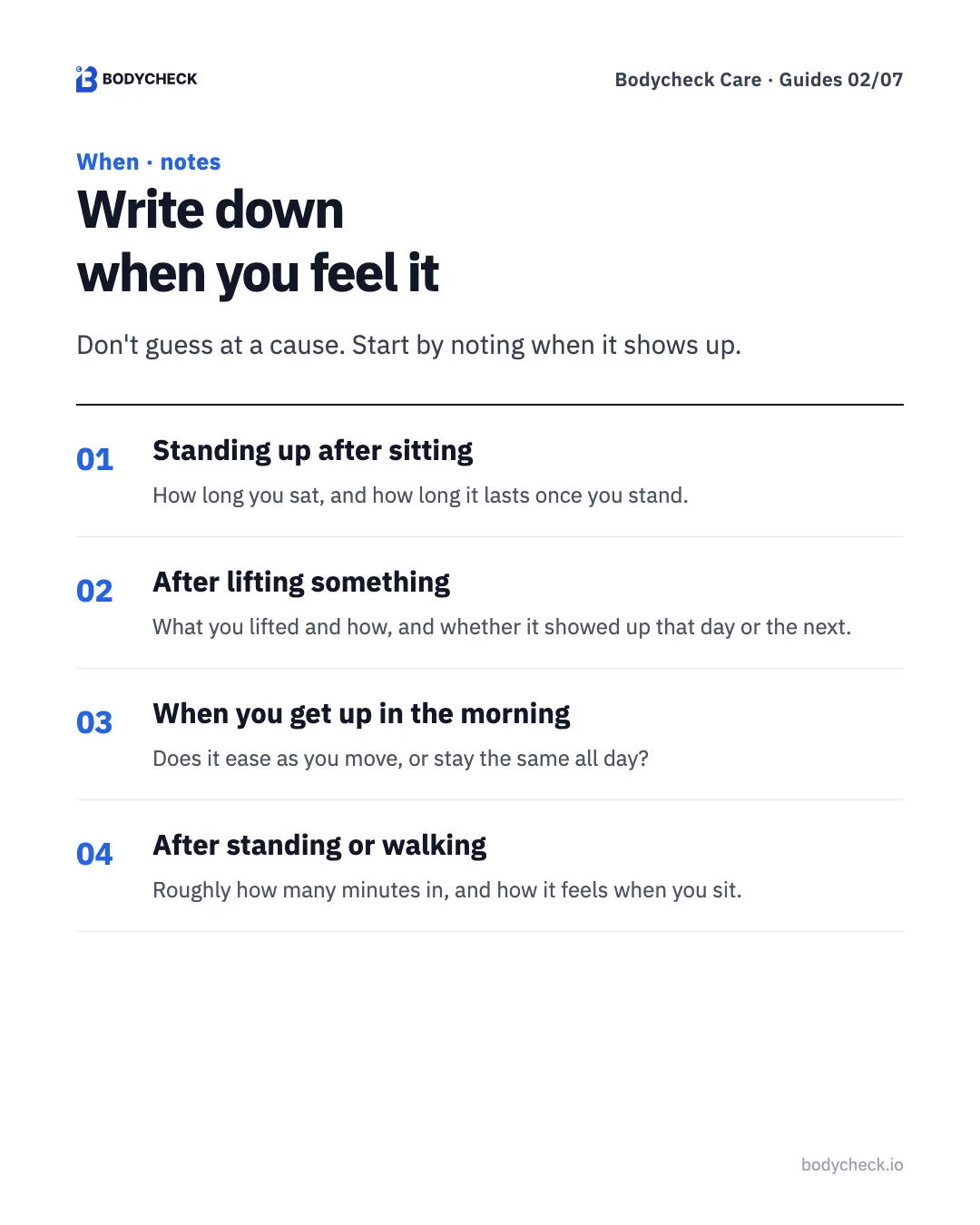
A week of notes can show more than you'd expect. For each time, jot down which of these four moments it was and how long it lasted.
- Standing up after sitting. How many hours you sat, and how many minutes it takes to feel okay once you stand.
- After lifting something. What you lifted and how (bending over? one hand?), and whether you felt it that day or the next.
- When you get up in the morning. Does it ease as you move, or stay the same all day? Note if you changed your mattress or pillow too.
- After standing or walking. Roughly how many minutes in, and how it feels when you sit down.
This isn't about finding a cause. It's a record of which moments repeat in your day, and it helps if you end up explaining things to a doctor. If long sitting days keep showing up, I put together a guide on why your lower back gets stiff when you sit all day with ways to break it up every 50 minutes.
What does your posture look like from the side?
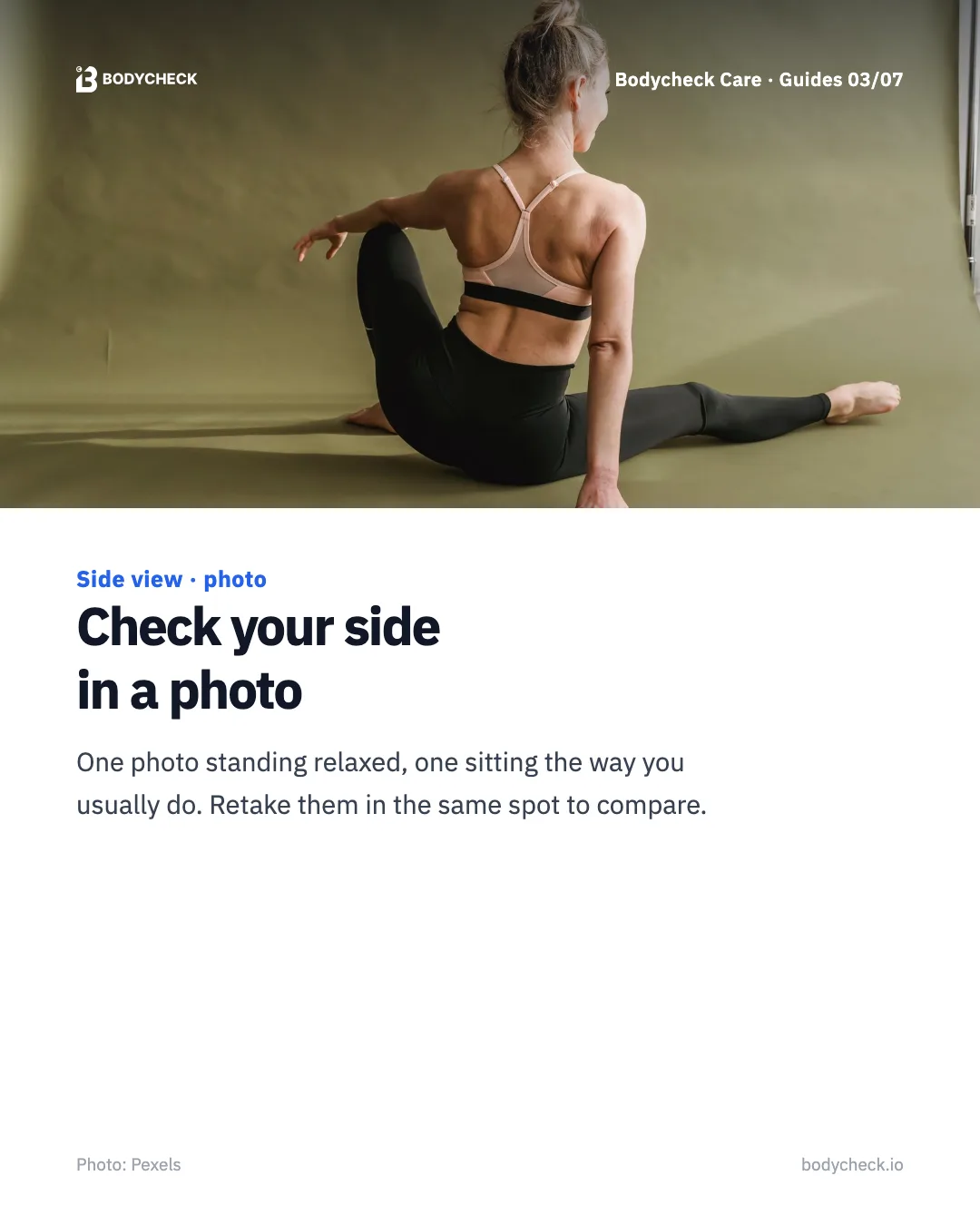
A mirror only shows you from the front, so the front-to-back shape of your lower back and pelvis is hard to see. A side photo is easier.
- Standing relaxed: Stand a little away from a wall the way you normally do, and ask someone to take a photo from the side at hip height. Don't stand up straight on purpose.
- Sitting the way you usually do: Take one more while you sit like you do when you work or scroll. I was a little surprised to see how rounded my back was on the sofa.
One photo can't tell you good or bad. Everyone's lower back curves differently. But if you retake it in the same spot, in the same clothes, at the same height a few weeks later, your habits start to show.
When should you see a doctor first?
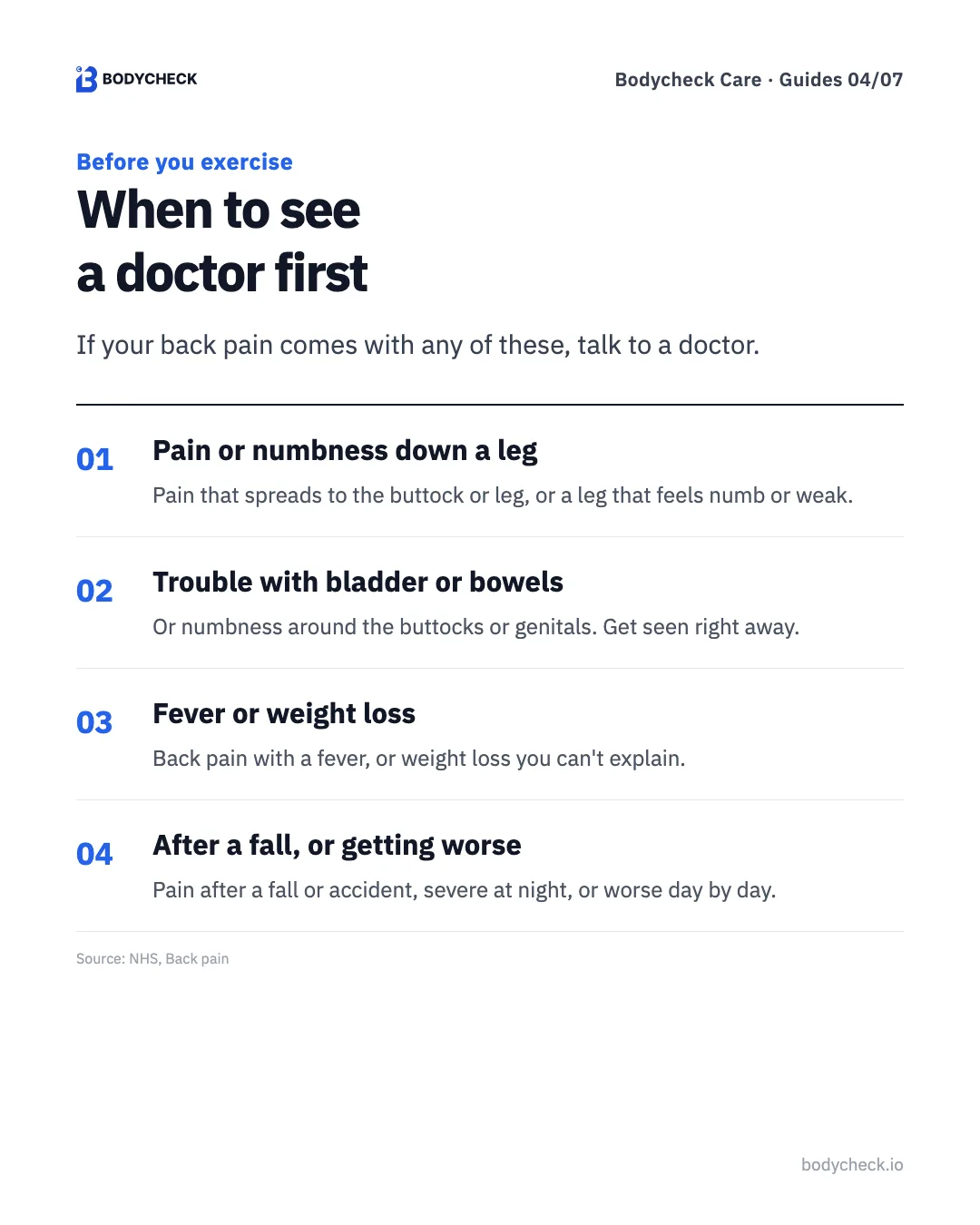
Please don't skip this part. If your back discomfort comes with any of the following, talk to a doctor before you stretch or exercise. The NHS back pain guidance lists these as reasons to get checked.
- Pain or numbness down a leg: Pain that spreads from your back to your buttock or leg, or a leg that feels numb, tingly or weak.
- Trouble with bladder or bowel control: Or numbness around your buttocks or genitals. Get care right away for this one.
- Fever or weight loss you can't explain: Back pain that comes with a fever, or weight loss without a clear reason.
- After a fall or accident: Pain that started after a fall or an injury.
- Severe at night or getting worse: Pain that's bad even when you lie down to rest, or worse day by day.
Even if none of these apply, see a doctor if things don't seem to be getting better after a few weeks, or if it gets in the way of daily life.
So how should you move day to day?
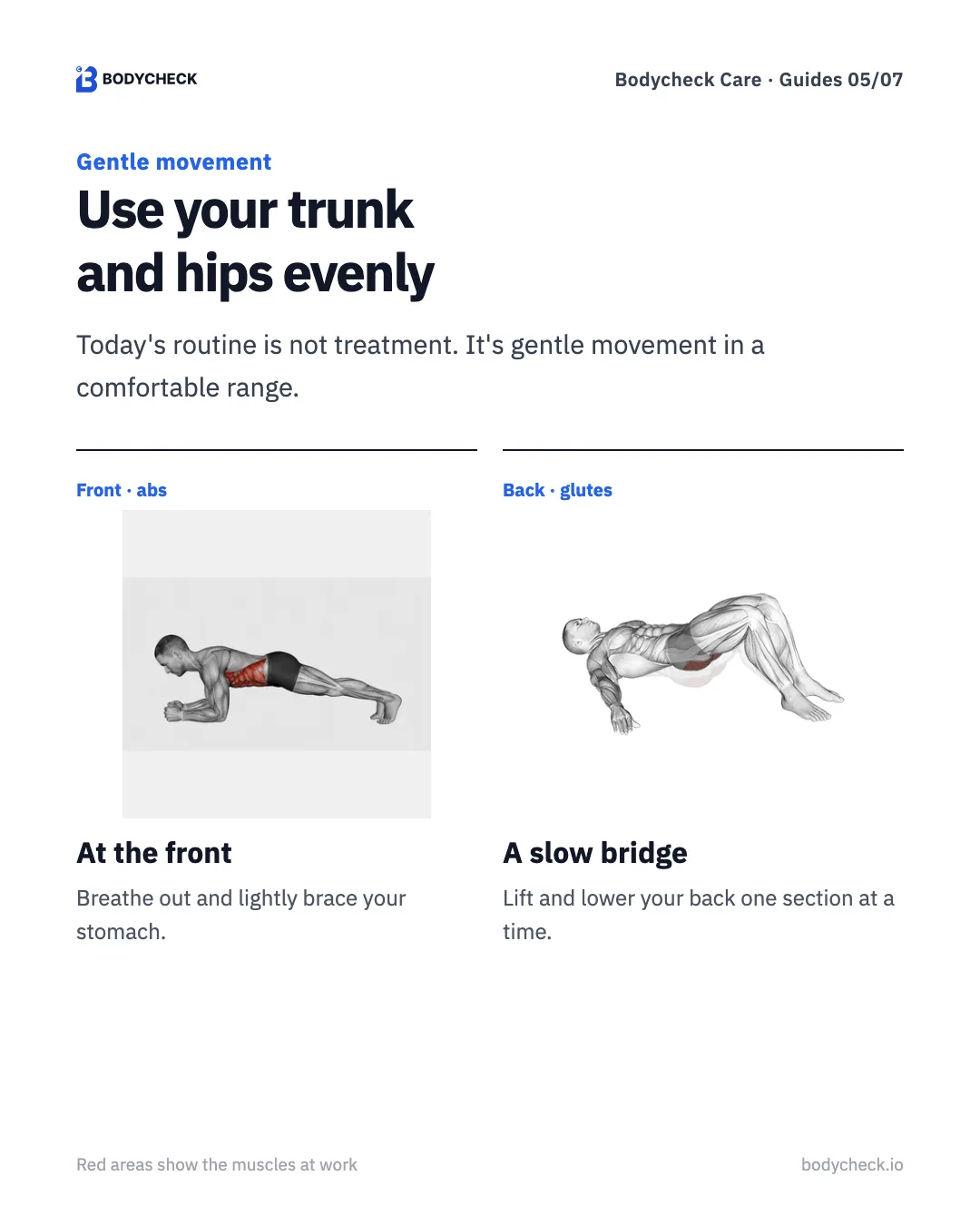
If none of the signs above apply, gentle movement in a comfortable range is something you can do in everyday life. Today's routine isn't meant to fix your back. It's a way to move a body that's been in one position all day.
- Front (abs): Start lying down, breathing out and lightly bracing your stomach.
- Back (glutes): Use a bridge to lift and lower your back slowly, one section at a time.
- Stretch: Finish with the back of your thighs, your hips and your upper back.
You don't need to go big or hard. If discomfort builds as you move, shorten the range or skip that move.
How can you see your side view as numbers?
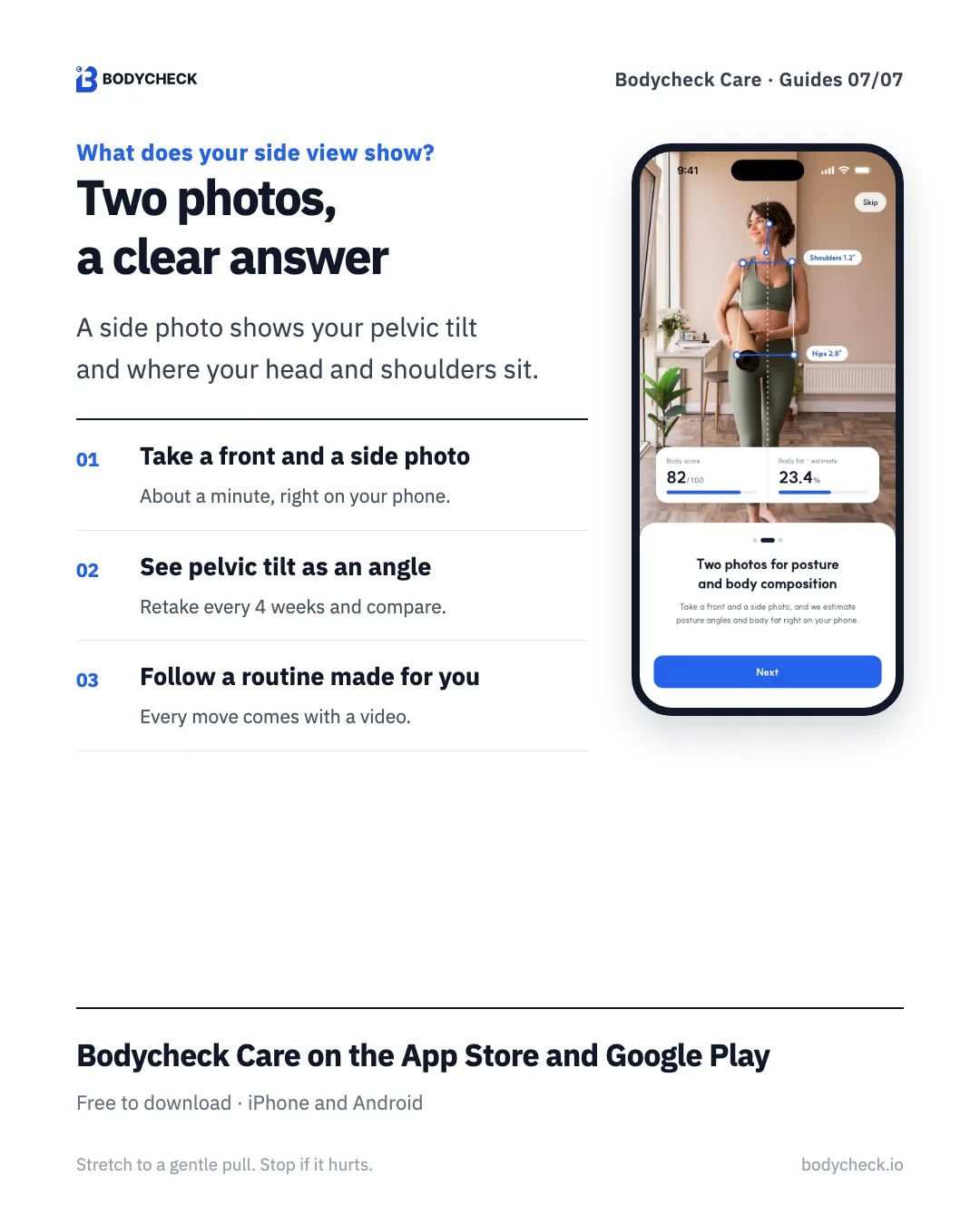
Your own side photos change a little depending on where you stand and how high the phone is. To check against the same standard each time, Bodycheck Care makes it easy. Take a front and a side full-body photo, and the app shows your pelvic tilt and how far your head and shoulders sit forward from the side, plus shoulder, hip and knee balance from the front, as angles and a score.
- Get the app and take a front and a side full-body photo.
- See your pelvic tilt as an angle and a score.
- Follow the moves picked for your result, each with a video.
- Retake the photos in the same spot after four weeks and compare.
The app is not a medical device. It doesn't tell you why your back bothers you. It records your posture against the same standard over time.
Bodycheck Care · Free
Check your side posture with two photos
Take a front and a side photo to see how far your head and shoulders sit forward as a score, then follow moves picked for your result, each with a video.
A gentle 10-minute routine
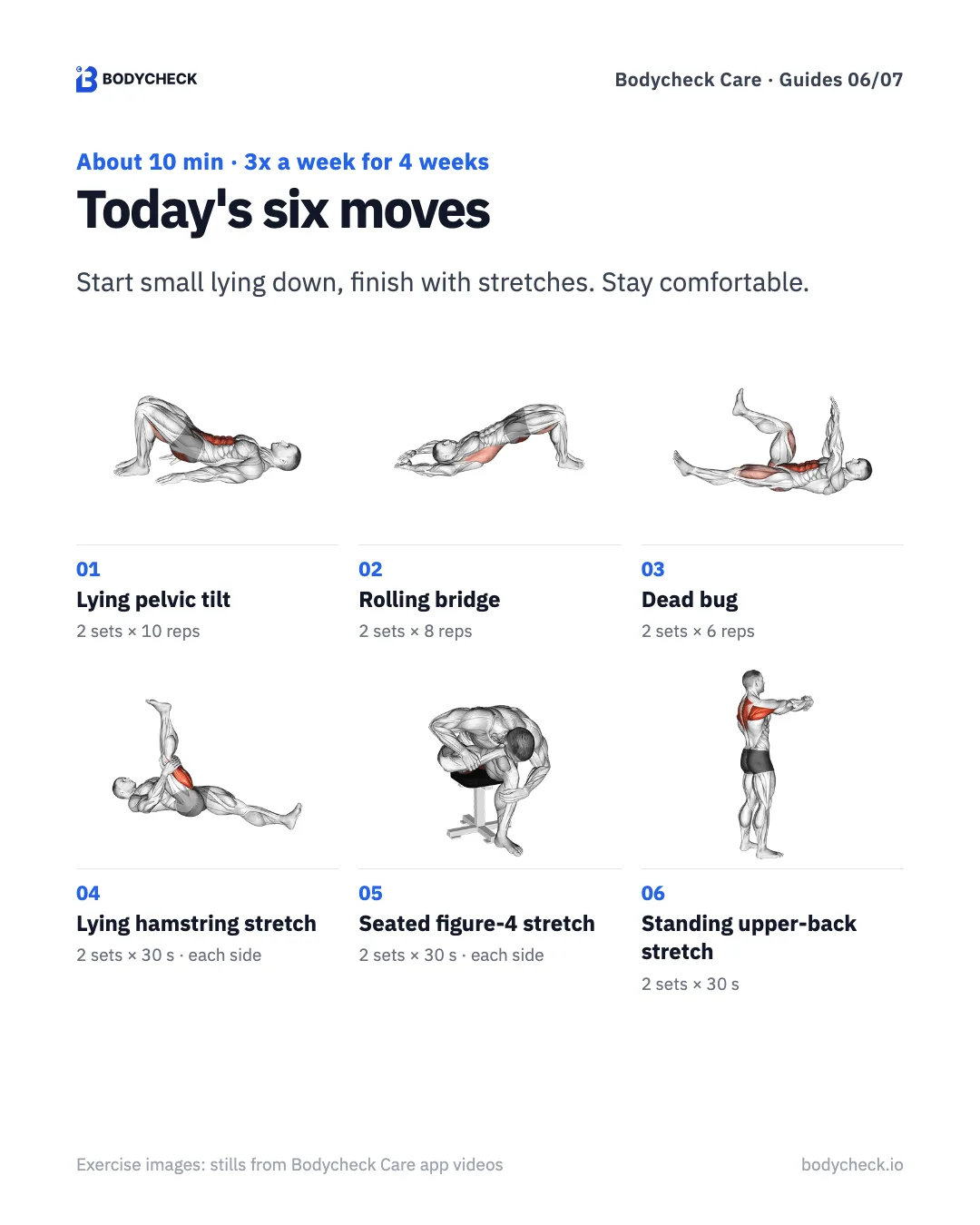
Start with small moves lying down and finish with stretches, seated and standing. A mat and a chair are all you need. Do it three times a week on alternate days, for four weeks, and keep every move in a comfortable range. I roll out my mat on Sunday mornings after a glass of water.
1. Lying pelvic tilt · 2 sets × 10 reps
- Lie on your back with knees bent and feet flat.
- Breathe out, brace your stomach and press your lower back toward the floor.
- Hold for two seconds as your pelvis tucks slightly.
- Breathe in, release, and repeat 10 times.
2. Rolling bridge · 2 sets × 8 reps
- Lie with knees bent and arms by your sides.
- Tuck your pelvis slightly to press your lower back to the floor.
- Lift from your tailbone up, one section at a time, into a bridge. Only go as high as feels comfortable.
- Roll back down from the top of your back, one section at a time. 8 reps.
3. Dead bug · 2 sets × 6 reps
- Lie with arms reaching to the ceiling and hips and knees bent to 90 degrees.
- Keeping your lower back on the floor, slowly reach one arm and the opposite leg out.
- Stop before your back lifts, then return.
- Alternate sides for 6 reps. If that's too much, move only your arms or only your legs.
4. Lying hamstring stretch · 2 sets × 30 s · each side
- Lie on your back and lift one leg toward the ceiling.
- Hold the back of your thigh or calf with both hands.
- Straighten the knee only as far as it goes and gently pull the leg toward you.
- Hold 30 seconds, then switch sides.
5. Seated figure-4 stretch · 2 sets × 30 s · each side
- Sit on a chair and rest one ankle on the opposite knee.
- Keep your back long and lean your chest forward.
- Turn slightly toward the raised leg to stretch deep in the hip.
- Hold 30 seconds, then switch sides.
6. Standing upper-back stretch · 2 sets × 30 s
- Stand tall with feet shoulder-width apart.
- Clasp your hands and reach forward at shoulder height.
- Push your hands away so your upper back rounds and your shoulder blades spread.
- Breathe out slowly and hold 30 seconds.
At a glance
| # | Move | Sets |
|---|---|---|
| 1 | Lying pelvic tilt | 2 × 10 reps |
| 2 | Rolling bridge | 2 × 8 reps |
| 3 | Dead bug | 2 × 6 reps |
| 4 | Lying hamstring stretch | 2 × 30 s · each side |
| 5 | Seated figure-4 stretch | 2 × 30 s · each side |
| 6 | Standing upper-back stretch | 2 × 30 s |
Rolling up and down one section at a time is hard to picture from text. In Bodycheck Care every move has a video, and the app counts the time and sets for you.
Frequently asked questions
Can I figure out what's causing my back pain? Back discomfort can have many causes, and you can't pin one down from an article or a home check. Writing down when it shows up makes it easier to explain at an appointment. If it comes with leg numbness, bladder or bowel trouble, or a fever, see a doctor first.
When should I see a doctor before exercising? When pain spreads down a leg or your leg feels numb or weak, when you have trouble controlling your bladder or bowels or numbness around your buttocks or genitals, when back pain comes with a fever or weight loss you can't explain, after a fall or accident, or when pain is severe at night or keeps getting worse. Bladder or bowel trouble needs care right away.
Is it okay that my back is stiff in the morning? Note for a few days whether it eases as you move, stays the same all day, or gets worse. If it lasts or comes with other symptoms, talk to a doctor.
Can I do this routine while my back bothers me? This routine is not treatment. It's gentle movement in a comfortable range. Stop if anything hurts or tingles, and if any of the see-a-doctor signs apply, get checked before you exercise.
Can I see my side posture as numbers? Bodycheck Care uses a front and a side full-body photo to show your pelvic tilt and how far your head and shoulders sit forward, as angles and a score. Retake every four weeks to compare. It is free on iPhone and Android, and it is not a medical device.
Before you start
- Your notes and photos are a record of your day. Don't use them alone to judge a cause or your condition.
- Keep every move in a comfortable range. Stop right away if anything hurts or tingles.
- Don't hold your breath. Breathe out as you push.
- This is exercise guidance. If you have pain spreading down a leg, numbness or weakness, trouble with bladder or bowel control, fever or unexplained weight loss, pain after a fall, or pain that's severe at night or keeps getting worse, see a doctor before you exercise.
How about one line in your phone notes today: when, and after doing what? A week of those, and your day starts to look a little different.
Bodycheck Care · Free
Take two photos and get moves picked for you
Take a front and a side photo to see how far your head and shoulders sit forward as a score, then follow moves picked for your result, each with a video.
References
- NHS. Back pain. nhs.uk/conditions/back-pain
- Photos: Pexels (free license). Exercise images and app screens: Bodycheck Care app.