How to Choose the Best Posture App for You: 7 Questions to Ask Before You Scan
What should you look for in a posture analysis app? Seven plain questions about what it measures, where your photos go, re-scans, exercise videos, price, account deletion and medical claims, plus how to take good photos and read the results. Written by the Bodycheck Care team.
Short answer: Choose a posture app by what it measures and how, where your photos are processed and stored, whether you can re-scan and compare, and whether it leads to exercises you can follow. Also check the price and ads, account deletion and whether it says it is not a medical device. This guide is written by the Bodycheck Care team, so our own app comes up. We don't rank or compare other apps. We list the questions, then show how our app answers each one.
Hi, I'm an editor on the Bodycheck Care team. Let me say it up front: I work on the team that makes the Bodycheck Care app. So this page is not a sales pitch. Instead, here are the questions I'd ask if a friend wanted a posture app, and I'll hold our app to the same questions.
I still remember my first posture photo. I propped my phone on the shoe rack by the front door and used the timer. On screen I looked like I was leaning back. The phone was at knee height, looking up at me. I moved it to waist height, took it again, and a different person was standing there. That's when I learned that how you take the photo matters as much as which app you pick.
What does a posture app measure, and how?
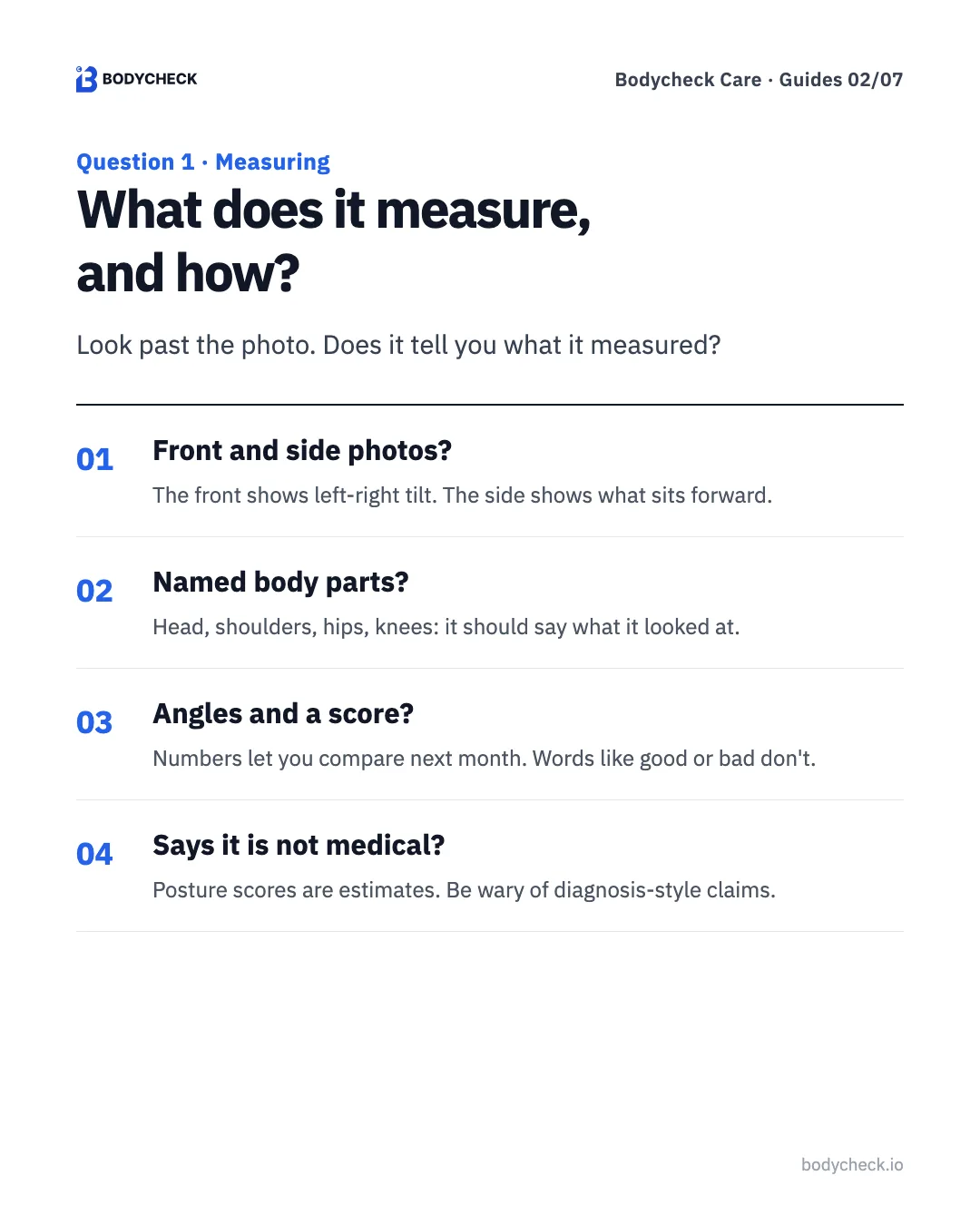
Some apps take one photo and say "your posture needs work." Others show a number for each body part. Ask these four things.
- Does it use both a front and a side photo? The front shows left-right tilt in the shoulders and hips. The side shows how far the head and shoulders sit forward. One photo shows only half the picture.
- Does it name what it measured? Head, shoulders, hips, knees. You should be able to see what it looked at.
- Does it give angles or a score? Words like "good" or "poor" are hard to compare next month. Numbers let you see change.
- Does it say plainly that it is not a medical device? A posture score from photos is an estimate. Be careful with any app that talks about results like a diagnosis.
How Bodycheck Care answers. It uses a front and a side full-body photo, taken automatically when the outline turns green. A scan takes about a minute. Your phone finds body landmarks such as the shoulders, hips and knees, and the app shows a posture score out of 100, the angles behind it and the body part that stands out most. From the same photos plus height, weight, age and sex it estimates body fat, which is an estimate, not a measurement. AI is used for the body analysis and the exercise picks. It is not a medical device and does not diagnose, treat or prevent any disease.
Where are your photos processed and stored?
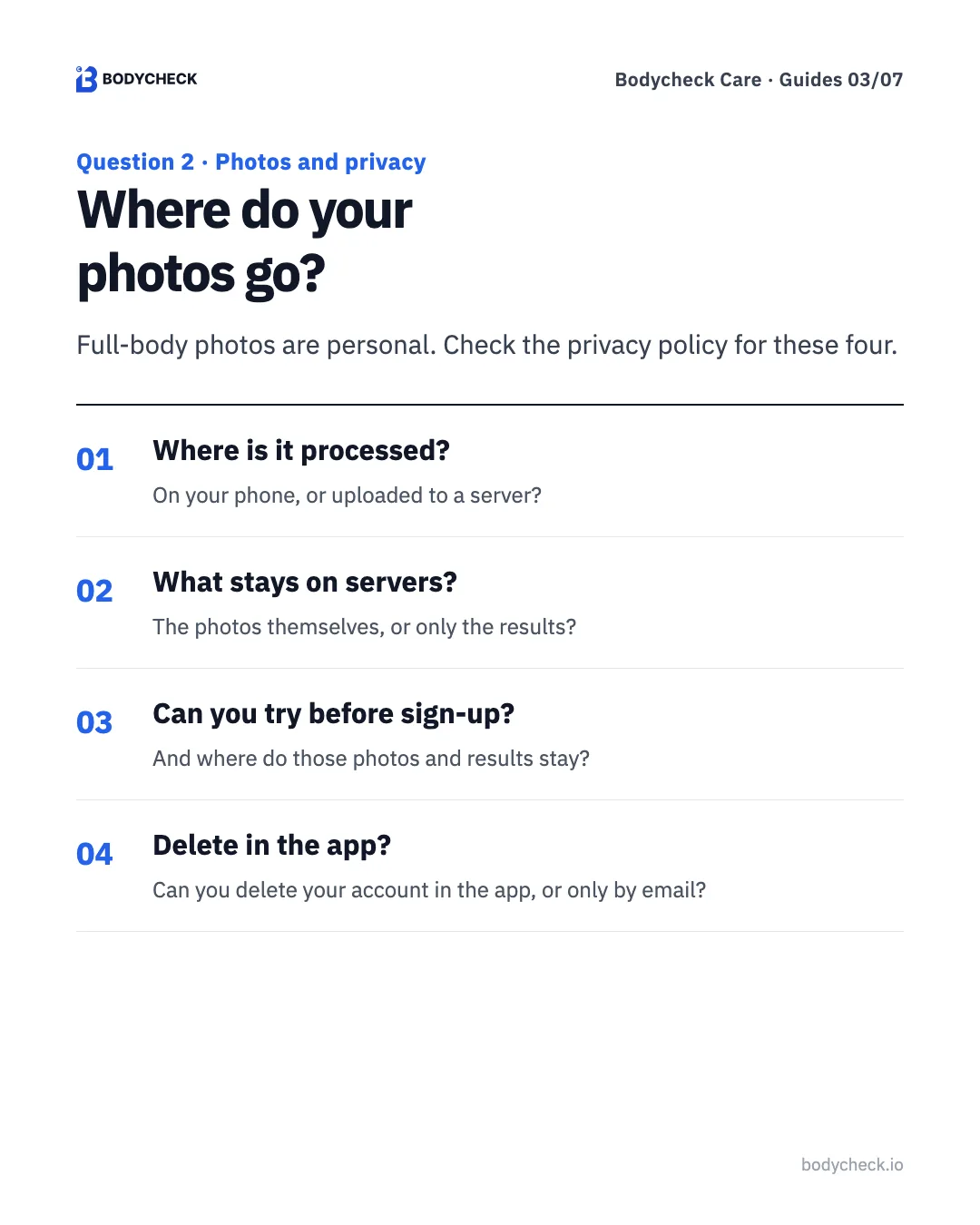
Posture photos are full-body photos in fitted clothes. That's why I look at this before any feature. Check the app description or privacy policy for these four.
- Where is the analysis done? On your phone, or after the photos are uploaded to a server?
- What is kept on the servers? The photos themselves, or only the results?
- Can you try it before you sign up? If so, where do those photos and results stay?
- Can you delete your account in the app? Or do you have to send an email?
How Bodycheck Care answers. The phone finds the body landmarks. Before you sign up, scan photos and results stay on the phone. Account data is stored on servers in Seoul, Republic of Korea. Scan photos are not used to recognize or identify anyone. There are no ads, no ad trackers or third-party analytics in the app, and no sale of data. You can delete your account in the app.
Can you re-scan, compare and get exercises?
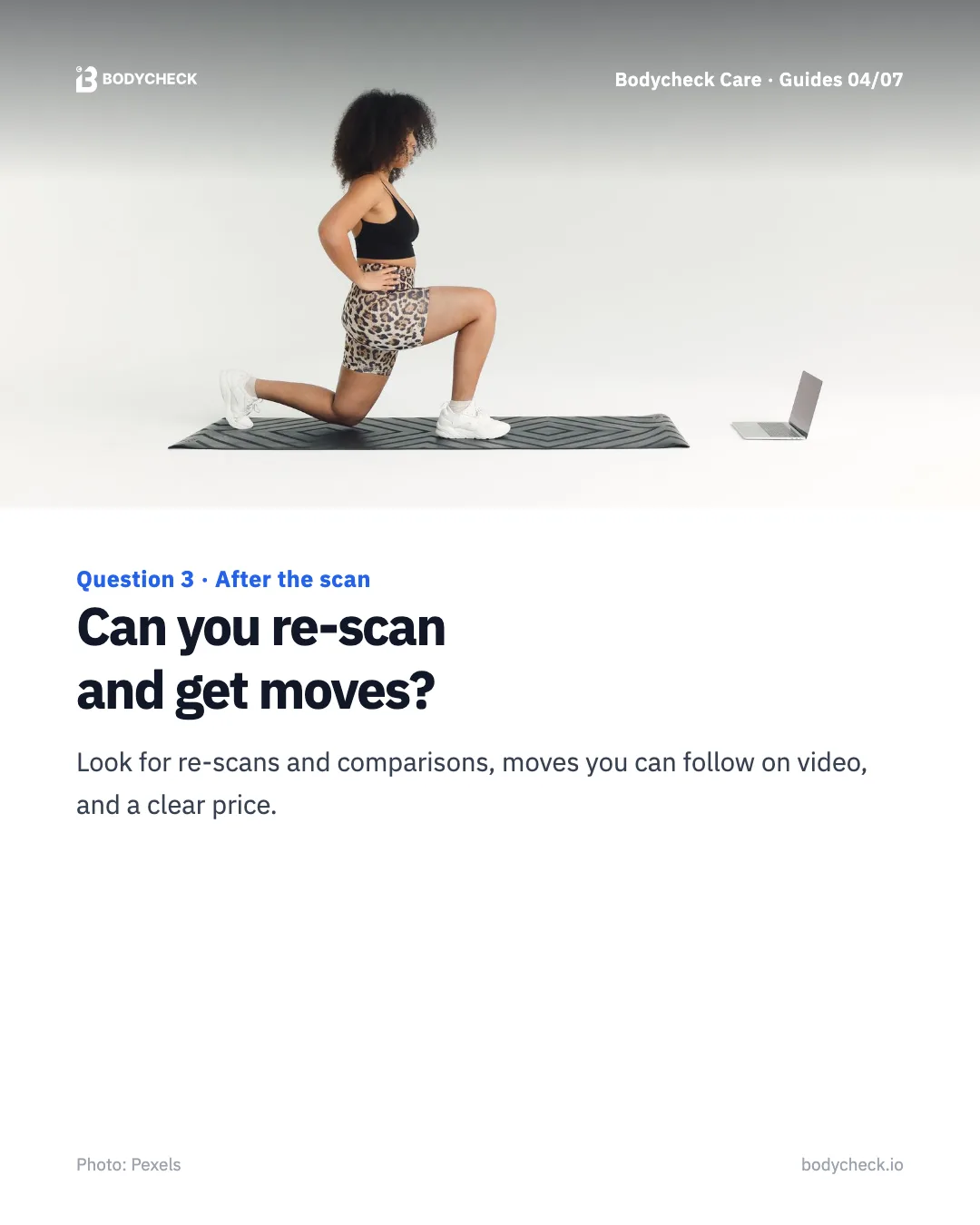
An app that scans once and stops only shows you today. Look for what comes next.
- Can you re-scan and see results side by side? Posture doesn't change in a day or two, so it helps to re-scan every few weeks under the same conditions.
- Does it suggest exercises for your result? A list of exercise names is easy to get wrong. Check for videos, and for moves that fit where you train.
- What does it cost, and are there ads? Check what is free, what is paid, whether a subscription renews automatically, and whether ads interrupt a scan.
How Bodycheck Care answers. Scans are unlimited on the free plan, along with the posture score, the top finding, a starter routine and exercise videos. Routines come from more than 1,300 exercises, each with a video, matched to the place you train (home, gym, outdoors) and the equipment you have. Premium adds details for every body part, a full program that updates when you re-scan, scan comparison and trends. In the United States, Premium is US$9.99 per month or US$59.99 per year (US$4.99 per month billed yearly), and both start with a 7-day free trial for new subscribers. It is billed by Apple or Google and renews automatically until you cancel in your App Store or Google Play subscription settings. Local prices vary by country, and Canada has the monthly plan only. The app is for adults 18 and over, on iPhone and Android.
How do you take good photos and read the results?
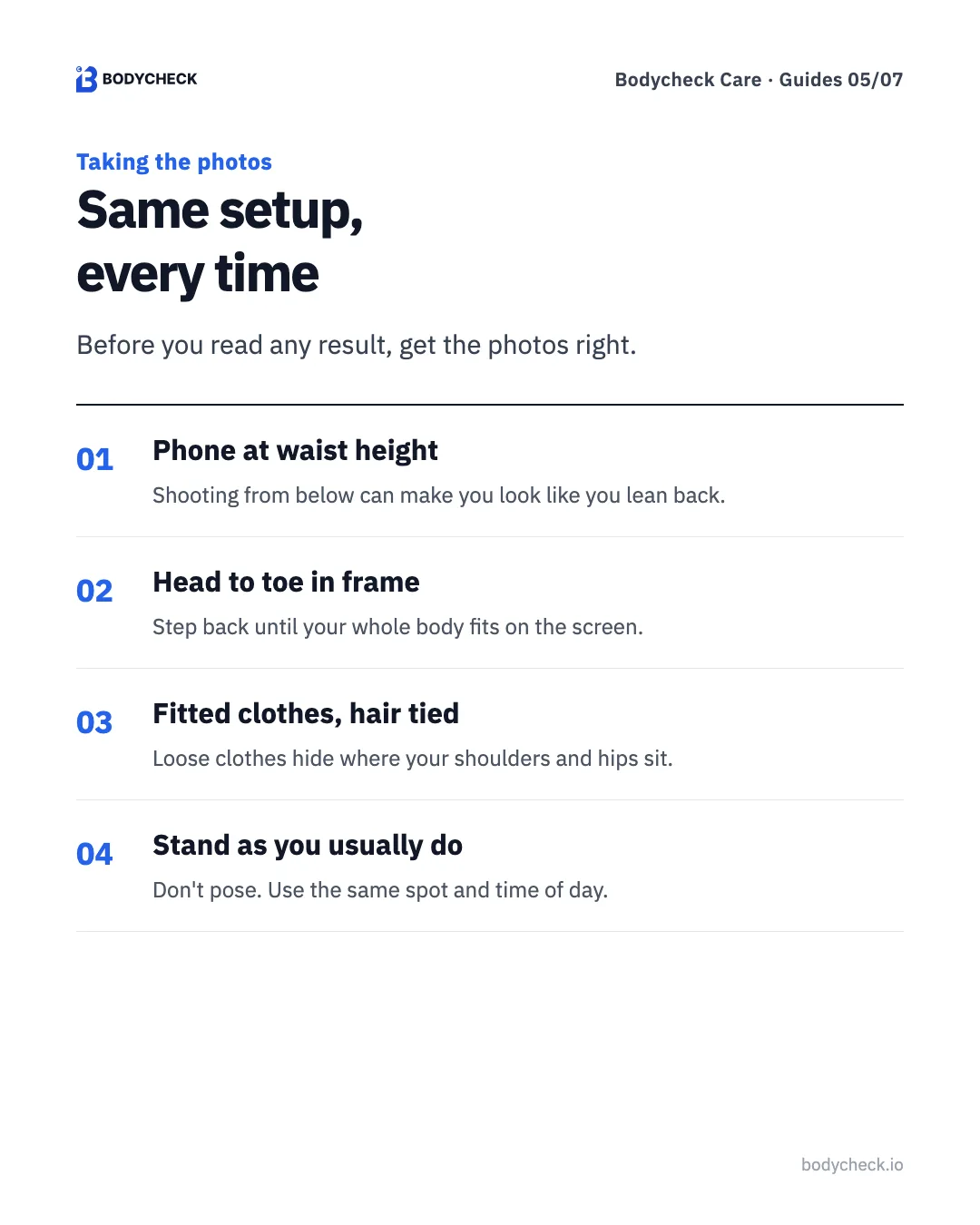
Whatever app you use, uneven photos give uneven results. To avoid my shoe-rack mistake:
- Put the phone at waist height. From below you look like you lean back. From above your head looks bigger.
- Fit your whole body, head to toe, in the frame.
- Wear fitted clothes and tie your hair back. Loose clothes hide where your shoulders and hips sit.
- Stand the way you usually do. Don't pose. Next time, use the same spot, the same time of day and similar clothes so you can compare.
For more on side photos, see Forward Head Posture Self-Check: A 30-Second Wall Test and One Side Photo.
How to read the results
- Look for "which way, and how much." Front results are about left and right. Side results are about forward and back. Which part tilts which way tells you more than a single score.
- Start with the one part that stands out most. Trying to change everything at once rarely lasts.
- Don't judge from one scan. Numbers can shift a little with the photo setup. Re-scan under the same conditions a few weeks later and look at the trend.
- Compare with your past self, not other people. Bodies differ, so your own change means more.
- Your body comes before the number. If something hurts or feels numb, see a doctor whatever the score says.
How can you see your own posture in numbers?
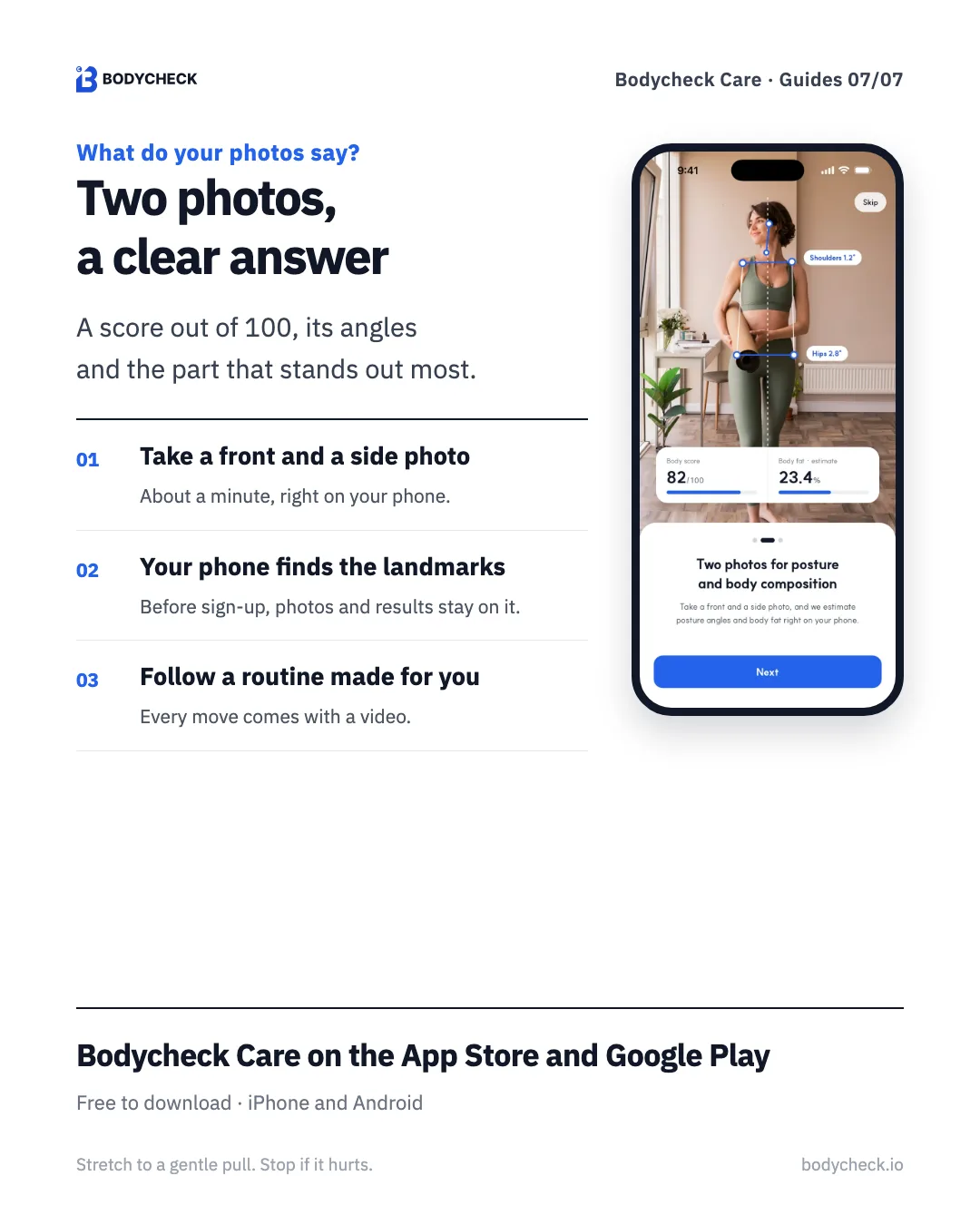
Here is how Bodycheck Care answers each question, in one table.
| Question | Bodycheck Care |
|---|---|
| What it measures, and how | A front and a side full-body photo. Posture score out of 100, the angles behind it and the top finding |
| Where photos are processed | The phone finds the body landmarks. Before sign-up, photos and results stay on the phone |
| Where account data lives | Servers in Seoul, Republic of Korea. Photos are not used to identify anyone |
| Re-scan and compare | Unlimited scans on the free plan. Scan comparison and trends are in Premium |
| Exercises | 1,300+ exercises with videos, matched to your place and equipment |
| Price and ads | Free plan. Premium US$9.99/month or US$59.99/year in the US, 7-day free trial for new subscribers, local prices vary. No ads |
| Account deletion | In the app |
| Medical device | No. Does not diagnose, treat or prevent any disease. Scores are estimates |
Using it is simple.
- Get the app and take a front and a side full-body photo. It takes about a minute.
- See your posture score, the angles and the part that stands out most.
- Follow the moves picked for your result, each with a video.
- Re-scan under the same conditions in a few weeks.
Bodycheck Care · Free
See your posture in numbers, from two photos
Take a front and a side photo to see how far your head and shoulders sit forward as a score, then follow moves picked for your result, each with a video.
A first-week routine after your first scan
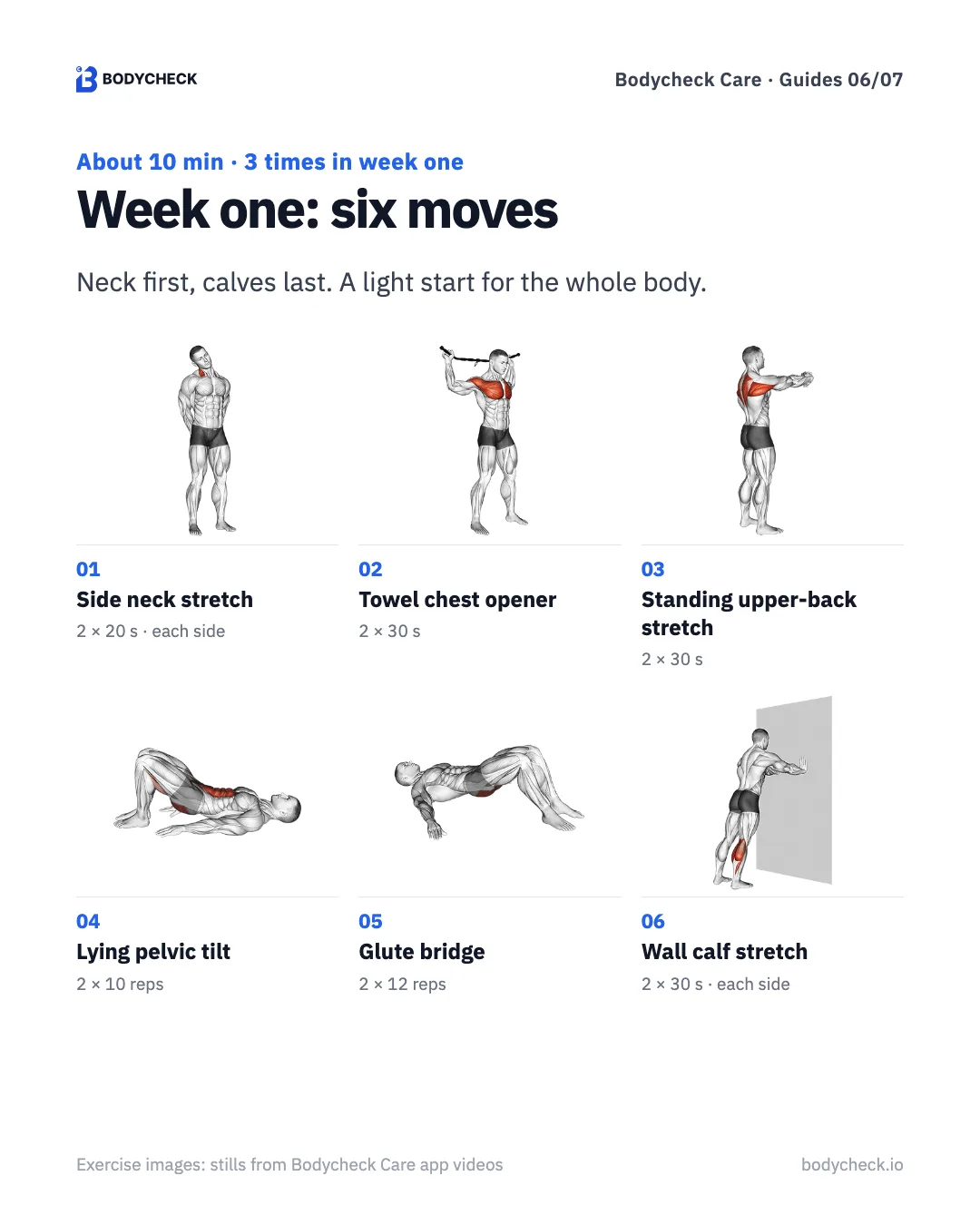
After your first scan it's tempting to go all in. In week one, it's enough to tell your body "we're going to move now." The order runs from the neck through the upper back, pelvis and hips down to the calves, so each area the photos look at gets a light turn, top to bottom. Do it three times in the first week, on alternate days, then carry on with the moves the app picks for your result.
1. Side neck stretch · 2 sets × 20 s · each side
- Stand or sit tall with relaxed shoulders.
- Rest a hand on the side of your head and tilt your ear toward your shoulder.
- Keep the opposite shoulder pressed down so it doesn't rise.
- Hold 20 seconds, then switch sides.
2. Towel chest opener · 2 sets × 30 s
- Stand tall holding a towel or long stick wider than your shoulders.
- Keep your arms straight and raise them slowly overhead.
- Take them behind your head only as far as they move freely, opening the chest and front shoulders.
- Come back slowly and repeat for 30 seconds. If your shoulders catch, widen your grip.
3. Standing upper-back stretch · 2 sets × 30 s
- Stand with feet shoulder-width apart.
- Interlace your fingers and reach forward at shoulder height.
- Push your hands far forward and round your upper back so the shoulder blades spread.
- Breathe out slowly and hold 30 seconds.
4. Lying pelvic tilt · 2 sets × 10 reps
- Lie on your back with knees bent and feet flat on the floor.
- Breathe out, brace your stomach and press your lower back toward the floor.
- Pause for two seconds as your pelvis tucks slightly.
- Breathe in and release. Repeat 10 times.
5. Glute bridge · 2 sets × 12 reps
- Lie on your back with knees bent and arms by your sides.
- Push through your heels and lift your hips.
- Squeeze your glutes in a straight line from knees to shoulders and pause one second. Don't arch your lower back.
- Lower slowly. Repeat 12 times.
6. Wall calf stretch · 2 sets × 30 s · each side
- Face a wall and place both hands on it.
- Step one foot back and keep that heel on the floor.
- Bend the front knee and lean toward the wall to stretch the calf.
- Hold 30 seconds, then switch legs.
At a glance
| # | Move | Sets |
|---|---|---|
| 1 | Side neck stretch | 2 × 20 s · each side |
| 2 | Towel chest opener | 2 × 30 s |
| 3 | Standing upper-back stretch | 2 × 30 s |
| 4 | Lying pelvic tilt | 2 × 10 reps |
| 5 | Glute bridge | 2 × 12 reps |
| 6 | Wall calf stretch | 2 × 30 s · each side |
Moves can be hard to follow from text alone. In Bodycheck Care every move has a video, and the app counts the time and sets for you.
Frequently asked questions
What should I look for in a posture analysis app? Check what it measures and how (front and side photos, named body parts, angles and a score), where your photos are processed and stored, whether you can re-scan and compare, whether it suggests exercises with videos, the price and ads, whether you can delete your account in the app, and whether it says clearly that it is not a medical device.
Can a posture app tell me if something is wrong with my body? No. A posture app is not a medical device and does not diagnose anything. The score is an estimate to help you look at your own posture. If you have pain or numbness, see a doctor.
How should I take posture photos? Put your phone at waist height and step back until your whole body fits, head to toe. Wear fitted clothes, tie your hair back and stand the way you usually do. To compare later, use the same spot and the same time of day.
Does Bodycheck Care upload my photos? Your phone finds the body landmarks. Before you sign up, scan photos and results stay on the phone. Account data is stored on servers in Seoul, Republic of Korea, scan photos are not used to recognize or identify anyone, and you can delete your account in the app.
Is Bodycheck Care free? There is a free plan with unlimited scans, the posture score and the top finding, a starter routine and exercise videos. Premium adds details for every body part, a full program, scan comparison and trends. In the United States it is US$9.99 per month or US$59.99 per year, with a 7-day free trial for new subscribers. Local prices vary by country. The app has no ads.
Before you start
- Stretch to a gentle pull. Stop right away if anything hurts or tingles.
- Don't hold your breath. Breathe out as you push.
- Week one is a wake-up week. If it feels like a lot, drop one set.
- A posture score is an estimate. Don't judge your body by one number.
- This is exercise guidance. If you have back or neck pain, or numbness in your arms or legs, see a doctor before you exercise.
When you pick an app, ask it these questions. Ours included.
Bodycheck Care · Free
Take two photos and get moves picked for you
Take a front and a side photo to see how far your head and shoulders sit forward as a score, then follow moves picked for your result, each with a video.
References
- Bodycheck Care summary (bodycheck.io/llms-en.txt): processing, storage, pricing, ads, account deletion, age, not a medical device.
- Bodycheck Care Privacy Policy: https://www.axonmed.io/axon-care/en/privacy/
- Delete your Bodycheck Care account: https://www.axonmed.io/axon-care/en/delete-account/
- Photos: Pexels (free license). Exercise images and app screens: Bodycheck Care app.